Askpile — Project Story
Inspiration
Every creator hits the same wall: post a video, and within a day the comments section fills up with the same five questions, just worded differently. "Does this work for beginners?" becomes "is this good for someone just starting out?" becomes "beginner friendly??" A creator ends up typing nearly the same reply over and over, buried between one-word compliments and unrelated chatter — and the questions that matter most get lost in the pile.
We wanted something that could read that pile once, find the real questions hiding in it, and hand the creator a clean list they could answer a single time.
What it does
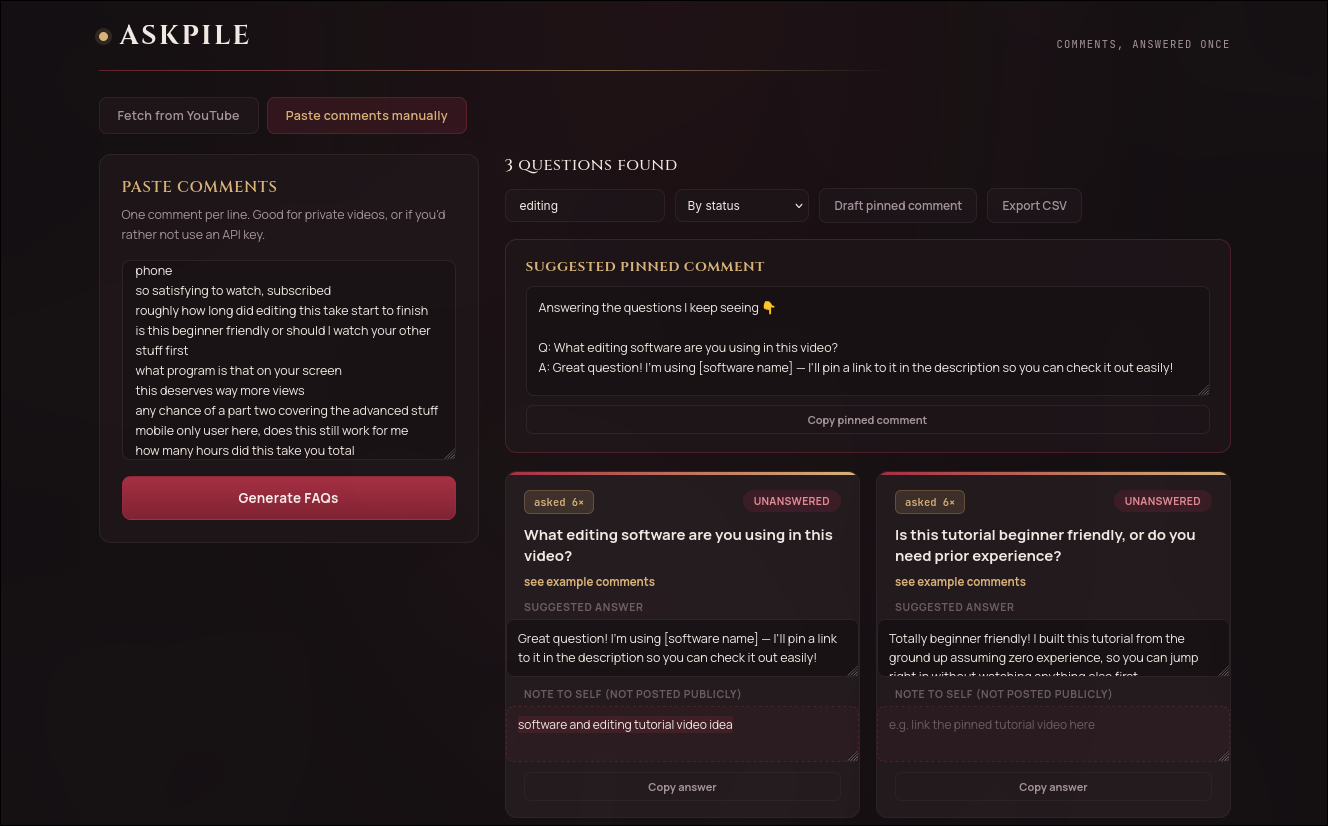
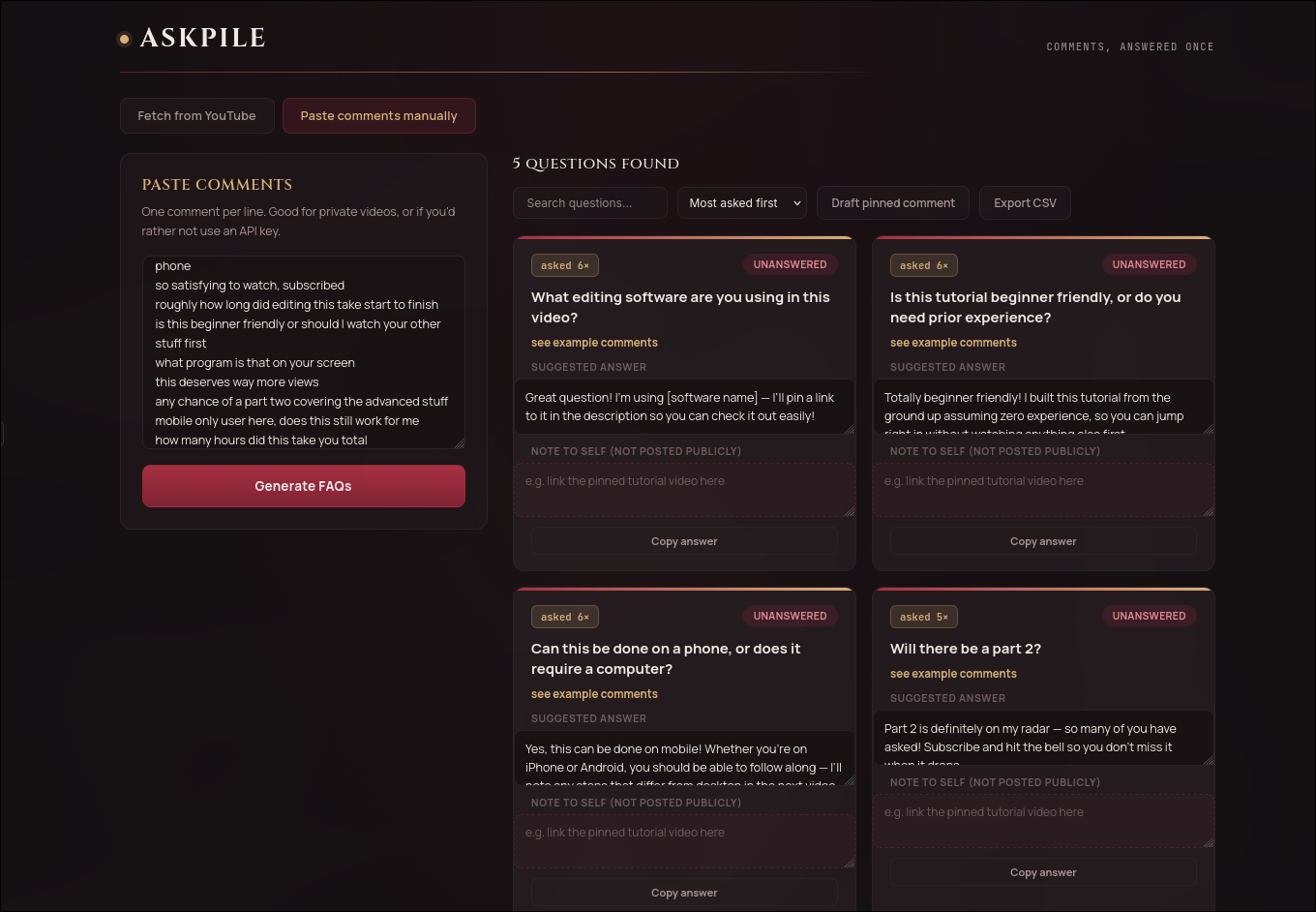
Askpile takes a YouTube video's comments — either pulled live via the YouTube Data API or pasted in manually — and clusters them into recurring questions. For each question it shows:
- How many comments were asking some version of it
- A couple of real example phrasings, so the creator can verify the grouping
- A drafted, friendly suggested answer they can edit and reuse
From there, creators can mark each question as unanswered, drafting, or answered, jot a private note to themselves (like "link the tutorial here"), copy any answer straight to their clipboard, generate a ready-to-post pinned comment summarizing the top questions, or export everything to CSV.
How we built it
Askpile is a single self-contained HTML/CSS/JS app — no backend, no build step. Two intake paths feed into one pipeline:
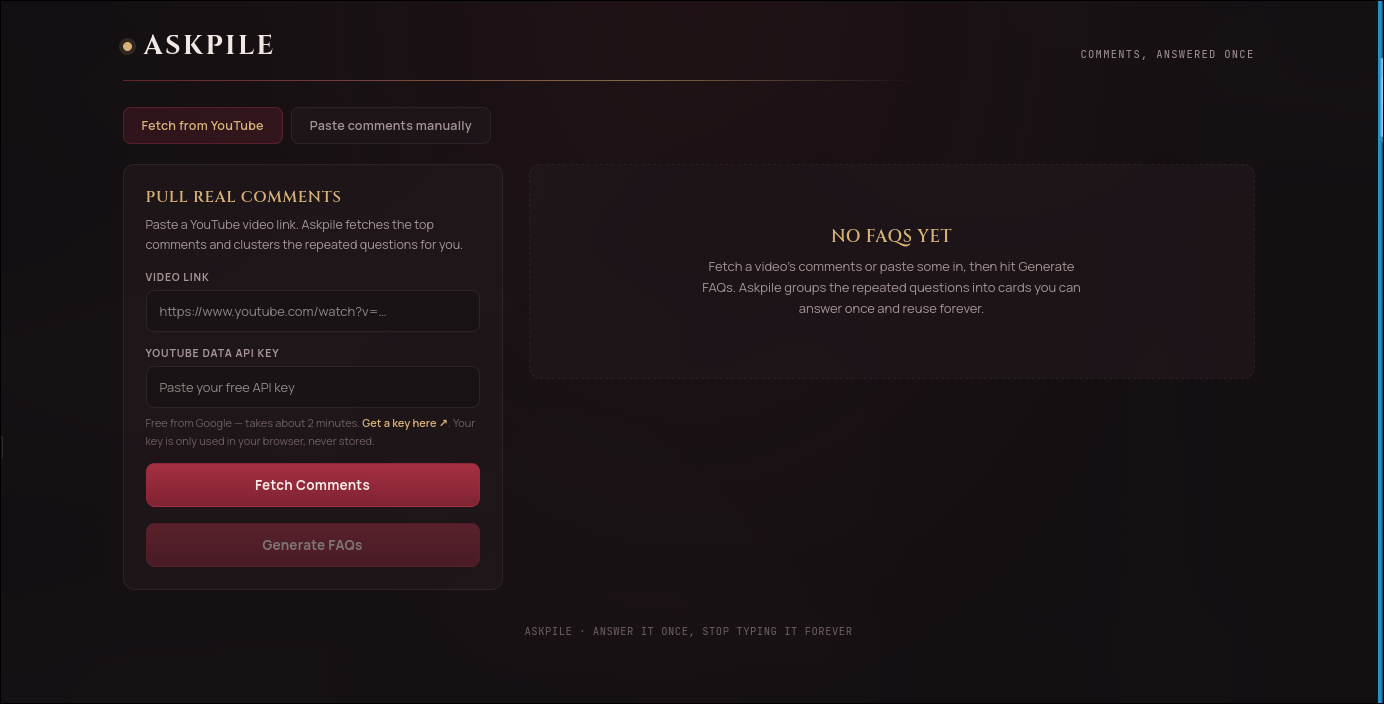
- YouTube fetch — the video URL is parsed for its ID, then the YouTube Data API's
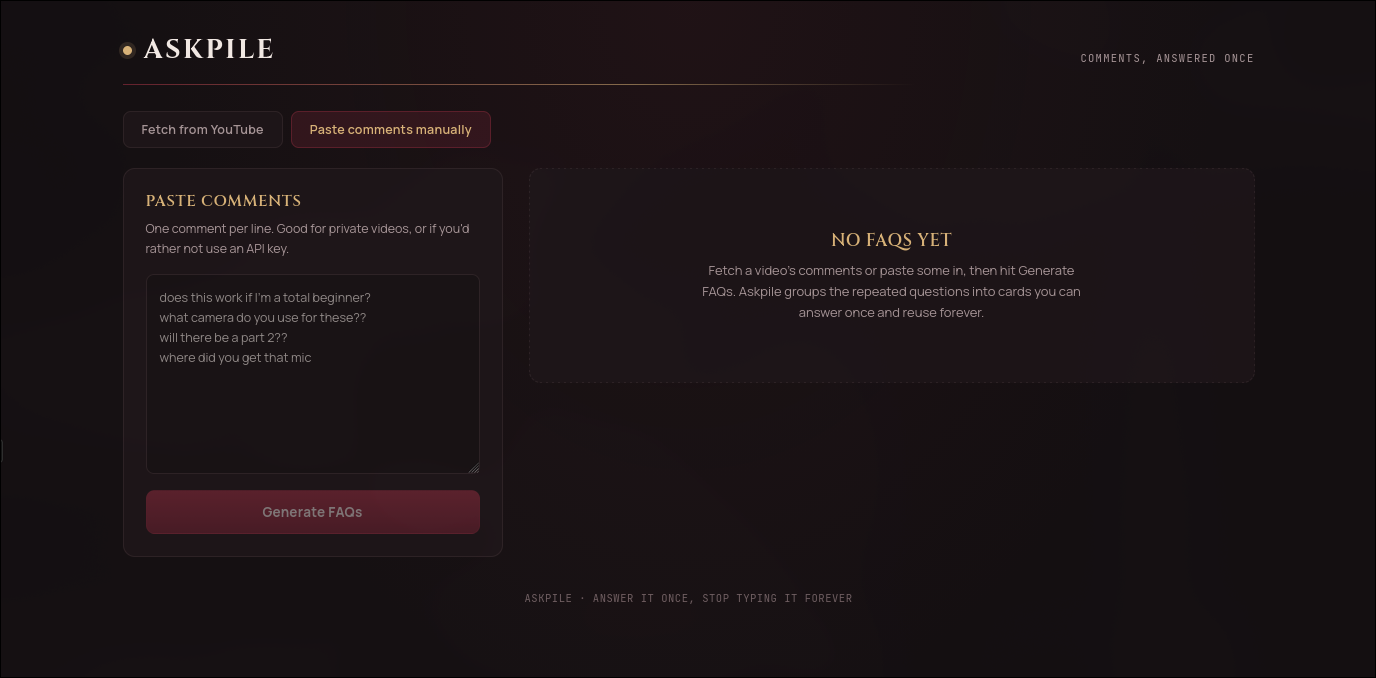
commentThreadsendpoint pulls the top comments, which get stripped of HTML and normalized. - Manual paste — for private videos, or anyone who'd rather skip the API key entirely, comments can just be pasted in, one per line.
Both paths converge on the same step: the comment batch is numbered and sent to Claude with a prompt asking it to identify genuinely recurring questions (not praise, emojis, or one-offs), cluster near-duplicate phrasings, count them, and draft a short suggested reply for each — returned as structured JSON that the UI renders directly into interactive cards.
We leaned into a distinct visual identity for it too — a deep maroon-and-gold "archive" aesthetic with serif display type, meant to feel like flipping through indexed correspondence rather than a generic dashboard.
Challenges we ran into
- Getting Claude to return clean, parseable JSON every time, without markdown fences or commentary creeping in and breaking the parser.
- Distinguishing real questions from noise — comment sections are full of praise, reactions, and tangents that aren't questions at all, and near-duplicate questions needed to be merged without becoming so broad they lost meaning.
- Designing for two very different comment sources (live API data vs. freeform pasted text) while keeping one unified generation flow underneath.
- Respecting API and token limits — comment batches are capped and truncated sensibly so large videos don't break the request.
Accomplishments that we're proud of
- A genuinely usable end-to-end flow: paste a link (or comments), get back editable, ready-to-post answers in seconds.
- Zero backend — it runs entirely client-side, which kept the build fast and the deployment trivial.
- Small but real creator-facing touches: per-card status tracking, a private notes field, one-click pinned-comment drafting, and CSV export for anyone managing this across a whole channel.
What we learned
Most of the hard problems weren't about calling an LLM — they were about designing the surrounding product: what "recurring" should mean, what counts as a question, how much creators would trust and want to edit an AI-drafted answer rather than just accept it wholesale. Good prompting mattered less than good product judgment about what to ask the model to do in the first place.
What's next for Askpile
- Support for pulling comments from additional platforms beyond YouTube.
- Direct posting of the pinned comment and individual replies via API, instead of copy-paste.
- Cross-video FAQ memory, so a creator's answered questions carry forward and get auto-suggested on their next upload.
- Sentiment and topic trends over time, so creators can see not just what's being asked, but how that's shifting video to video.


Log in or sign up for Devpost to join the conversation.