-
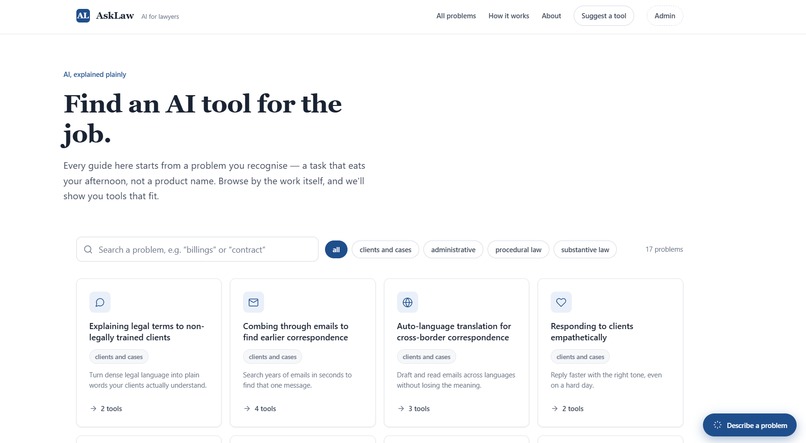
Homepage
-
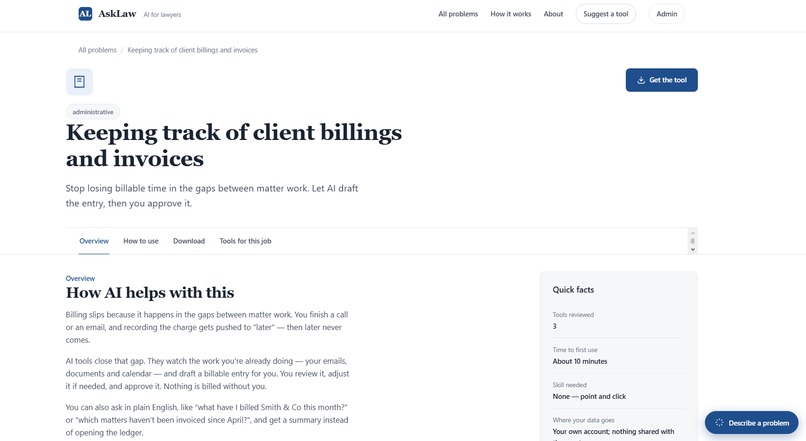
Subpage
-
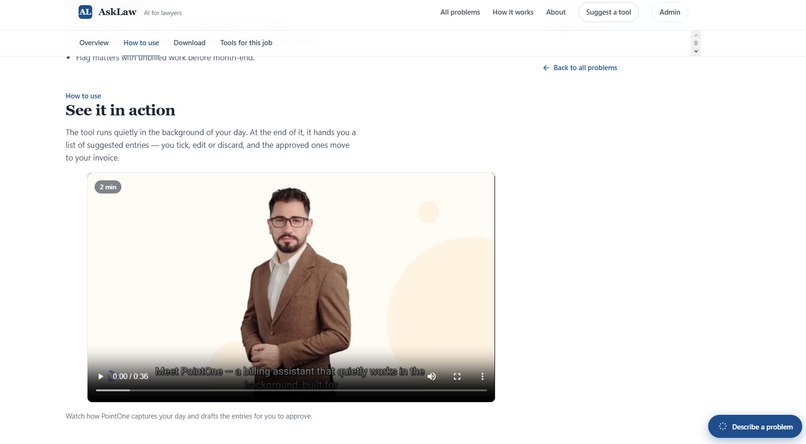
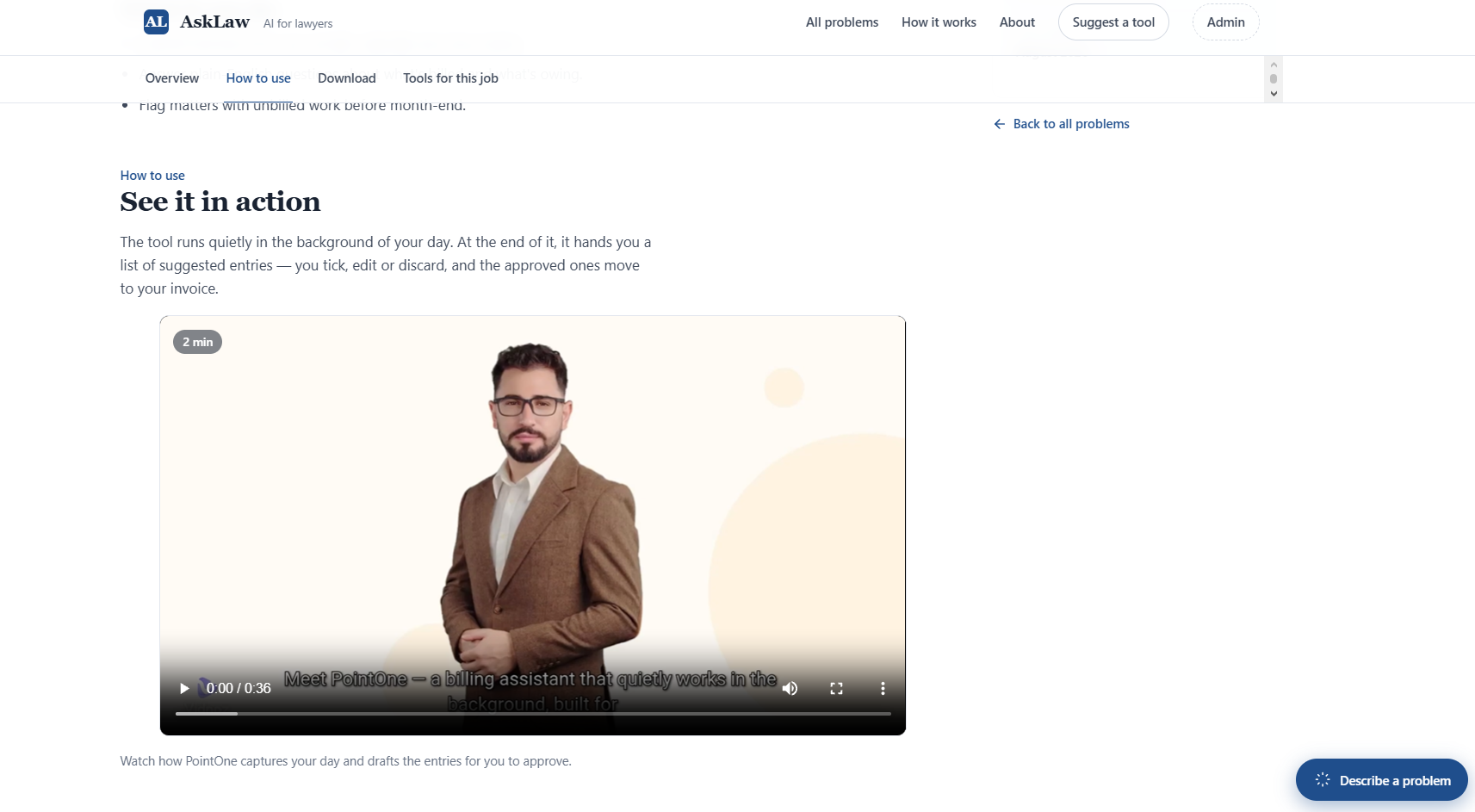
Example of Video Demo Generated
Team Info
Team 16 - Ashton and friends
Inspiration
Lawyers are drowning in AI hype but starved for practical guidance. Every week brings another "AI for law" product launch, yet the average lawyer has no neutral, government-backed place to figure out which tool actually solves their problem — drafting a contract, chasing billable hours, sorting through discovery documents. We wanted to flip the usual tool-first, marketing-driven directory on its head: instead of browsing by product name, a lawyer should be able to search by the task eating their afternoon and get pointed toward several credible options, with no single vendor endorsed over another. That's the premise behind AskLaw, a collaboration concept between the Singapore Academy of Law and the Ministry of Law.
What it does
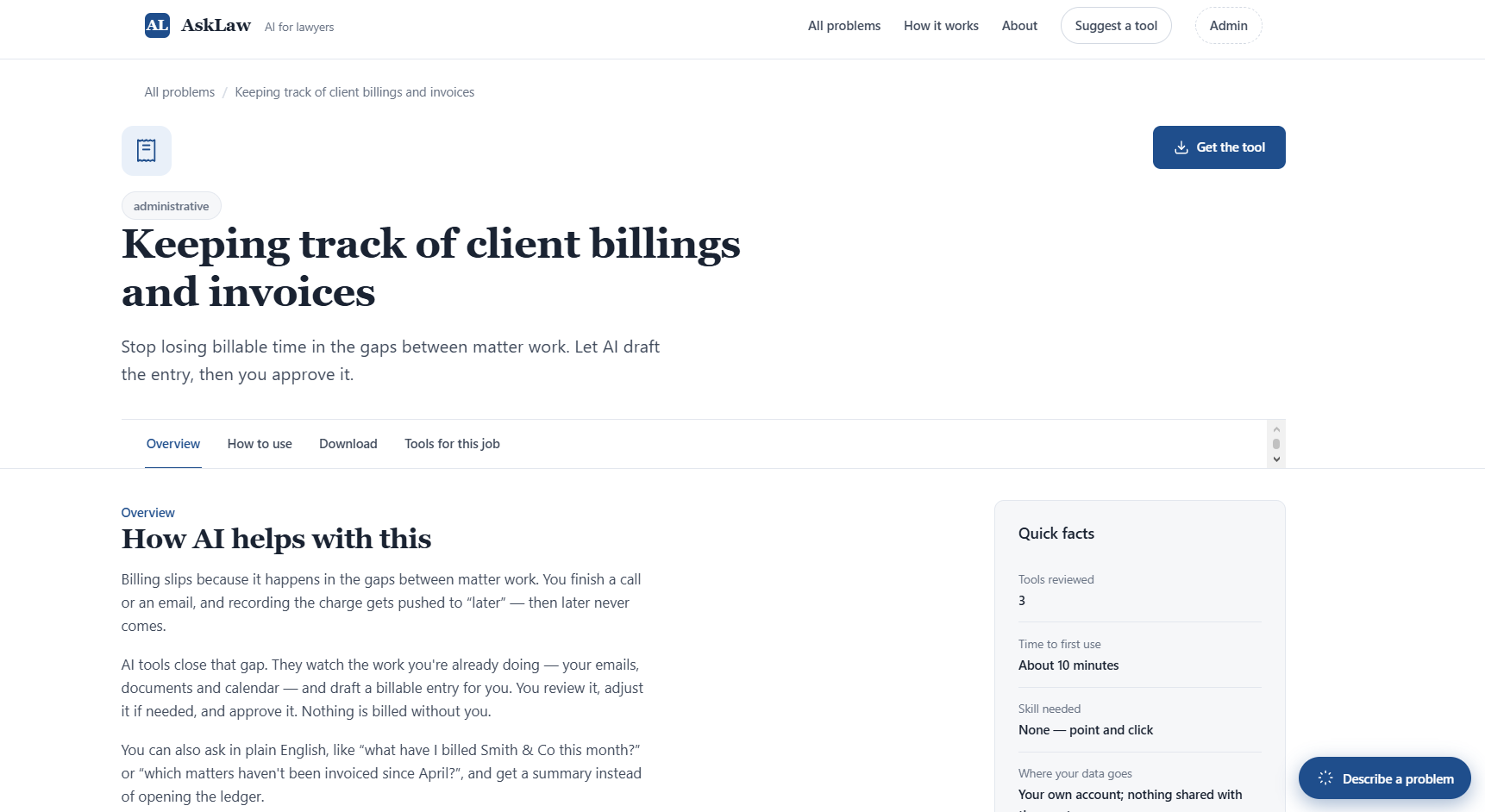
AskLaw is a problem-first directory of AI tools for legal practice. The homepage lets a lawyer search or filter across common problems (clients, administrative, procedural law, substantive law) instead of hunting through product names. Each problem has its own detail page that answers two questions without making the user click away: how does AI actually help with this, and which tools do it. A short explainer video sits at the top of each page, and a floating chat assistant helps route someone who can only describe their problem vaguely to the right page.
How we built it
- Frontend: a data-driven Next.js app (web/) — one /problems/[slug] template rendered from a single problems.json record per problem, so adding or editing a problem never means hand-writing a new page.
- Design process: we started with a static HTML/CSS mockup (mockup/) to nail the IA, filtering model, and visual language before investing in the React rebuild — cheap iteration first, framework second.
- Video pipeline: an experimental GenAI pipeline (Remotion + HeyGen/Synthesia) that generates the "how it helps" explainer clip directly from a problem's data record — script generation → narrated avatar render → Remotion composition with diagram overlays and one genuine, manually-captured screen recording of the featured tool's real UI.
- Content model: every problem carries a category tag, practice-area tags, an overview, quick facts, and a list of tools — kept structurally identical across all 17 problems so the template, chat routing, and video pipeline can all consume the same shape of data.
Challenges we ran into
- Video that doesn't lie. We wanted explainer videos, but AI-generating a "screen recording" of a third-party product's real interface would be dishonest and would go stale the moment that vendor redesigned their UI. We solved this by strictly separating generic, AI-generated conceptual animation (the mechanism: input → AI step → human review → output) from a single genuinely screen-recorded clip of the real tool, and enforcing a fixed three-part scene structure (what it is → how to use it → how it helps) so no clip can open with a benefit claim before naming the tool.
- The HeyGen fallback bug. Our narration pipeline needed a graceful fallback path when the primary avatar API failed mid-render — debugging where the fallback silently produced a broken composite instead of erroring loudly cost real time.
Accomplishments that we're proud of
- A genuinely useful and neutral information architecture — problem-first navigation with zero single-vendor endorsement, validated against a real government "how it helps" trust requirement (a human-review step must appear in every generated video, not just the copy).
- A fully data-driven page architecture: 17 problem pages, one template, one JSON file — no duplicated markup to maintain.
- A video pipeline with an honest line between generated and real footage, with freshness tracking (capturedAt/verifiedAt) built in from day one instead of bolted on later.
- Going from a dependency-free static mockup to a working data-driven app without losing the design decisions the mockup validated.
- Creating a functional chatbot that navigates and guides user's with more niche requirements and problems.
What we learned
- Generative video pipelines need guardrails written down before generation starts
- Creating a chatbot involves more than just accuracy. It should also account for scope, and be resistant to malicious usage.
What's next for AskLaw
- Decide whether to extend the GenAI video pipeline beyond the single pilot problem or scale it directorate-wide.
- Add more practice-area tags (corporate, conveyancing, litigation) as content coverage grows.
- Build out the "suggest a tool" intake flow so the directory can grow from lawyer submissions, still filtered through a neutral review process.
Built With
- ai
- law
- nextjs
- react
- remotion

Log in or sign up for Devpost to join the conversation.