-
-
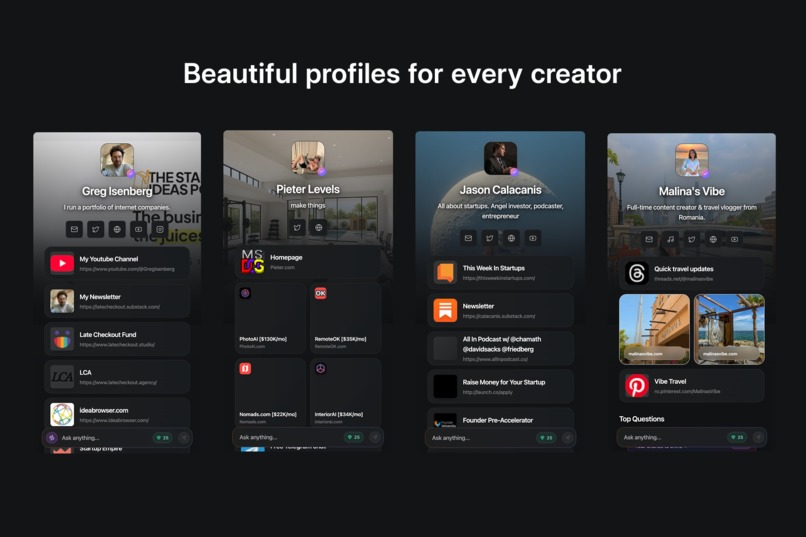
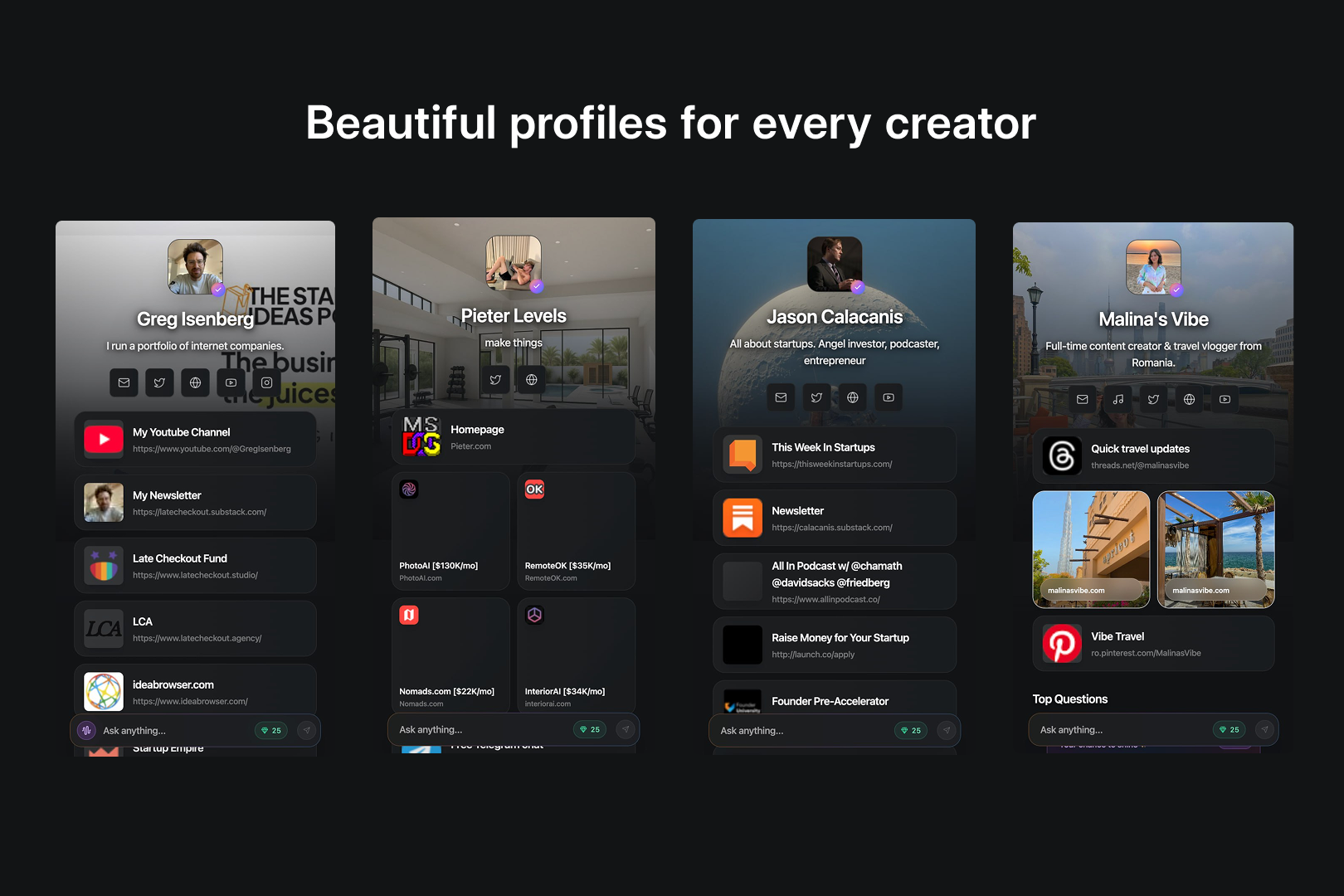
Sleek profiles for every creator
-
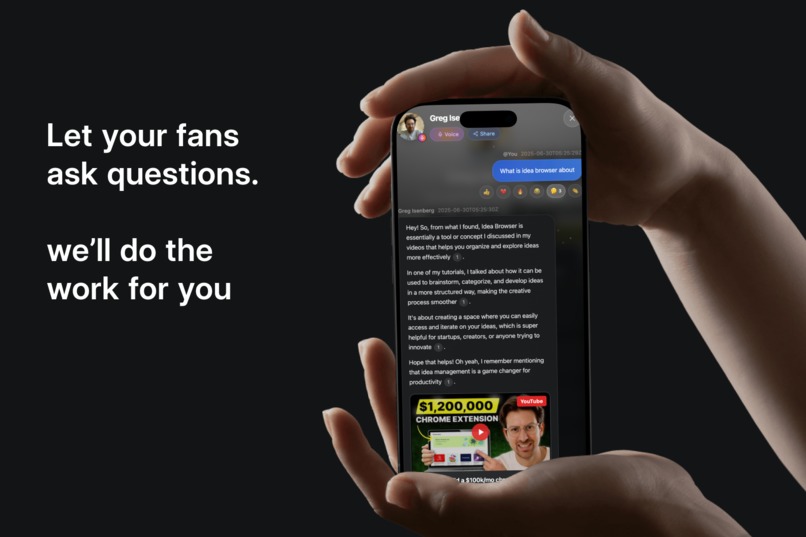
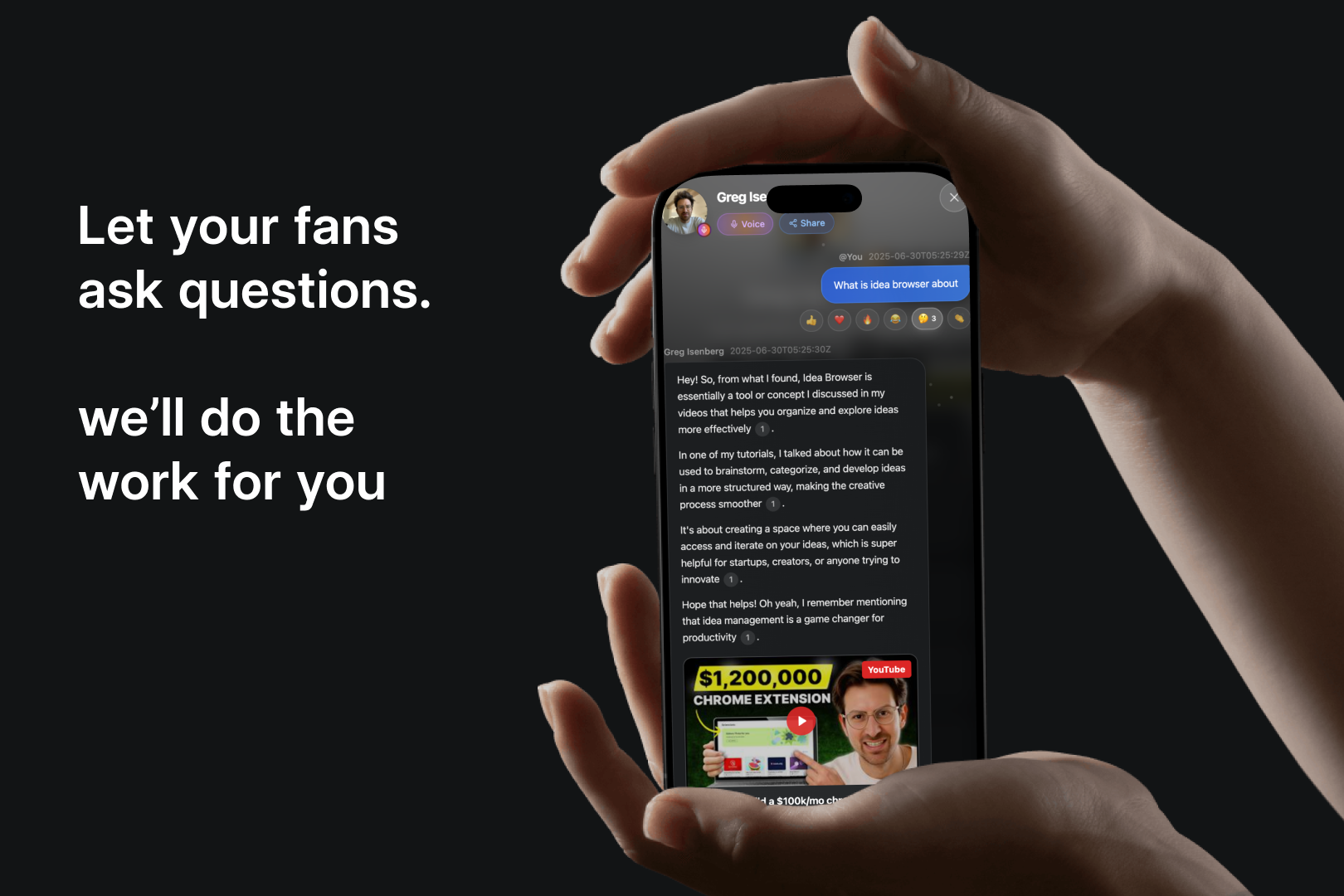
Chat with any creator
-
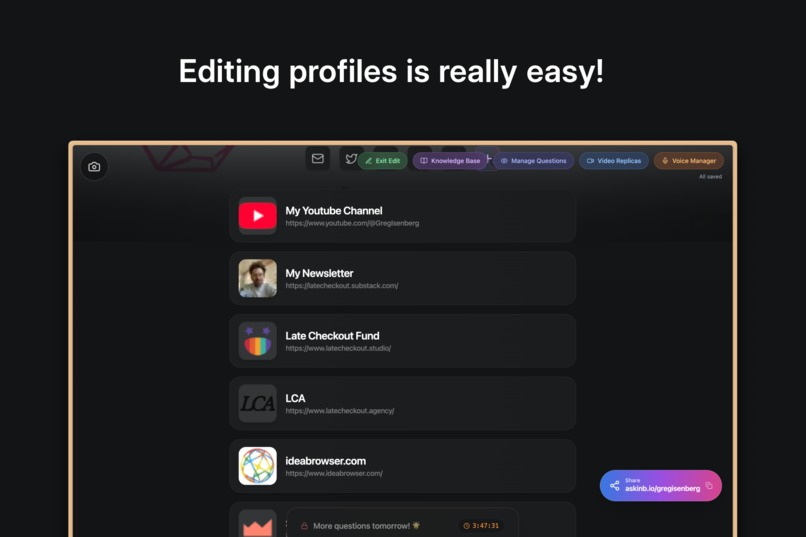
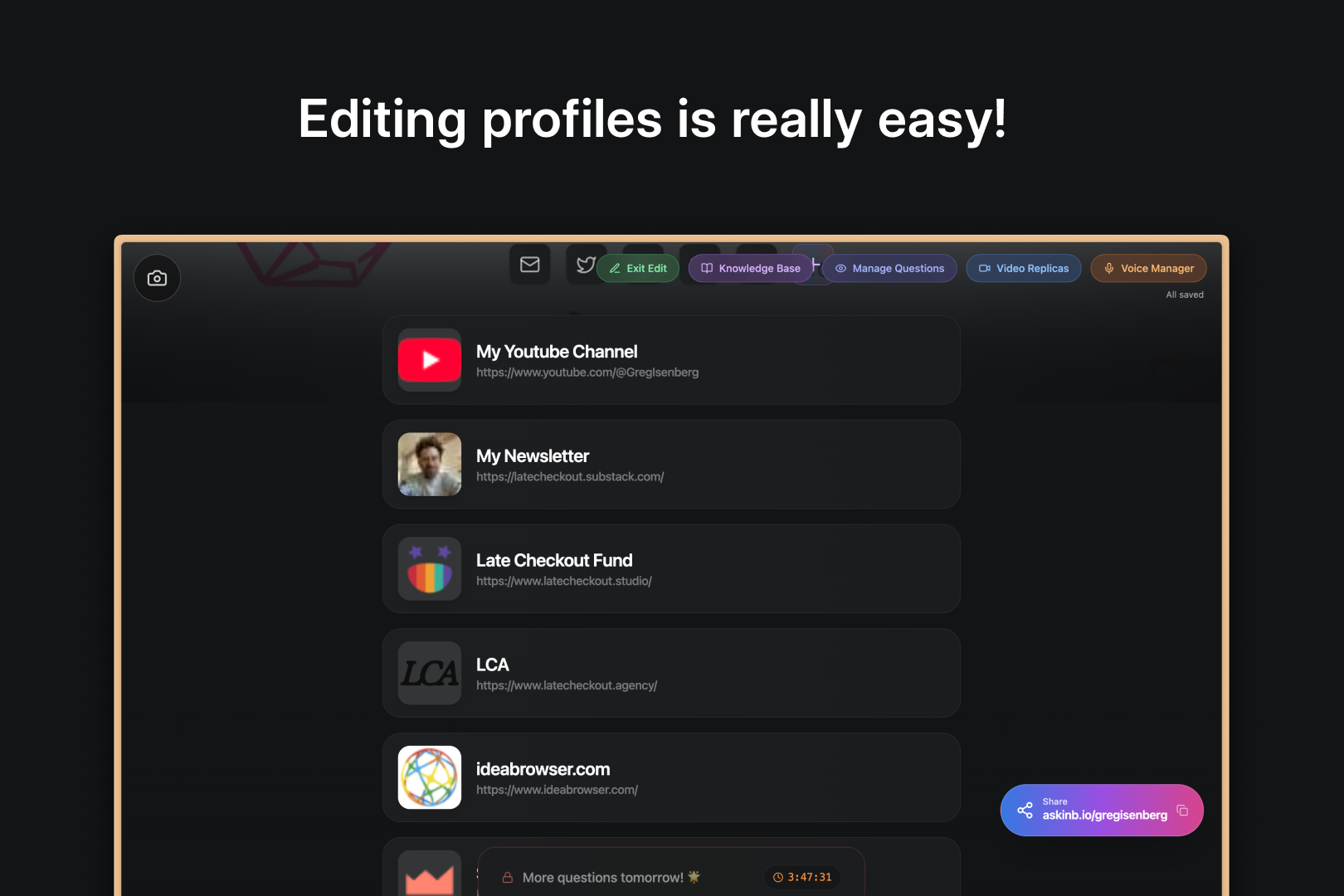
Edit profile
-
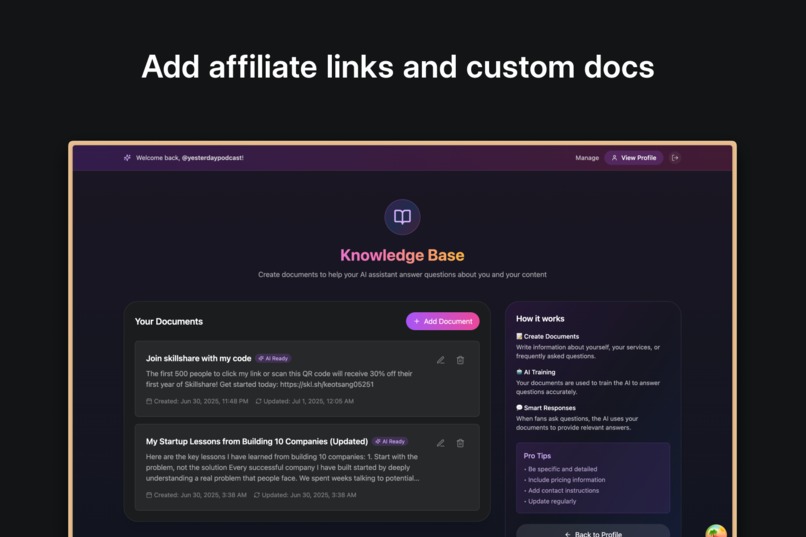
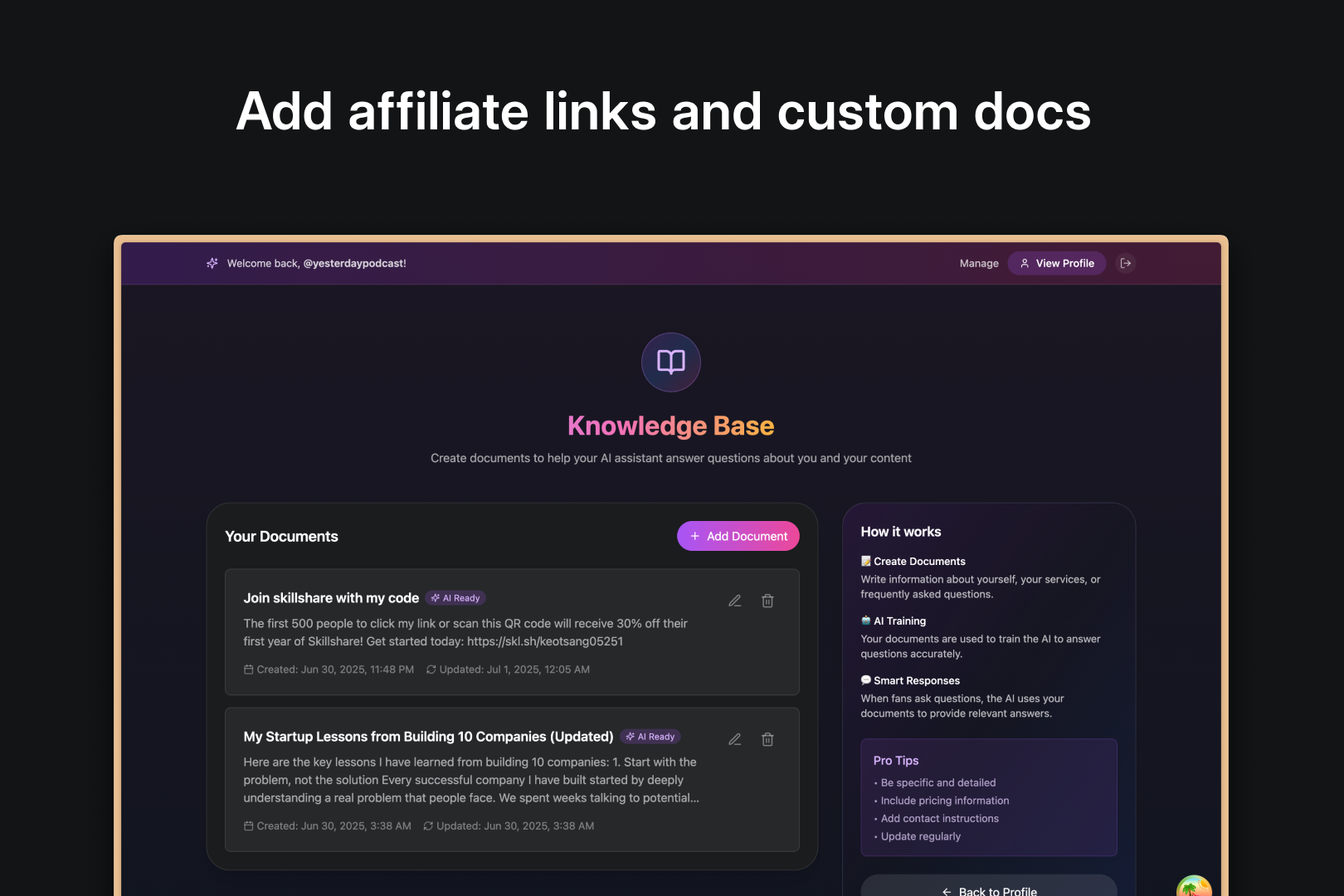
Add affiliate links and custom docs
-
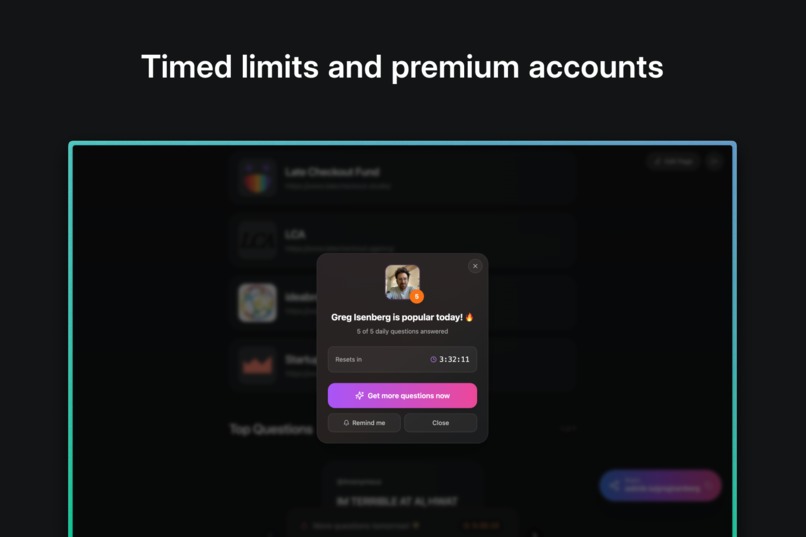
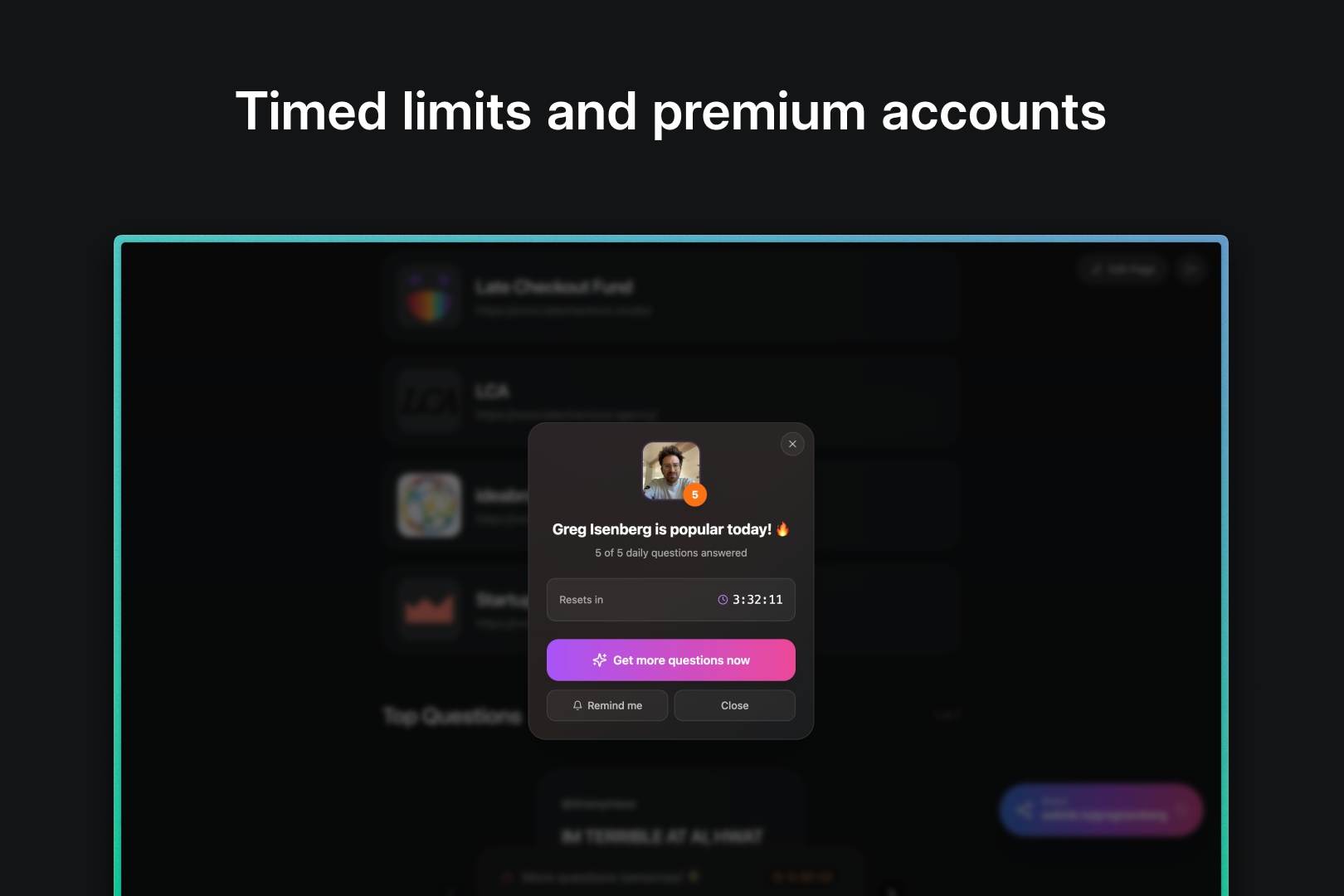
Limited questions to incentivise micro-transactions
-
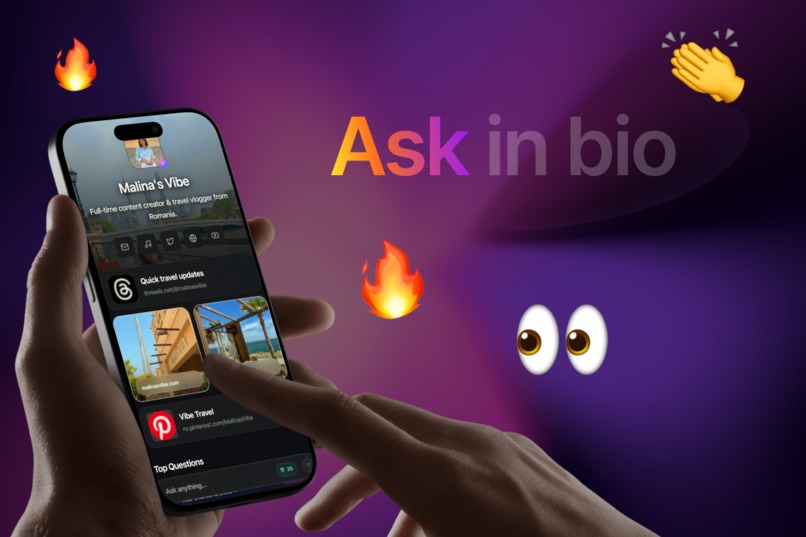
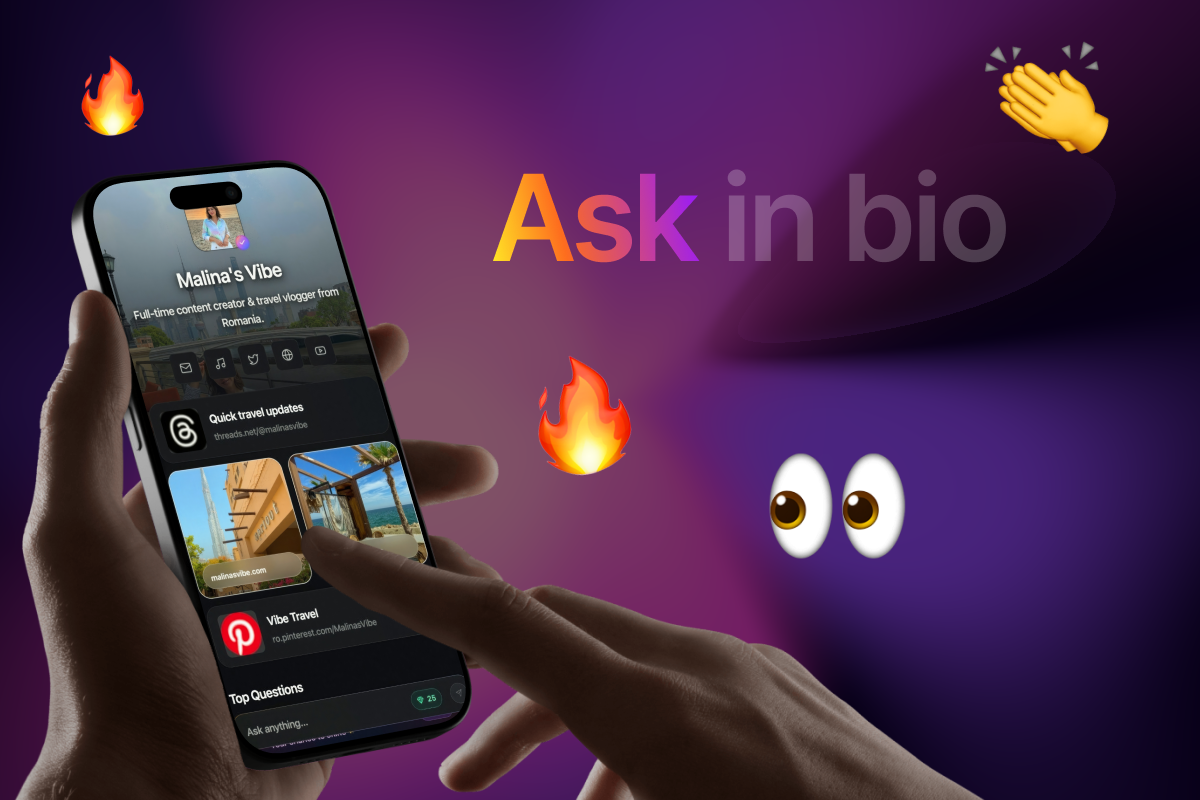
Ask in bio
Inspiration
Brief
If we could be really honest, we came up with this idea because we kept talking about various content, like, "Hey, check out this YouTube video," "Check out this TikTok," or "Check out this tweet." We had so many talking points about what was great about each piece of content. However, we realized that not everyone will watch a video in its entirety just to gather information from it.
A thought occurred to us: why not ask a question about the video or any of the creator’s content and receive answers? We could then share those answers with attribution. This would allow us to assist friends, by saying, "Hey, check this out! This creator covered this; you might want to explore more of their content."
For example, Gabe (EngMarketer) enjoys watching interior design videos on YouTube from his favorite creators. He often wants to know which company they used for a particular tile, lighting, furniture, or appliances. He wants to note exactly why they chose those items and where he can source them. And being an Asian, of course, he wants to know if there are referral codes to get discounts (brands give creators discount codes for their fans)
Hunting through 100+ links on a page felt so 2000. There had to be a better way that was also engaging for the creator and their fans.
Longer Answer
The longer answer is we have been vibe coding for some time with our other products (with paying customers). Bolt hackathon came up and we were like "why not leverage this hackathon as an opportunity to win the prize and use the money to fund this project as our moonshot project?"
We could use the prize money to keep growing our project even further, get lots of users, and become a successful startup. Very seriously, there is so much potential in coding and what it can do for the world and entrepreneurship. We have been evangelizing this to a lot of our friends, but many of them remain skeptical. Winning this would really give us the credibility to show them that if we can do it, we can win this, build a company around it, attract real customers—many at the same time—and become a unicorn.
This would be a once-in-a-lifetime story that we could share with our kids and many more people for decades to come. We believe that it would be inspirational to do things that stand out and tell the most interesting story.
What it does
Ask In Bio is a new kind of link-in-bio that turns a creator’s bio into an interactive space where fans ask questions, upvote the best ones, and spark more conversations.
Instead of just boring, static links, we create a sort of living Q&A feed powered by AI that showcases what fans actually want to know such as tools, routines, their favorite stuff.
Our goal is simple: replace “link in bio” with “Ask In Bio” and build the engagement layer Linktree and Patreon missed.
How we built it
When the hackathon started, we used ChatGPT to explain our core idea. We came up with a very comprehensive prompt with it that we put into Bolt, which kickstarted the project. The initial design was purely conceptual.
Gabe (EngMarketer) pitched to Paulius who then said, "Hey, this is a pretty good idea. It's interesting. Let's play with it a bit more."
Along the way, we ran into some issues, but we cleared them up. We overcame them one by one and finally arrived at what you're seeing now.
We also got ChatGPT to play different personas as well. For example, we asked how a certain VC or top founder like Nikita Bier (gas and tbh app founder) would grow this project and build virality into it. Using all those prompts, we went back and forth and used Bolt to experiment with different concepts.
Then we tested each iteration with friends and between ourselves. If something resonated with us and made sense, we kept working on it. If it didn't, we tossed that aside. Essentially, we were able to iterate very quickly on different concepts, test them out rapidly, and see how they felt to users as if they were interacting with them on their phones, devices, or computers. All with Bolt and AI tools like Cursor and Claude.
Challenges we ran into
So much challenges! At the technical level, we encountered quite a fair bit of bugs on Bolt. We've even sent a document of all the issues we've faced to Eric (Bolt CEO) via DM on X/Twitter.
Accomplishments that we're proud of
The design language feels right, and vibes with the new generation of creators and internet users The simplicity of the profile editing
Cracking Voice and Video Cloning
This took days to figure out since they required edge functions and was purely vibe coding throughout which meant debugging and re-prompting with more context to get it working.
I had never previously shipped elvenlabs or AI video agents in the past so this was completely new territory. My best moment during this hackathon was finally facetiming myself!
Shipping the fastest we've ever shipped
The fact we were able to ship a lot* of features in such a short time
Before this hackathon, we spent a lot of time thinking about what we should do for this idea. However, the constraints of the hackathon forced us to sit down and figure out how we could maximize the capabilities of vibe coding to build out what we had in mind as quickly as possible. This pushed us to weigh the constraints we had and find creative workarounds.
For instance, if something was too complicated, we utilized various AI tools to first mock it out, and then we assessed how to build it with the backend we had. Currently, we have two backends: one on Superbeast and one on Ruby on Rails. If a task is too challenging to accomplish with Ruby on Rails, we switch to Superbeast and vice versa. Much of our process is driven by APIs.
We organized our work in a way that made things discrete, allowing us to easily add and remove components independently as we vibe coded, which we thought was really cool. We did have some tense moments when we had conflicts but vibe coding, ironically, made it easy to resolve them too :'>
What we learned
Bolt can be very good for iterative development
We were both able to move quickly on testing different concepts for how the user would experience the ideas we had in mind. We created bold examples and proofs of concept, then sent them to friends and asked, "Hey, what do you think about this?" We also tested our ideas among ourselves, asking questions such as, "Is this going to go viral? Does this make sense to the creator and the fans? How can we make this better?"
Vibe coding actually isn't that easy!
We ran into so many problems when it comes to vibe coding. There were numerous occasions when vibe coding introduced more bugs than expected. As we tried to add more features, the bugs came back to haunt us. It turned out that what we really needed was to plan things out very carefully, creating a clear plan and structure for AI to perform at its best.
Vibe coding v1 helps you to get to a more robust v2!
This is actually our first rodeo with vibe coding and an actual product. We have built another product that is already generating recurring revenue from paid subscriptions, and we realized that when you vibe code quickly, it allows you to iterate faster and figure out what works and what doesn't. You can apply that to build a better version, too.
This is exactly what we're going to do. We will take all the learnings we've had in this Bolt hackathon and create an even better version that we know will resonate well with hundreds of thousands of fans and creators.
What's next for Ask In Bio
Targets

Our big goal is to hit 100,000 creators in the next 6 to 8 months. This means we need to attract at least 10,000 to 20,000 creators financially.
Our Plan
What we're going to do is reach out to many of these up-and-coming indie creators. By collaborating with them, we aim to build this out. Since they are smaller and not as established as the major players, it will be easier for us to form partnerships, communicate, and determine how we can improve the tool.
After this initial phase, in the third or fourth month, we plan to reach out to larger creators—those with significant audiences. We will have them try our platform and onboard them to provide the best possible experience, allowing them to see real results and generate more revenue from their content.
Also, we are working on building out more features for the platform, namely the ability to add affiliate links and to connect affiliate accounts across different platforms like Amazon. The idea is that we can easily pull any of these affiliate links, store them, and also automatically insert them into any messages that fans may ask.
For instance, if fans ask about a favorite chair, mouse, or keyboard, we will be able to find online whether they have any links for those items or create one for them and plug that in.
Additionally, we want to allow them to provide custom sources for content, such as newsletters on Substack or Beehiiv. With this, we believe we can incrementally index most of what they have online and provide a more comprehensive question-and-answer system for the fans.
Documentation
Testing & Challenges
Tavus Challenge: /create - when creating profile. Please allow 2-4 hours for the training. Further instructions on /create page flow. Once you have a profile you can go to /manage/replicas or click "edit" on your profile page to edit and manage the replica.
Elevenlabs Voice Challenge: /create - when creating profile you can record your voice for training or upload a pre-recording to train. Once you have a profile created you can go to /manage/voice to edit and change your voice clone.
Netlify Deploy challenge: We have used Netlify to host our app and host askinb.io domain. Deployed from within bolt.
Stack
- Bolt to start and built main experience features: user profile, profile creation, UI, initial backend edge functions, setting up auth
- Cursor for fixing bugs that bolt lacked context to fix (such as edge functions, browser console log and network tab errors)
- Perplexity for researching bugs and pasting into bolt for context to fix bugs
- Github for working together
- Different Github branches for backing up work and experimentation
- Ruby on Rails backend to do heavy data scraping, embedding data and agentic calls to tools for bolt app to get answers from creators' documents
- Netlify for hosting
- Tavus AI for video agents
- Elevenlabs for audio cloning
- Supabase for Edge functions, and managing most features on our Bolt app such as profiles, reactions, accounts, auth, replicas and cloned voice id's, managing creators
- ChatGPT for images and copywriting
- Figma for thumbnails, assets, etc
Built With
- anthropic
- bolt.new
- elevenlabs
- netlify
- openai
- react
- react-dnd
- render.com
- ruby-on-rails
- shadcn-ui
- supabase
- tanstack-query
- vite


Log in or sign up for Devpost to join the conversation.