-
-
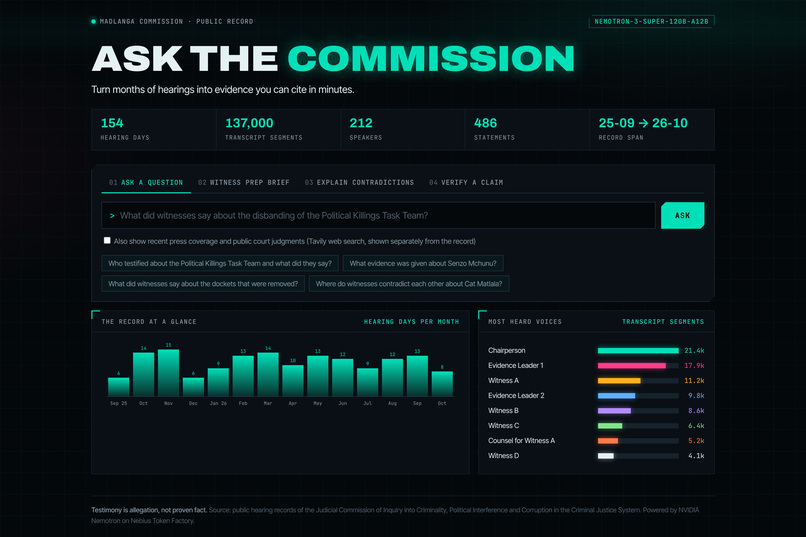
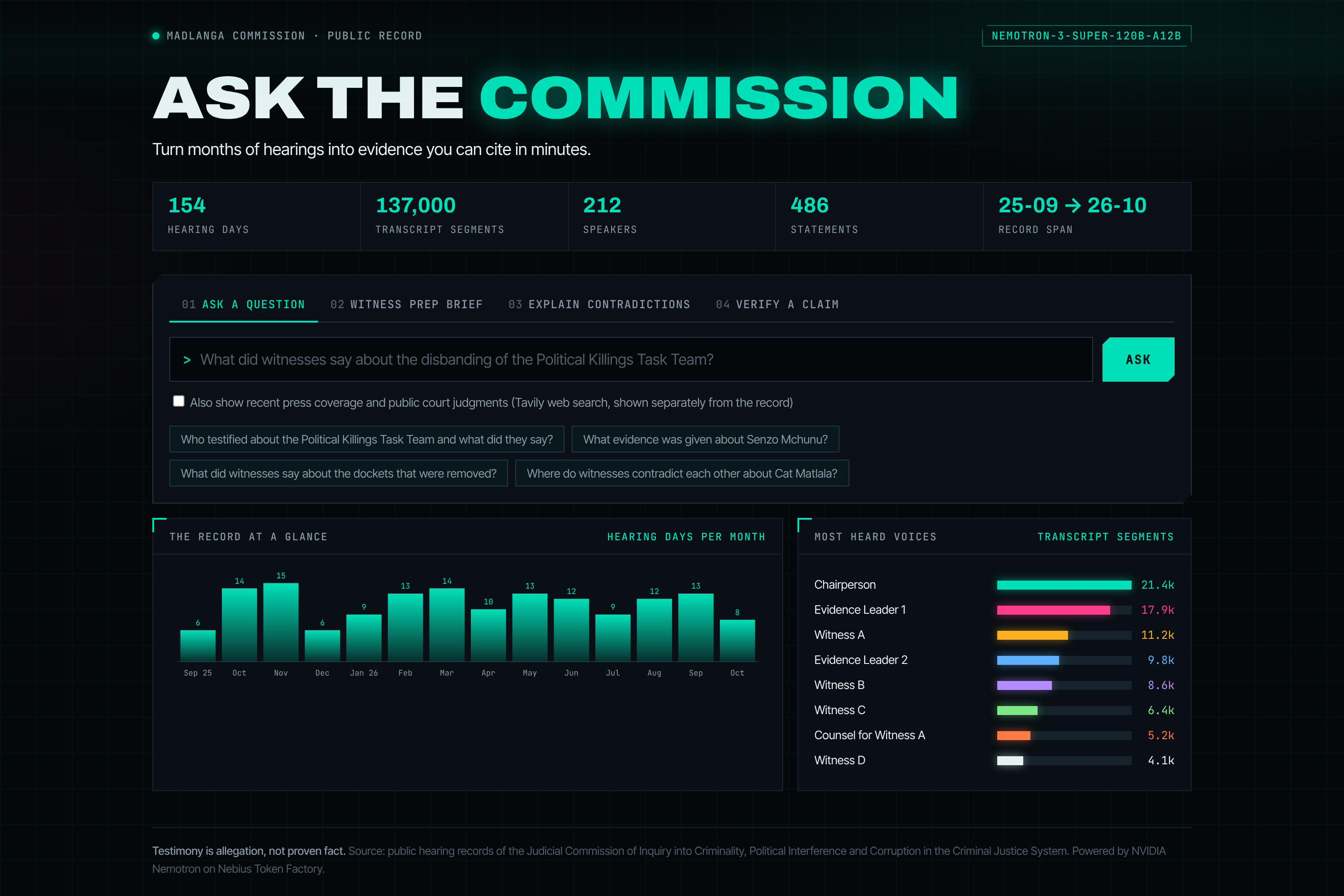
Home:154 hearing days at a glance.Pick a mode (Ask, Witness prep, Contradictions or Verify) and see how the inquiry unfolded month by month.
-
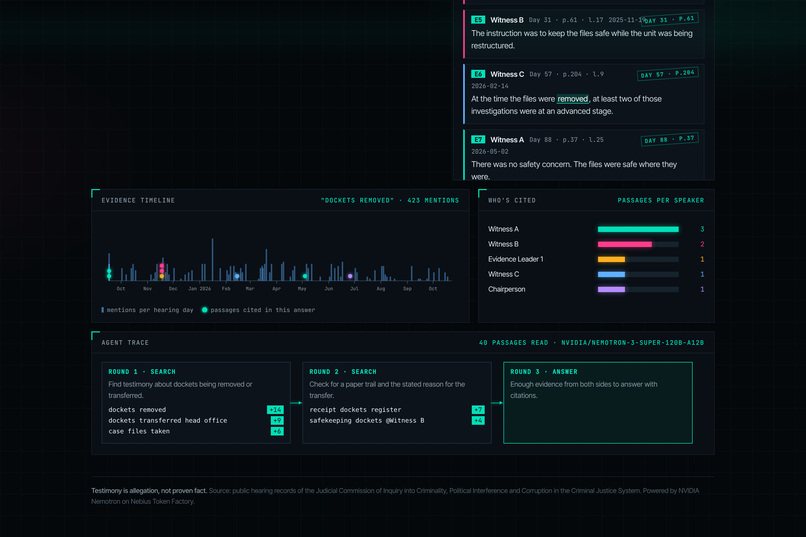
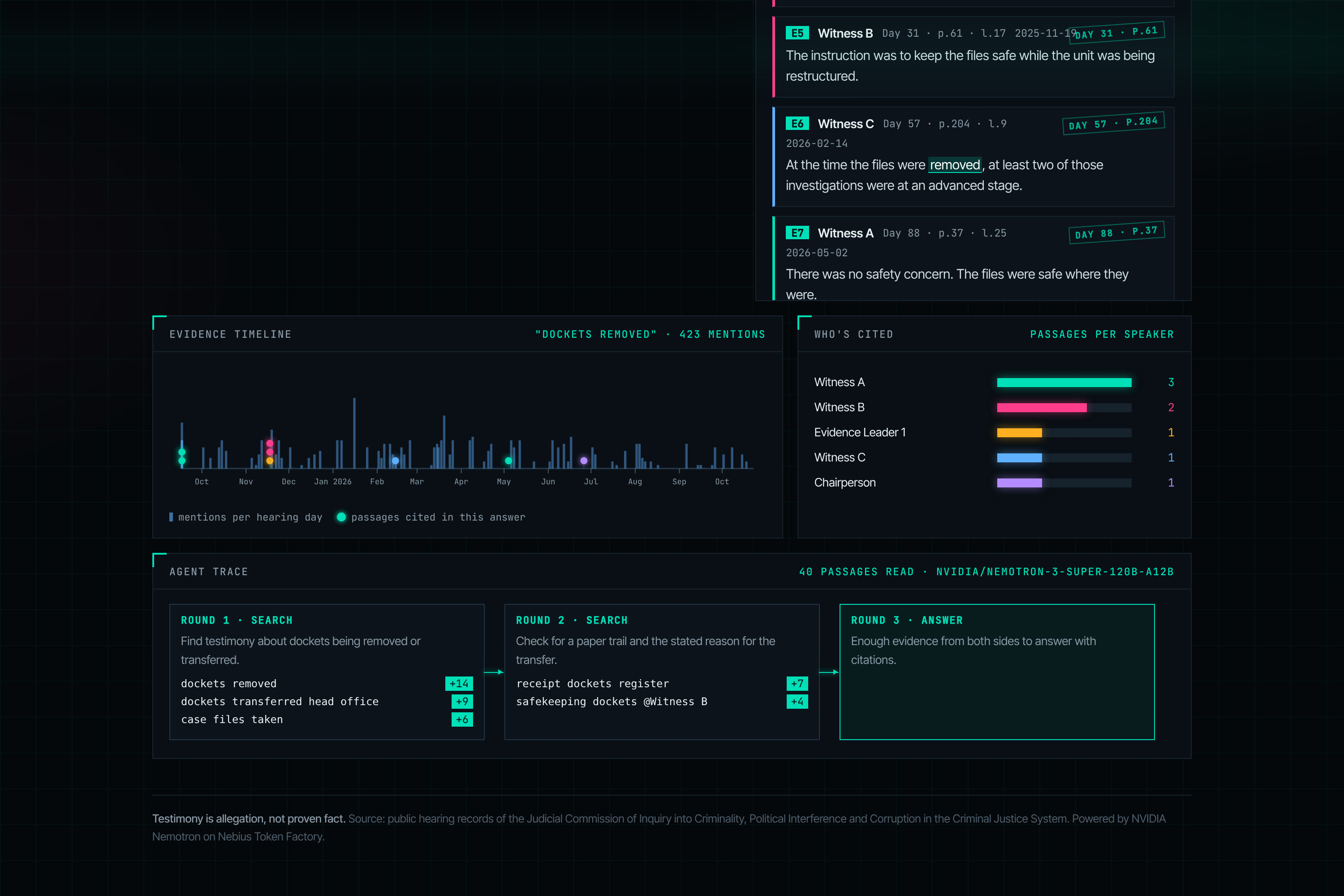
See the evidence and the agent's work:when the topic came up across the hearings, who is cited most, and each search round Nemotron planned.
-
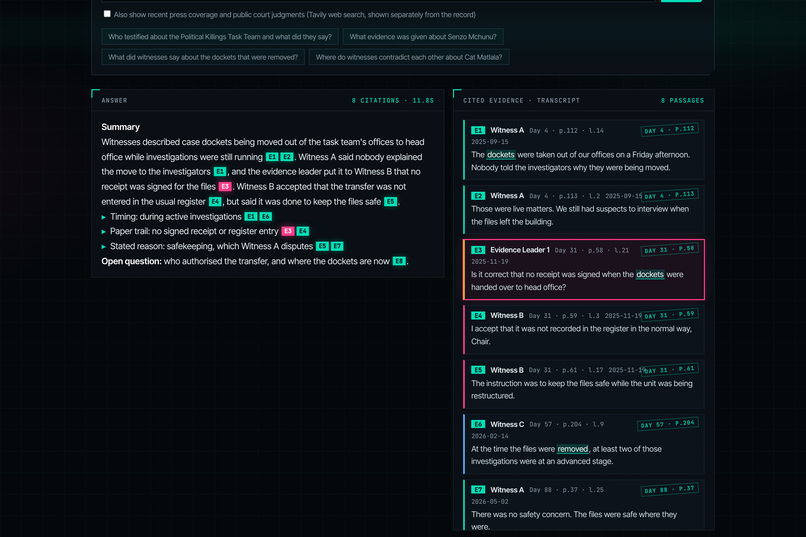
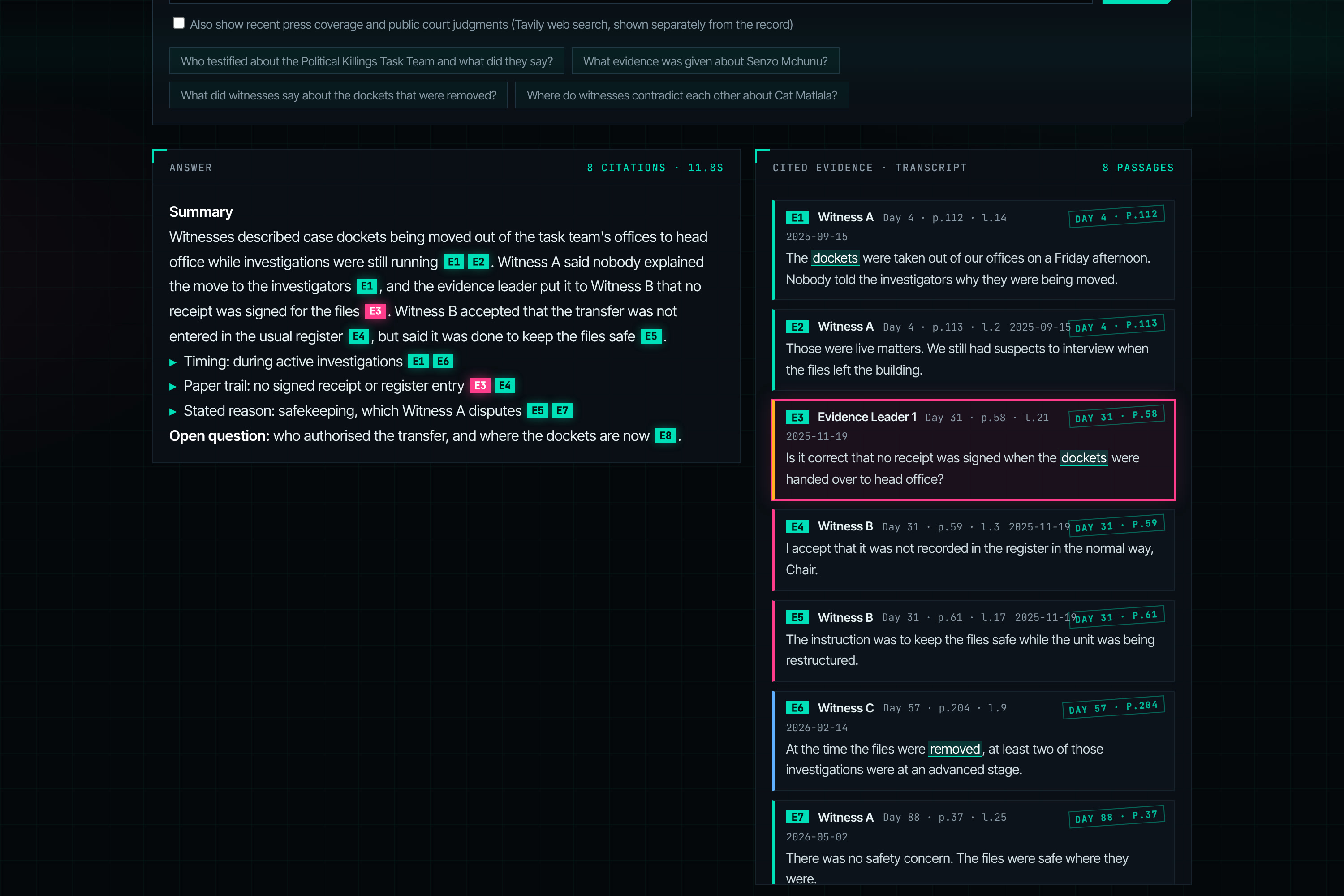
Every claim is cited. Nemotron's answer links each [E#] marker to the verbatim quote, with its speaker, hearing day, page and line.
-
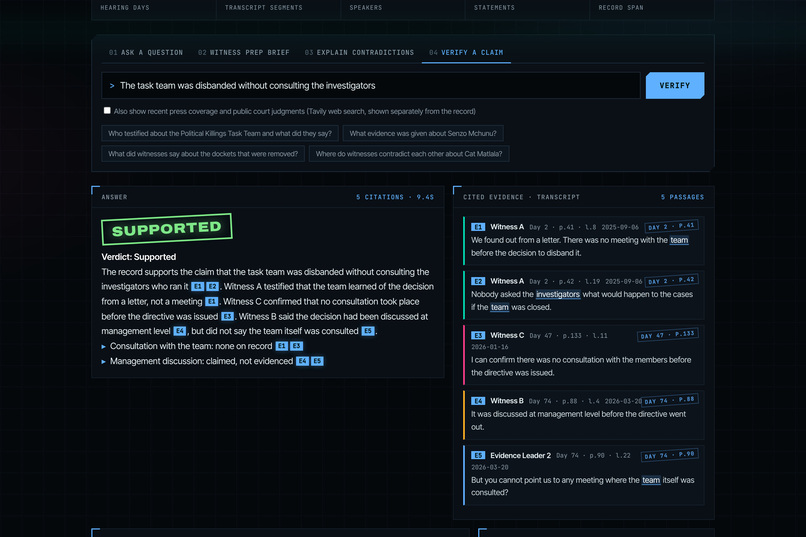
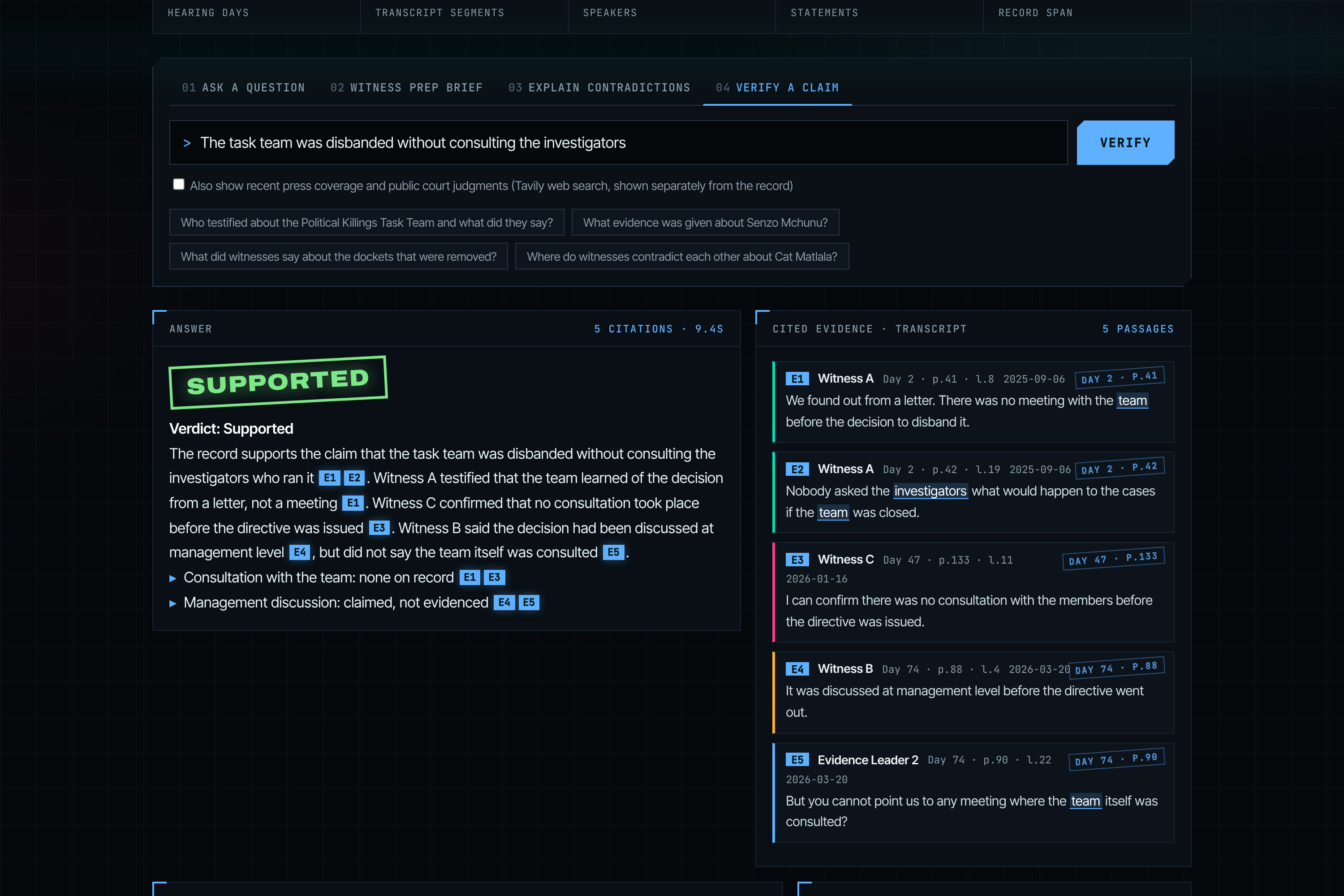
Verify a claim: paste a headline and get a verdict (Supported,Contradicted,Partly supported or Not in the record),backed by sworn testimony.
Inspiration
Commissions of inquiry are where a country's hardest questions get answered under oath. South Africa's Madlanga Commission has heard 154 hearing days of testimony on criminality, political interference and corruption in the criminal justice system, more than 137,000 transcript segments. But the record is a pile of PDFs, and nobody can ask it a question.
We wanted to find out whether an open NVIDIA model could work like a junior investigator. It would plan its own searches, read sworn testimony and come back with an answer a lawyer or journalist could stand behind, cited to the exact speaker, hearing day, page and line.
What it does
Ask the Commission is an AI agent that turns a public inquiry record into answers you can check. You type a question. Nemotron plans its searches, reads the evidence and decides whether it has enough. Then it answers with verbatim quotes and citations.
- Ask a question: a direct, cited answer.
- Witness prep brief: what a witness said, who corroborates or contradicts them, and the gaps to probe in cross-examination.
- Explain contradictions: side A and side B, where they differ and what would resolve it.
- Verify a claim: paste a headline and get a verdict (Supported, Contradicted, Partly supported or Not in the record).
Every answer comes with:
- An agent trace: each round of searches Nemotron planned, why it planned them and what it found.
- Clickable citations: every [E#] marker jumps to the exact quote, with its speaker, day, page and line.
- Charts: citations by hearing date and by speaker.
- A Tavily context panel (optional): recent press coverage and possibly related SAFLII court judgments. These are shown beside the answer and never fed into it as evidence.
How we built it
The agent, built for this hackathon on 30 October 2026
- Model: NVIDIA Nemotron 3 Super (
nvidia/nemotron-3-super-120b-a12b) on Nebius Token Factory, called through its OpenAI-compatible API. - Planner and analyst loop: Nemotron first plans in structured JSON. Each round has 1 to 4 keyword searches and an optional speaker filter, with up to 3 rounds and a cap of 24 passages. Then it switches to the role of evidence analyst and may only use the numbered passages it retrieved.
- Citation verification: the server drops any citation that doesn't point to a retrieved passage. If an answer comes back with no citations, it retries once.
- Retrieval: BM25 over SQLite FTS5, with neighbouring transcript lines added for context. Every word the user types is quoted, so input can't inject search syntax.
- Tavily: news and SAFLII searches appear in separate panels and are deliberately kept out of the prompt.
- Stack: Python, FastAPI, a single-page web UI, Docker and an offline pytest suite. Each answer takes 3 to 4 model calls and costs about one US cent.
The foundation, built before the submission period The project started on 22 July 2026 with one question: can we download the whole record? There was no bulk export, so we wrote a downloader that follows the commission site's hearing pages and signed document links. That grew into a parsing pipeline: page and line numbers, canonical names for 259 speakers, entity extraction and an FTS5 index. It also grew into an R/Shiny research dashboard with network views, story maps and a contradictions view. The hackathon agent runs on top of that index.
Challenges we ran into
- Making an LLM prove itself. Nemotron sometimes cited evidence that didn't exist, forgot citations, used full-width brackets such as 【E2】 or ran out of tokens mid-sentence. We fixed each of these in code: citation filtering, a single retry, bracket normalisation and trimming to the last complete sentence.
- Keyword search needs a smart planner. FTS5 only matches words, so the planner has to try names, ranks, spellings and synonyms. A bigger model can't recover a passage that was never retrieved.
- Messy transcripts. Speaker labels varied, roles were mixed, and some dialogue was filed under the wrong segment. Citations only work if page and line numbers survive parsing, indexing and retrieval.
- Keeping the web out of the evidence. Putting press coverage into the prompt would make answers sound better and mean less, so Tavily results stay in their own panels.
Accomplishments that we're proud of
- A real agent, not a single prompt. It plans, searches, judges whether it has enough evidence and only then answers.
- Answers you can check across 154 hearing days, 137,000+ segments, 33 statements and 259 speakers. Every claim is tied to a speaker, day, page and line.
- Unsupported citations are removed automatically before the user sees them.
- About one US cent per answer on Nebius Token Factory.
- The agent was built in one day on top of months of evidence work. It ships as a FastAPI service and Docker image running on a single SQLite file.
What we learned
- Citations are the product. In legal work, an answer without a line reference is unusable.
- Open models are ready for agentic work. Nemotron 3 Super reliably followed a strict JSON planning format and stuck to the evidence when told to use only the numbered passages.
- Bounded loops win. Three rounds and a 24-passage cap kept answers fast and cheap.
- Retrieval sets the ceiling, and the planner raises it.
What's next for Ask the Commission
Madlanga is the first case study. Next comes DataQuant Inquiry, a commercial inquiry intelligence platform built on the same citation rules:
- Bring your own transcripts: the Zondo State Capture Commission, other African commissions, court records and public inquiries.
- Private workspaces for law firms and newsrooms.
- Hybrid retrieval (FTS5 plus vector search), so the agent finds paraphrases as well as exact keywords.
- Dedicated tools: a contradiction engine, witness prep packs and PDF evidence bundles.
Testimony is allegation, not proven fact. Every answer is attributed and linked to the public record.
