-
-
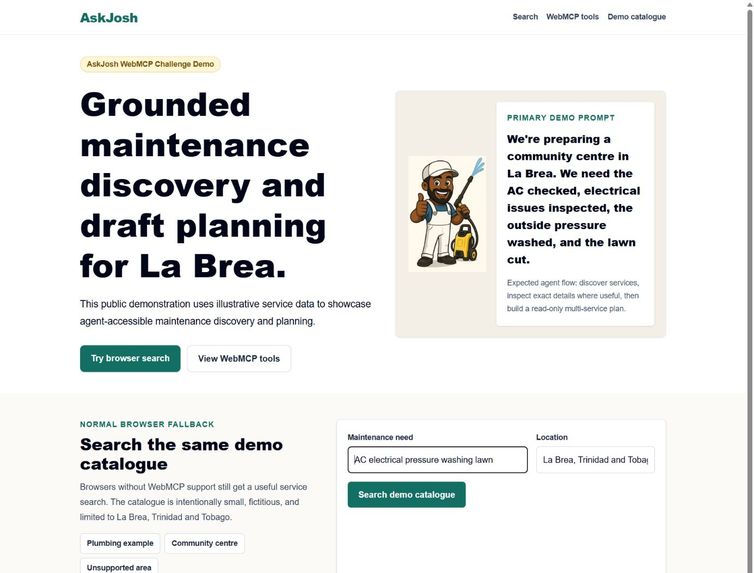
Ask Josh WebMCP Challenge Demo
-
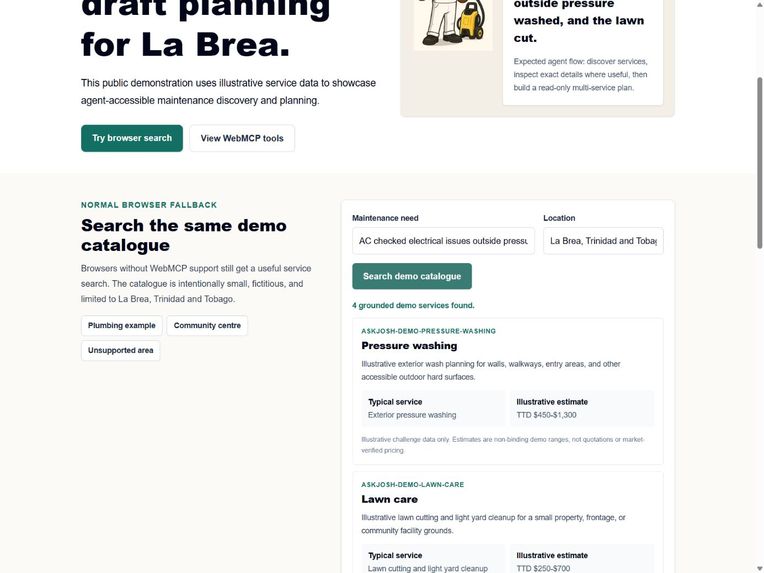
Grounded Multi-Service Discovery
-
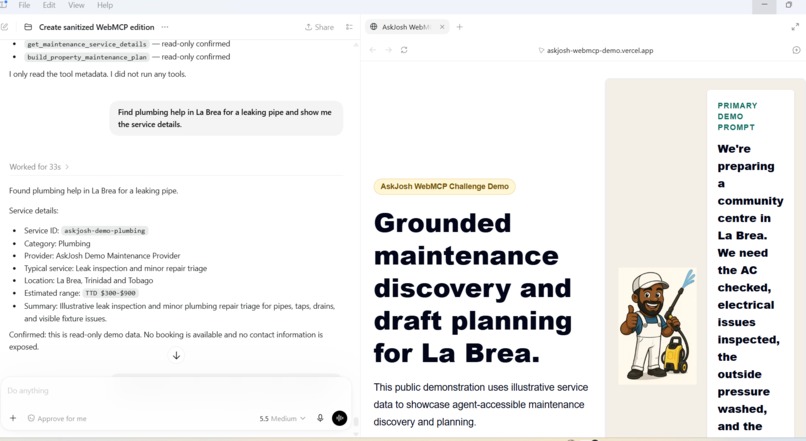
Grounded Plumbing Service Details
-
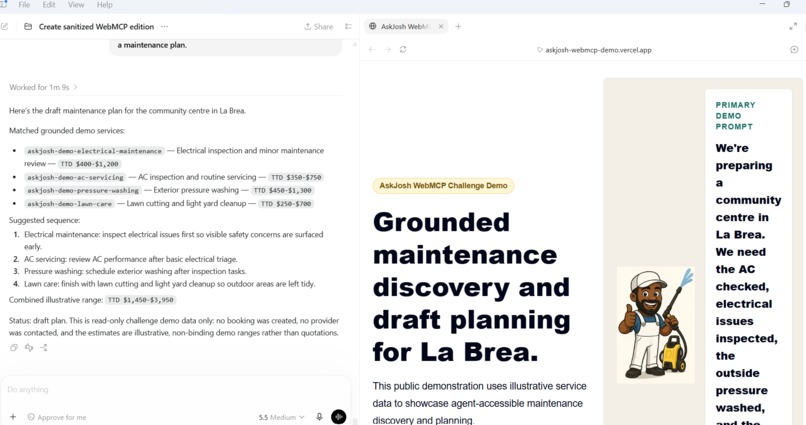
Agent-Built Maintenance Plan
-
Three Read-Only WebMCP Tools
Inspiration
AskJosh began as a Forward Ever Foundation digital initiative to explore a simple but practical problem: how can people more easily find the right local service for a property-maintenance need?
For the WebMCP Challenge, I wanted to explore what happens when that experience becomes agent-accessible. Rather than requiring a user to manually navigate a directory, an AI agent can interact directly with AskJosh's structured service data and help turn a real-world maintenance problem into an actionable plan.
This challenge edition is focused on La Brea, Trinidad and Tobago, and uses a deliberately small illustrative demo catalogue. The goal is to demonstrate an architecture that could later expand to verified providers, additional communities and more service categories.
What it does
AskJosh is an agent-ready local maintenance concierge.
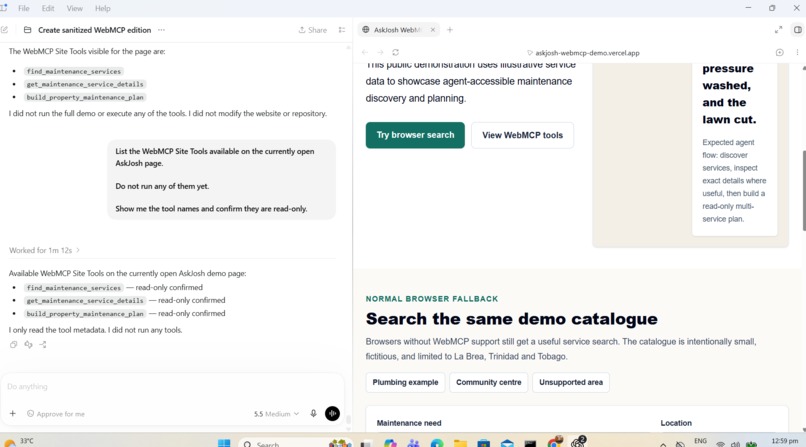
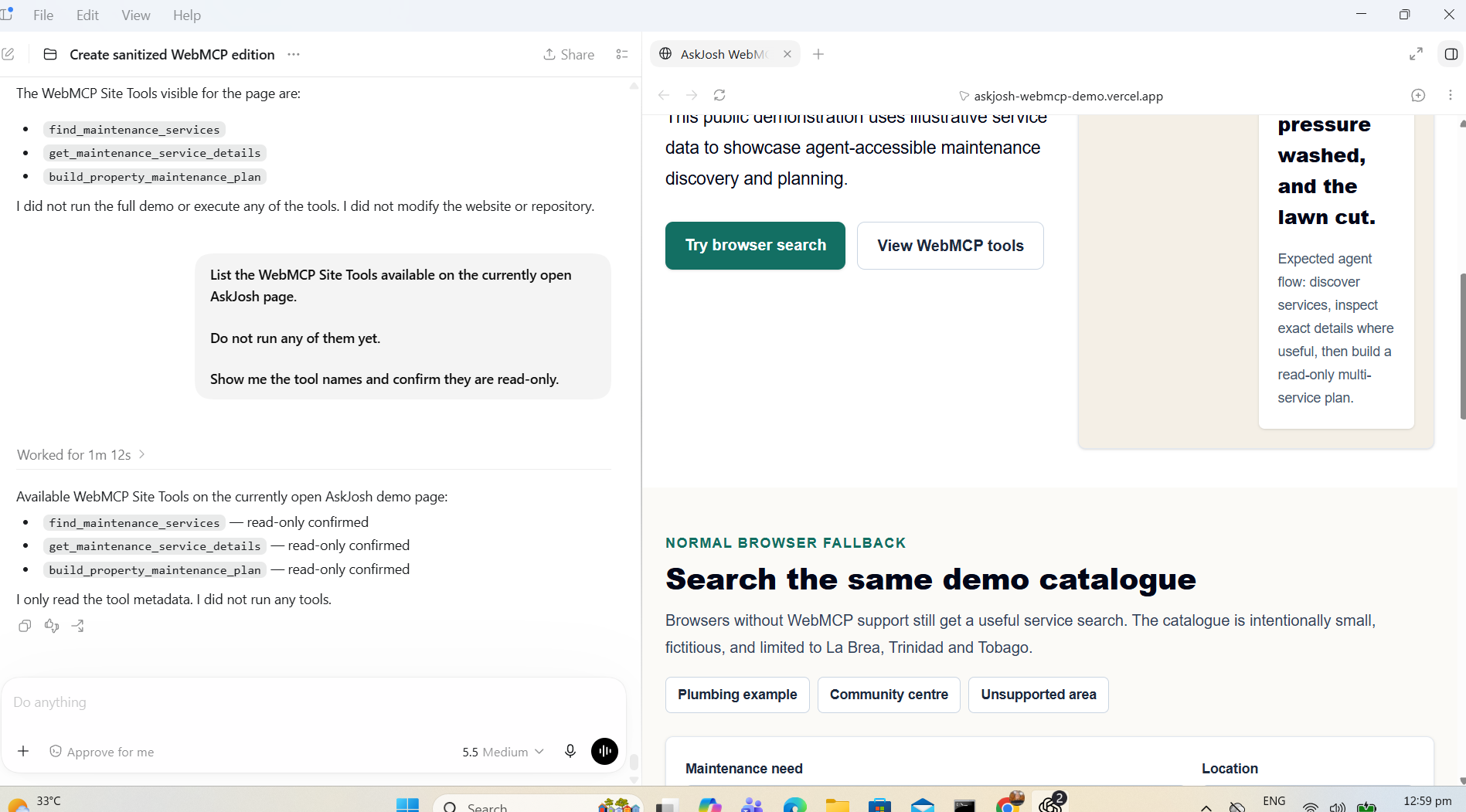
Through WebMCP, the challenge edition exposes three read-only tools:
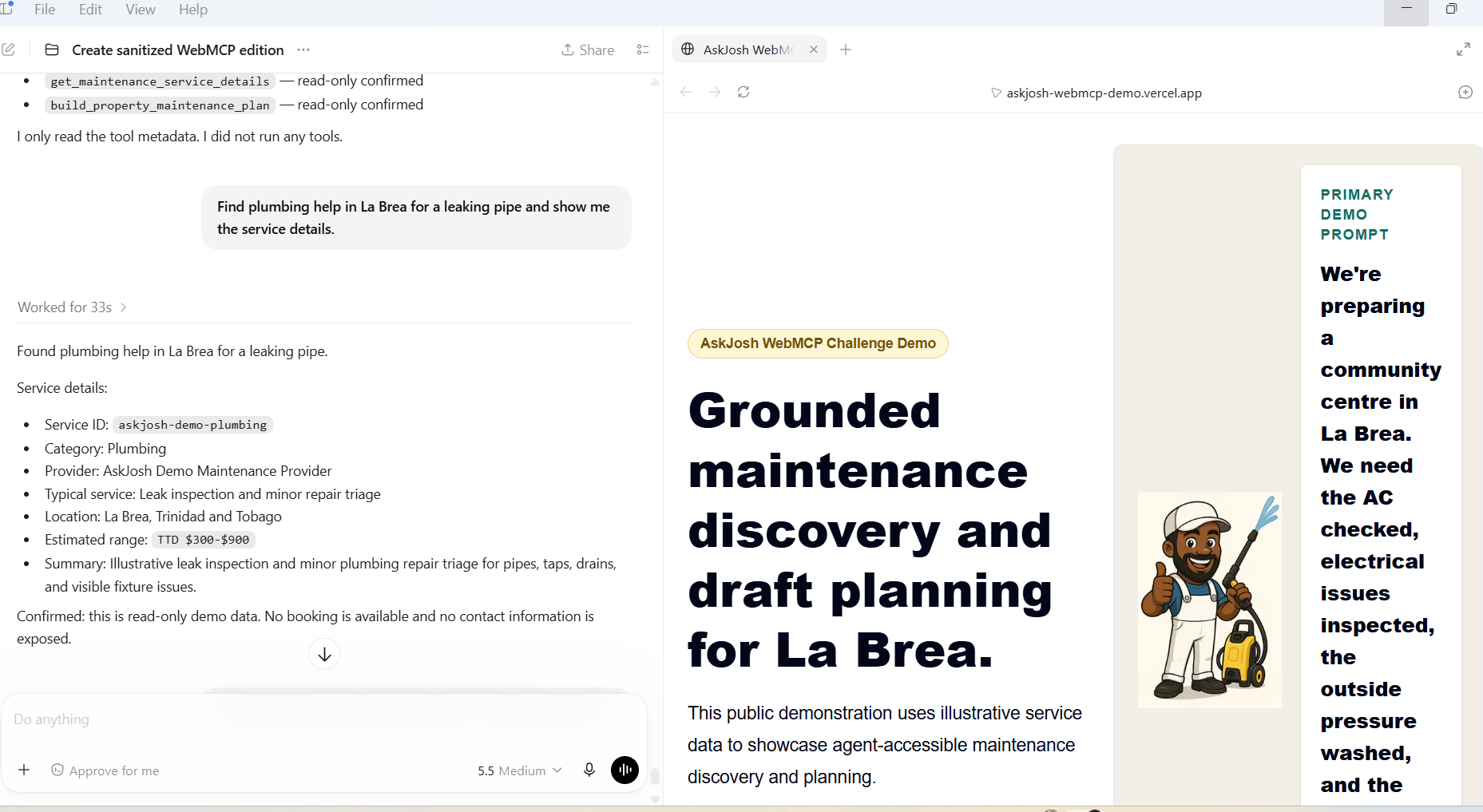
find_maintenance_services— finds relevant maintenance services from the AskJosh demo catalogue.get_maintenance_service_details— retrieves grounded information about a specific service using its exact service ID.build_property_maintenance_plan— combines selected services into a structured draft maintenance plan with deterministic sequencing and illustrative cost ranges.
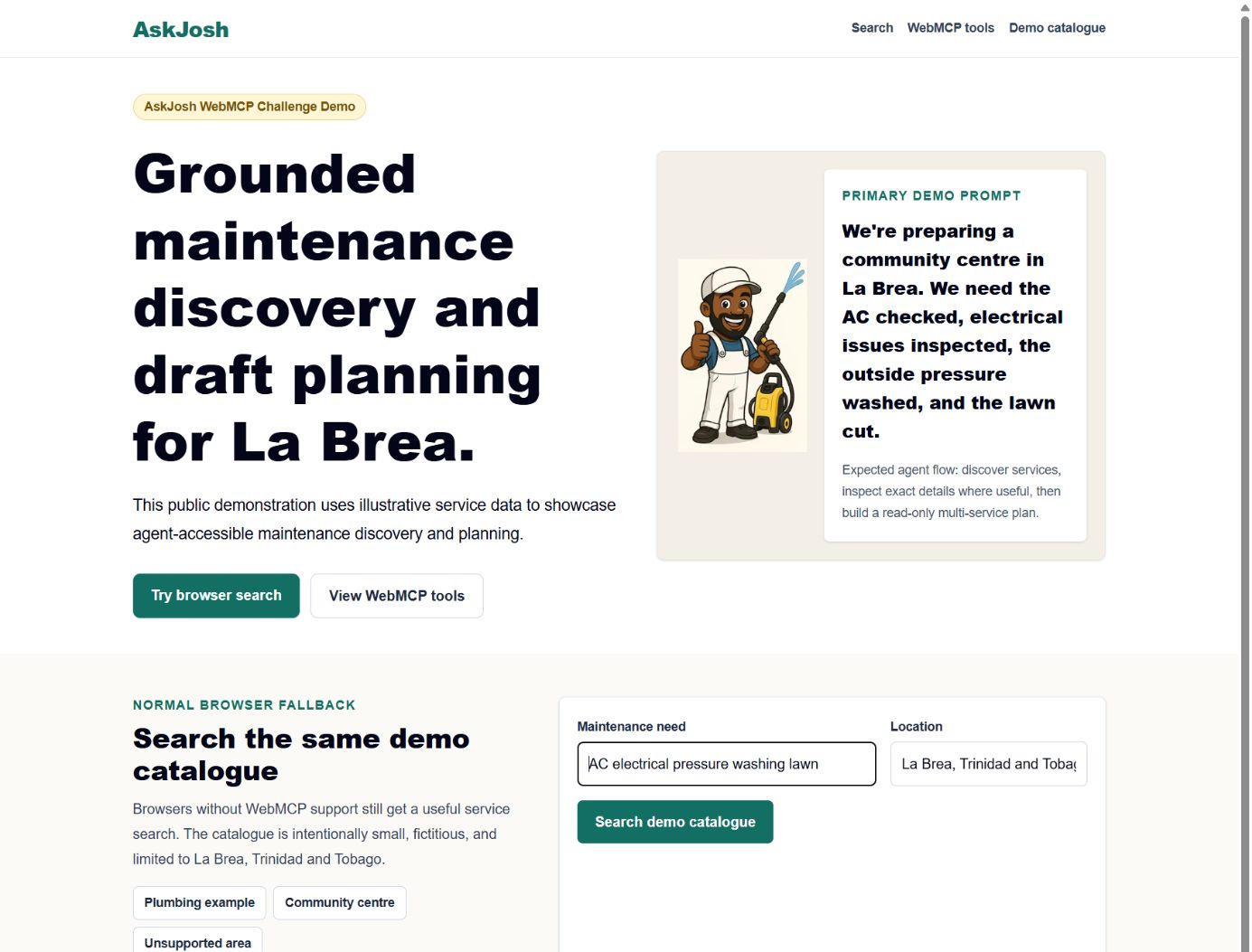
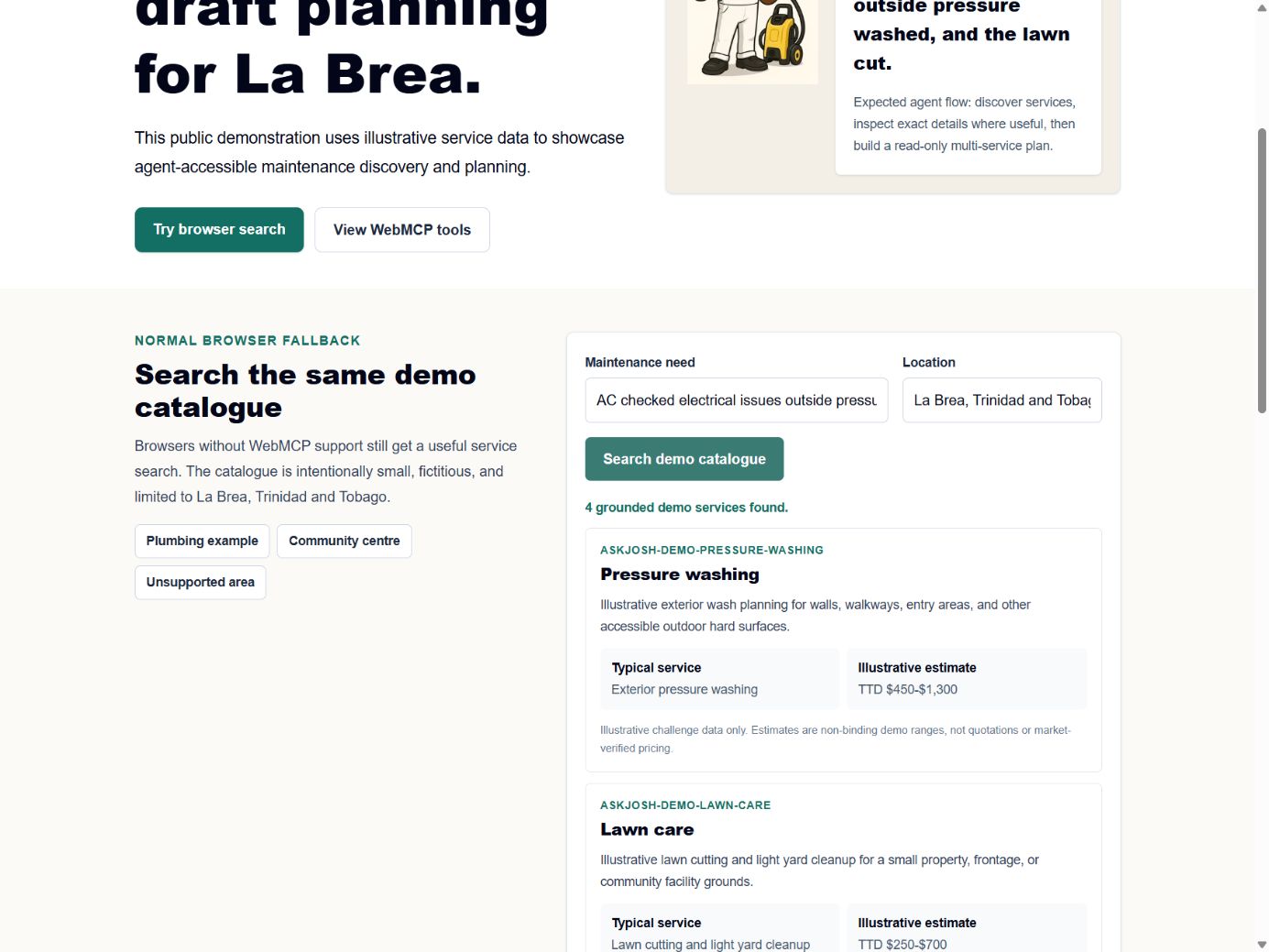
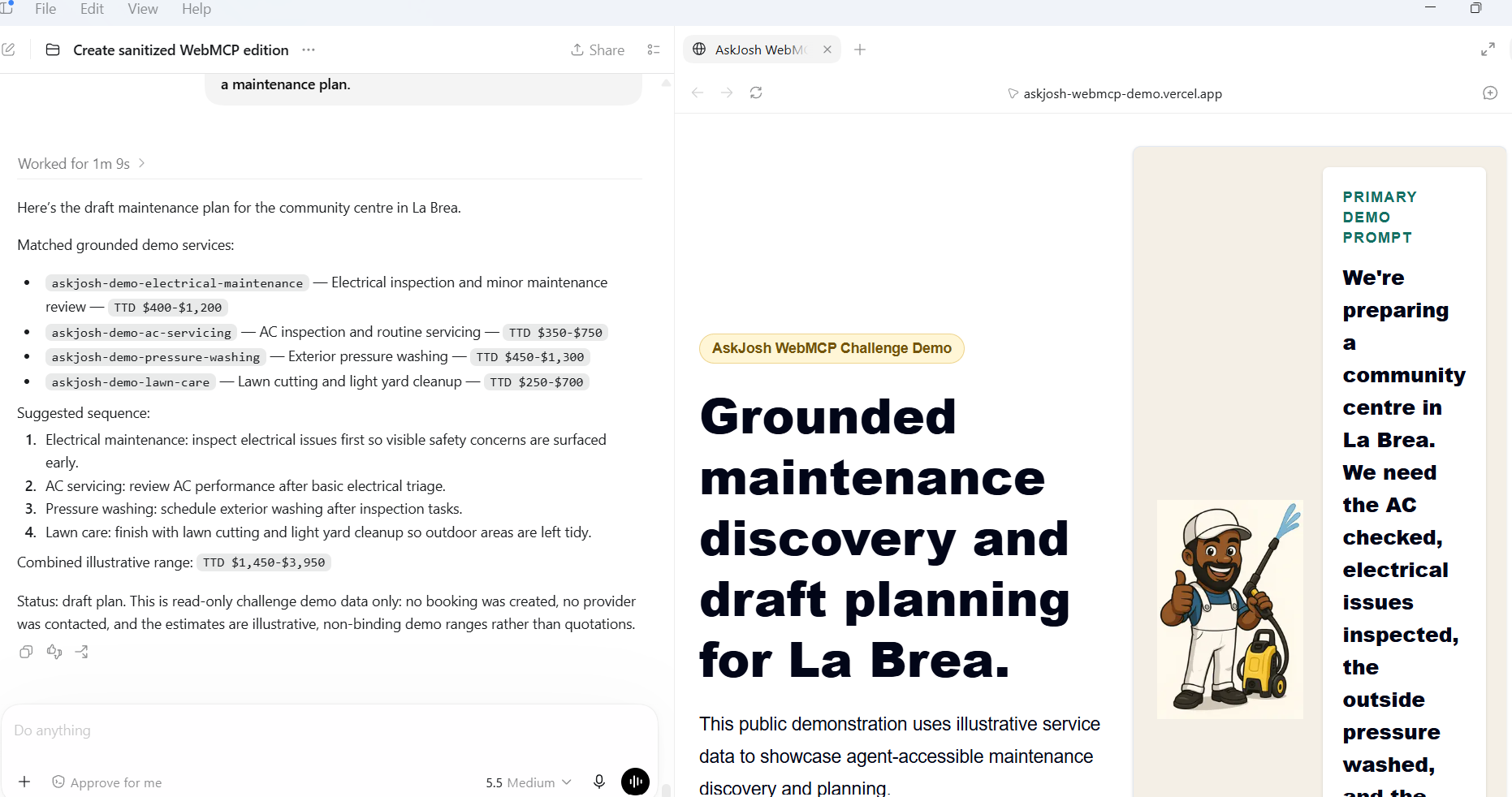
For example, a user can ask for help preparing a community centre that needs AC servicing, electrical checks, pressure washing and lawn care.
The agent can discover the relevant AskJosh services, work with their exact service IDs and create a combined maintenance plan without inventing providers, prices or availability.
AskJosh also works as a normal website, allowing people to search the same demo catalogue without using an AI agent.
How I built it
AskJosh is built with Next.js, React and TypeScript and deployed on Vercel.
For the challenge edition, I created a deliberately small deterministic catalogue containing illustrative maintenance services for La Brea, Trinidad and Tobago.
The underlying service logic is shared by both the normal website experience and the WebMCP tools.
The WebMCP integration uses the browser's Site Tools / WebMCP interface to register structured tools directly from the AskJosh web application.
The architecture is intentionally simple:
AskJosh illustrative demo catalogue
→ deterministic shared service logic
→ WebMCP tools
→ AI agent
→ structured grounded response
The WebMCP tools are read-only. They do not submit bookings, contact providers, send emails, write personal information to a database or expose private administrative functionality.
AskJosh also detects whether WebMCP is available so the normal website remains usable in unsupported environments.
Challenges I ran into
One of the biggest challenges was making the agent experience useful without allowing the system to invent local service information.
Rather than asking an AI model inside AskJosh to generate providers, prices or service information, I designed the WebMCP tools around deterministic catalogue data and stable service IDs.
I also separated discovery and planning from consequential actions. The current WebMCP implementation can search, retrieve details and prepare maintenance plans, but it cannot silently contact providers or submit requests on a user's behalf.
Another challenge was maintaining a normal human-facing website while introducing an agent-facing WebMCP capability. WebMCP support is feature-detected so unsupported browsers continue to receive the conventional AskJosh experience.
Accomplishments that I'm proud of
- Three working read-only WebMCP tools that can be discovered and called by an agent.
- A multi-tool workflow from service discovery to detailed retrieval to maintenance planning.
- Exact service-ID grounding to reduce hallucination and incorrect matches.
- Deterministic illustrative cost aggregation using catalogue values rather than AI-generated estimates.
- Safe handling of unsupported locations and invalid service IDs.
- A read-only architecture with no hidden consequential actions.
- A normal website experience that continues to work independently of WebMCP.
- Automated tests covering the WebMCP service-search, detail and planning functionality.
- A separate sanitized public challenge edition that demonstrates the WebMCP architecture without exposing the broader AskJosh project.
What I learned
WebMCP changes the role of a website.
Instead of an AI assistant only reading visible page content, a site can expose carefully designed capabilities that allow an agent to interact with the product in a structured way.
I also learned that more tools are not necessarily better. A small set of well-scoped, grounded tools can create a useful agent workflow while remaining predictable, deterministic and safe.
What's next for AskJosh
The challenge edition intentionally uses a small illustrative maintenance catalogue.
The longer-term opportunity is to expand AskJosh to verified local providers, additional service categories and more communities while preserving the same agent-access architecture.
Future possibilities include broader geographic coverage, provider onboarding and verification, richer service discovery, and carefully reviewed user-authorized request workflows.
The goal is to evolve AskJosh from a focused maintenance concierge into a practical AI-accessible community services platform.
Built With
- codex
- css
- github
- javascript
- next.js
- react
- tailwind
- typescript
- vercel
- webmcp

Log in or sign up for Devpost to join the conversation.