-
-
Ask First: the authority layer for autonomous AI. Let AI act. Keep the final say.
-
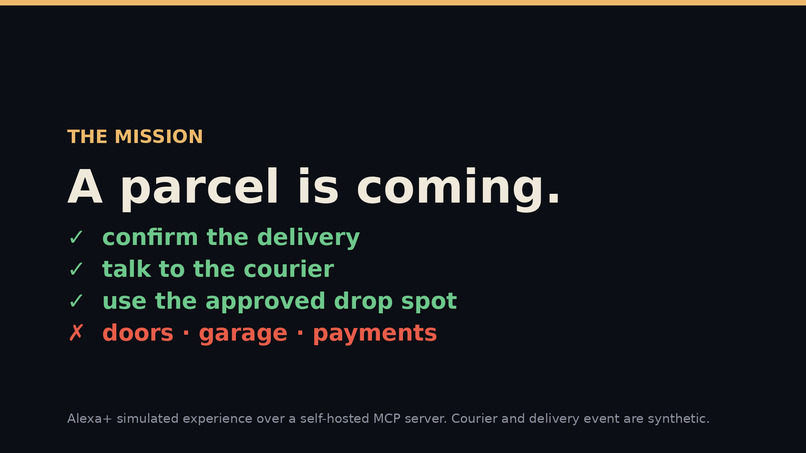
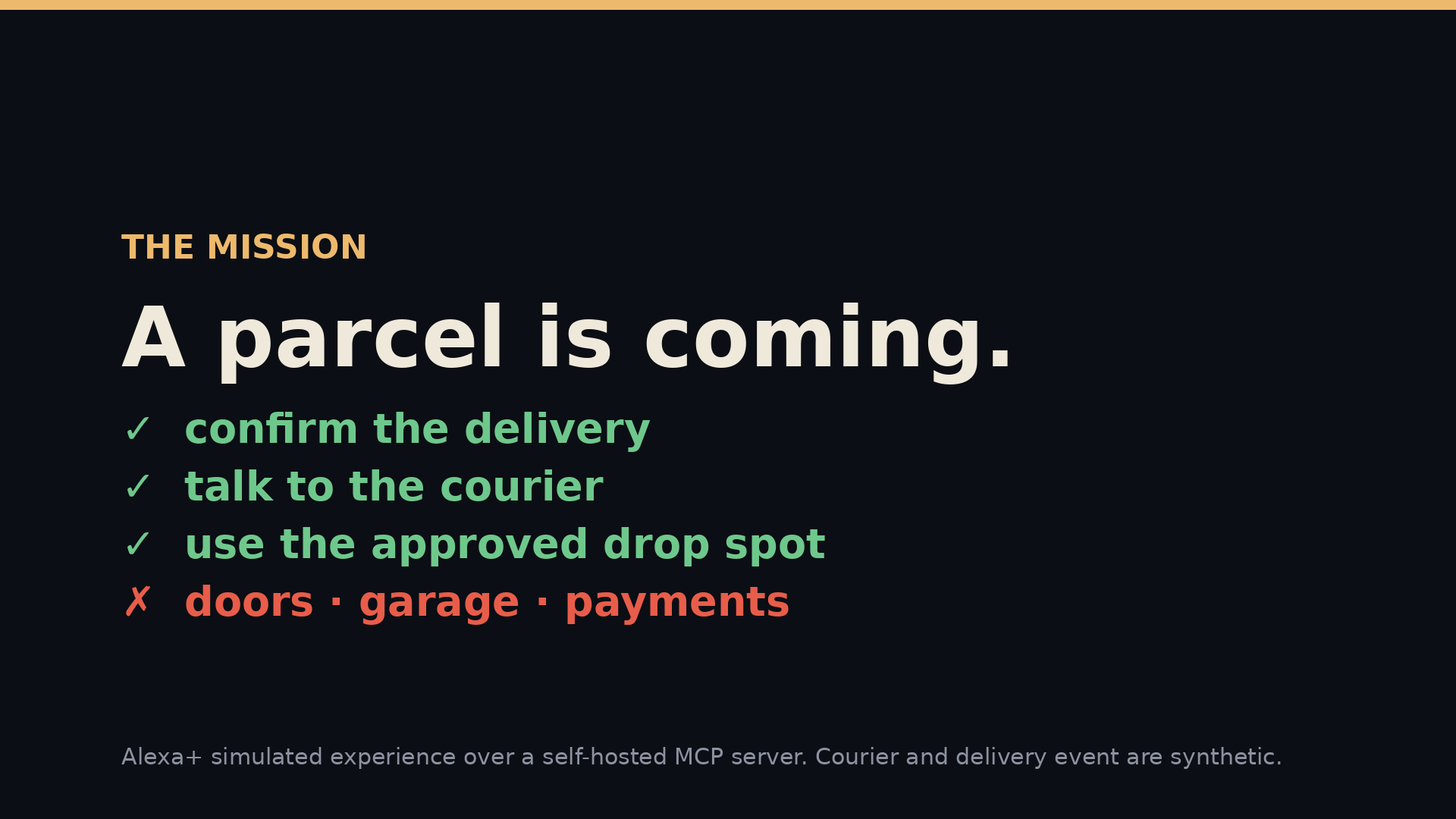
Bounded delegation: confirm the delivery, talk to the courier, use the approved drop spot. Doors, garage, payments: out of scope.
-
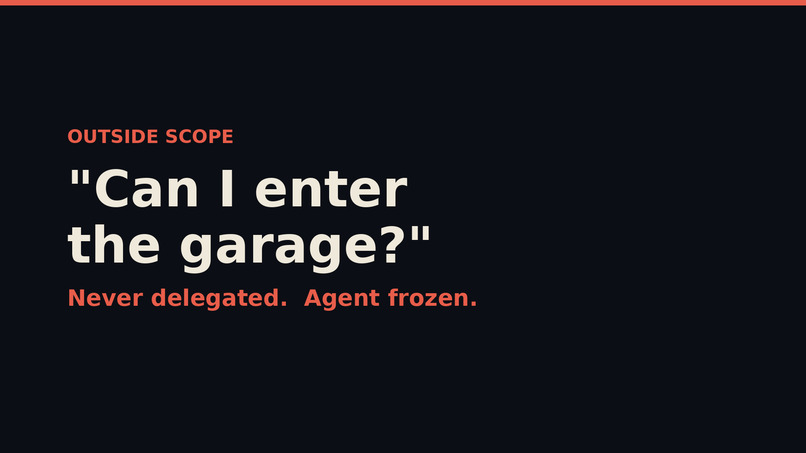
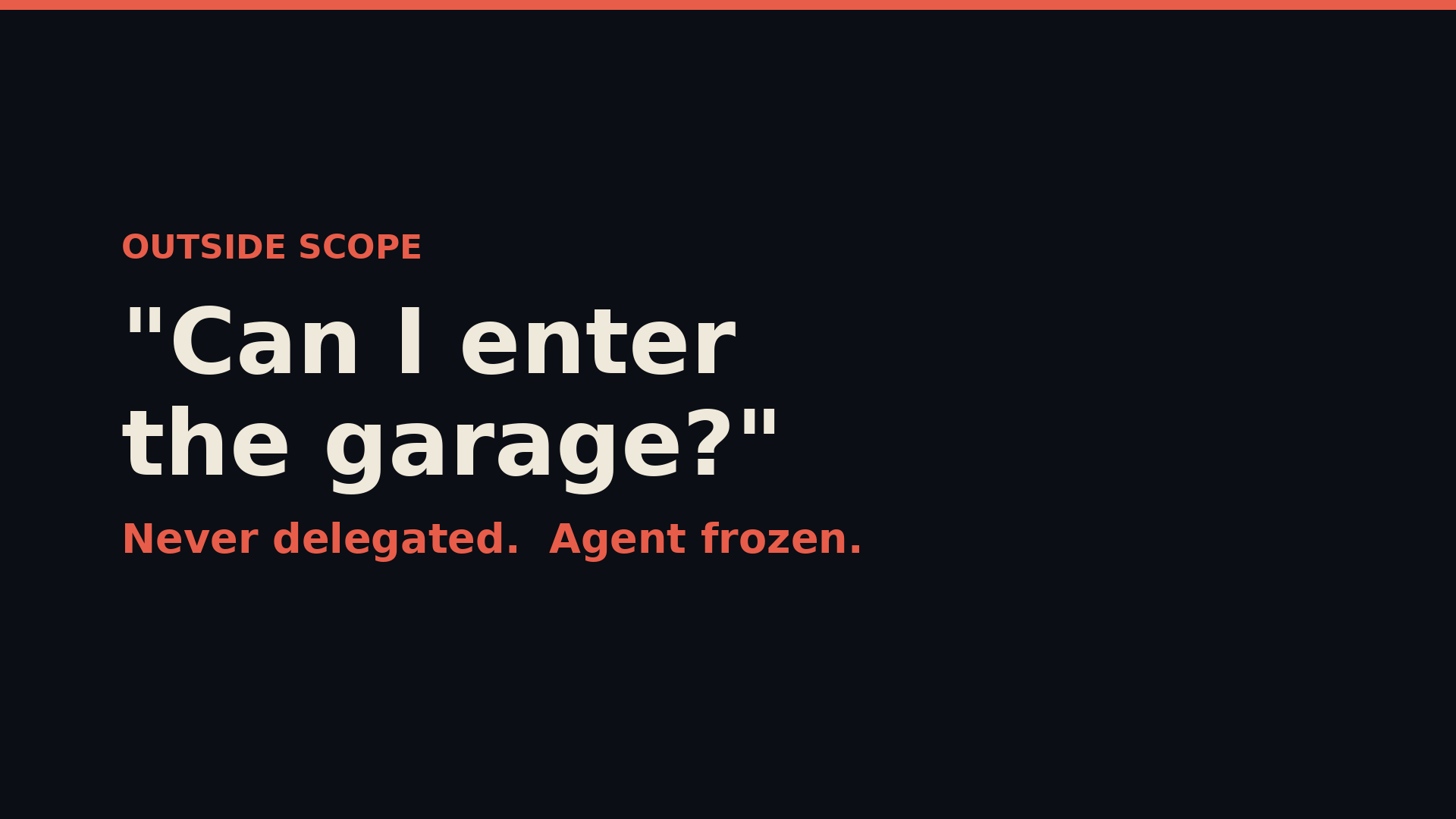
Outside scope: the courier asks to enter the garage. Ask First freezes the agent before it acts and escalates to the household.
-
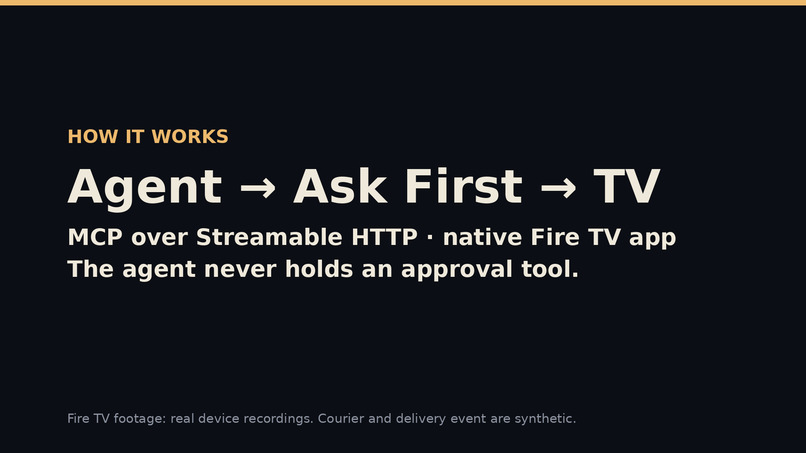
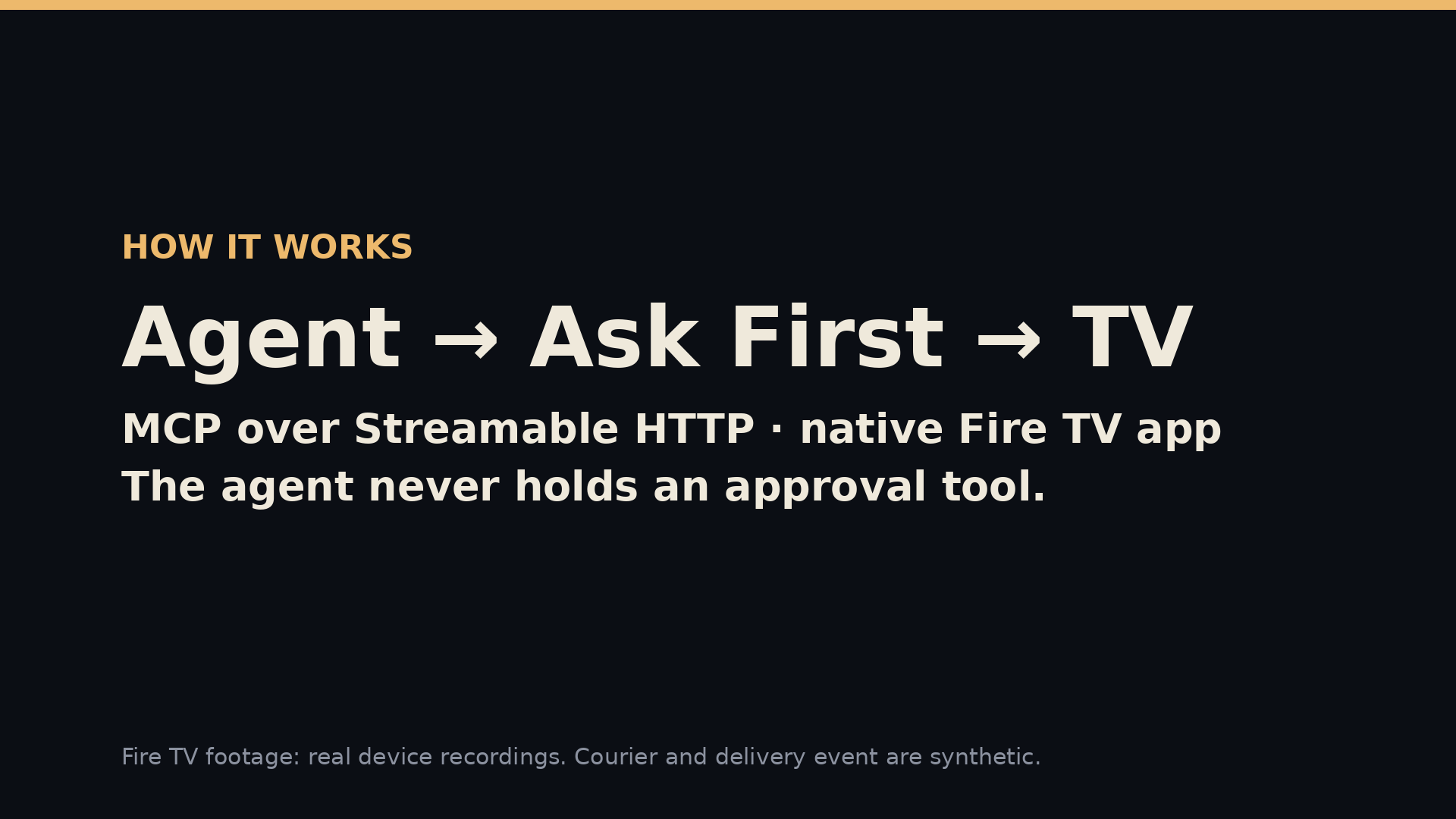
Agent to Ask First to TV: MCP over Streamable HTTP, native Fire TV app as decision console. The agent holds no approval tool.
-
Every useful agent eventually reaches a line it needs permission to cross. Ask First makes that line explicit.
Ask First — The Authority Layer for Autonomous AI
Inspiration
AI agents are learning to do more than answer questions. They can plan, communicate, use tools, and act on our behalf.
But there is one fundamental question:
Who decides how far an AI agent can go?
We built Ask First to make meaningful autonomy possible without handing an agent unlimited authority.
What it does
Imagine a delivery arriving while you're busy.
Your AI concierge can handle routine delivery instructions within the limits you've approved. But then the courier asks:
“Can you open the garage so I can put the package inside?”
That was never part of the delegation.
Instead of improvising or silently expanding its permissions, Ask First recognizes the boundary and pauses the workflow. A Fire TV becomes the household's authority console, allowing the human to review the request and decide what happens next.
A denial doesn't have to end the task. The concierge can continue within its original authority.
Delegate → Act → Detect boundary → Pause → Human decides → Resume.
Delivery management is our demonstration, but the same model can apply to shopping budgets, travel bookings, smart homes, communications, and enterprise agents.
How we built it
Ask First combines several developer technologies:
- Model Context Protocol (MCP): A self-hosted Streamable HTTP interface exposes bounded agent operations without giving the agent a tool to approve its own requests.
- Amazon Fire TV and Amazon Device Messaging: A Tauri/Rust authority interface connects native notifications to reviewable proposals and versioned human decisions.
- Ring integration architecture: A separate event and media adapter supports the intended doorstep scenario, with simulator and provider evidence distinguished explicitly.
- Python and containerized services: An isolated customer gateway manages authentication, household/device pairing, proposal ownership, sessions and authority boundaries.
- Login with Amazon: The customer pilot supports browser-assisted account sign-in and explicit Fire TV pairing.
- Scout personal concierge: An additional owner/visitor experience explores natural agent conversations, reviewed preferences and human takeover.
The demonstration uses mock-backed delivery and authority semantics. It does not unlock real doors or execute physical access changes.
Challenges we ran into
The difficult part wasn't creating another chatbot. It was maintaining one coherent, auditable decision across an agent, an event source, a notification system and a television.
We had to address notification identity, exact proposal matching, Fire TV navigation, stale decision versions, interrupted network calls, safe retries and the distinction between a simulated event and a real provider event.
We also learned that an autonomous agent must never be able to grant itself additional authority simply because it can call another tool.
Accomplishments
We built and physically tested a Fire TV authority workflow using real Amazon Device Messaging notifications and a mock delivery backend. The accepted hardware tests demonstrated native notification review and distinct human Approve/Decline outcomes with observable state-version changes.
We developed the customer-account and household-pairing system, an Alexa-oriented MCP/simulator experience, and additional Scout owner/visitor interfaces. More ambitious live-agent and cross-provider journeys are being validated separately.
We also developed a reusable open-source Tauri/A3L messaging integration supporting native Fire TV notification handling.
What we learned
The best human-in-the-loop experience is one that doesn't interrupt the human unnecessarily.
Autonomy should be the default inside a clearly delegated mission. Human intervention should happen at the exceptional moment when new authority is genuinely required.
That is what transforms an approval screen into an authority system.
What's next
Our next milestones are to complete integrated provider/device acceptance, advance the personal-concierge experience, and extend bounded delegation beyond deliveries.
Our long-term vision is a reusable authority layer that works with different agents, devices and real-world workflows.
Ask First — Let AI act. Keep the final say.

Log in or sign up for Devpost to join the conversation.