-
-
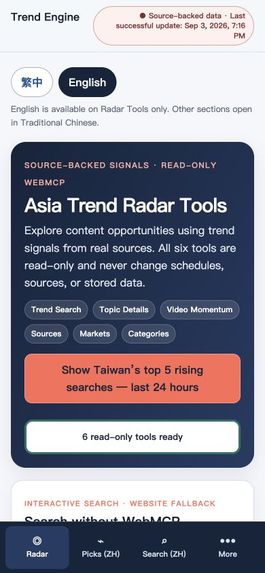
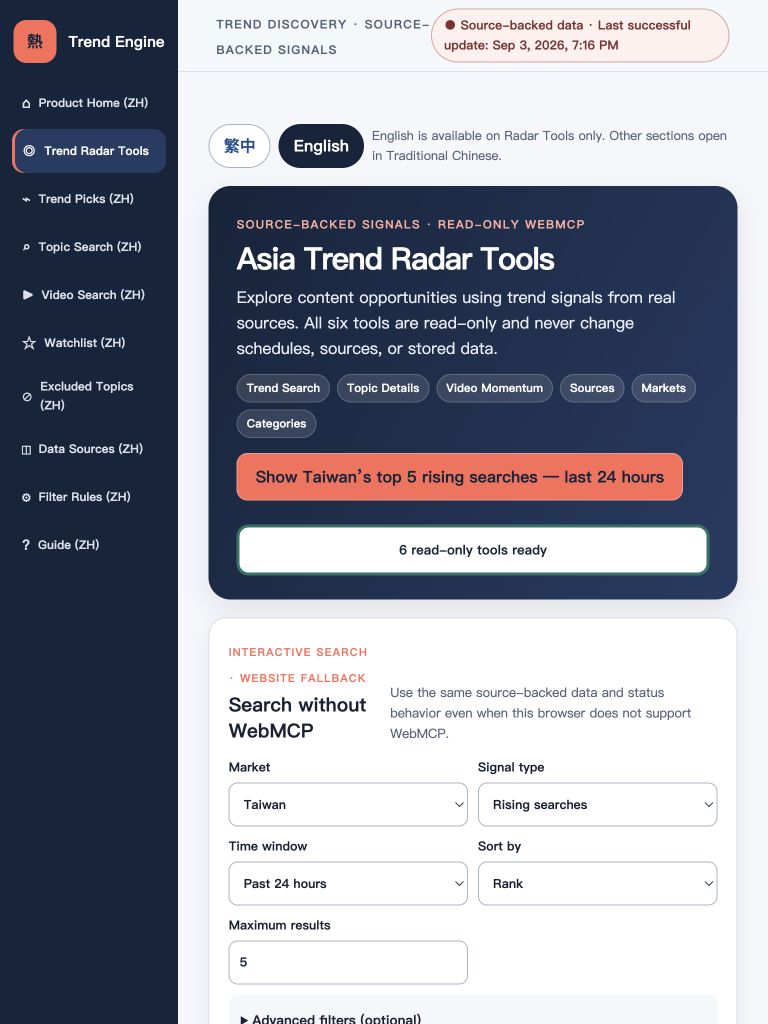
Six read-only WebMCP tools — English judge-facing interface with a safe website fallback.
-
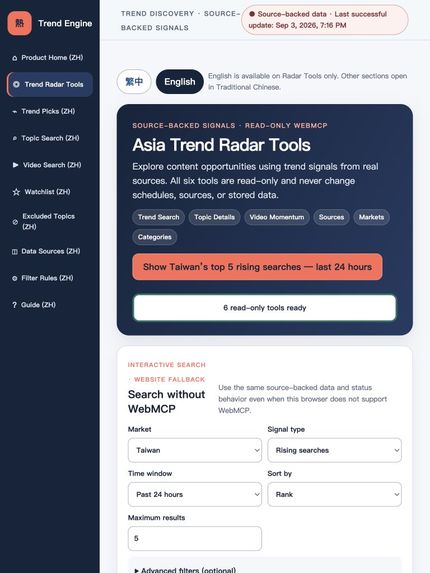
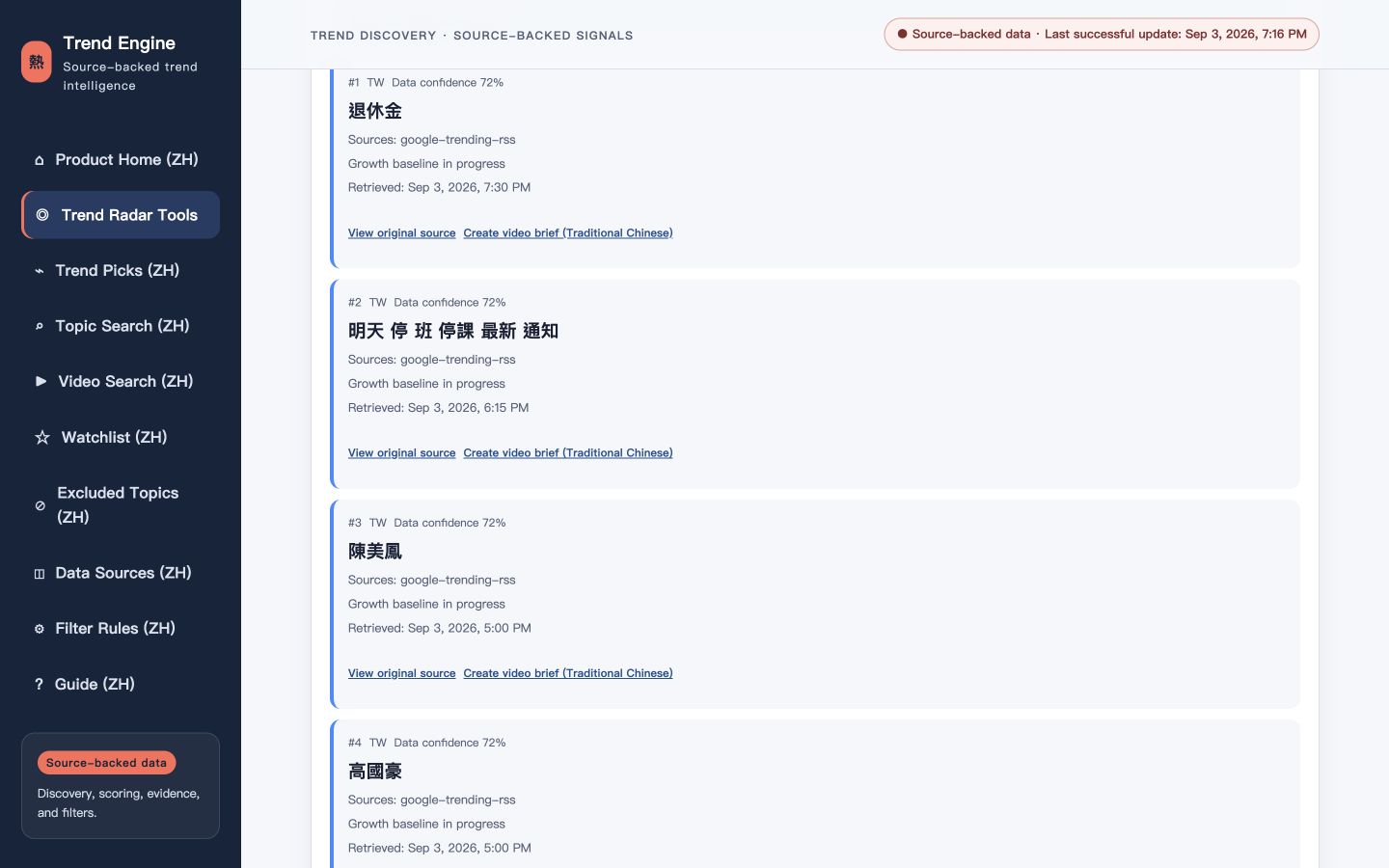
Real source-backed Taiwan trends — five live results for Taiwan rising searches in the previous 24 hours.
-
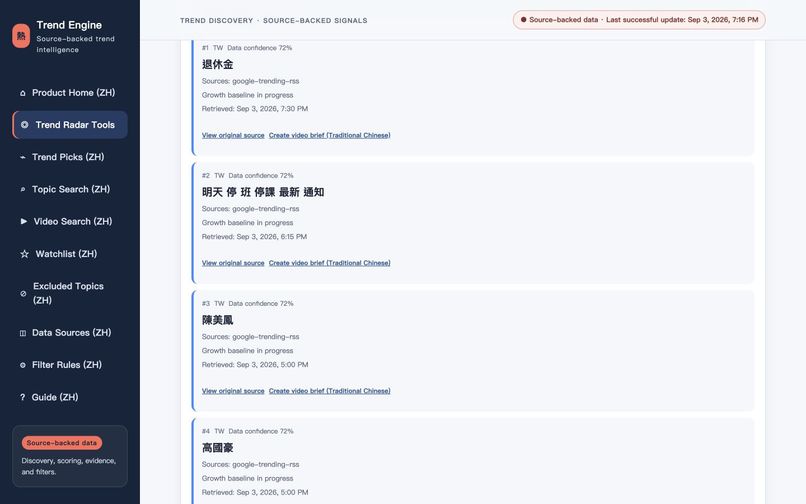
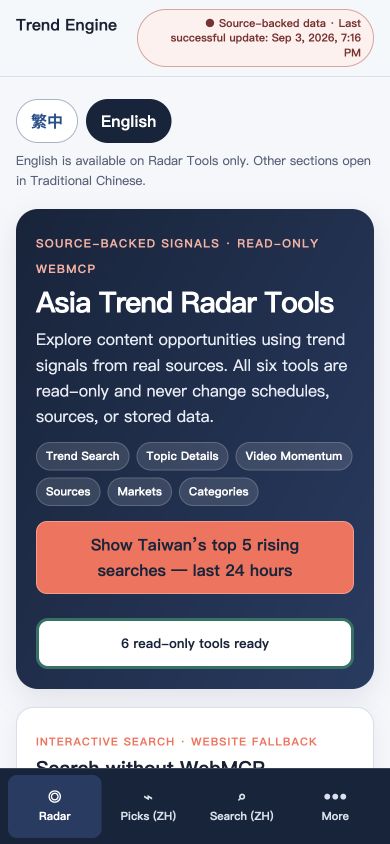
Responsive mobile workflow — the same read-only discovery experience at a 390 × 844 viewport.
Inspiration
Trend research is often fragmented across dashboards, search pages, and inconsistent source formats. An agent may find a popular topic but still lack the evidence needed to explain where it came from, how fresh it is, or whether the source is healthy. Copying results between a website and an assistant also loses structured context and uncertainty.
We wanted the website itself to expose a controlled interface to an agent without creating a separate plugin or giving the agent administrative access.
What it does
Asia Trend Radar exposes six browser-native, read-only tools:
search_radar_trendssearches trend signals by market, category, signal type, time window, confidence, source, and sort order.get_radar_trendretrieves one topic together with its supporting evidence.search_radar_videossearches available video signals and returns an honest empty result when no qualifying data exists.list_radar_sourcesreports source availability and operational status.list_radar_marketslists supported markets and their enabled state.list_radar_categorieslists normalized categories.
A judge can request Taiwan's top five rising searches from the previous 24 hours, inspect a Chinese-language topic ID, review source status, and query markets, categories, and video signals. The six-tool WebMCP surface exposes no management, scheduling, membership, payment, publishing, or write operations. Oversized requests such as limit=500 are rejected.
Why WebMCP
A normal webpage is designed for people to read. WebMCP adds a machine-readable interaction layer that lets a compatible browser agent discover the site's capabilities, understand each input schema, and invoke the correct operation directly.
This project uses WebMCP as the core interaction layer. The agent no longer needs to scrape rendered text or guess button locations, and it does not receive unrestricted API access. People can still use the same responsive website when native WebMCP is unavailable.
Human-agent collaboration
The agent handles structured retrieval: it selects a read-only tool, applies the requested filters, and returns topic evidence and source status. The human remains responsible for interpretation and every downstream content or publishing decision. The agent cannot modify the radar, change sources, schedule jobs, or invoke management operations.
How it was built
The interface uses React, TypeScript, Vite, and React Router and is hosted on Cloudflare Pages with Pages Functions.
Each tool is registered through document.modelContext.registerTool() with a strict JSON Schema and read-only annotations. Tools that may return external material are marked as containing untrusted content.
Native WebMCP calls and visible website searches share one server-side Radar adapter. The adapter handles field normalization, sorting, cache behavior, stale-data labels, bounded retries, sanitized errors, and a fixed allowlist of read-only upstream routes. Credentials remain server-side and are never returned to the webpage or tool output.
Safety and truthful data handling
- Every public tool is read-only.
- Strict schemas reject unknown and unsafe inputs.
limit=500is rejected because the maximum is 50.- Unsafe topic-ID formats and traversal attempts are rejected.
- External titles are treated as untrusted content.
- Missing video data produces an empty result, not fabricated records.
- Relative popularity is not described as an exact search or view count.
- User-supplied URLs must be public HTTPS links and are rejected before storage when they contain credentials, fragments, signed parameters, or private-access tokens.
- Upstream records pass through field allowlists and secret redaction before cache, UI, or WebMCP output.
- No management operation is registered as a WebMCP tool, and the Radar adapter allowlist excludes management routes.
Work completed during the challenge
The underlying trend product, regional discovery interface, source pipeline, scoring concepts, evidence model, filters, and original responsive interface existed before the challenge. We do not claim those foundations as new WebMCP development.
After August 25, 2026, the challenge work added the isolated competition edition, six read-only WebMCP Radar tools, strict schemas and safety annotations, a dedicated server-side read-only adapter, native discovery and invocation support, honest empty and stale states, safe browser fallback behavior, localized topic-ID handling, an English judging interface, and challenge-specific validation evidence. Dated commits and the repository's PREEXISTING_WORK.md and NEW_WORK_LOG.md document the boundary.
Challenges
Native WebMCP support is browser-dependent, so we had to distinguish genuine tool discovery and invocation from ordinary website automation. Native calls were verified in a compatible in-app browser. Safari was tested only as a normal website fallback; Safari native WebMCP is explicitly NOT RUN.
Localized identifiers were another edge case. Chinese topic IDs had to survive URL encoding and route decoding without weakening validation.
The central product challenge was handling uncertainty honestly. A successful query can legitimately return zero videos. The tool preserves that result rather than filling the interface with demonstration data.
Accomplishments
- Six native, discoverable, read-only WebMCP tools.
- Real Taiwan trend results from the production competition URL.
- Safe lookup of localized Chinese topic IDs.
- Honest video empty states with no fabricated records.
- Rejection of oversized inputs and absence of management tools.
- One shared data contract for human and agent interfaces.
- Responsive desktop, tablet, and mobile validation.
- 20 test files and 305 tests passing at the final implementation checkpoint, together with TypeScript, ESLint, production build, dependency audit, secret scanning, and whitespace checks.
What we learned
A trustworthy agent interface needs strict schemas, bounded inputs, explicit read-only semantics, untrusted-content warnings, safe errors, and evidence that the browser actually discovered and invoked the tools. An honest empty answer can be more valuable than an impressive-looking fake result.
Potential impact
Content teams, researchers, and analysts can ask an agent for narrowly defined trend candidates while retaining source status, timestamps, confidence, and uncertainty. More broadly, WebMCP can turn existing websites into controlled agent-ready interfaces without replacing their human experience or exposing administrative APIs.
What's next
Future work could add more authorized sources, richer provenance views, and user-controlled workflows. Any write capability would remain separate and require explicit human confirmation. The competition surface intentionally remains read-only.
Built With
- cloudflare
- react
- typescript
- vite
- vitest
- webmcp

Log in or sign up for Devpost to join the conversation.