-
-
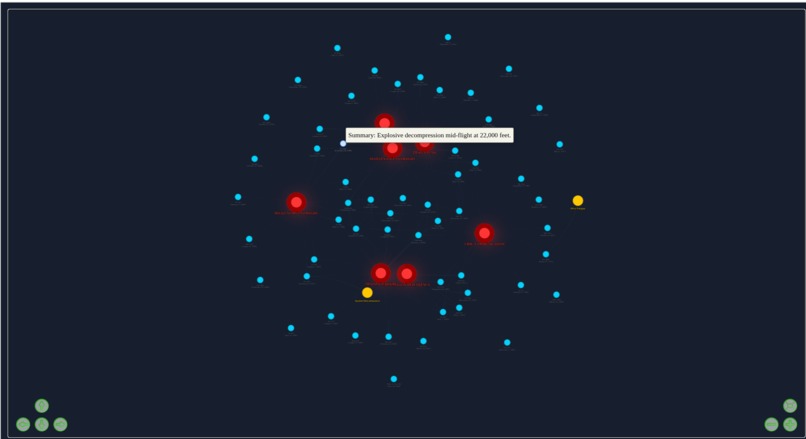
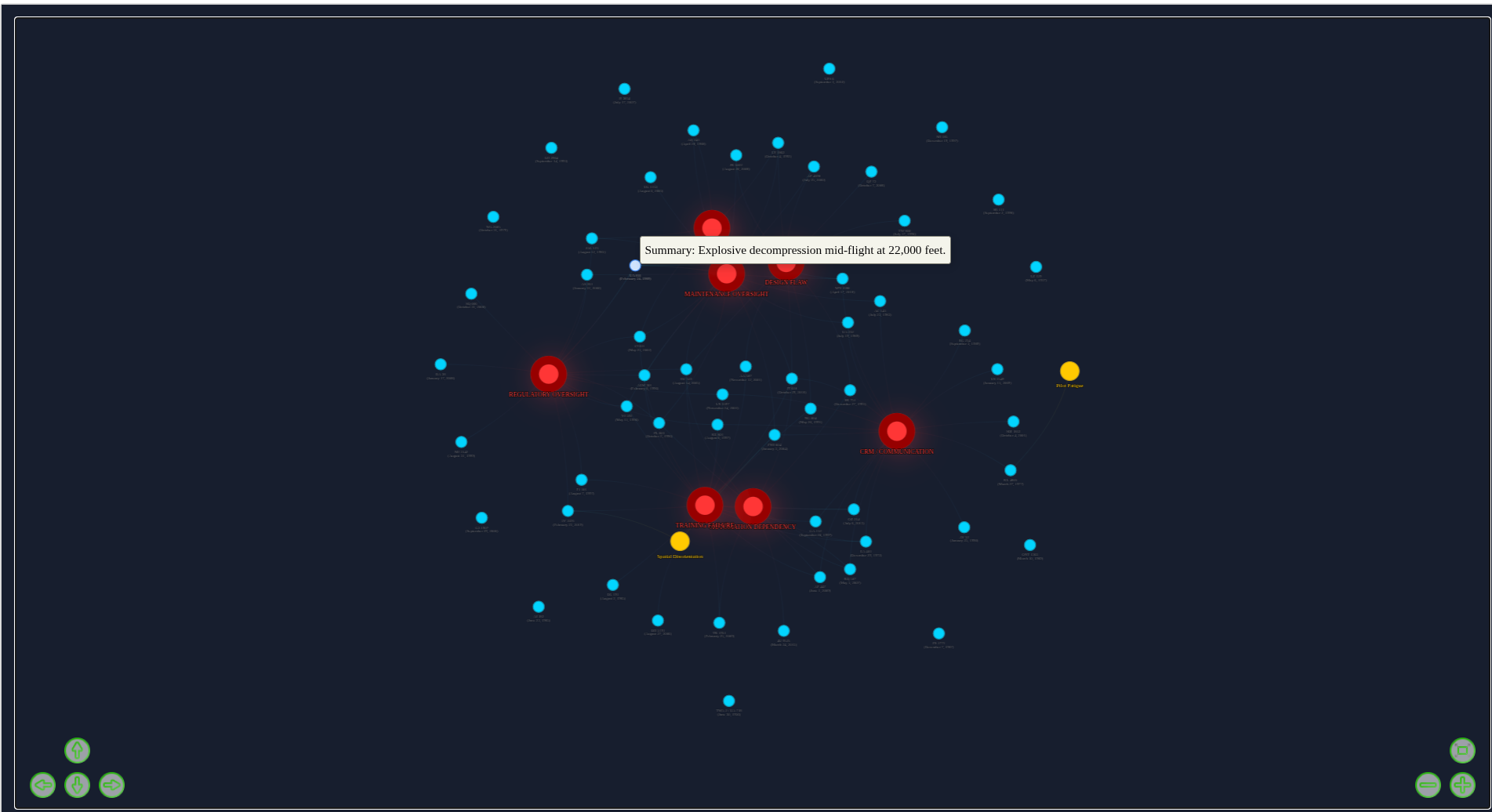
56 accidents mapped across history. A red bubble means more than three crashes share that same systemic cause
-
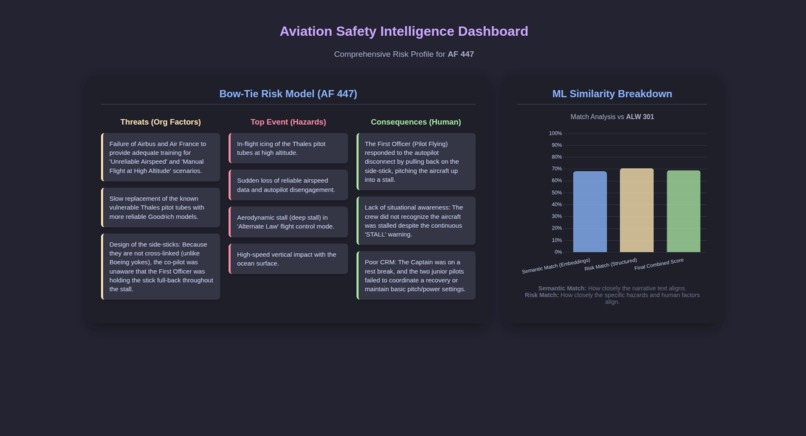
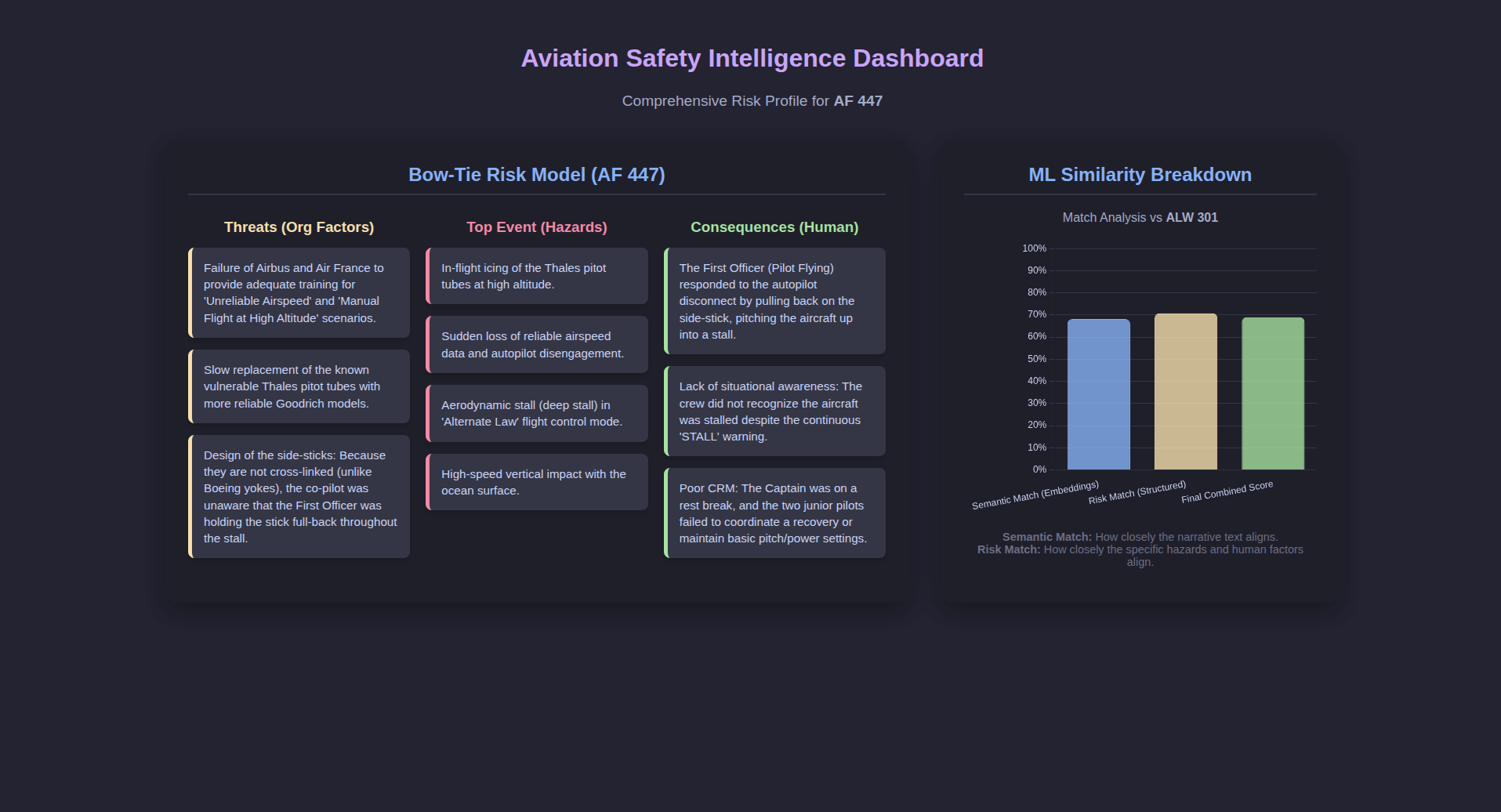
AF 447's full failure chain, and the ML score that links it to Birgenair 301
Inspiration
Whenever I didn't want to go to class, I'd lie in bed watching Mentour Pilot videos on my phone — breakdowns of AF 447, JAL 123, the Helios Airways ghost flight. What kept striking me was that the same patterns kept appearing across completely different accidents, different airlines, different decades. Pitot tube failures, automation dependency, CRM breakdowns — the industry kept relearning the same lessons. I wanted to build something that could connect those dots systematically, before the next accident, not after.
What it does
ASI is a semantic safety intelligence platform that transforms 56+ high-fidelity aviation accident records (1956–2023) into proactive, decision-ready intelligence. It identifies Systemic Safety Hotspots — the organizational and human failure patterns that repeat across history — and visualizes them as an interactive Knowledge Graph where node size reflects accident frequency per theme. Given an operational scenario (e.g., "Airbus Alternate Law reversion"), the Scenario Advisor identifies the most historically analogous accidents (Semantic Twins), then generates a Company Decision Framework with time-horizoned actions and real cost estimates — not generic advice, but something a safety officer could actually act on.
How we built it
The data layer is 56 manually curated JSON records, each structured with hazards, human causes, organizational causes, and recommendations. We embedded the accident narratives into a FAISS vector index using sentence-transformers (all-MiniLM-L6-v2), enabling semantic similarity search across the full dataset. A custom scoring engine combines embedding distance with risk feature overlap to produce ranked, explainable Semantic Twin matches. NetworkX and PyVis render the results as a force-directed knowledge graph. The Scenario Advisor applies strict manufacturer-level filtering and maps findings to a three-tier decision framework backed by real aviation industry cost data. The entire system is verified by a 26-check validation suite across 6 phases.
Challenges we ran into
Making the advice defensible, not just present. Early versions would generate plausible-sounding recommendations that were operationally incoherent — recommending an immediate fleet-wide ground stop with no cost or regulatory qualifier. We built Phase 6 of the validation suite to catch exactly this: it parses dollar figures to assert they fall within a realistic $1K–$50M range, checks that immediate actions reference hours or days (not years), and blocks any "ground fleet" recommendation that isn't accompanied by a revenue impact or authority coordination clause. Another challenge was semantic pollution — without strict manufacturer constraints, a query for "Airbus fatigue" would surface Boeing 737 lap joint failures.
Accomplishments that we're proud of
The Semantic Twin match between AF 447 and Birgenair 301 working correctly — two accidents 13 years apart, different carriers, different aircraft, same failure signature. We're also proud of Phase 6: it's one thing to generate advice, another to prove programmatically that it's cost-realistic, timeline-coherent, and risk-pillar-aligned. The 26/26 validation pass isn't just a green light — it's a guarantee the output meets a defensible standard.
What we learned
The density and structure of input data determines the quality of everything downstream. Scraped text produced noisy, uninterpretable similarity results. Manually annotated, structured records transformed the output quality entirely. 56 high-fidelity records outperformed a larger set of poorly structured ones. We also learned that testing the quality of generated advice — not just its presence — requires domain-aware validation logic, not generic unit tests.
What's next for ASI: Aviation System Intelligence
Expanding the dataset through automated ingestion from the Aviation Safety Network and NTSB databases, with a schema validation gate before any new record enters the index. Beyond that — a Fleet Profile layer where an operator registers their aircraft types, routes, and crew demographics, and the system continuously flags emerging hotspots relevant to their specific operation. Longer term, connecting the decision framework to live EASA AD/SB registries so recommended actions are automatically cross-referenced against open airworthiness directives for the operator's fleet.
Built With
- beautiful-soup
- faiss
- flask
- networkx
- numpy
- plotly
- pyside6
- pyvis
- sentence-transformers

Log in or sign up for Devpost to join the conversation.