-
-
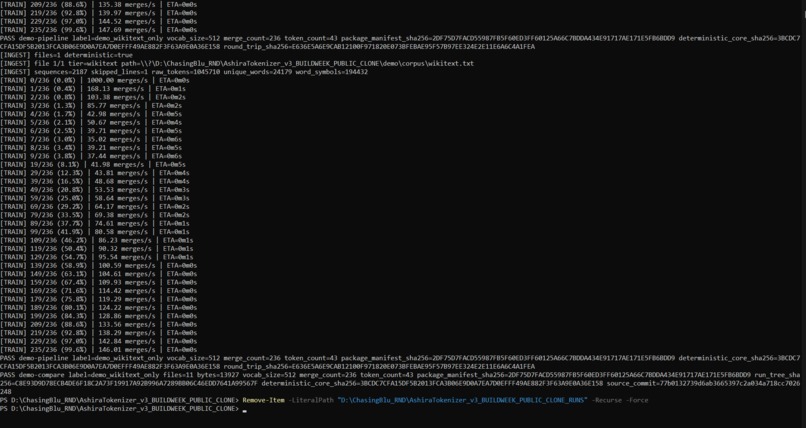
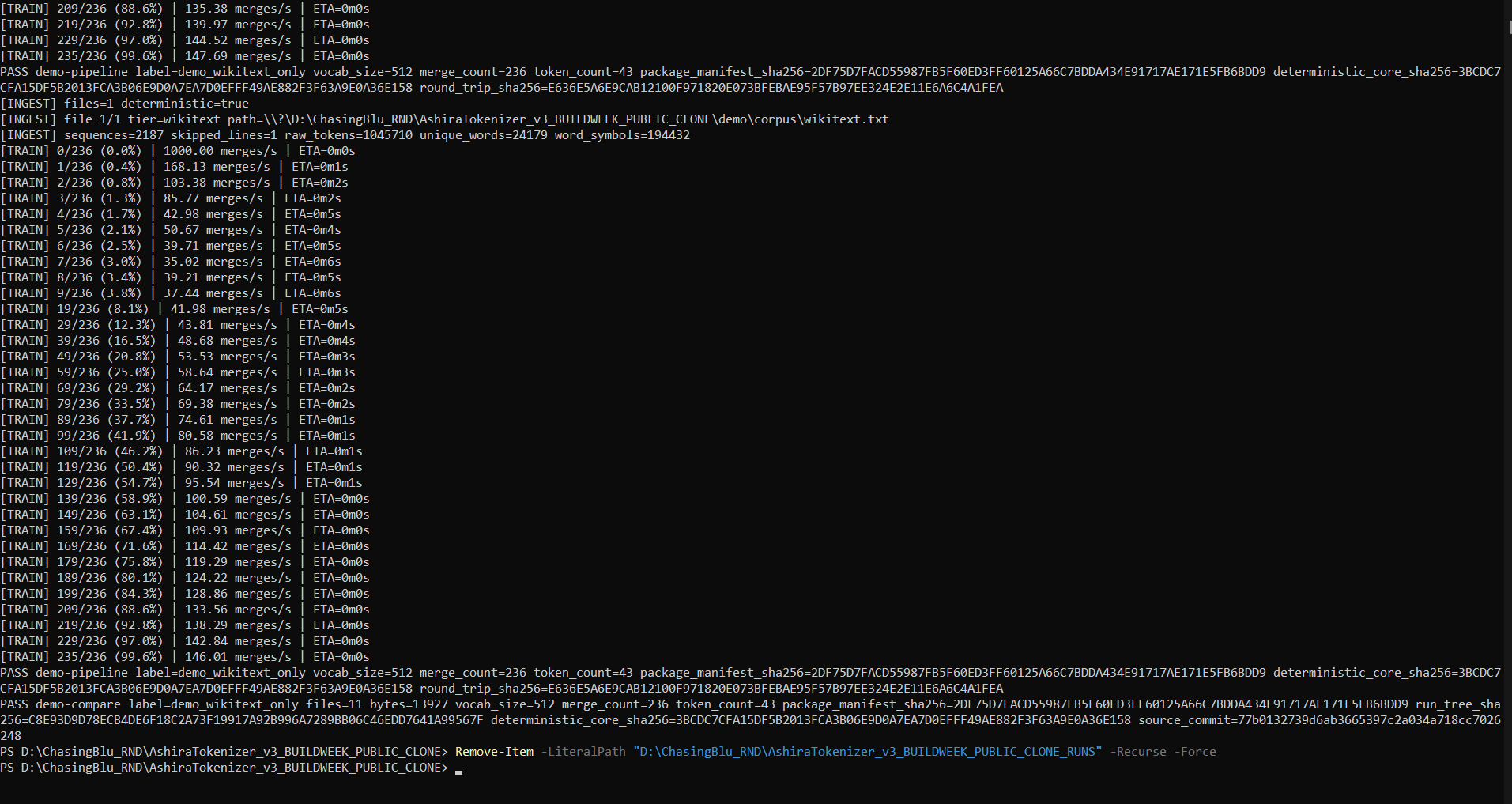
Terminal showing PASS
Tokenizers are a critical part of AI systems, but they are often treated as invisible preprocessing. In research and production pipelines, that can create a reproducibility problem: a model may depend on tokenizer artifacts whose training data, merge order, binary format, validation rules, or corpus selection policy are difficult to inspect or reproduce.
AshiraTokenizer v3 was built around a simple idea: tokenizer training should produce auditable software artifacts, not just files that happen to work on one machine.
The project began as part of ChasingBlu R&D's internal reproducibility stack and was developed into a Build Week submission using Codex with GPT-5.6 Sol.
What it does
AshiraTokenizer v3 is a deterministic Rust tokenizer toolkit for reproducible AI pipelines.
It focuses on:
u32token IDs for vocabularies beyond the oldu16ceiling;- deterministic pair handling and boundary-tested token allocation;
- explicit legacy v2 compatibility loading;
- a proposed self-describing v3 artifact format;
- manifest-driven corpus admission instead of hidden file-pattern selection;
- validation reports with cryptographic hashes;
- clear setup, test, and demo workflows for judges and developers.
The goal is to make tokenizer artifacts easier to reproduce, inspect, validate, and compare across runs.
How we built it
The project builds on an existing AshiraTokenizer v2 codebase and a governed v3 design line. During Build Week, Codex with GPT-5.6 Sol was used to accelerate the implementation and review process.
Codex and GPT-5.6 Sol helped with:
- planning the v2-to-v3 migration;
- identifying why a simple
u16tou32substitution would not be enough; - designing typed token-ID and pair-key boundaries;
- drafting and reviewing artifact-format requirements;
- mapping legacy v2 compatibility behavior;
- creating implementation stages and acceptance gates;
- generating tests, documentation, and validation workflows;
- keeping the project scoped to a working developer-tool submission.
The implementation was managed under a local governance workflow: human operator review, GPT-55 documentation/governance checks, and Spike as the coding operative. This helped separate design decisions, implementation work, and release claims.
Challenges we ran into
The main challenge was scope.
A tokenizer that works on a small folder is not the same as a tokenizer that can support large, reproducible research corpora. The v3 design had to address several risks:
- token IDs larger than
65,535; - binary artifact compatibility between v2 and v3;
- deterministic merge ordering;
- safe handling of corpus manifests;
- avoiding silent file inclusion or exclusion;
- preventing unchecked integer conversion or overflow;
- separating implemented features from future scale claims.
Another challenge was honesty. The full AshiraTokenizer v3 roadmap includes BookCorpus-scale training, external-memory state, deterministic checkpoints, resume support, and larger validation gates. This submission focuses on the working contest scope and does not claim that the full-scale trainer is complete unless those gates are actually passed.
Accomplishments that we're proud of
We are proud of turning tokenizer training into a more inspectable engineering problem.
AshiraTokenizer v3 is designed around reproducibility from the beginning: typed IDs, explicit compatibility modes, deterministic validation, artifact boundaries, manifest-driven inputs, and hash-verifiable outputs.
We are also proud that the project uses AI assistance transparently. GPT-5.6 Sol and Codex were not used as a magic button; they were used as engineering accelerators for refactoring, test planning, documentation, design review, and implementation support.
What we learned
We learned that reproducible tokenizer training is not just about the merge algorithm. It also depends on boring but important details:
- how files are admitted into the corpus;
- how paths and hashes are validated;
- how binary artifacts describe themselves;
- how compatibility is handled;
- how deterministic outputs are separated from run-specific metadata;
- how much a project should claim before scale evidence exists.
The most useful lesson was that good AI-assisted engineering still needs governance: clear boundaries, tests, manifests, and honest claim language.
What's next for AshiraTokenizer v3
The next step is to continue the staged v3 roadmap:
- complete the typed
u32core; - finalize the v3 artifact format;
- strengthen v2 compatibility tests;
- expand corpus-manifest validation;
- add deterministic validation and benchmark reports;
- run staged scale probes before any full large-corpus training claim;
- package the project as a clean developer tool for reproducible tokenizer experiments.
The long-term goal is a tokenizer trainer that researchers can run, inspect, reproduce, and audit without treating tokenization as hidden preprocessing magic.
Built With
- cli
- codex
- developer-tools
- gpt-5.6
- powershell
- rust

Log in or sign up for Devpost to join the conversation.