-
-
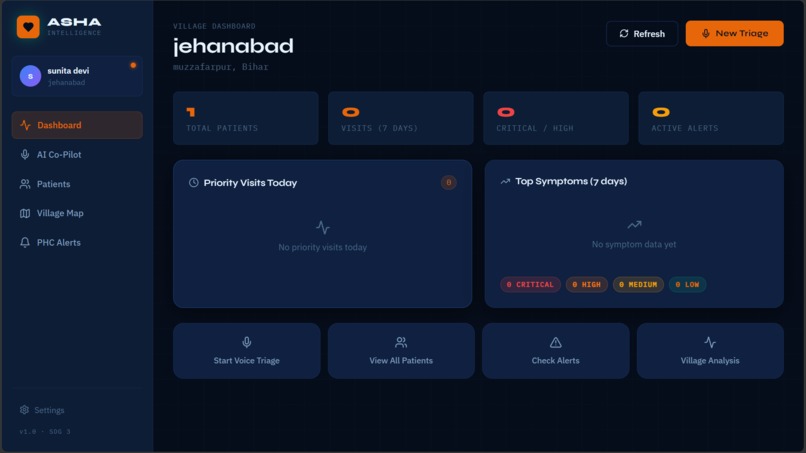
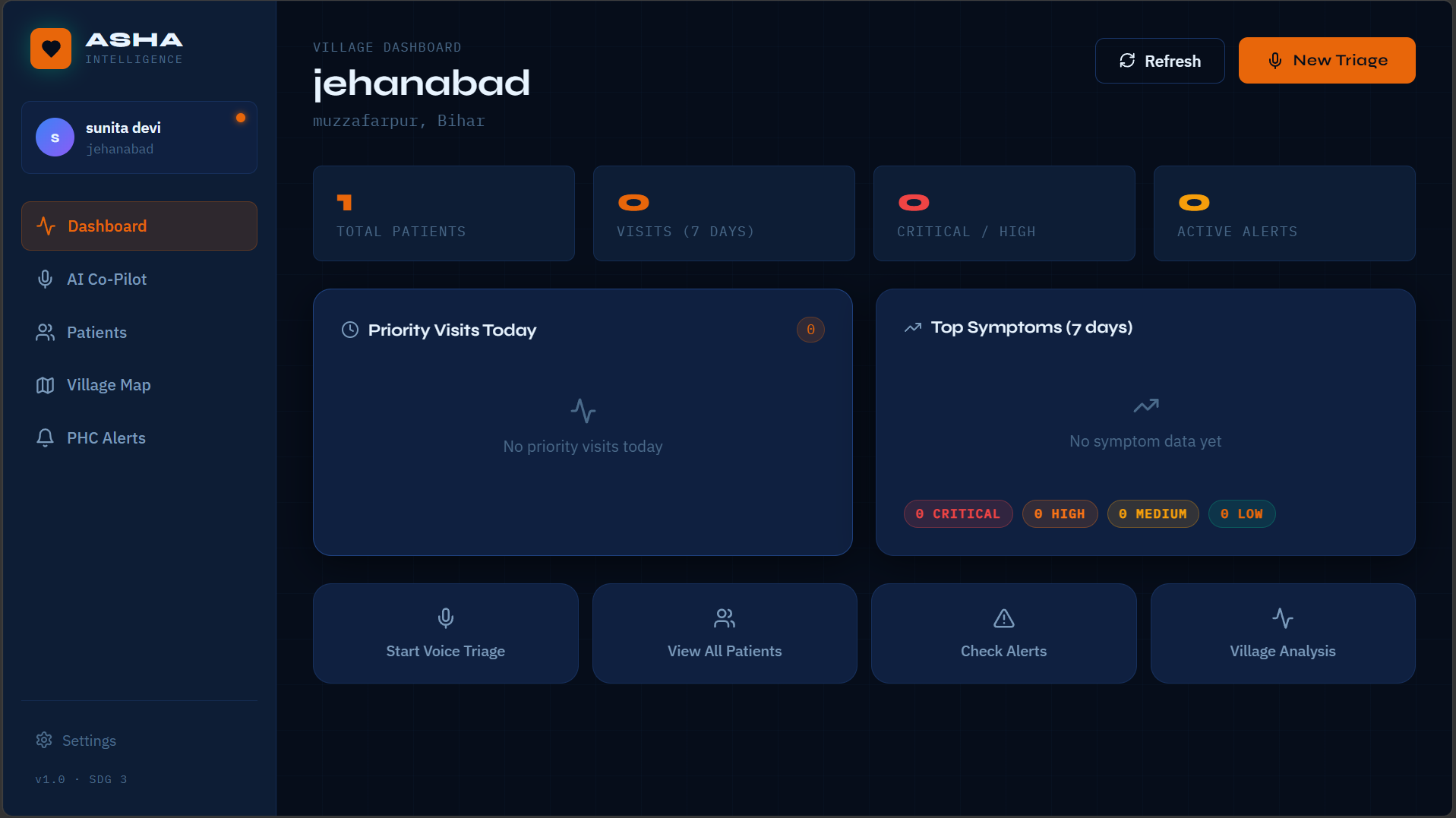
Dashboard
Inspiration
She walks 8 kilometers every day.
Door to door, in extreme heat, carrying basic medicines and a paper register. When a child has a fever, she relies on experience. When a pregnant woman shows warning signs, she hopes she’s making the right decision. When multiple families fall sick in the same week, there’s no system to connect the dots.
She is an ASHA worker — one of over 1 million frontline health workers in India.
This problem is not limited to India. Millions of community health workers across Africa and Southeast Asia face the same reality: no real-time clinical support, no data intelligence, and no connection to the larger health system.
ASHA Intelligence was built to change that.
What it does
ASHA Intelligence is an AI-powered platform that transforms community health workers into AI-assisted decision-makers.
It provides:
- Real-time clinical guidance using AI
- A living health memory of the entire village
- Predictive risk scoring for prioritizing visits
- Early outbreak detection with automatic alerts to health centers
Instead of reacting to illness, workers can act proactively — focusing on the highest-risk cases first.
How we built it
We designed the system to work in low-resource environments, where internet is slow and devices are basic.
- Frontend: React + Vite (PWA — no installation required)
- Backend: Node.js + Express
- Database: Firebase Firestore
- AI Engine: Groq (Llama 3.3 70B)
- Voice Input: Web Speech API (multilingual support)
The backend acts as a secure AI layer that combines patient data, village trends, and real-time input to generate structured outputs for the worker.
The entire system is optimized for speed, simplicity, and real-world usability.
Challenges we ran into
The biggest challenge was not building features — it was making them reliable in real-world conditions.
- AI outputs needed to be structured, not conversational
- Response time had to stay under 2 seconds
- The UI had to work for users with minimal digital literacy
Another challenge was ensuring the system assists decision-making without replacing doctors, maintaining safety and trust.
Accomplishments that we're proud of
- Built a fully working end-to-end system (not just a prototype)
- Achieved real-time AI responses in under 2 seconds
- Designed for real-world deployment, not just demo environments
- Integrated voice input for multilingual accessibility
- Created a scalable architecture that works on free-tier infrastructure
What we learned
We learned that the biggest gap in rural healthcare is not infrastructure — it is access to intelligence.
The workers are already there. The trust is already there. What’s missing is decision support.
We also learned that impactful solutions are not the most complex ones — they are the most deployable.
What's next for ASHA Intelligence
India is the starting point — not the limit.
This system can be extended to:
- Community health workers across Africa
- NGO field workers in low-resource settings
- Public health systems globally
Future improvements include:
- Offline-first AI capabilities
- Integration with government health databases
- Advanced predictive modeling for disease outbreaks
The system is already live, open-source, and ready for deployment.
We just need someone to say yes.
Built With
- app
- css-modules
- express.js
- firebase-admin-sdk
- firebase-firestore
- groq-api-(llama-3.3-70b)
- javascript
- node.js
- progressive
- react
- recharts
- render
- vercel
- vite
- web
- web-speech-api


Log in or sign up for Devpost to join the conversation.