-
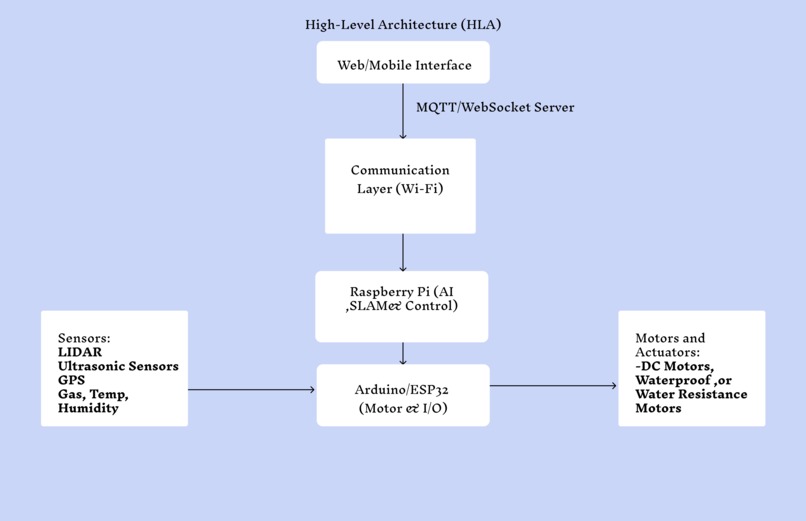
Architecture
-


Inspiration
What it does
ASER is an autonomous robot designed for surveillance and exploration in challenging or hazardous environments. It uses AI-powered navigation, real-time monitoring, and advanced sensors to patrol areas, inspect remote locations, and gather data with minimal human input. ASER ensures enhanced safety, efficiency, and precision across industries like security, disaster response, and industrial inspection.
How we built it
ASER was developed using a combination of hardware and software technologies.
Hardware: Microcontrollers (e.g., Raspberry Pi/Arduino), LIDAR sensors, cameras, GPS, and motorized wheels for mobility. Software: AI-based algorithms for object detection and path planning, written in Python and ROS (Robot Operating System). Communication: IoT modules enable remote data transmission and control. Power system: Rechargeable battery integrated for extended autonomous operation.
Challenges we ran into
Navigation issues: Fine-tuning obstacle avoidance in dynamic environments was complex. Real-time processing: Managing data streams from multiple sensors without delays was challenging. Battery life: Optimizing power consumption for long-duration operations. Environmental factors: Handling uneven terrains and adverse weather conditions required specialized components and calibration.
Accomplishments that we're proud of
Achieved reliable autonomous navigation with real-time obstacle avoidance. Integrated multiple sensor modules for seamless environmental monitoring. Developed a modular design that allows for easy upgrades and adaptation to new use cases. Successfully completed test runs in both indoor and outdoor environments.
What we learned
The importance of efficient sensor fusion to handle complex environments. How to optimize machine learning models for resource-constrained hardware. Managing power consumption is critical for any autonomous system. Team collaboration across hardware and software disciplines was key to solving multi-faceted challenges.
What's next for ASER
Scaling up: Deploying ASER for large-scale operations in industries such as security, logistics, and mining. AI upgrades: Incorporating deep learning models for better anomaly detection and autonomous decision-making. Swarm robotics: Enabling multiple ASER units to work together for enhanced surveillance and exploration. Environmental adaptability: Developing modules for extreme weather conditions and underwater exploration. Public launch: Collaborating with partners for real-world deployment and commercialization.
