Inspiration
When patients and caregivers leave a hospital or clinic, they are handed discharge paperwork packed with dense clinical terminology, complex medication instructions, and conditional warnings. Research and clinical guidelines from the Agency for Healthcare Research and Quality (AHRQ) highlight a concerning reality: simply handing someone a simplified summary does not ensure they actually understood it.
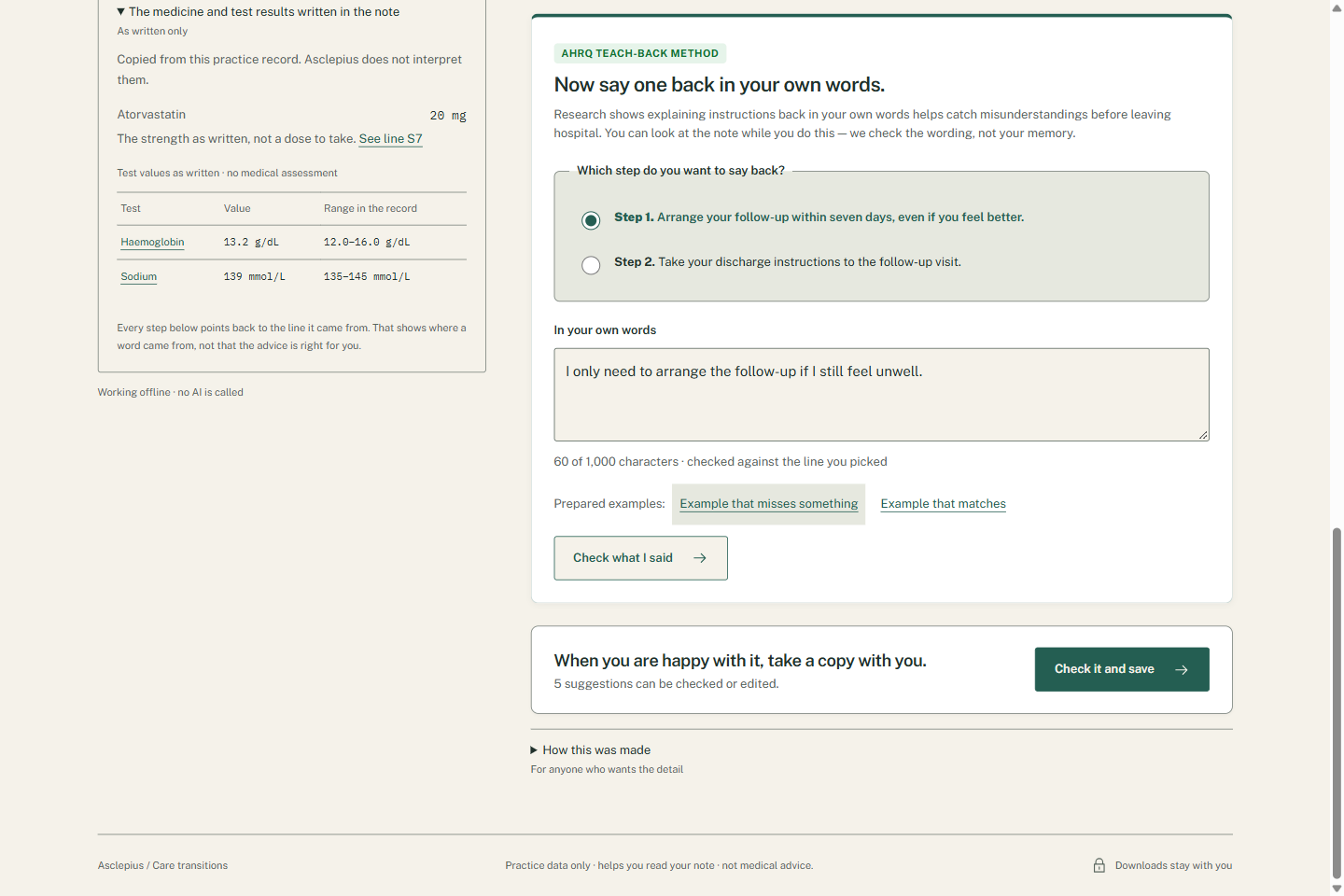
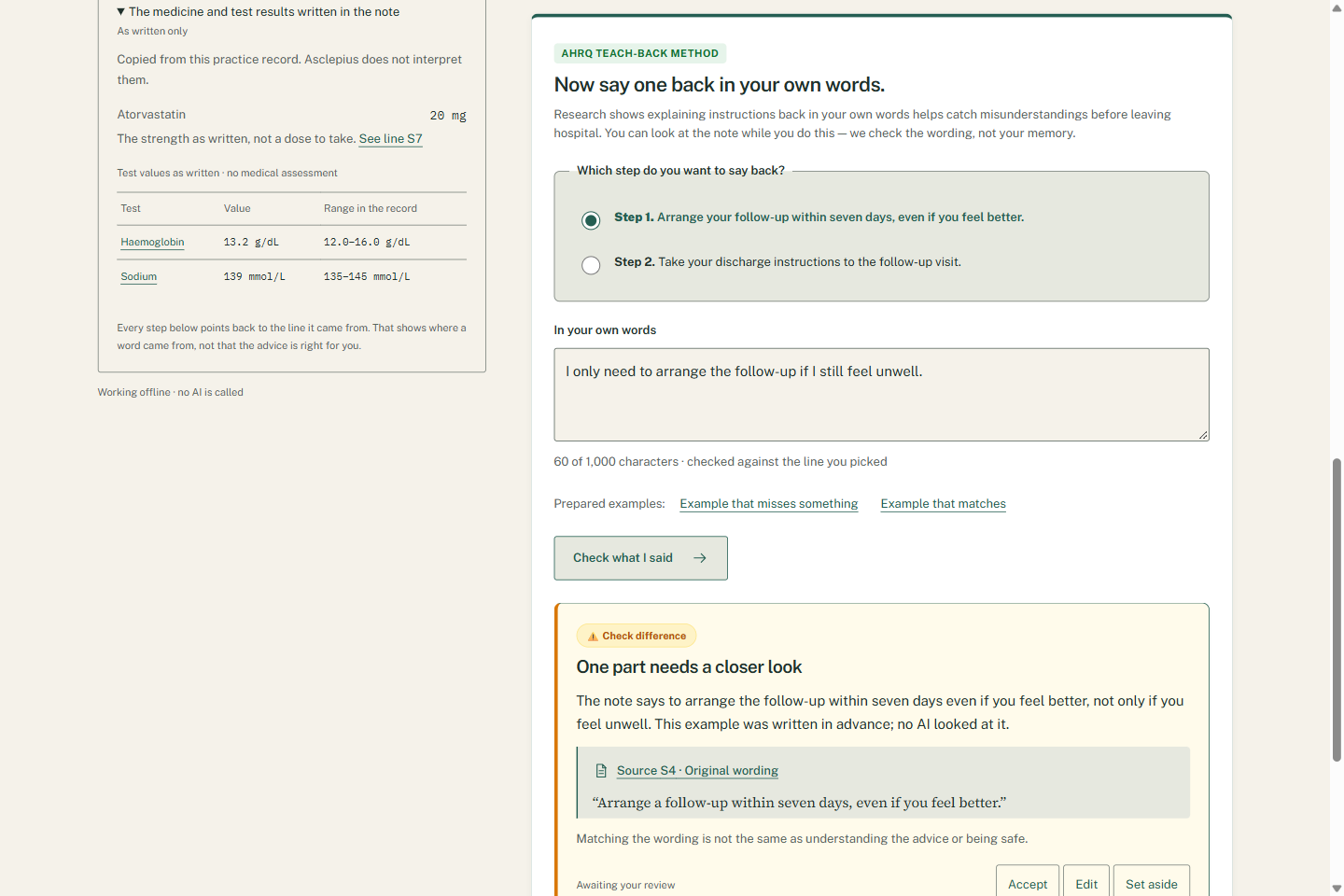
Standard AI summarizers often look convincing and fluent while quietly dropping critical nuances. For example, a note stating "Schedule a follow-up visit within 7 days, even if you feel better" can easily be summarized as "Schedule a follow-up if you feel unwell". In healthcare, a plausible but inverted condition directly increases the risk of preventable complications and hospital readmissions.
We were inspired by the Teach-Back method—an evidence-based clinical communication technique where patients are invited to explain care instructions in their own words, without feeling tested or judged. We asked ourselves:
What if AI didn't just summarize instructions, but served as a transparent safety desk that pairs every single action with its exact source text, verifies comprehension through patient teach-back, and preserves a verifiable audit trail?
That vision became Asclepius.
What it does
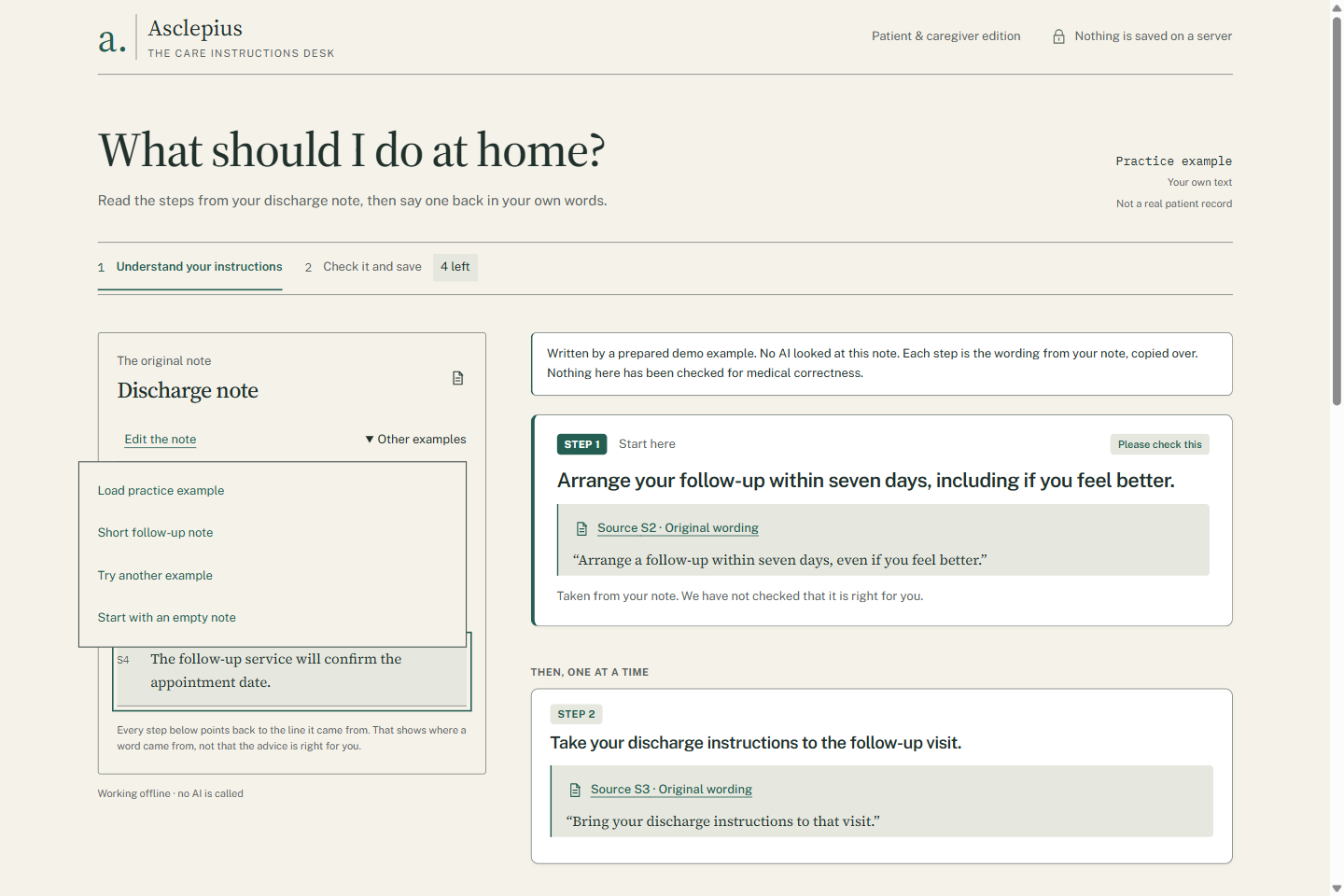
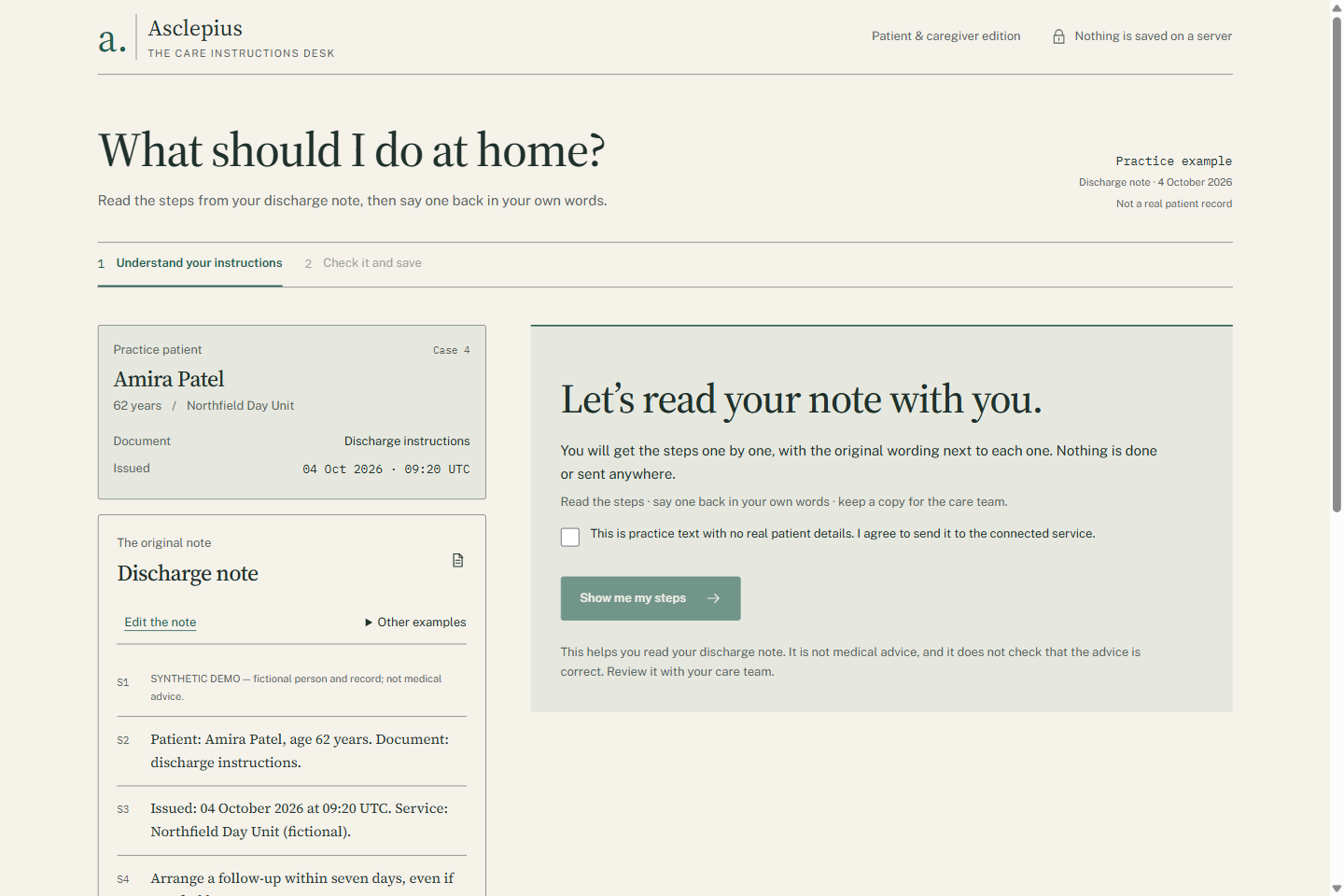
Asclepius transforms complex discharge instructions into clear, source-linked steps and verifies understanding through an intuitive workflow:
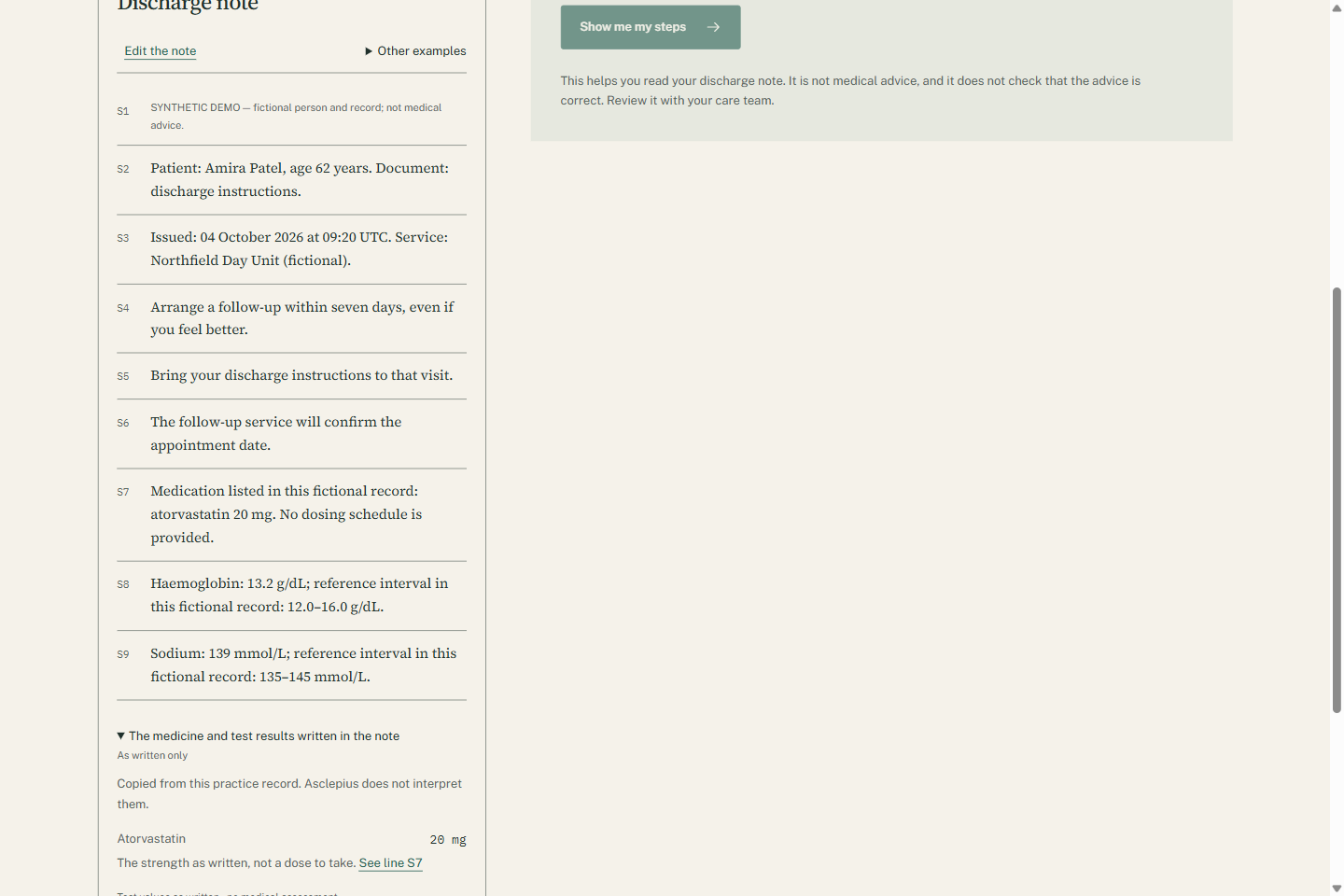
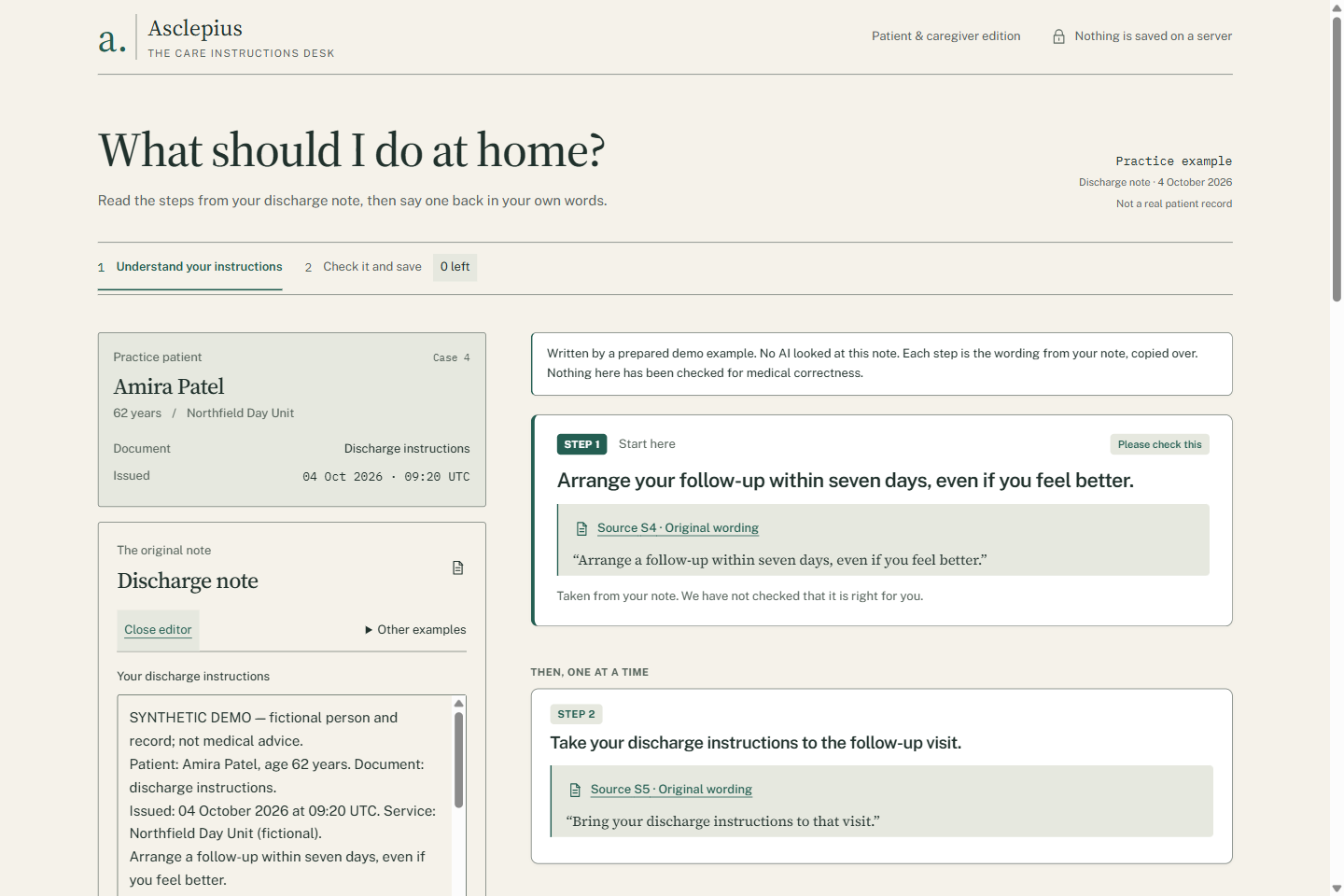
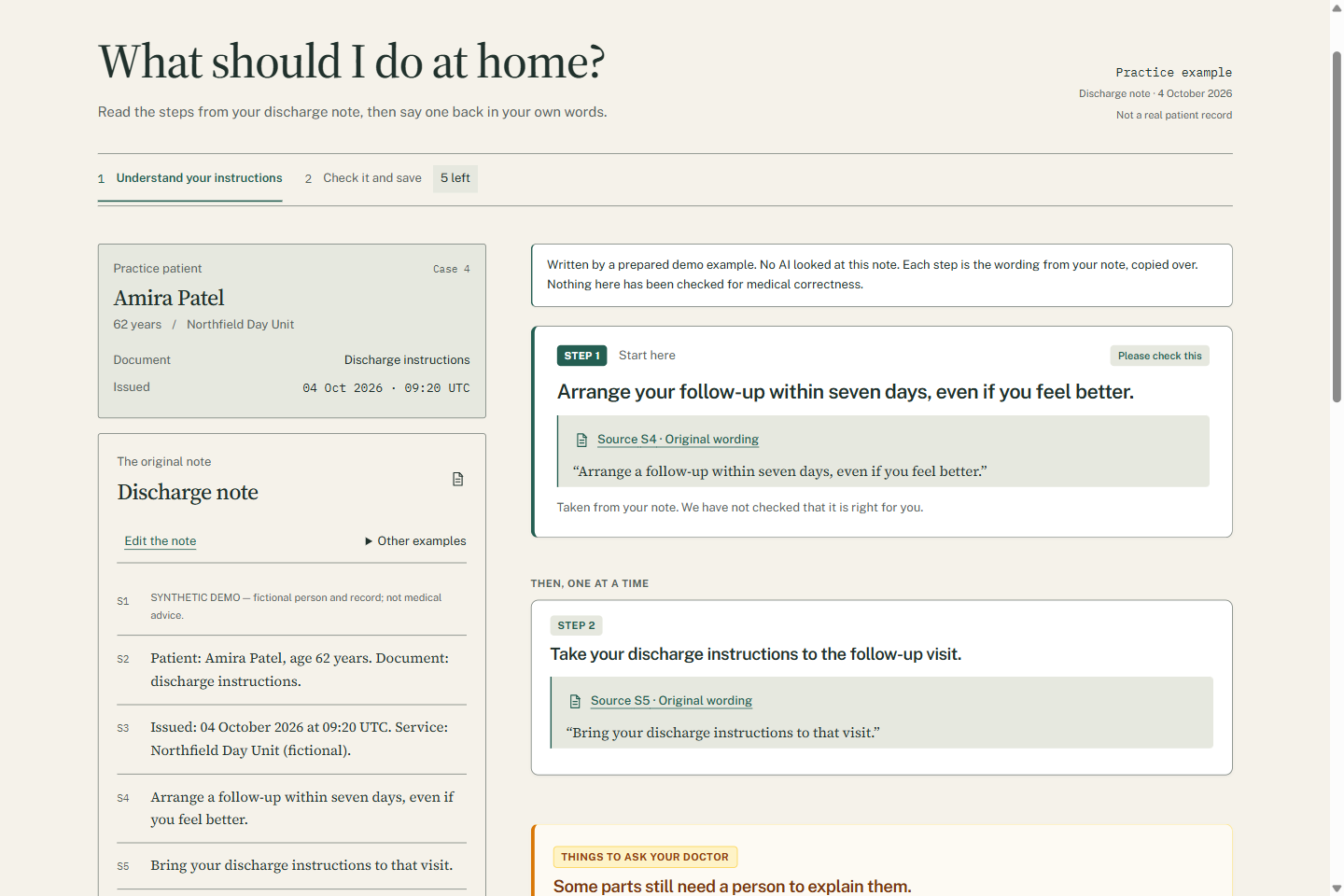
- Strictly Grounded Step Extraction: Every single instruction is presented in bite-sized, plain-language cards paired directly with a clickable citation linked to the exact source sentence in the patient's original record.
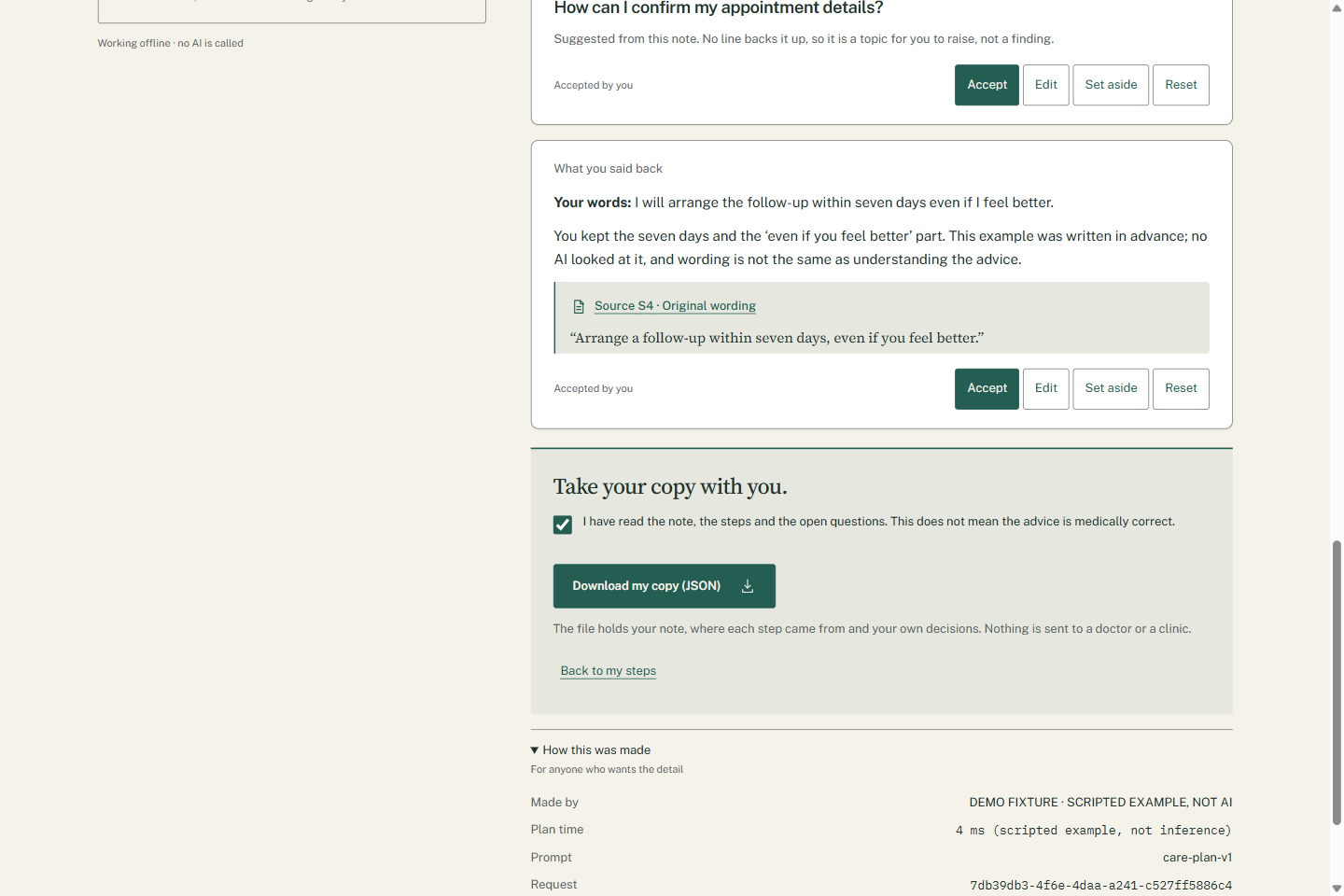
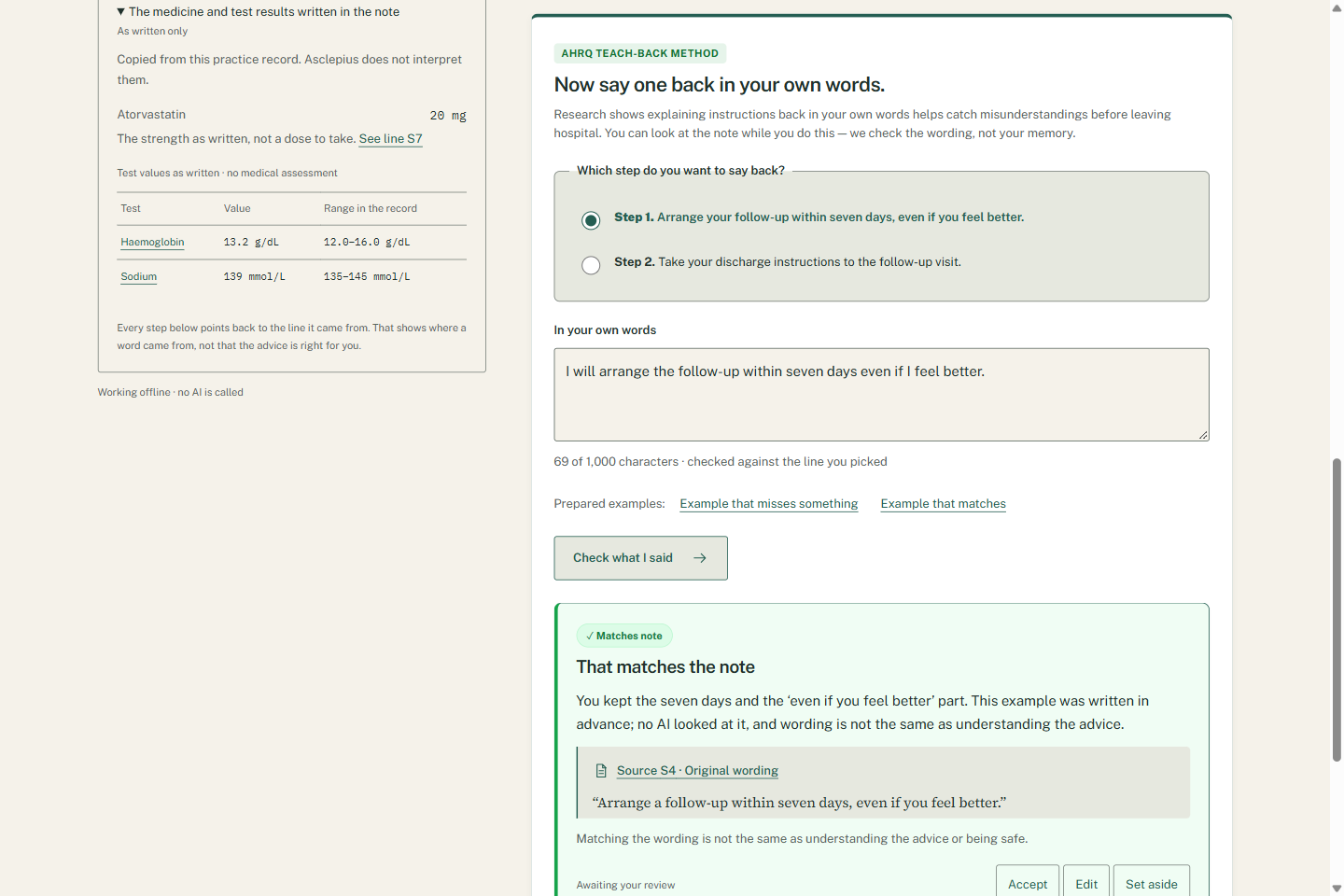
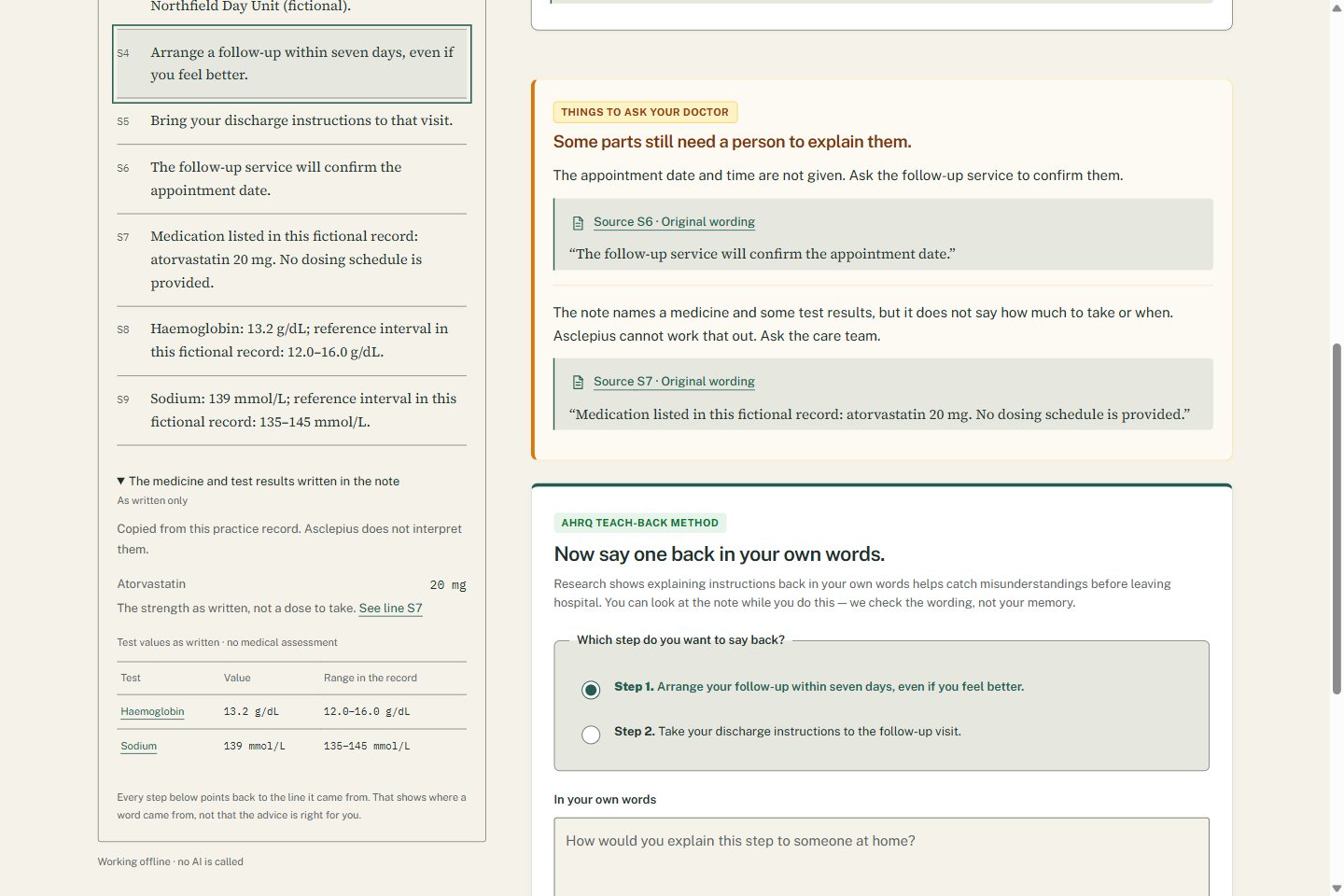
- Interactive AHRQ Teach-Back Check: The patient selects a care step and explains what they plan to do in their own words. Asclepius compares their explanation against that specific source line, flagging missed timing, inverted conditions, or overlooked warnings with encouraging, non-blaming guidance.
- Explicit Uncertainty Surfacing: Missing dates, unstated dosage regimens, or ambiguous lines are never hallucinated or filled in. Instead, they are prominently highlighted under "Things to ask your doctor".
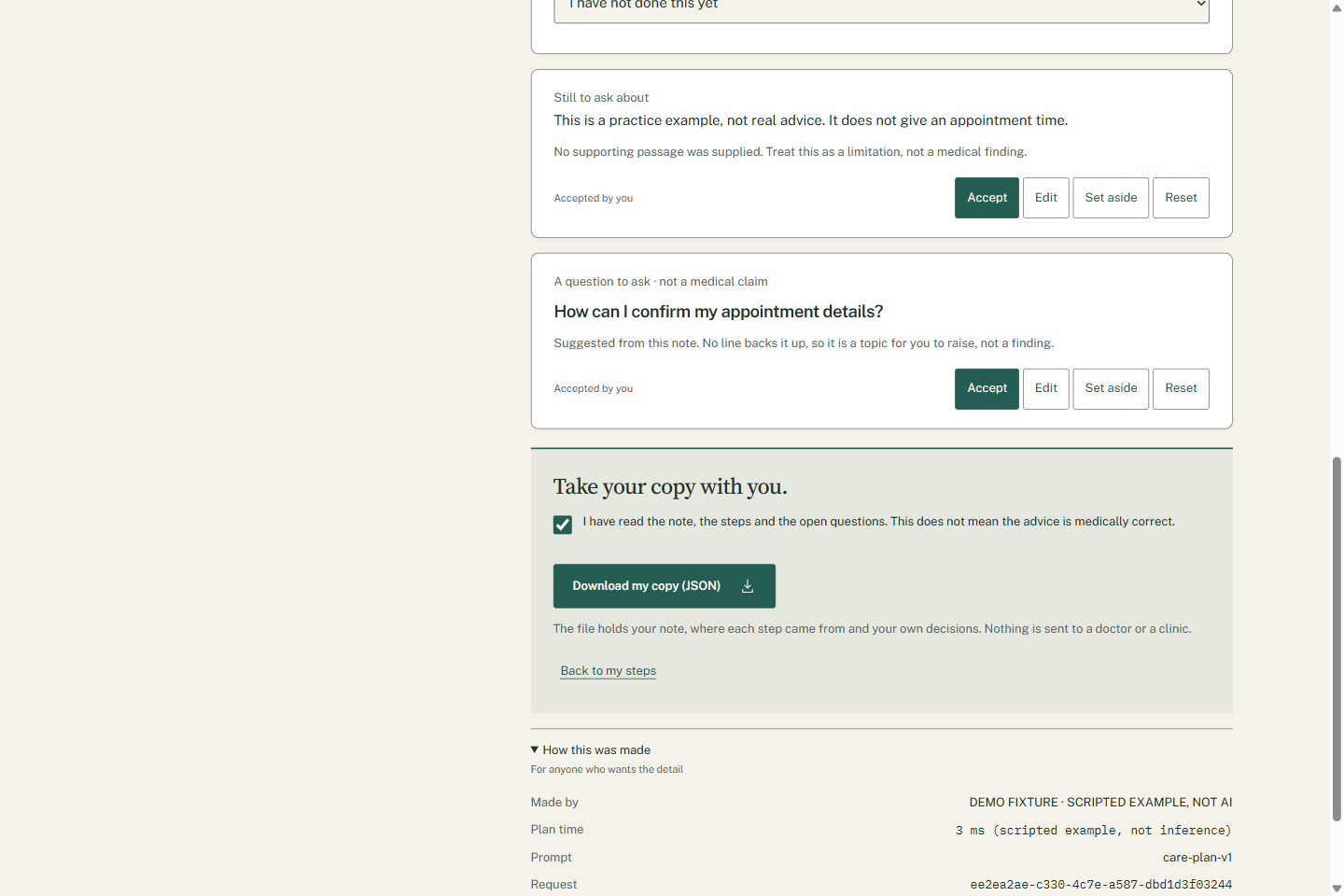
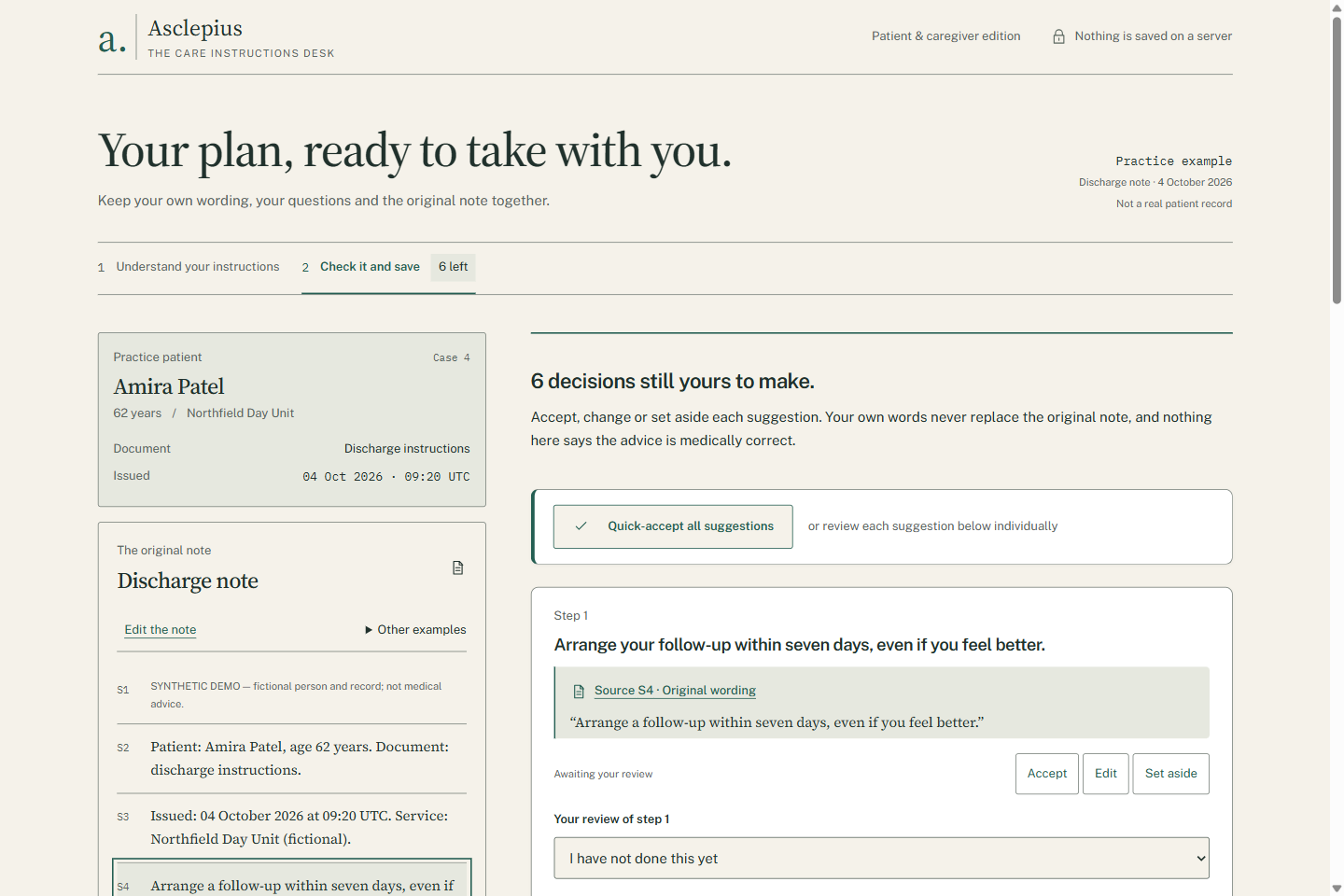
4. Human-in-the-Loop Review Desk: Before downloading, the patient or caregiver reviews each suggestion, with full autonomy to Accept, Edit, or Set aside with a reason. Asclepius then exports a portable, tamper-evident JSON dossier preserving the original text, machine reasoning, and human decisions.
How we built it
Asclepius was engineered with a strict focus on mathematical grounding, determinism, and zero external dependencies:
- Frontend: Built with React 19, TypeScript, and Vite, featuring a clean clinical aesthetic. We implemented a custom design system with WCAG AAA-compliant color contrasts ($12.2:1$ body contrast, $\ge 4.9:1$ accents), self-hosted OFL typography (Source Serif 4, Public Sans, IBM Plex Mono), and touch targets of $\ge 44\text{ px}$.
- Backend: Powered by Python 3.14 and FastAPI, with strict schema enforcement via Pydantic v2.
- Dual-Engine Architecture: Asclepius operates in two interchangeable modes:
- An offline, deterministic rule engine that segments sentences, detects clinical cues, and abstains when uncertain—allowing judges to evaluate the app locally without API keys or network access.
- A live OpenAI-compatible LLM adapter with structured JSON schema outputs and exact quotation grounding. ### Grounding & Mathematical Safety Formulation To prevent hallucinations, every extracted claim $c \in C$ must satisfy exact verbatim substring containment within the segmented source sentences $S = {s_1, s_2, \dots, s_n}$: $$\forall c \in C, \quad \exists s_i \in S \quad \text{such that} \quad \text{quote}(c) \sqsubseteq s_i$$ If any output references a quote outside $S$, the transaction is aborted ($422 \text{ Ungrounded Output}$). For the Teach-Back evaluation, let $y \in {\text{matched}, \text{clarification}}$ denote the ground truth understanding state, and $\hat{y}$ denote the model prediction. In patient safety, false reassurance is dangerous, whereas prompting a safe clarification is harmless. We mathematically bounded the False Positive Rate ($\text{FPR}$) to zero: $$\text{FPR}{\text{safety}} = P(\hat{y} = \text{matched} \mid y = \text{clarification}) = 0.0\%$$ $$\text{Recall}{\text{safety}} = \frac{\text{True Positives}}{\text{True Positives} + \text{False Negatives}} = 100\% \quad (0/30 \text{ unsafe false passes})$$ --- ## Challenges we ran into
- The Dangerous "Illusion of Fluency": Standard LLMs tend to generate smooth, pleasant summaries that silently discard critical caveats (e.g., "take with a full meal", "only if resting pulse exceeds 90"). Forcing the model to produce verifiable bidirectional citations required strict JSON schema prompts and post-generation AST verification.
- Preventing Accidental Prescribing: We had to strictly enforce that medication mentions in discharge text never become operational patient action cards. We designed AST filtering rules where drug references are classified strictly as limitations to be confirmed with the pharmacy or physician.
3. Dual Offline/Online Determinism: Designing a deterministic rule engine capable of handling free-form text with 100% offline reproducibility for hackathon judges—while maintaining the exact same API contract as a state-of-the-art LLM—required rigorous test suite engineering.
Accomplishments that we're proud of
- 114 / 114 Automated Tests Passing: $$N_{\text{total}} = 93_{\text{backend (pytest)}} + 21_{\text{frontend (vitest)}} = 114 \text{ tests} \quad (100\% \text{ pass rate})$$
- Zero False Reassurances: Across our 30-case synthetic validation corpus, our comparison engine achieved 0 out of 30 false
matchedverdicts, guaranteeing that every ambiguity safely triggers a request for clarification. - Instant, Zero-Config Evaluation: Judges can clone the repository and run Asclepius locally in under 60 seconds with no API keys, accounts, or telemetry.
* Production Build Quality: Full type safety (mypy clean, tsc clean), Vite production build emitted in $< 1 \text{ second}$, and automated CI/CD running on GitHub Actions.
What we learned
- Grounding beats summarization: In high-stakes domains like healthcare, generative summaries without direct source citations are unacceptable. Showing the original text side-by-side with extracted steps builds genuine patient trust.
- Teach-back is the real metric of accessibility: Real clarity isn't measured by a readability score like Flesch-Kincaid; it is measured by whether a patient can synthesize and articulate the instructions in their own words.
* Safety means knowing when to abstain: An AI system that clearly states "I cannot verify this part, please check with your doctor" is infinitely more valuable than one that guesses.
What's next for Asclepius
- Multilingual & Health Literacy Adaptation: Expanding Teach-Back support to non-native speakers and low-literacy populations, allowing patients to speak their explanation in their mother tongue and cross-reference clinical notes in real time.
- Audio-First Teach-Back: Implementing direct speech-to-text input and natural voice synthesis, allowing elderly or visually impaired patients to converse naturally with the care desk.
- FHIR & EHR Standard Integration: Enabling patient-authorized exports into HL7/FHIR format so verified teach-back notes can be transmitted directly into the patient's electronic health record for clinician review.
Built With
- accessibility
- ahrq
- artificial-intelligence
- care-coordination
- deterministic-ai
- discharge-instructions
- explainable-ai
- fastapi
- forgehacks-2026
- grounded-ai
- hallucination-prevention
- health-literacy
- healthcare
- healthtech
- human-in-the-loop
- medical-ai
- patient-safety
- pydantic
- python
- react19
- teach-back
- typescript
- vite
- wcag-aaa
- zero-trust

Log in or sign up for Devpost to join the conversation.