Inspiration
The inspiration for Asclepius AI stemmed from the growing need for accessible and accurate healthcare information. Many individuals face challenges in understanding medical conditions through complex medical terminology and diagnostic images. Additionally, healthcare professionals require efficient tools to assist in interpreting these images. We aimed to bridge the gap between advanced medical insights and user-friendly explanations, empowering patients and healthcare providers alike.
What it does
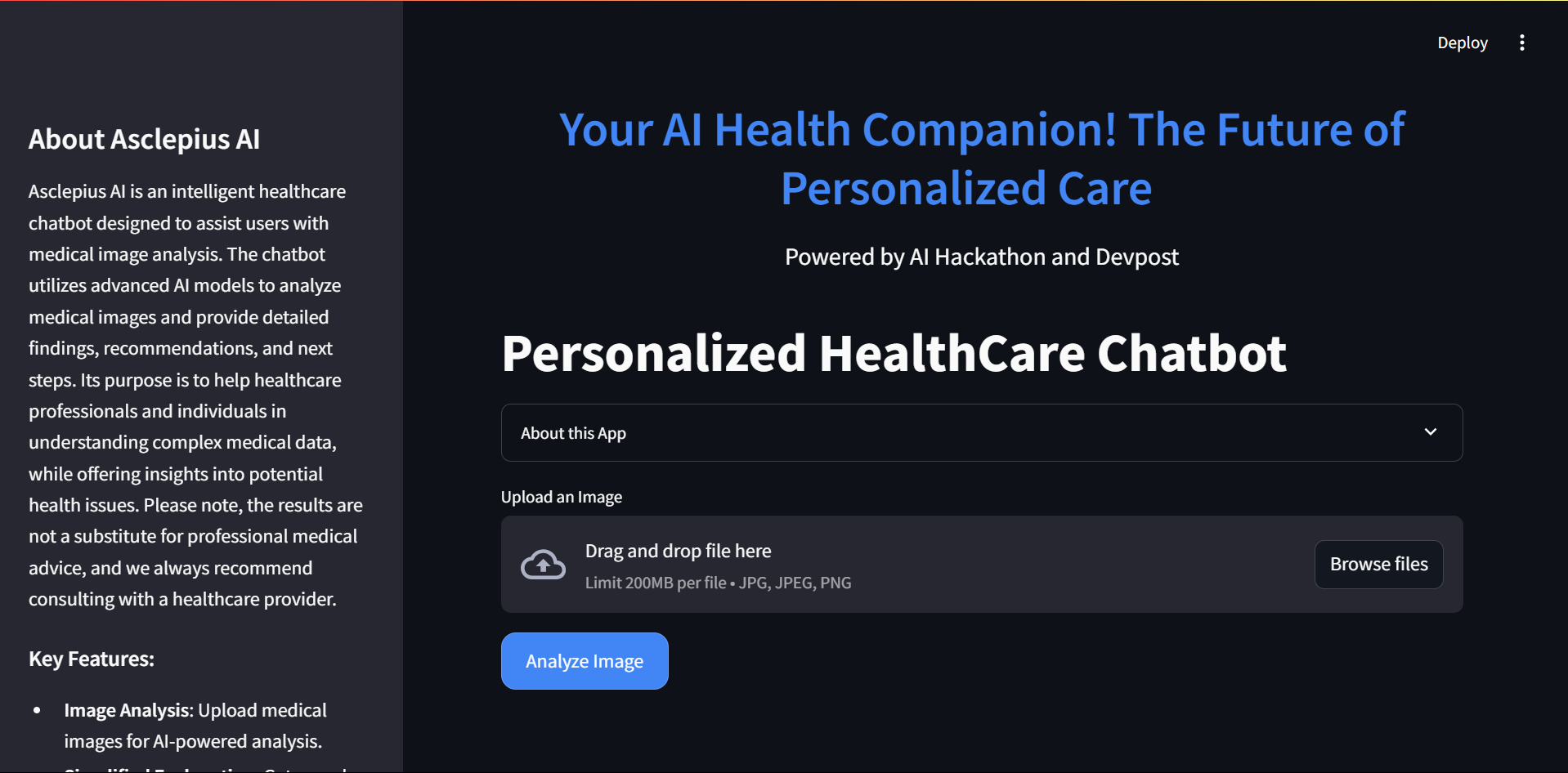
Asclepius AI is an intelligent healthcare chatbot designed to analyze medical images uploaded by users. It provides detailed findings and actionable recommendations tailored to individual health needs. The chatbot not only assists healthcare professionals in interpreting diagnostic data but also helps individuals understand their health conditions through simplified explanations of intricate medical findings. Moreover, it prioritizes user privacy and data security, ensuring compliance with regulations like HIPAA.
How we built it
Asclepius AI leverages a sophisticated architecture that combines a large language model (LLM) with a multi-agent system to efficiently perform various healthcare-related tasks. This approach enhances the chatbot's ability to analyze medical images, generate insights, and ensure user privacy and compliance. Below is a detailed breakdown of the technical components involved:
1. Large Language Model (LLM)
OpenAI GPT-4 serves as the backbone of Asclepius AI, providing advanced natural language processing capabilities. The model is utilized for various tasks:
Natural Language Understanding: The LLM interprets user queries, ensuring accurate comprehension of the context and intent. This enables the chatbot to engage in meaningful conversations with users, responding appropriately to their concerns and questions.
Natural Language Generation: When generating findings from the image analysis, GPT-4 helps craft detailed, coherent, and contextually relevant explanations. It translates complex medical terminologies into layman-friendly language, allowing users to understand the analysis without medical expertise.
2. Multi-Agent System
Asclepius AI employs multiple specialized agents that work collaboratively to handle different tasks within the chatbot ecosystem:
Image Analysis Agent: This agent processes the uploaded medical images using machine learning algorithms. It employs techniques such as computer vision and image classification to detect abnormalities, patterns, and features indicative of specific health conditions.
- Image Preprocessing: Before analysis, images undergo preprocessing, including normalization, resizing, and noise reduction, to enhance the accuracy of the analysis.
- Model Training: The image analysis agent is trained on diverse datasets of medical images to improve its ability to identify various conditions accurately. Continuous model refinement is essential to adapt to new findings and ensure robustness.
Findings Generation Agent: Once the image analysis is complete, this agent synthesizes the results and generates comprehensive reports. It summarizes the findings, highlighting key observations and potential health issues.
- Layman Explanation: To cater to users with varying levels of medical knowledge, this agent uses the LLM to provide simplified explanations, ensuring that users can easily grasp the implications of the analysis.
Privacy Protection Agent: This agent focuses on safeguarding user data and ensuring compliance with regulations like HIPAA. It manages data encryption, anonymization, and secure storage practices to protect sensitive health information.
- Data Handling Procedures: All user-uploaded images and conversations are securely handled, with strict protocols in place to prevent unauthorized access or data breaches.
3. Tech Stack
The development of Asclepius AI utilizes a robust tech stack that includes:
Python: The primary programming language for backend development, chosen for its extensive libraries and frameworks that facilitate AI and machine learning tasks.
- Frameworks Used: Libraries like TensorFlow or PyTorch can be employed for training machine learning models, while Flask or FastAPI may be used for building the web server that handles user interactions.
OpenAI GPT-4: The cutting-edge language model that powers the chatbot’s natural language capabilities, allowing it to understand and generate human-like text.
Langchain & Langgraph: These libraries are integrated to manage conversational workflows effectively.
- Langchain: Helps structure interactions, manage conversational context, and allow for branching dialogues based on user inputs, enhancing the overall user experience.
- Langgraph: Facilitates data organization, ensuring that the chatbot can seamlessly retrieve and store information as needed, maintaining context throughout the interaction.
4. Workflow Overview
- User Interaction: Users upload medical images via an intuitive interface.
- Image Analysis: The Image Analysis Agent processes the images, identifying potential issues.
- Findings Generation: The Findings Generation Agent compiles the results, creating a user-friendly report.
- User Feedback Loop: Users can provide feedback on the clarity of explanations, helping to refine the model further.
- Privacy Assurance: Throughout the process, the Privacy Protection Agent ensures that data is handled securely.
5. Continuous Improvement
The technical approach emphasizes the importance of continuous learning and improvement:
User Feedback Integration: Feedback from users is crucial for refining the model's performance, especially regarding clarity and accuracy of the findings.
Ongoing Model Training: Regular updates to the machine learning models are necessary to keep pace with new research and advancements in medical imaging technology.
By combining advanced AI techniques, a multi-agent system, and a strong focus on user experience and privacy, Asclepius AI aims to transform the way medical image analysis is conducted, providing valuable insights while ensuring patient confidentiality.
Challenges we ran into
Complexity of Medical Image Analysis: Detecting subtle abnormalities in medical images can be challenging. The variations in conditions, image quality, and presentation require sophisticated algorithms and extensive training data to ensure high accuracy. In some cases, the model may struggle to differentiate between benign and malignant conditions or recognize less common diseases.
Data Privacy and Security: While robust security measures are in place, maintaining compliance with healthcare regulations, such as HIPAA, can be complex. Ensuring that all user data is handled appropriately, especially in an environment with evolving regulations, poses ongoing challenges.
User Understanding and Interpretation: Translating complex medical findings into layman-friendly language without losing critical details is a delicate balance. Users may misinterpret the information if the simplification process is not handled carefully, leading to confusion or unnecessary alarm.
Scalability: As the user base grows, ensuring that the system can handle increased traffic and processing demands without degradation in performance is essential. This includes optimizing the algorithms and infrastructure to support a larger volume of image uploads and queries.
Bias in AI Models: Like any AI system, Asclepius AI may be subject to biases present in the training data. It is crucial to continually evaluate and refine the models to ensure equitable treatment of diverse patient populations and avoid perpetuating existing healthcare disparities.
Accomplishments that we're proud of
- Successful Image Analysis: The chatbot accurately analyzes a wide range of medical images, providing valuable insights to users.
- User-Friendly Interface: We created an intuitive interface that makes it easy for individuals and healthcare professionals to interact with the chatbot.
- Privacy Assurance: Our commitment to user privacy and data security has been validated by the implementation of stringent compliance measures.
What we learned
- Importance of User Feedback: Continuous feedback from users is crucial for improving the clarity and accuracy of findings.
- Collaboration Between Domains: Collaborating with healthcare professionals enriched our understanding of medical data and helped refine our approach.
- Technical Adaptability: Navigating the challenges of AI and healthcare technology requires flexibility and a willingness to adapt to new developments.
What's next for Asclepius AI
- Model Refinement: We aim to continuously improve the accuracy of our image analysis models through regular updates and user feedback integration.
- Feature Expansion: We plan to expand the chatbot’s capabilities to include analysis of other medical data, such as lab results and patient history.
- Partnerships with Healthcare Providers: Building partnerships with healthcare institutions will help validate our findings and enhance trust in our solutions.
- User Experience Enhancements: Ongoing testing and refinement of the user interface will ensure that it remains accessible and intuitive for all users.
Built With
- crewai
- css
- fastapi
- html
- javascript
- langchain
- langgraph
- openai
- python
- sql
- streamlit


Log in or sign up for Devpost to join the conversation.