-
-
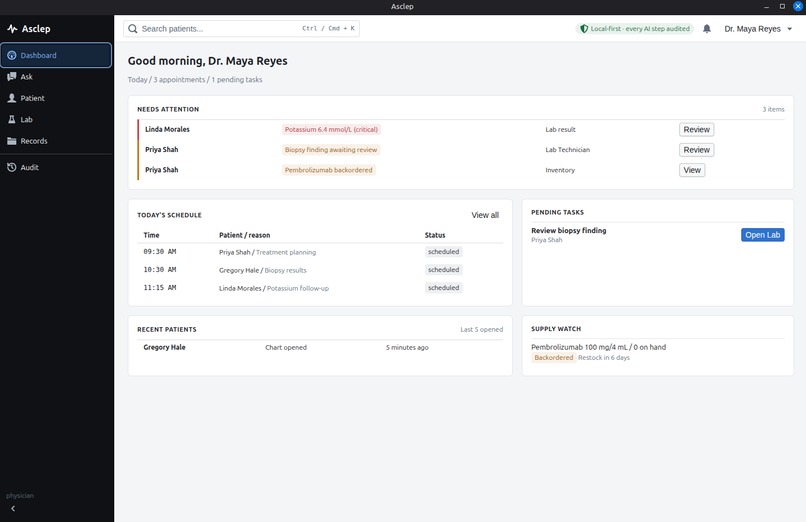
Homepage
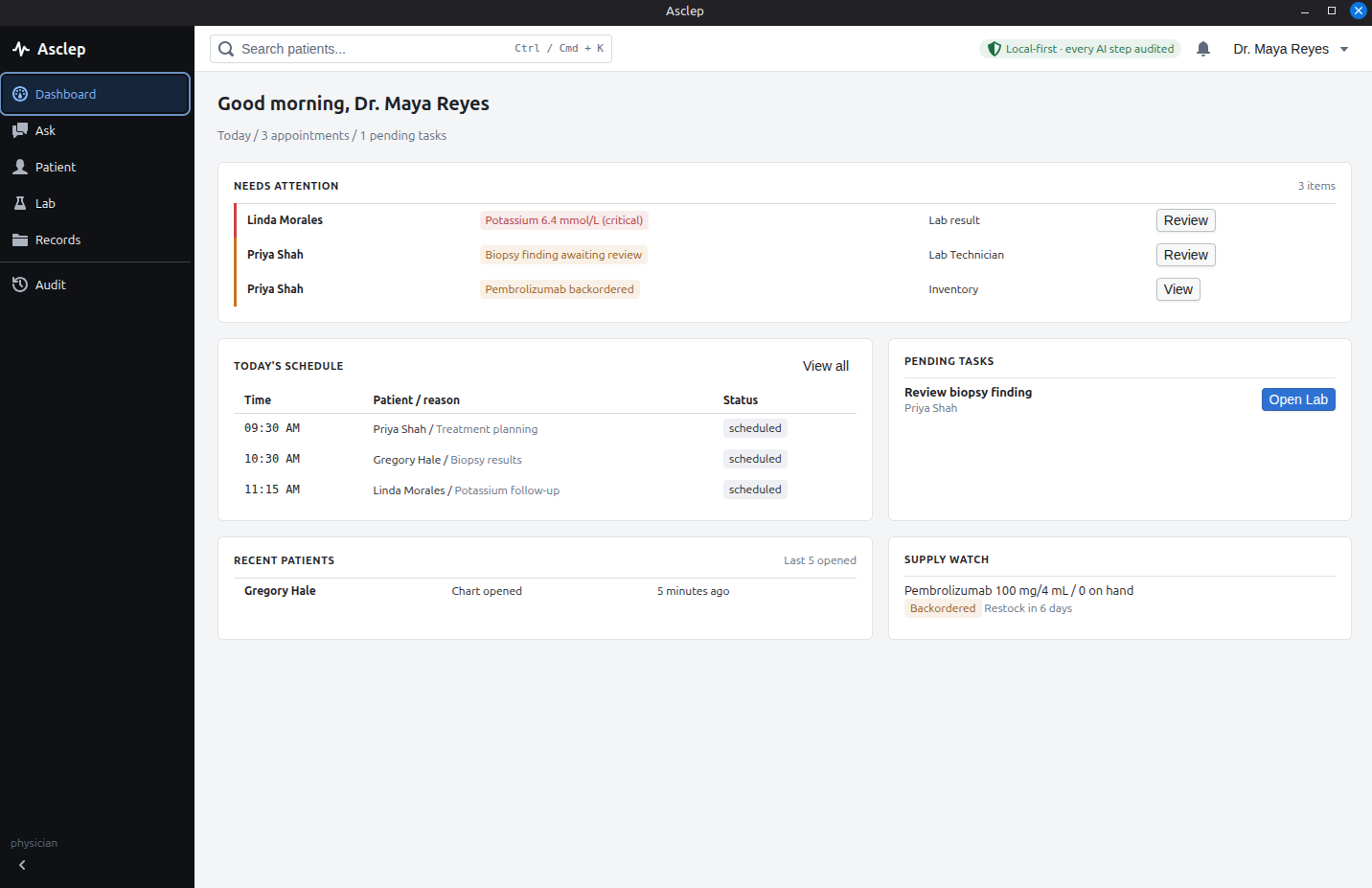
Inspiration
Doctors spend almost six hours of every workday inside electronic health records, about two hours of screen time for every hour with patients. That time goes into digging, not care: a patient's history split across providers, labs buried in bloated notes, a missing allergy that only exists at the clinic across town. EHRs like Epic and Cerner were built for billing, not for thinking. We wanted to build the layer that thinks.
We named it Asclep, after Asclepius, the Greek god of medicine. His rod was a tool; the healing came from him. That's our principle: the software is the tool, and the doctor is always the healer.
What it does
Asclep sits on top of existing EHRs and shows a clinician only the slice of data they need right now.
- A patient ontology: pulls records from multiple providers over FHIR and links them into one graph around each patient, with every fact traceable to its source.
- Transcript requests: a doctor requests records from another provider, and once consent is recorded, the history merges in. Conflicts, like an allergy one clinic never recorded, are flagged rather than silently resolved.
- The Lab Technician: a pathology model built on CONCH, an open vision-language foundation model, classifies lung cancer subtypes from tissue slides and shows a heatmap of which regions drove its call.
- The Resident: an AI agent that drafts reports and answers plain-language questions, like "Gregory's biopsy came back; if I order pembrolizumab, when will we have it?", citing every fact.
- The Scribe: a camera-based assistant (Qwen3.8-27B, running locally) that notes observable patient behavior during a consented visit. No video, images, or audio are ever saved.
- The Attending: the doctor. Every AI output is a draft until a physician confirms, overrides, or rejects it.
How we built it
We started with an unusually detailed spec so our coding agents could build in parallel without stepping on each other. The stack is a Python/FastAPI backend, PostgreSQL with pgvector for the ontology and search, and an Electron desktop app built with React and Palantir's Blueprint. Two HAPI FHIR servers seeded with Synthea synthetic patients stand in for real hospital systems. Shared typed contracts connect every service, and the Resident's outputs pass through IBM's Mellea framework, which validates them against requirements (locked values, resolvable citations, no dosing advice) and forces repairs before anything reaches a doctor. Security is built in from the start: role-based access, care-team checks, and an append-only audit log that records the AI's reads as well as humans'.
Challenges we ran into
[Fill in the real ones. Likely candidates: getting access to gated pathology models, fitting CONCH and a 27B vision model on limited GPUs, stopping the language model from rewording diagnoses, and matching the same patient across two providers.]
Accomplishments that we're proud of
[For example: the full Gregory story running end to end, the Lab Technician's accuracy on held-out TCGA slides, zero frames persisted by the Scribe as proven by our privacy test, and a UI that looks like a shipped product.]
What we learned
[For example: type safety stops malformed output, but grounding checks are what actually stop hallucination; "selective" has to show what it left out; and a spec written before kickoff let four people and their agents move like a much bigger team.]
What's next for Asclep
Real EHR integration through Epic's and Oracle Health's app programs, more disease models beyond lung pathology, a drug-response module using open structure-prediction models like Boltz-2, and the clinical validation and compliance work (including BAAs and a formal risk assessment) needed before it touches real patients.

Log in or sign up for Devpost to join the conversation.