Inspiration
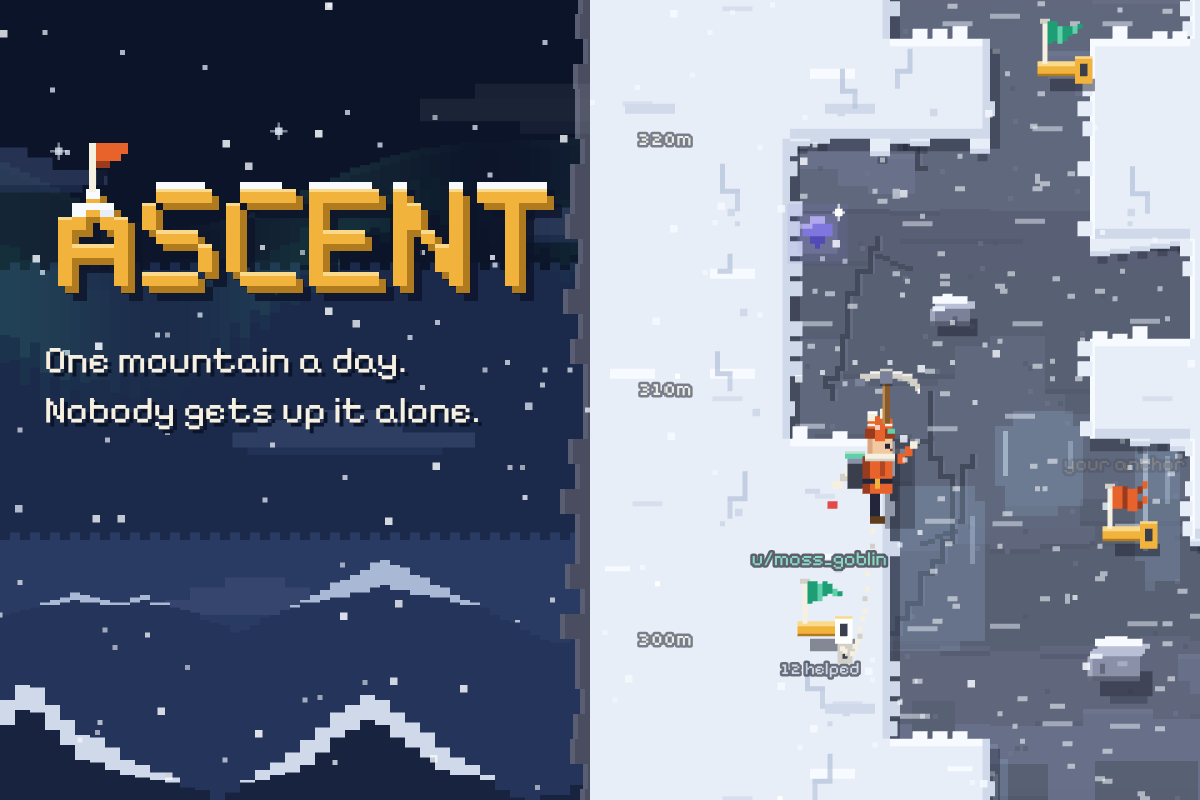
I wanted a daily game where turning up late isn't a disadvantage. In most daily games everyone plays alone and compares scores afterwards. I kept thinking about how a real expedition works: the first people up fix the ropes, and everyone after them climbs on that work.
The feel came from physics climbers like Getting Over It, where one clumsy tool and a long fall make every move matter. The twist I wanted was the opposite of that game's loneliness. In Ascent you still fall, but someone you've never met may have left something in the rock that catches you.
What it does
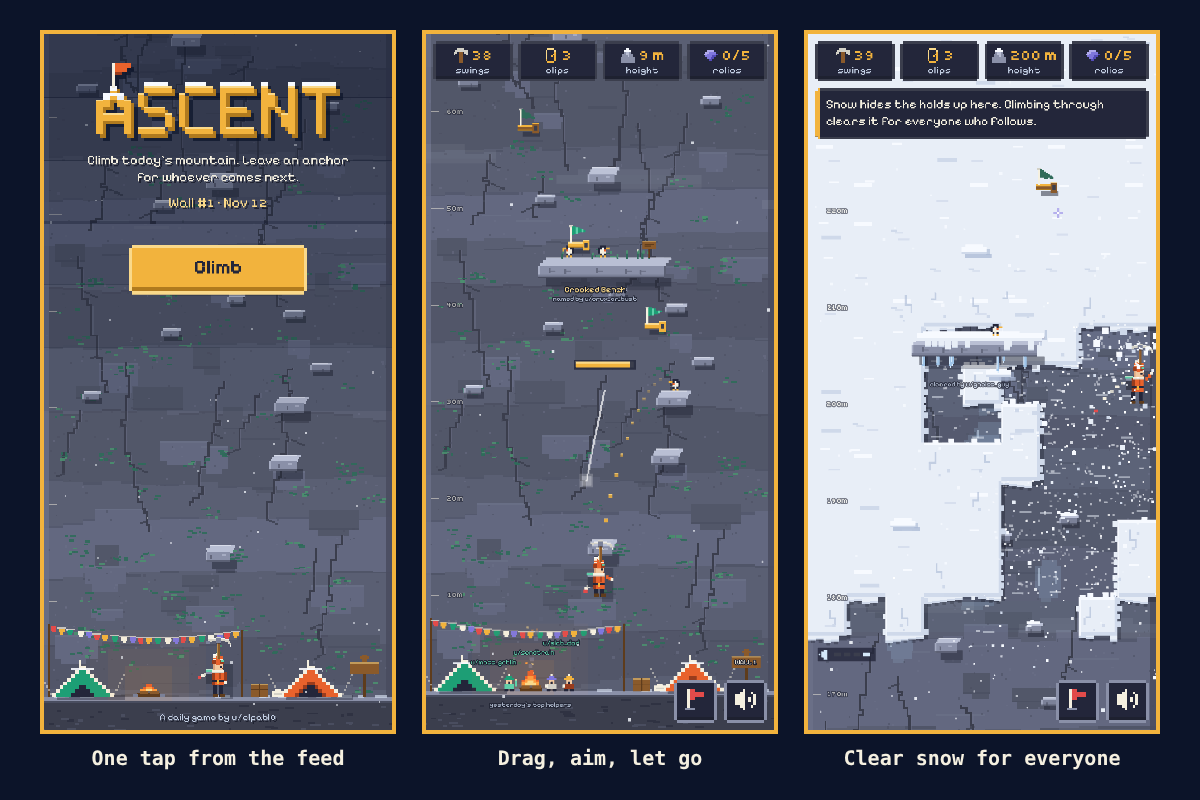
Everyone in the subreddit climbs the same generated mountain each day. You drag back and let go to swing a pickaxe from hold to hold, with 40 swings per climb and three climbs a day.
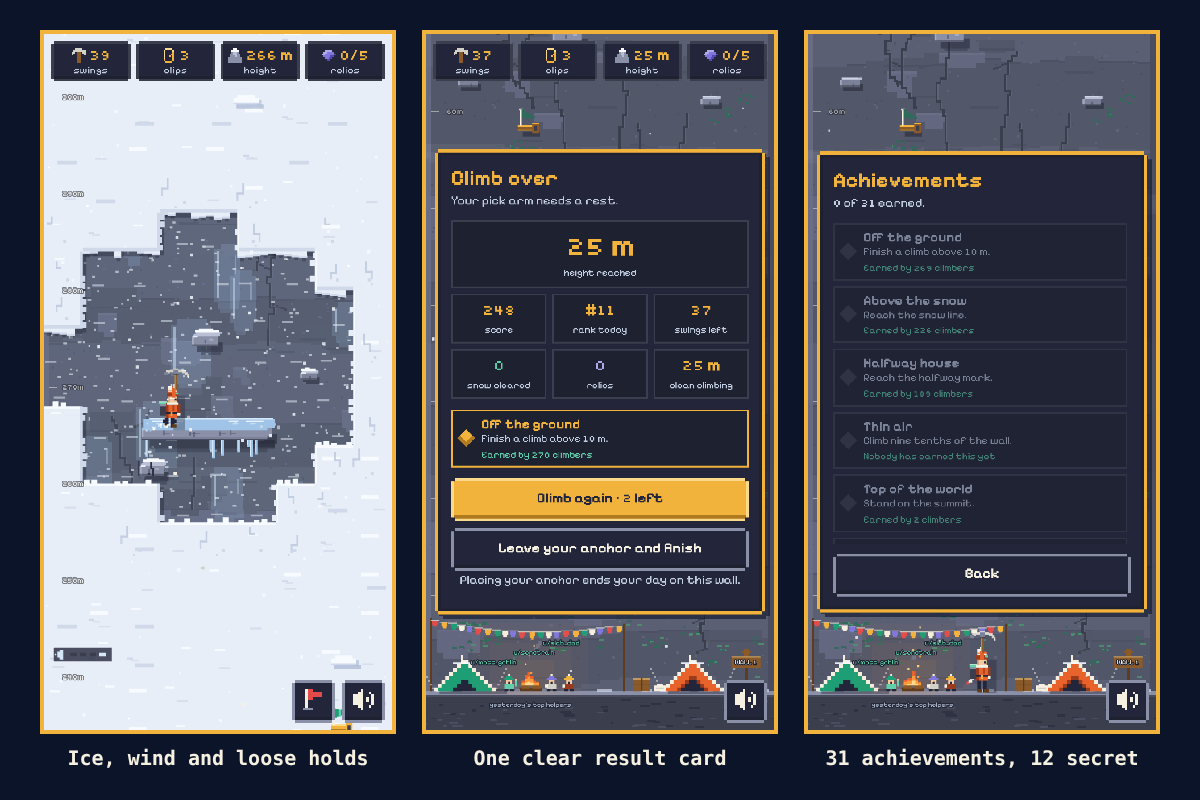
The mountain is 442 m tall and gets harder all the way up: holds shrink and spread out, ledges ice over, loose holds break away, and wind pushes you in flight. Alone, the summit is close to impossible.
So players help each other without being online together:
- Snow hides the holds higher up. Climbing through it clears it for everyone behind you, until it slowly settles back.
- Anchors. At the end of your day you leave one anchor on the wall with your username on it. Other climbers can hook it or clip a rope to it, and you score for every person it helps.
- Firsts. The first player onto a ledge names it for the day, and hidden relics go to whoever reaches them first.
There are two leaderboards, climbers and helpers, plus 31 achievements. Twelve are secret and mostly reward doing something daft, like sliding off an icy ledge or swinging your pick at the ground.
How I built it
I'm a product person, not a programmer. I wrote the design brief and a rough single-file prototype, then built the real thing in collaboration with Claude Code as my engineer. I directed, playtested and made the calls; it wrote the code.
It's a Devvit Web app: a Phaser client, a small server, and Redis for the shared wall. Three decisions shaped it:
- One physics engine, shared. The client and server run the same simulation. The client sends only its list of swings, and the server replays them to work out the score. Nobody can submit a height they didn't climb.
- A wall from a date. Each day's mountain is generated from the date alone, so every player and the server get the identical wall with nothing to download.
- Art drawn in code. Every sprite is placed rectangle by rectangle from one small palette, and the sound is synthesised. There are no image or audio files in the game.
Challenges
Balancing a game nobody has played yet. I couldn't get a thousand people to test scoring, so we built a simulator that runs a whole day of bot players of different skill, arriving at different hours, through the real server code. The first run was humbling: using other people's anchors lowered good players' scores, and anchors placed after midday helped nobody at all because they were never shown. Four rule changes later, anchors raise everyone's score and almost every anchor helps someone, whenever it is placed.
Making it hard without making it unfair. "Nearly impossible" is easy; "nearly impossible but always possible" is not. A checker now sends a perfect-aim bot up each upcoming wall to confirm the summit can be reached on bare rock.
The feed. Reddit rightly doesn't allow drag gestures inside the feed, and my whole game is a drag gesture. The post shows a tap-only preview with one button, and the climb opens full screen.
What I learned
That the interesting design problem in a shared game is what you choose to show people. The anchor rules barely changed during balancing; what changed was which anchors each climber sees.
I also learned to distrust my own scoring instincts. Every rule I was sure about turned out to reward something I didn't intend once a simulated crowd got hold of it.
What's next
Real players. The difficulty is tuned on bots, and people will find things bots never do. After that: overhangs, rockfall, and stretches of blank rock that can only be crossed on other people's anchors.
