Inspiration
Over 200,000 students gather in just one Ontario Grade 12 subreddit, asking the same questions every year:
- “Am I cooked?”
- “What should I do?”
Behind those questions are real, high-stakes decisions about admission odds, offer timelines, strategic course selection, and choosing the right program. The problem is that students are often forced to make those decisions through rumors, scattered admissions pages, screenshots, Reddit threads, and generic AI answers.
Post-Secondary Copilot was inspired by that gap. I wanted to build a tool that gives students something more useful than a chatbot: a grounded decision system that helps them understand tradeoffs, evaluate evidence, and make better post-secondary choices.
What it does
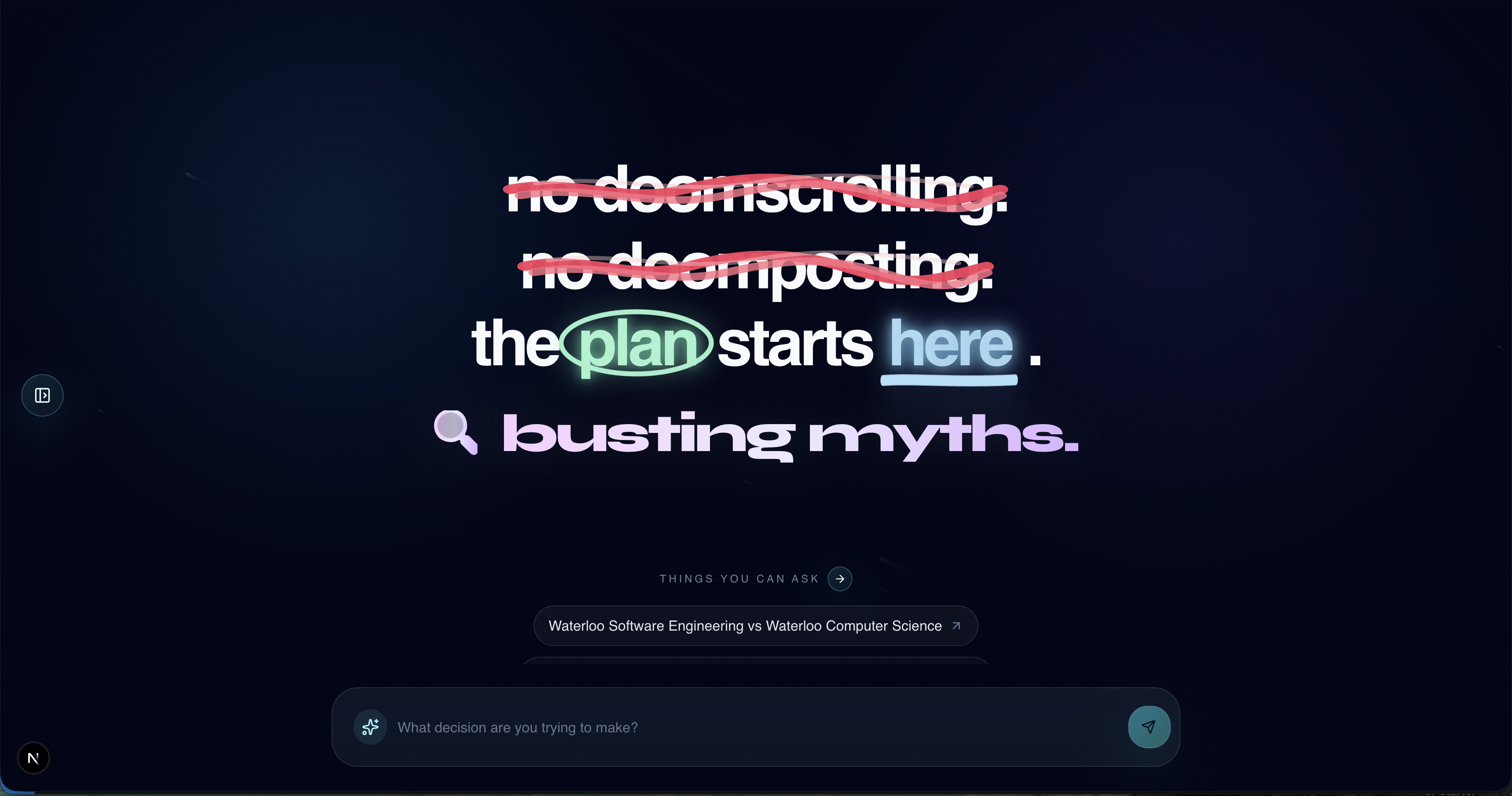
Post-Secondary Copilot is an Ontario admissions copilot that routes student questions into the right decision surface.
Its main features are:
- Program Arena for side-by-side program comparisons
- Mythbuster for common admissions misconceptions and policy questions
- Admissions Forecast for rough competitiveness estimates based on historical student-reported outcomes
- Timeline and planning flows for deadlines, offer windows, and next-step guidance
Instead of returning one long paragraph, it produces a structured result with:
- a verdict
- a rationale
- next actions
- evidence sources
- confidence and uncertainty cues
- follow-up prompts
The goal is to help students move from panic and confusion to grounded decision-making.
How we built it
We built Post-Secondary Copilot as a standalone Next.js application with a TypeScript core and a SQLite-backed admissions dataset.
The system combines:
- deterministic intent routing
- structured UI surfaces for each question type
- retrieval from official, curated, and community-calibration sources
- Gemini-powered explanation layers
- persistent auditor rails for tracked programs, deadlines, and checklist items
At a high level, the product was designed around this principle:
[ \text{useful AI guidance} = \text{routing} + \text{retrieval} + \text{grounding} + \text{actionability} ]
not just:
[ \text{prompt in} \rightarrow \text{text out} ]
We wanted the app to feel less like an LLM wrapper and more like a real post-secondary decision copilot.
Challenges we ran into
One of the biggest challenges was avoiding the default failure mode of AI apps: sounding polished while staying vague.
We had to figure out how to:
- separate official evidence from inferred guidance
- present historical admissions data without pretending it is an official cutoff
- build trust even when some sources are student-reported and biased
- turn messy admissions questions into structured interfaces instead of generic responses
- make the app demoable while still being transparent about caveats
Another challenge was product framing. This is not just a search engine and not just a chatbot. It sits somewhere between admissions intelligence, student support, and educational infrastructure.
Accomplishments that we're proud of
We are proud that Post-Secondary Copilot does not just answer questions. It helps students make decisions.
Some accomplishments we are especially proud of:
- building a product that turns vague admissions anxiety into structured decision tools
- creating a Program Arena that makes tradeoffs visible instead of relying on prestige-based comparisons
- building a Mythbuster that grounds rumor-heavy admissions questions in evidence
- integrating historical student outcome data while clearly surfacing its limitations
- designing a UI that feels like a real student support product instead of a generic AI chat screen
- creating a tool that can support not just students, but also families and counselors
What we learned
We learned that the most valuable AI experiences in education are not always the ones that generate the most text. They are the ones that reduce ambiguity and help people take the next right action.
We also learned that transparency matters. Students are willing to engage with imperfect data if the caveats are clear and the system does not pretend to know more than it does.
Most importantly, we learned that community impact in education often comes from access. If good guidance can be made more structured, inspectable, and widely available, AI can help narrow real support gaps.
What's next for Post-Secondary Copilot
Next, we want to evolve Post-Secondary Copilot from a strong hackathon prototype into a more complete student guidance platform.
That includes:
- expanding beyond Ontario into broader post-secondary admissions support
- improving data coverage and reducing school-specific bias
- deepening counselor, parent, and school-facing workflows
- adding richer personalization and longitudinal student planning
- strengthening the auditor so it becomes a real execution system for deadlines and applications
- integrating more official source ingestion and fresher policy updates
The long-term vision is to make Post-Secondary Copilot a trusted guidance layer for students who do not have easy access to high-quality admissions support.
Built With
- better-sqlite3
- eslint
- framer
- google-gemini-api
- next.js
- node.js
- react
- recharts
- sqlite
- tailwind
- typescript

Log in or sign up for Devpost to join the conversation.