-
-
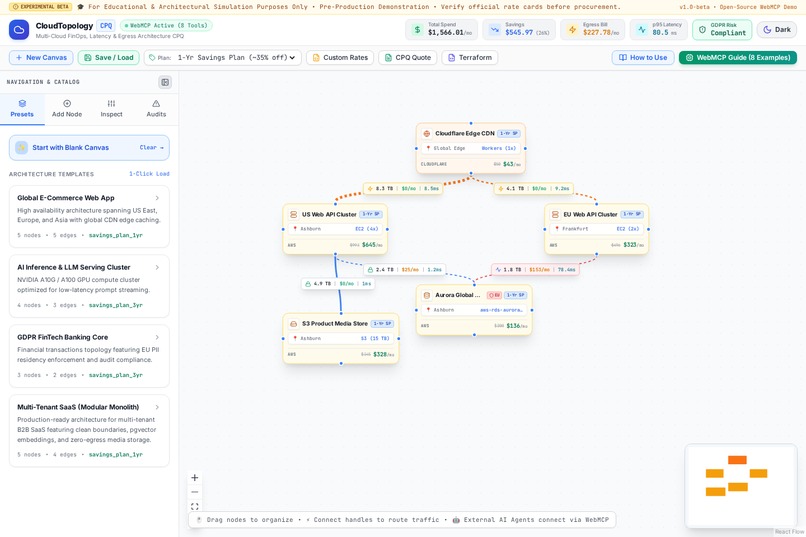
main canvas
-
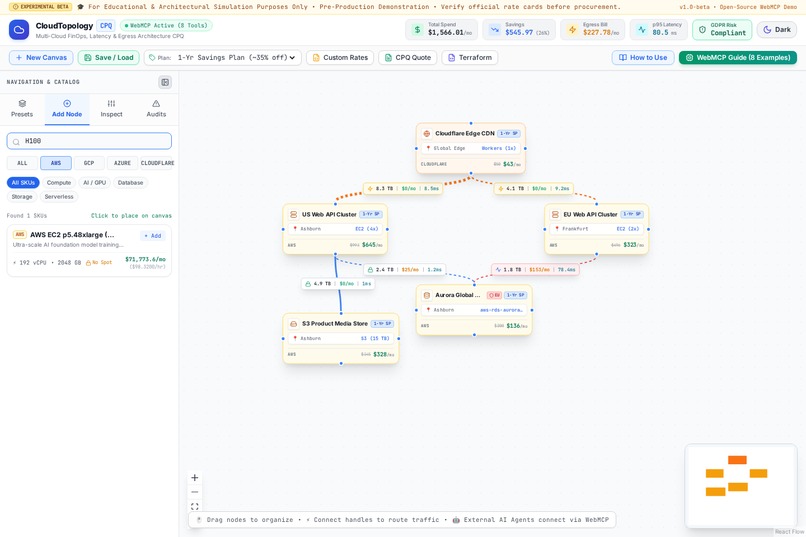
sku_catalog_palette
-
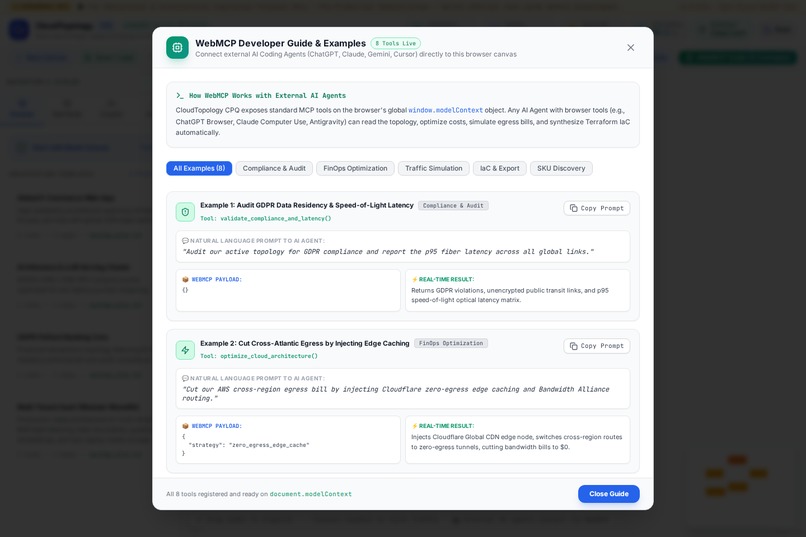
webmcp_guide_modal
-
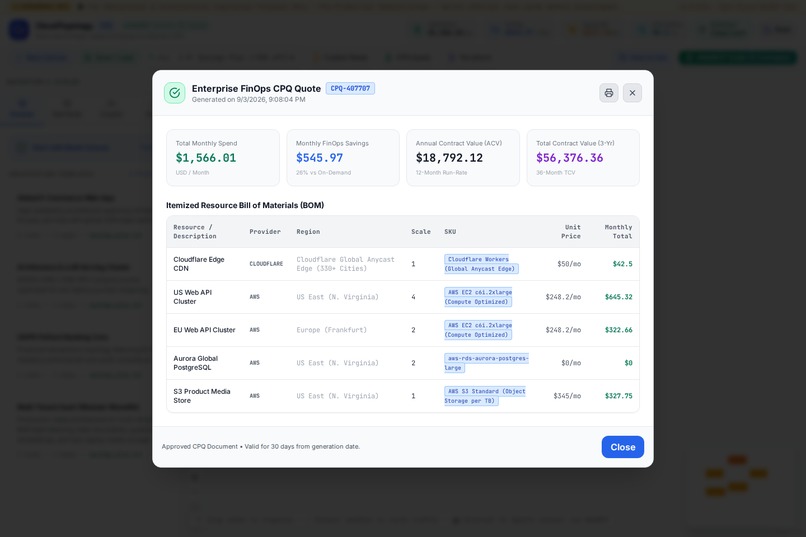
cpq_quote_document
-
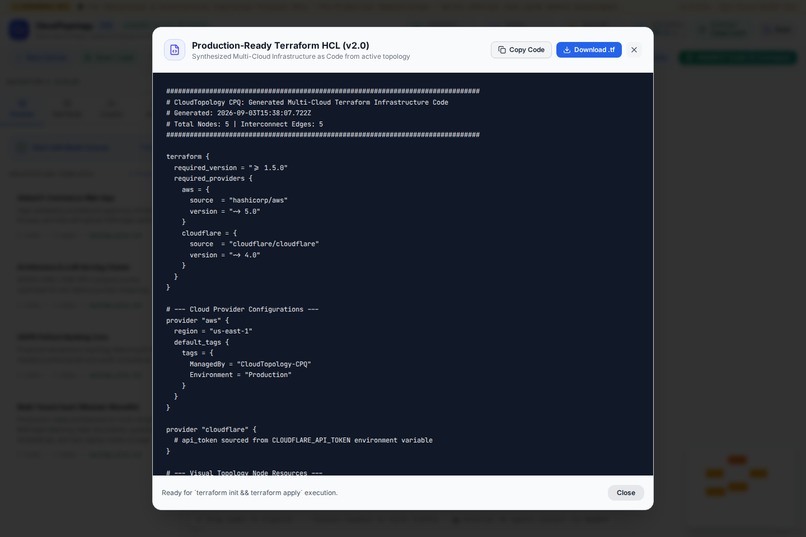
terraform_iac_export
-
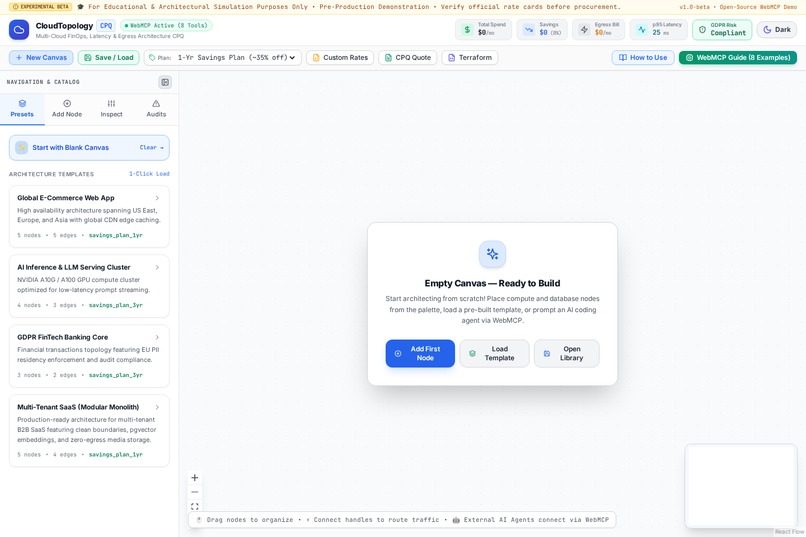
blank_canvas_hub
-
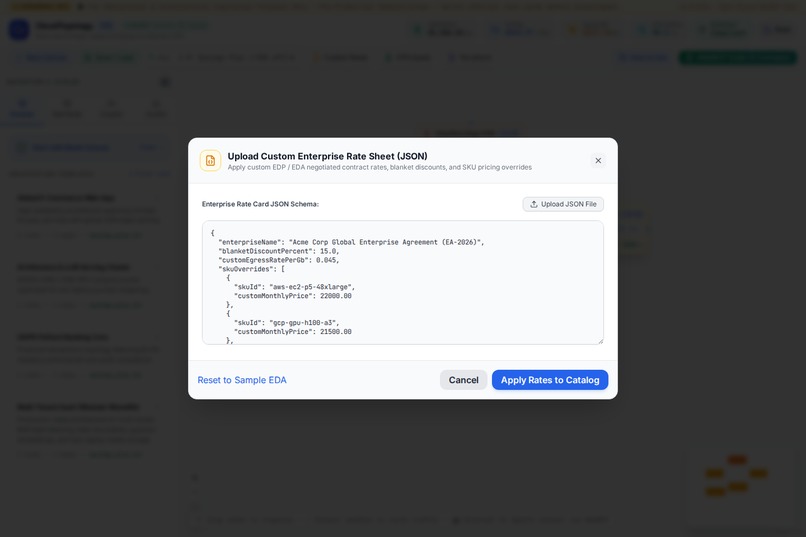
custom_rate_card_eda
-
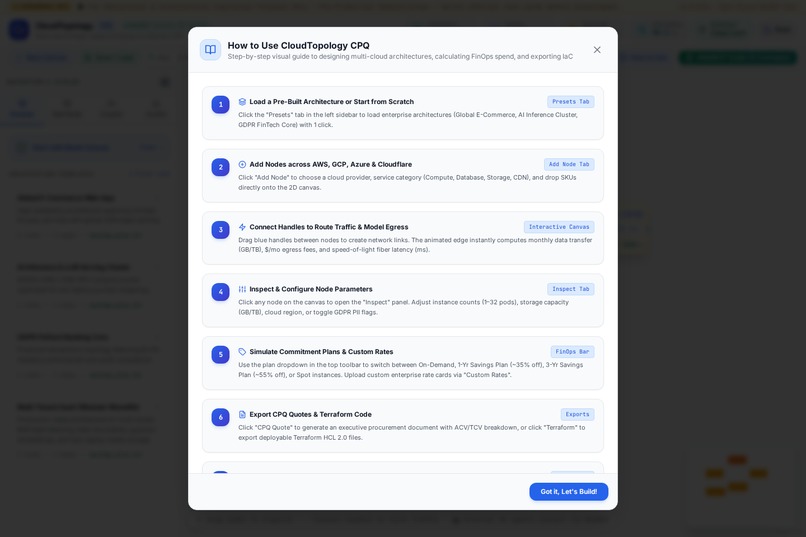
how_to_use_guide
Inspiration
Modern cloud architectures rarely live in a single region or provider. Today's engineering teams blend AWS compute, GCP AI accelerators, Azure enterprise systems, and Cloudflare edge networks. However, designing and estimating multi-cloud systems is frustratingly broken:
- Static Diagrams vs. Dynamic Bills: Traditional diagramming tools (Draw.io, Lucidchart) produce static pictures. They cannot calculate your monthly bill, warn you about non-linear cross-region egress tariffs, or alert you when a customer database violates European GDPR data residency laws.
- Opaque Egress Pricing: Data transfer fees between cloud datacenters and internet users range from $0.00 (Cloudflare Bandwidth Alliance) to $0.09+/GB (AWS public egress). Estimating this by hand with spreadsheets is prone to massive calculation errors.
- AI Coding Agents Lacked a Visual Canvas: While modern AI agents (ChatGPT, Claude, Gemini) can write infrastructure code, they lacked a standardized, bi-directional protocol to "see" a visual architecture canvas, test configuration changes, and verify FinOps mathematics in real time.
We built CloudTopology CPQ to solve this: an open-standard, visual multi-cloud CPQ (Configure, Price, Quote) workspace that both human engineers and AI coding agents can interact with simultaneously via WebMCP (window.modelContext / document.modelContext).
What it does
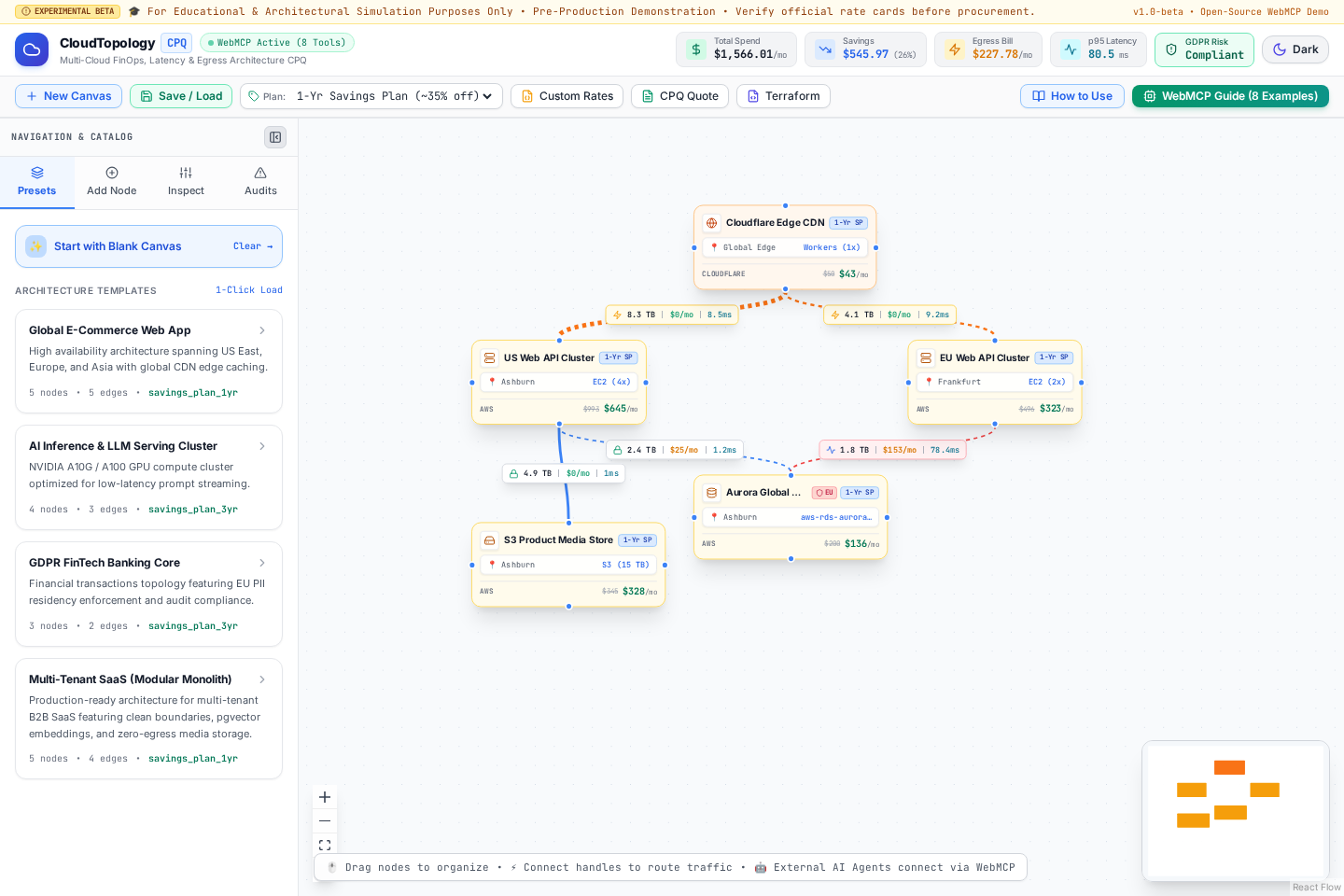
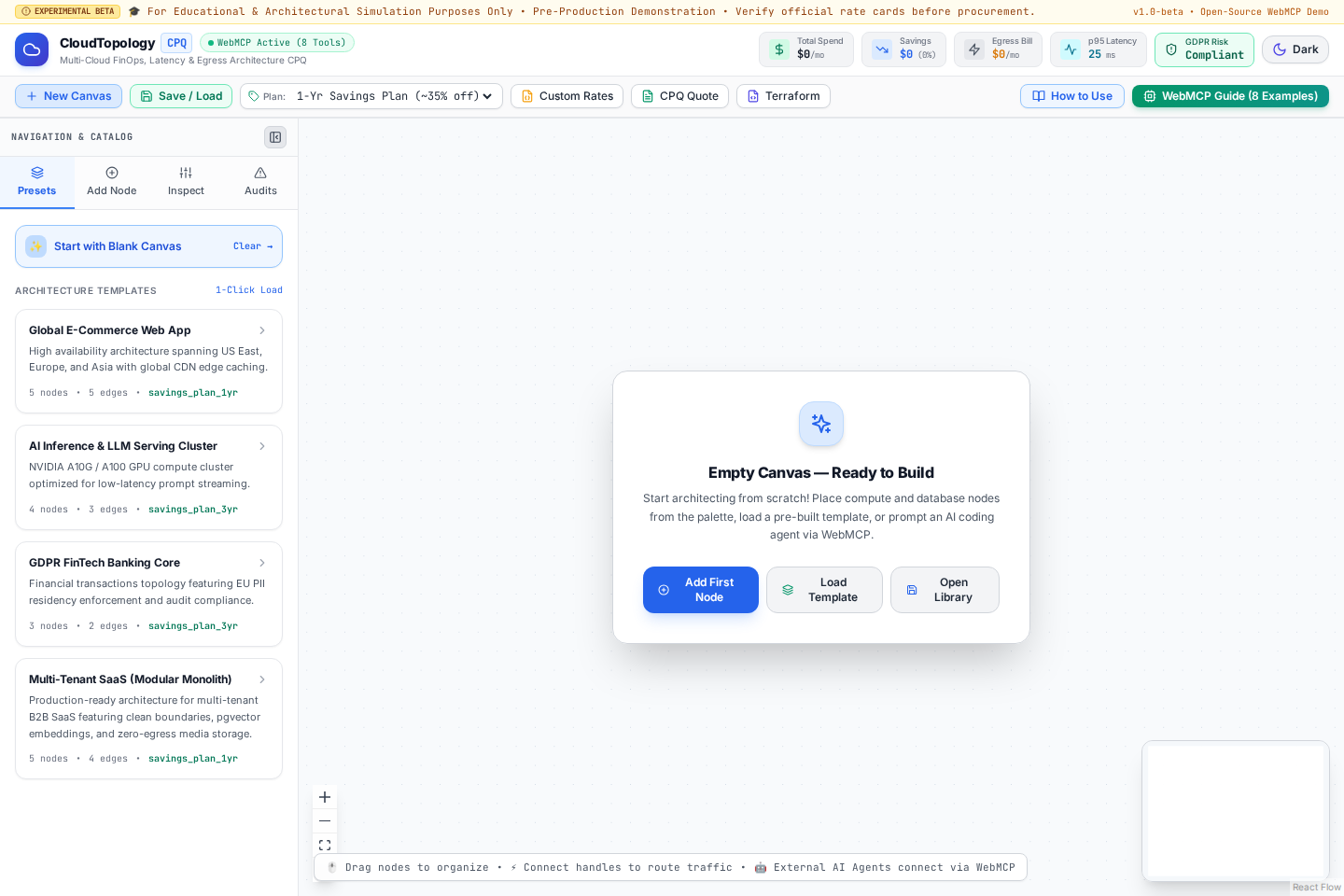
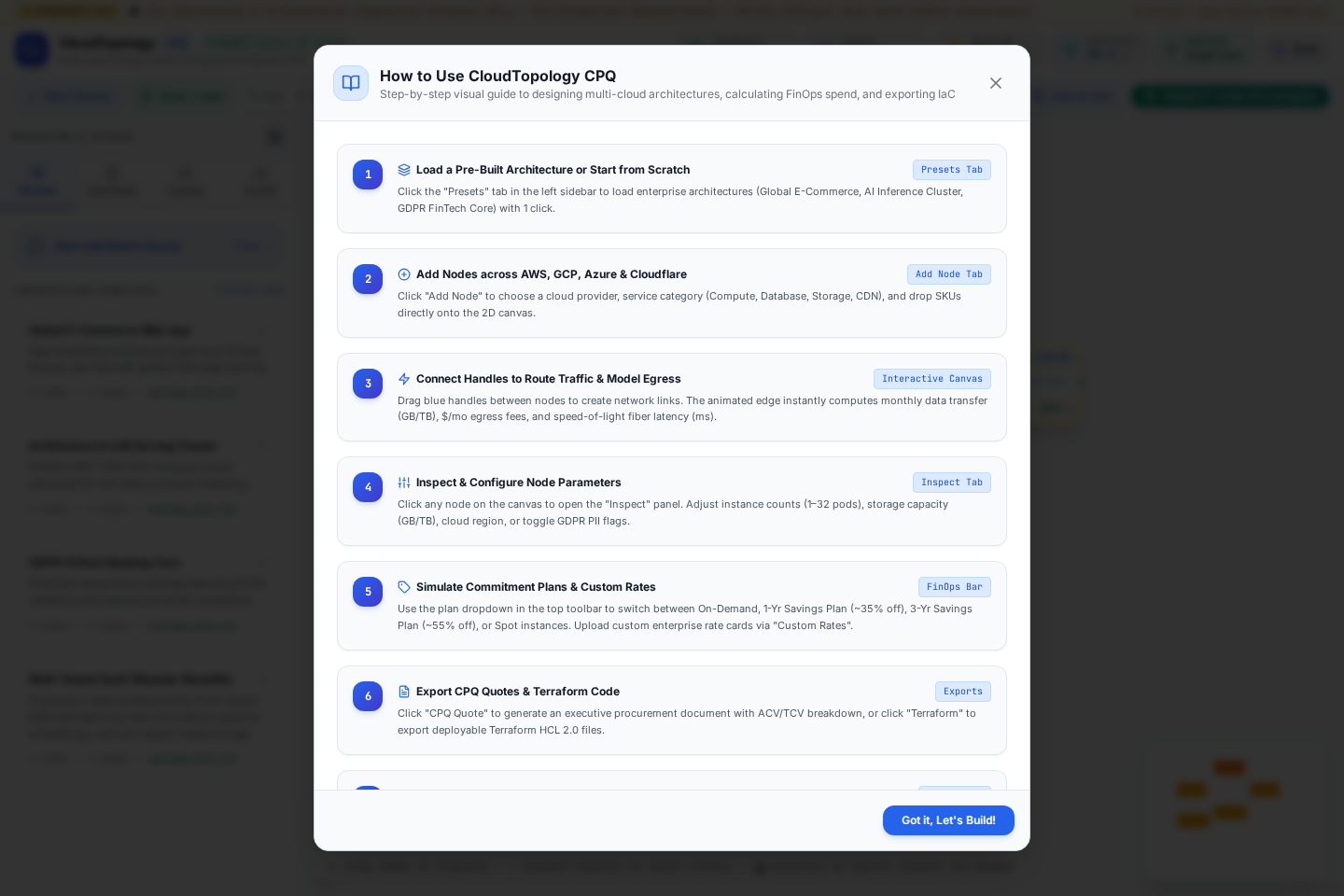
CloudTopology CPQ turns architecture diagrams into a live, FinOps-driven simulation canvas:
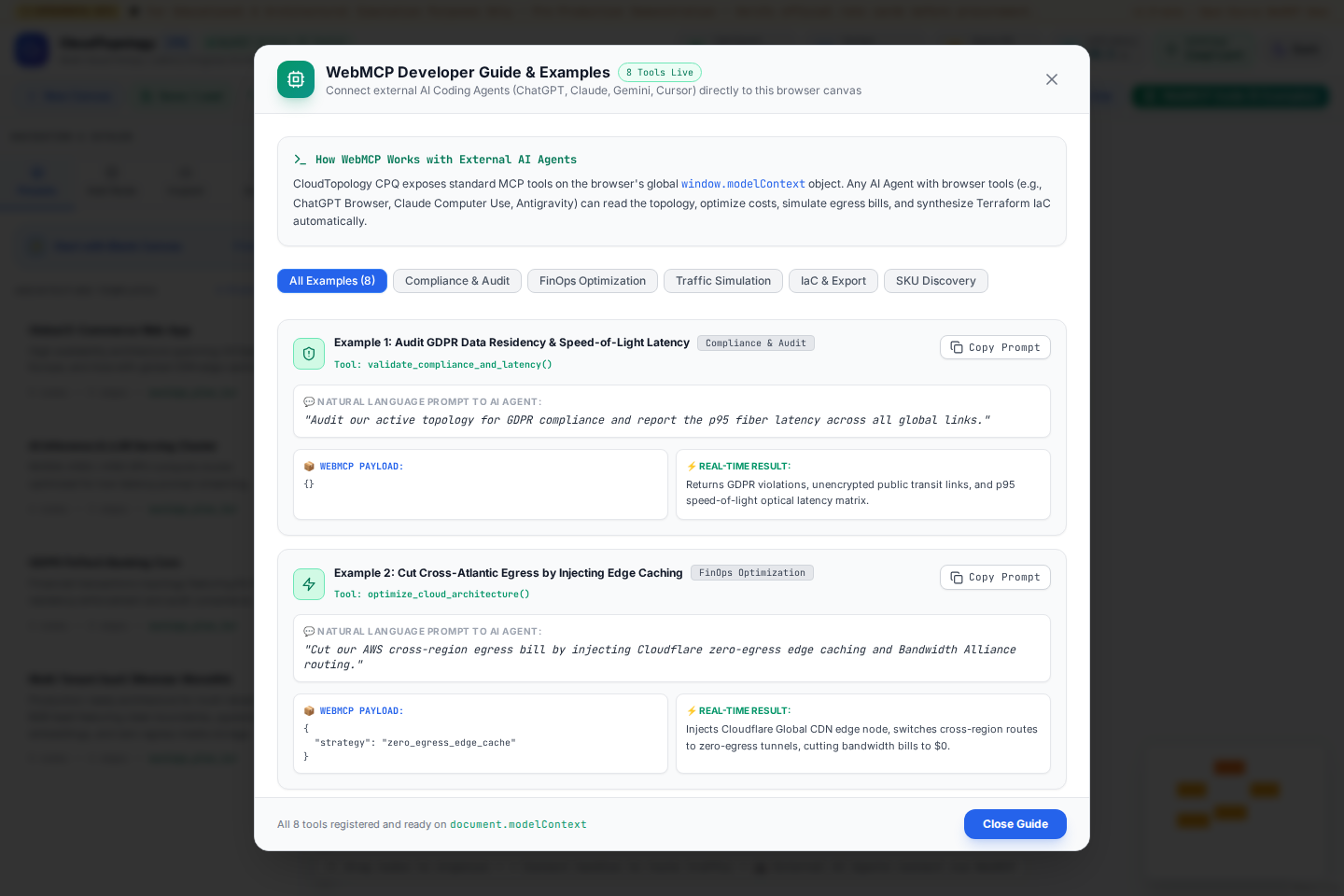
🤖 Autonomous WebMCP 8-Tool Suite: Exposes 8 typed tools directly on
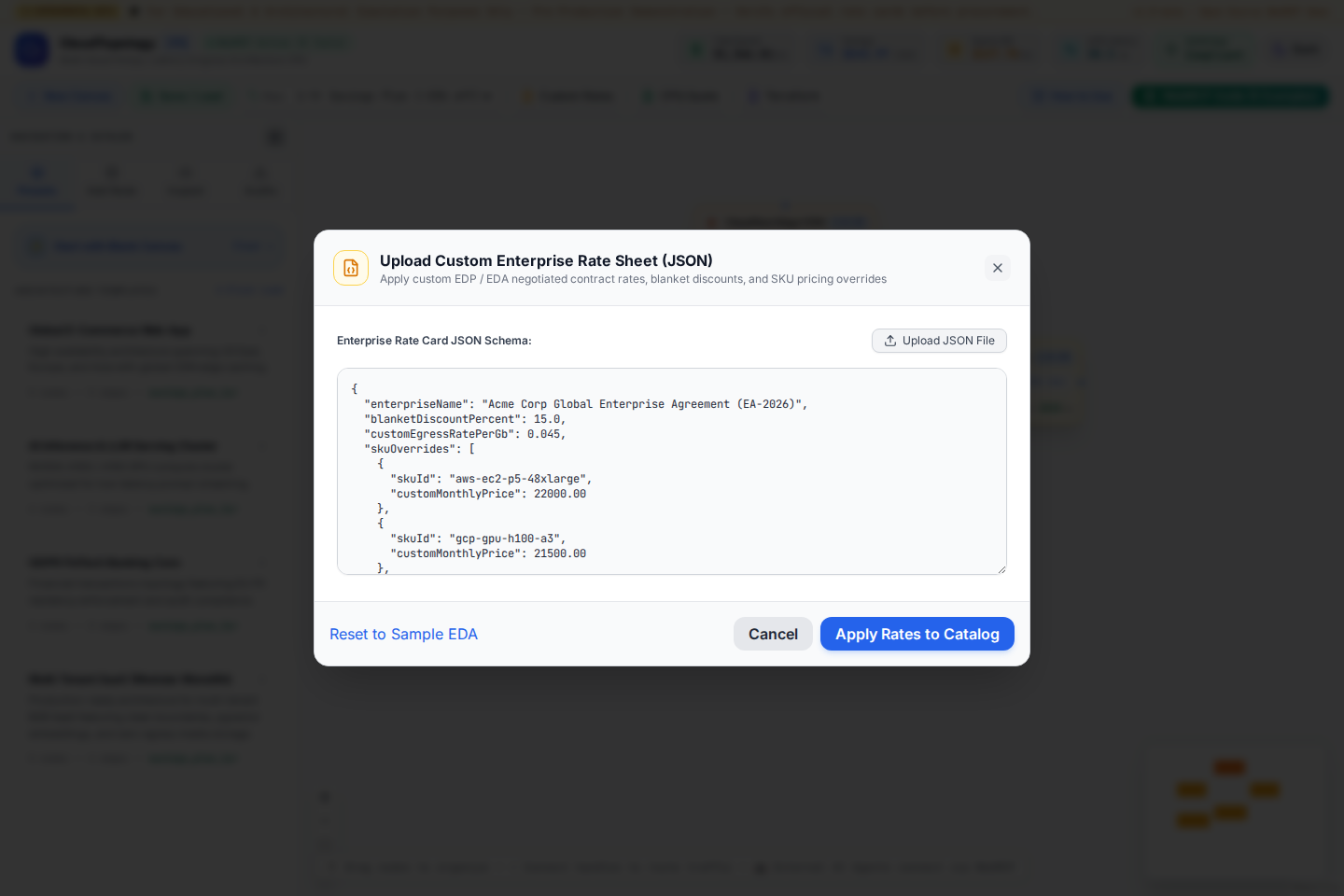
window.modelContextanddocument.modelContext. External AI agents (ChatGPT, Claude, Gemini, Antigravity) can query 50+ enterprise SKUs, programmatically generate or alter topologies, optimize commitment plans, and simulate network traffic in real time.💰 Real-Time Multi-Cloud FinOps Engine: Instantly calculates costs across On-Demand, 1-Year Savings Plans (~35% off), 3-Year Savings Plans (~55% off), and Spot Fleets (~65% off), with support for uploading custom negotiated Enterprise Discount Agreements (EDA).
⚡ Piecewise Cross-Region Egress Simulation: Accurately models non-linear, tiered bandwidth tariffs.
🌍 Geodesic Speed-of-Light Latency Modeling: Uses the Haversine great-circle distance formula between global datacenters to calculate physical optical fiber propagation time
🇪🇺 Built-In GDPR & Compliance Auditing: Automatically scans the active topology to flag databases storing EU PII outside sovereign European regions and detects unencrypted cross-cloud transit, offering 1-click remediation.
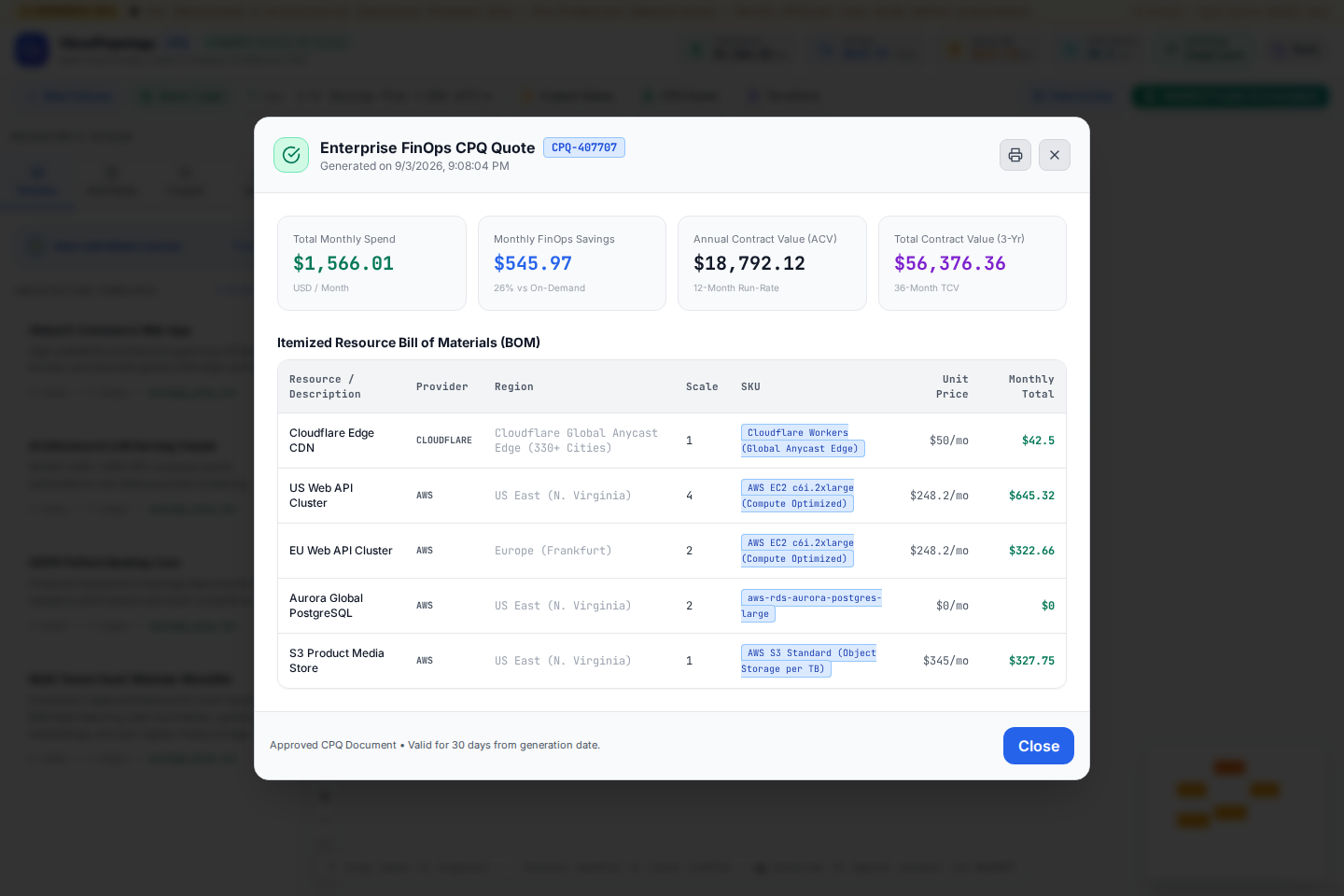
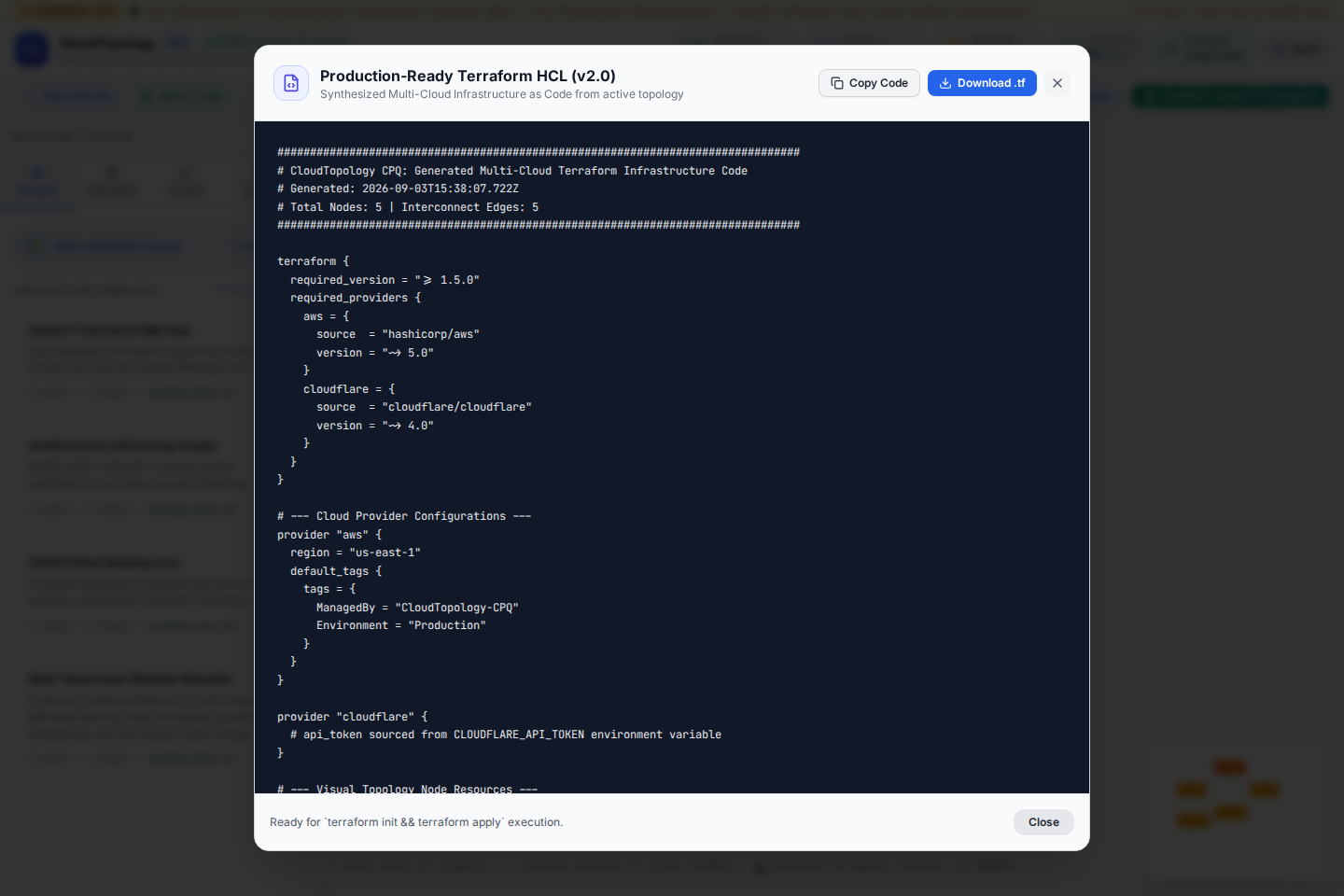
📋 Enterprise CPQ Quotes & Terraform IaC Export: Generates formal itemized CPQ procurement proposals (with ACV and 3-Year TCV breakdowns) and produces deployable Terraform HCL 2.0 configuration files.
💾 Project Persistence & Themes: Features auto-saving to
localStorage, a "My Saved Setups" project library, 1-click.jsonexport and import, and seamless toggling between high-contrast Light Theme (default) and Obsidian Dark Theme.
How we built it
- Interactive Frontend: Built with React 18, Vite, TypeScript, Tailwind CSS, and
@xyflow/react(React Flow) for 60fps hardware-accelerated SVG/canvas rendering. - WebMCP Architecture (
src/tools/modelContextBridge.ts): Implemented an open WebMCP bridge that registers typed tool schemas on bothwindow.modelContextanddocument.modelContext. We built a Universal JSON Normalizer that can parse flat AI responses, nested coordinate trees, or partial parameter maps from external LLMs. - FinOps Calculation Core (
src/engine/finopsEngine.ts): Created a deterministic pricing engine that enforces stateful vs. stateless pricing tiers, calculates piecewise egress curves, parses custom enterprise rate cards (rateCardParser.ts), and synthesizes Terraform HCL (terraformGenerator.ts). - Automated Verification: automated unit tests using Vitest covering WebMCP tool schemas, rate-card discount logic, egress calculations, and GDPR validation rules.
Challenges we ran into
- Real-World ChatGPT In-App WebMCP Payload Mismatches: When we tested the live app with ChatGPT Desktop asking it to create a multi-tenant SaaS architecture, ChatGPT called
apply_topology_to_canvaswith a flat list of node names and connections without X/Y pixel coordinates or pricing IDs. To make the app truly agent-friendly, we wrote a Universal AI Normalizer that auto-arranges node layout coordinates on a clean grid, maps plain-text provider names to real catalog SKUs, and infers default configurations automatically. - Google choreme webmcp not worked on Ubuntu I have first tried webmcp trial on google chrome, on my ubuntu laptop, but it was not worked. Hence decided to use chatgpt in app browser.
Accomplishments that we're proud of
- True Agent-Human Collaboration: external AI agents (like ChatGPT) can actually connect to the running browser app via WebMCP, inspect the catalog, add nodes, optimize commitment plans, and update the visual canvas in real time.
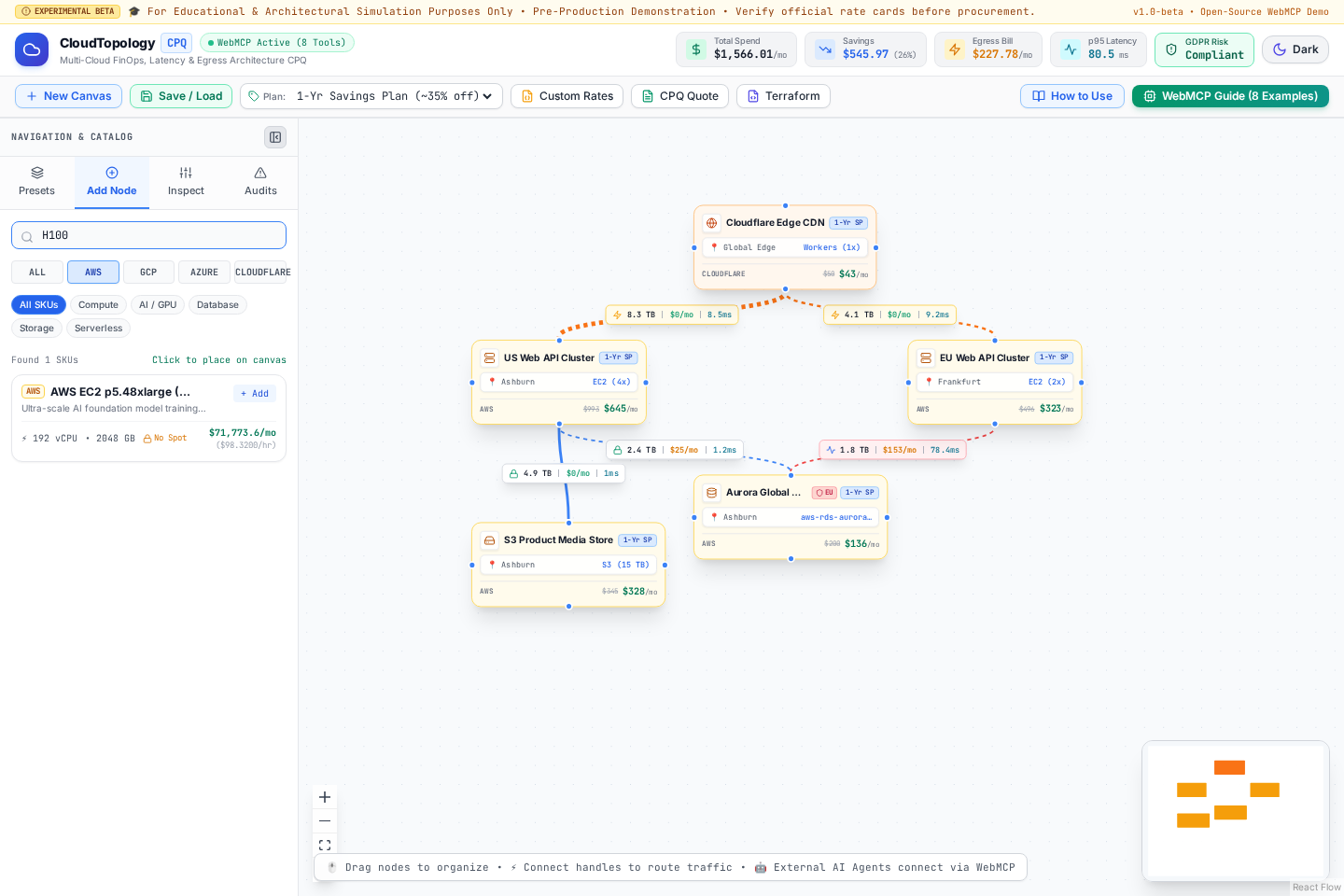
- Real 50+ Multi-Cloud SKU Catalog: Includes real-world enterprise hardware like NVIDIA H100 80GB (
p5.48xlarge, GCP A3, Azure ND96isr), AWS Graviton3, Aurora Serverless v2, Cloud Spanner, and Cloudflare Workers. - Production-Grade Outputs: The app does not just draw boxes; it generates genuine procurement-ready CPQ quote proposals and copy-pasteable Terraform HCL 2.0 infrastructure code.
What we learned
- WebMCP is the Future of Web Apps for AI: Exposing typed semantic JSON tool contracts via WebMCP is vastly superior to having AI agents take screenshots or attempt brittle pixel-based mouse clicks. It gives LLMs deterministic control over web applications with zero hallucinations.
What's next for CloudTopology CPQ
- Live Cloud Billing Ingestion: Connecting live AWS Cost Explorer, GCP Billing, and Azure Cost Management APIs to compare pre-deployment CPQ estimates against actual telemetry.
- CDK & Pulumi Synthesizers: Expanding IaC generation beyond Terraform to include AWS CDK (TypeScript/Python) and Pulumi stacks.
Built With
- finops
- model-context-protocol
- react
- react-flow
- tailwindcss
- terraform
- typescript
- vite
- webmcp

Log in or sign up for Devpost to join the conversation.