-
-
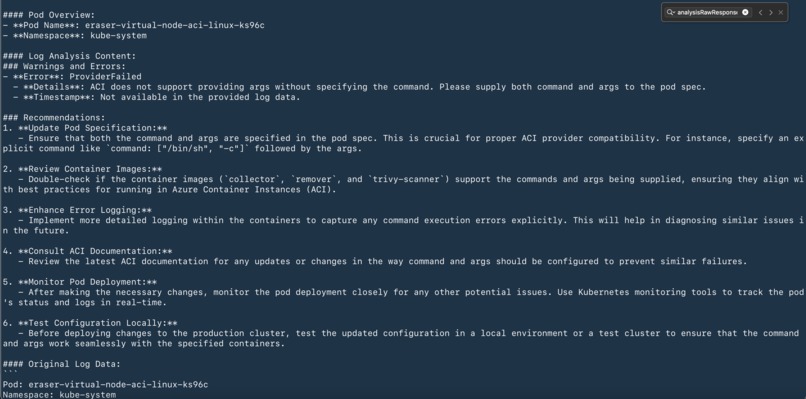
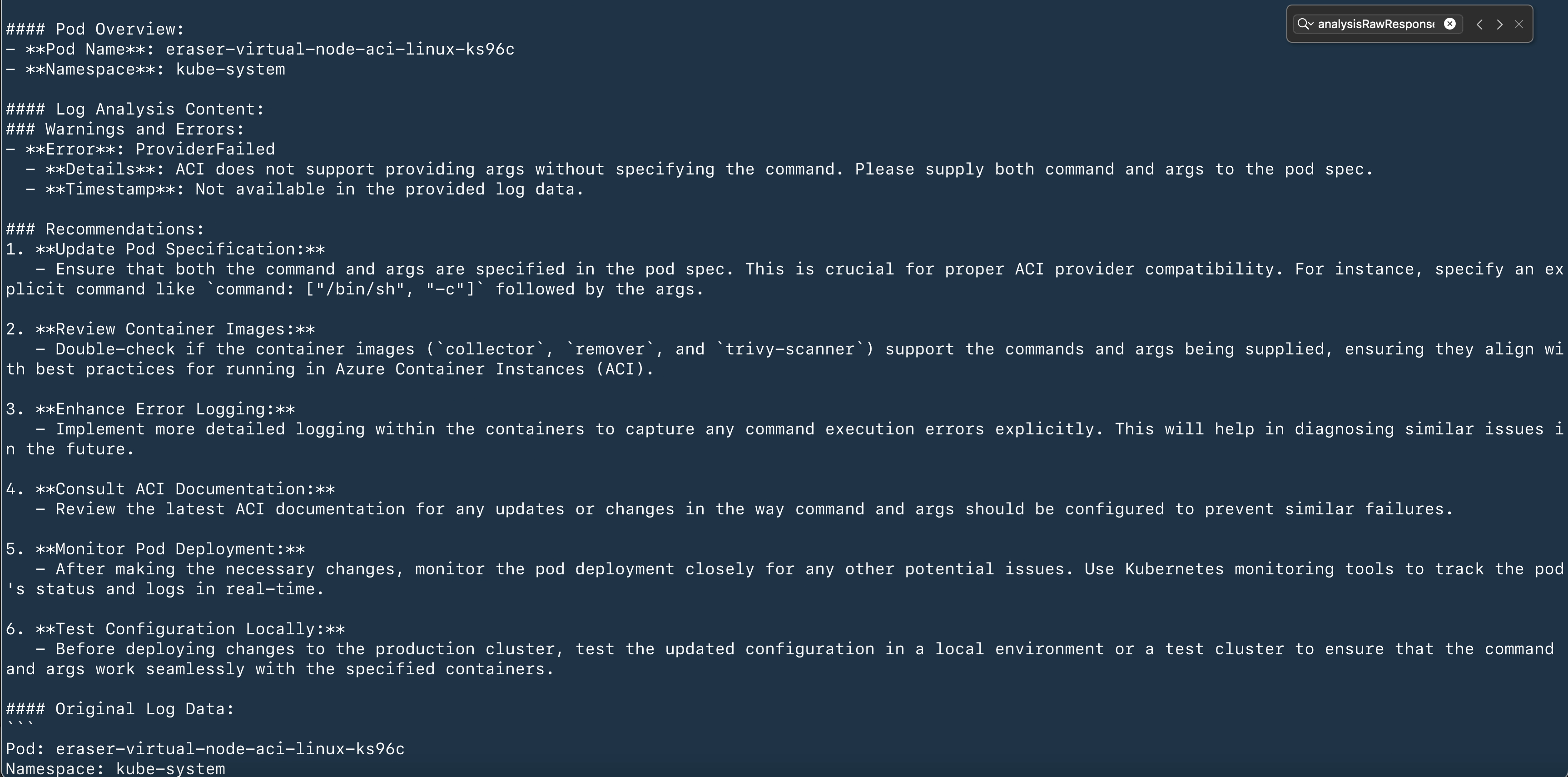
ASAP-AzureKubernetesService-log-analyzer-RAG report on Kubernetes "ProviderFailed" error in ACI, including diagnostics and logs.
-
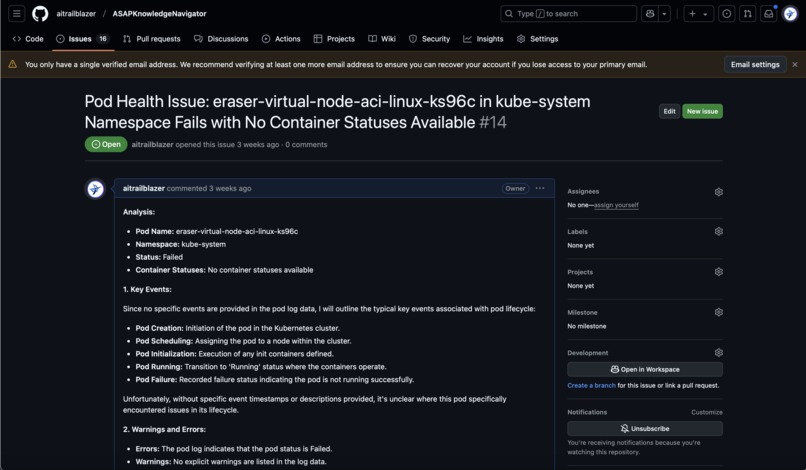
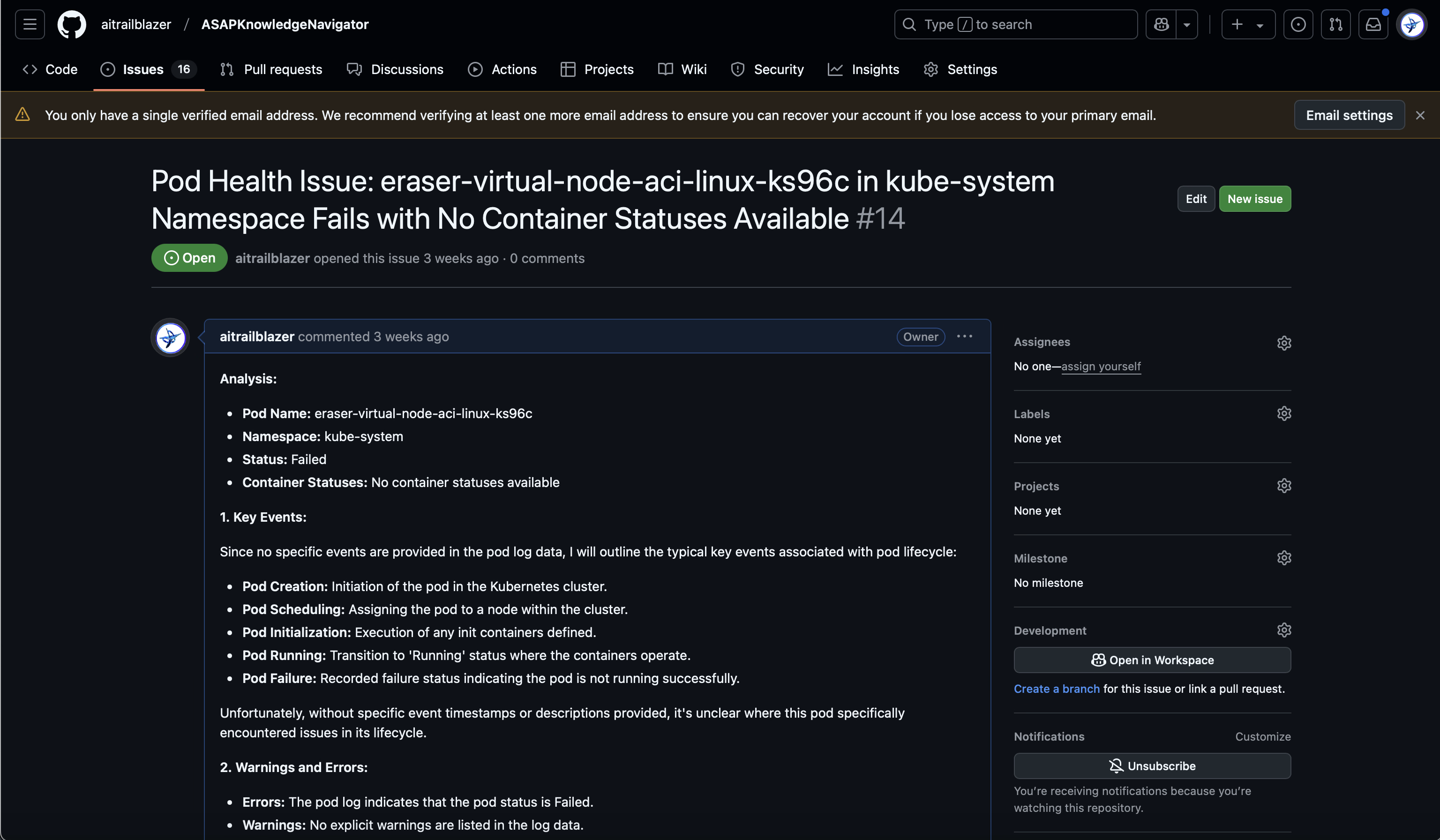
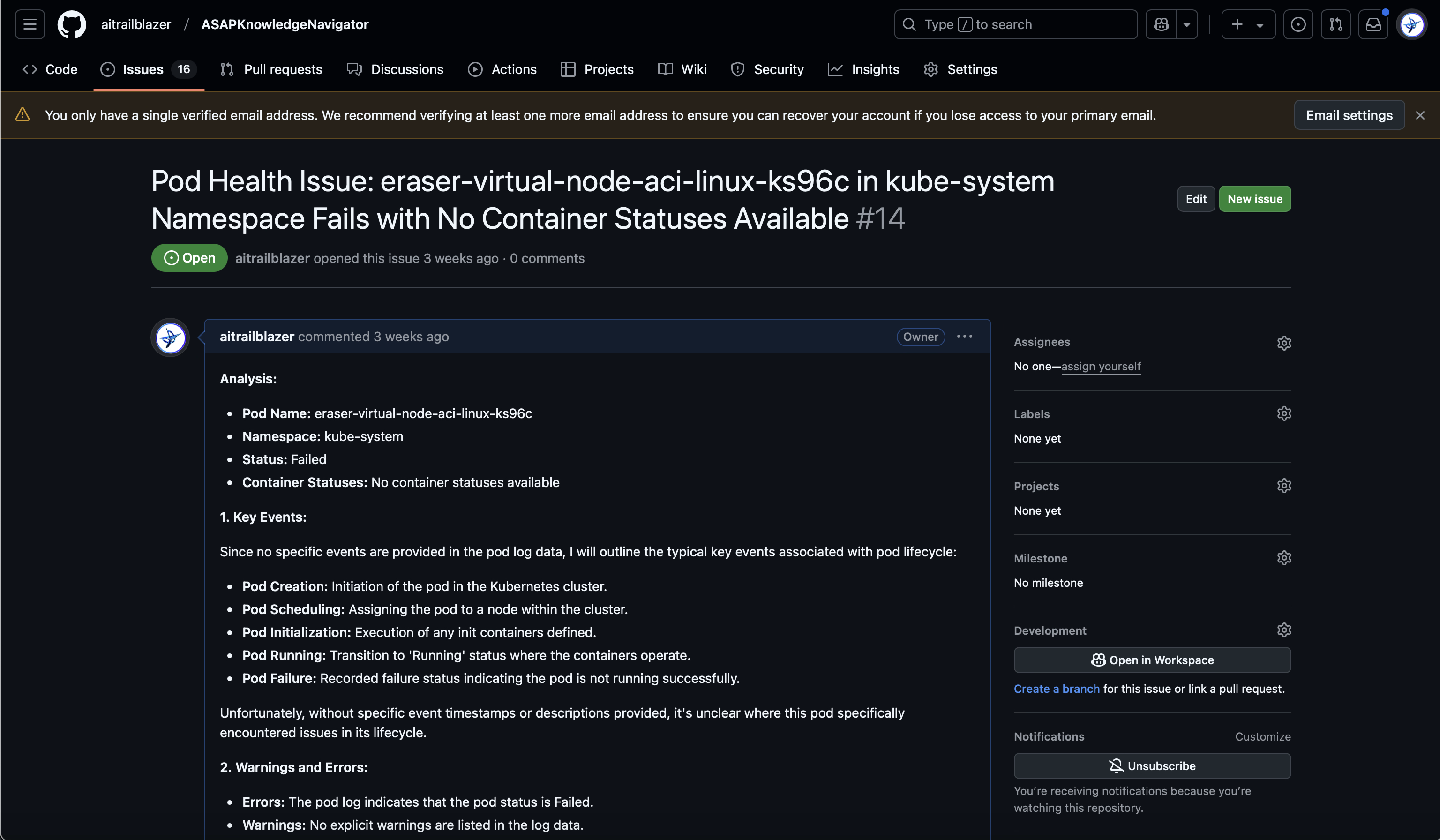
GitHub issue #14 in ASAPKnowledgeNavigator: Failed Kubernetes pod "eraser-virtual-node-aci-linux-ks96c" with no container statuses.
-
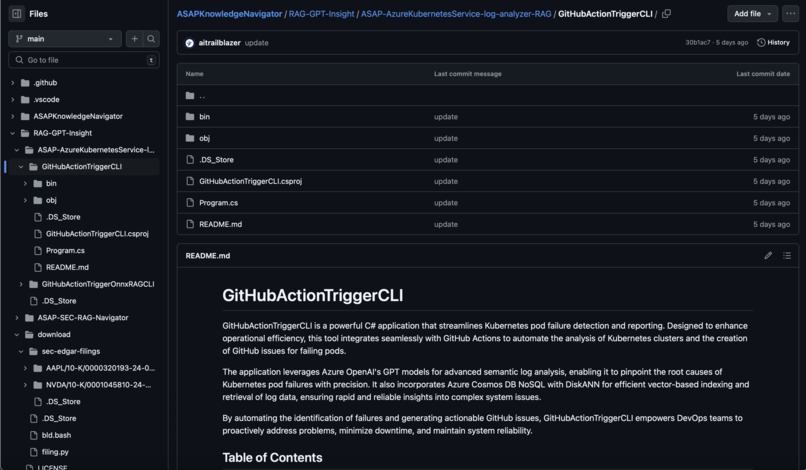
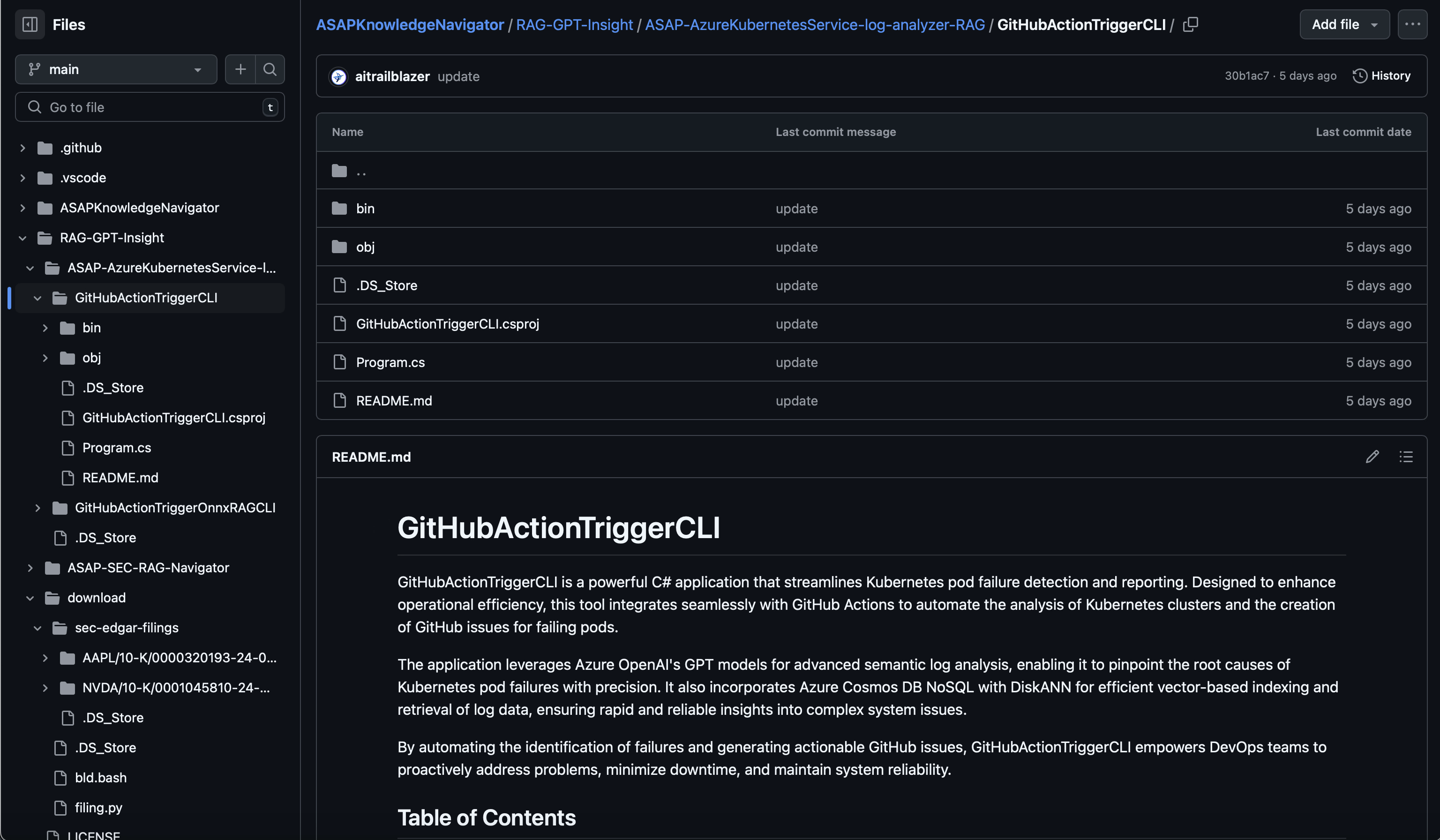
GitHub repository for GitHubActionTriggerCLI within ASAP Knowledge Navigator, showing project files and README.
-
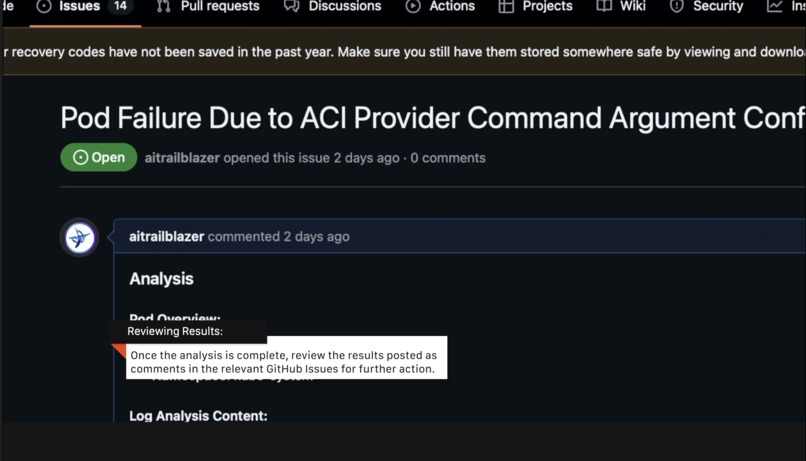
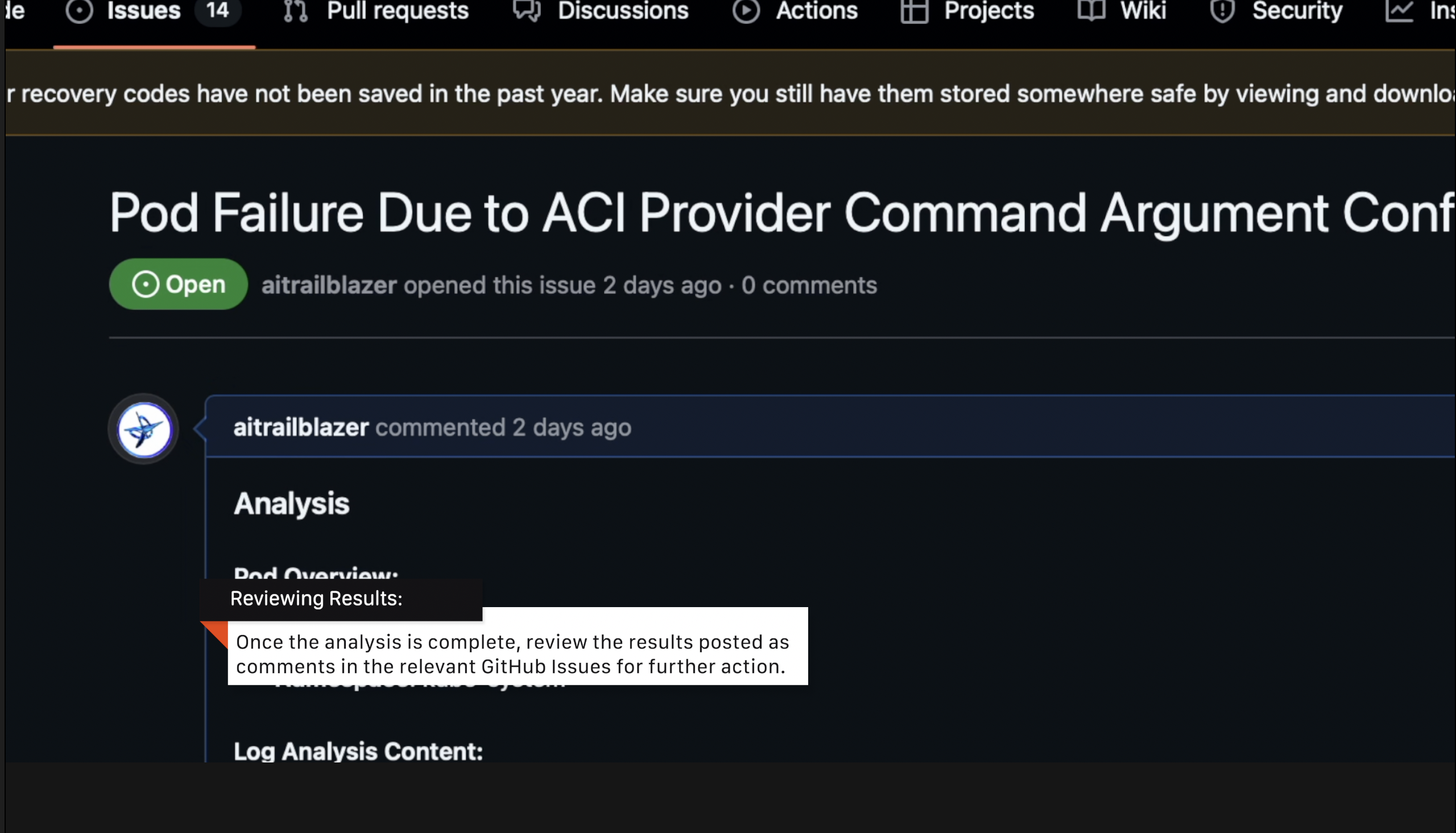
GitHub Issue: Pod failure analysis in progress.
-
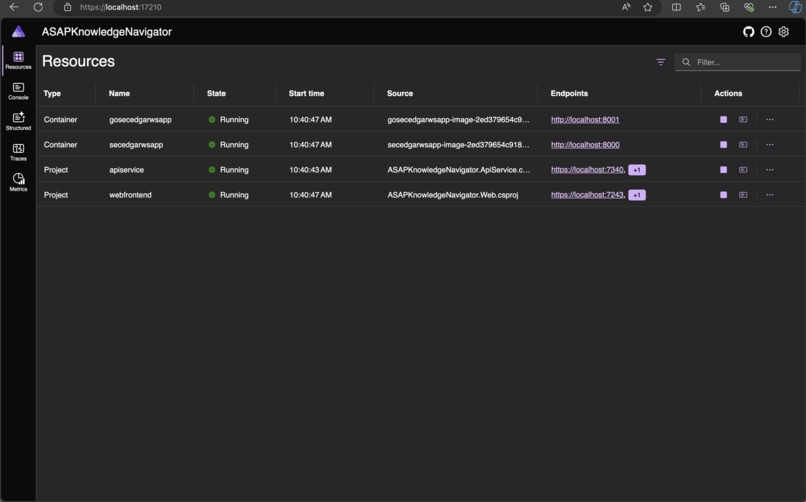
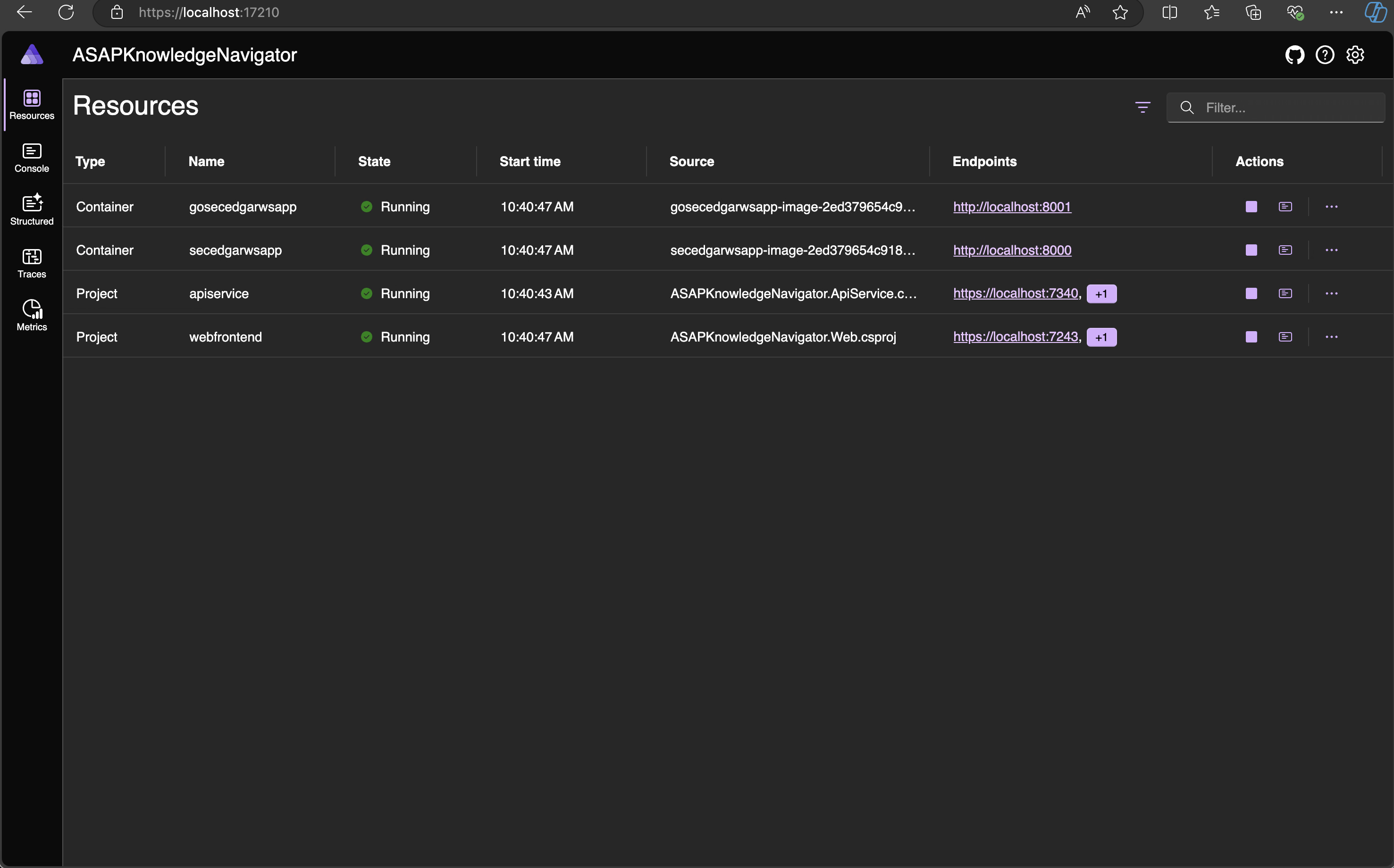
ASAP Knowledge Navigator: Resources overview with running containers and projects.
-
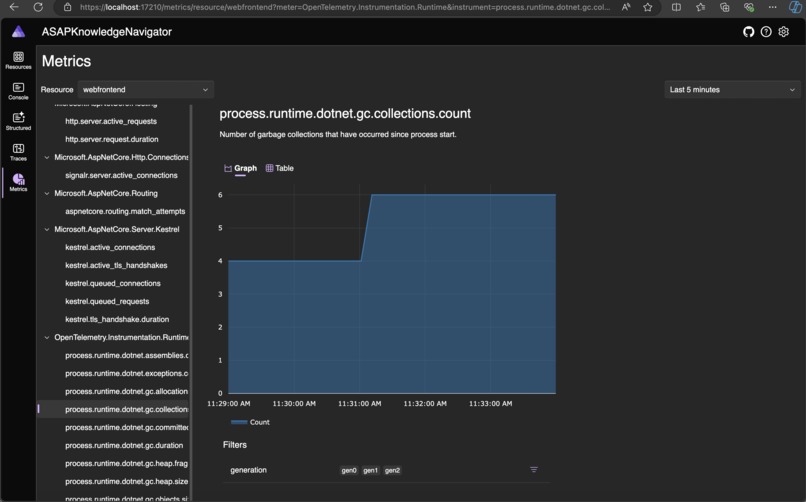
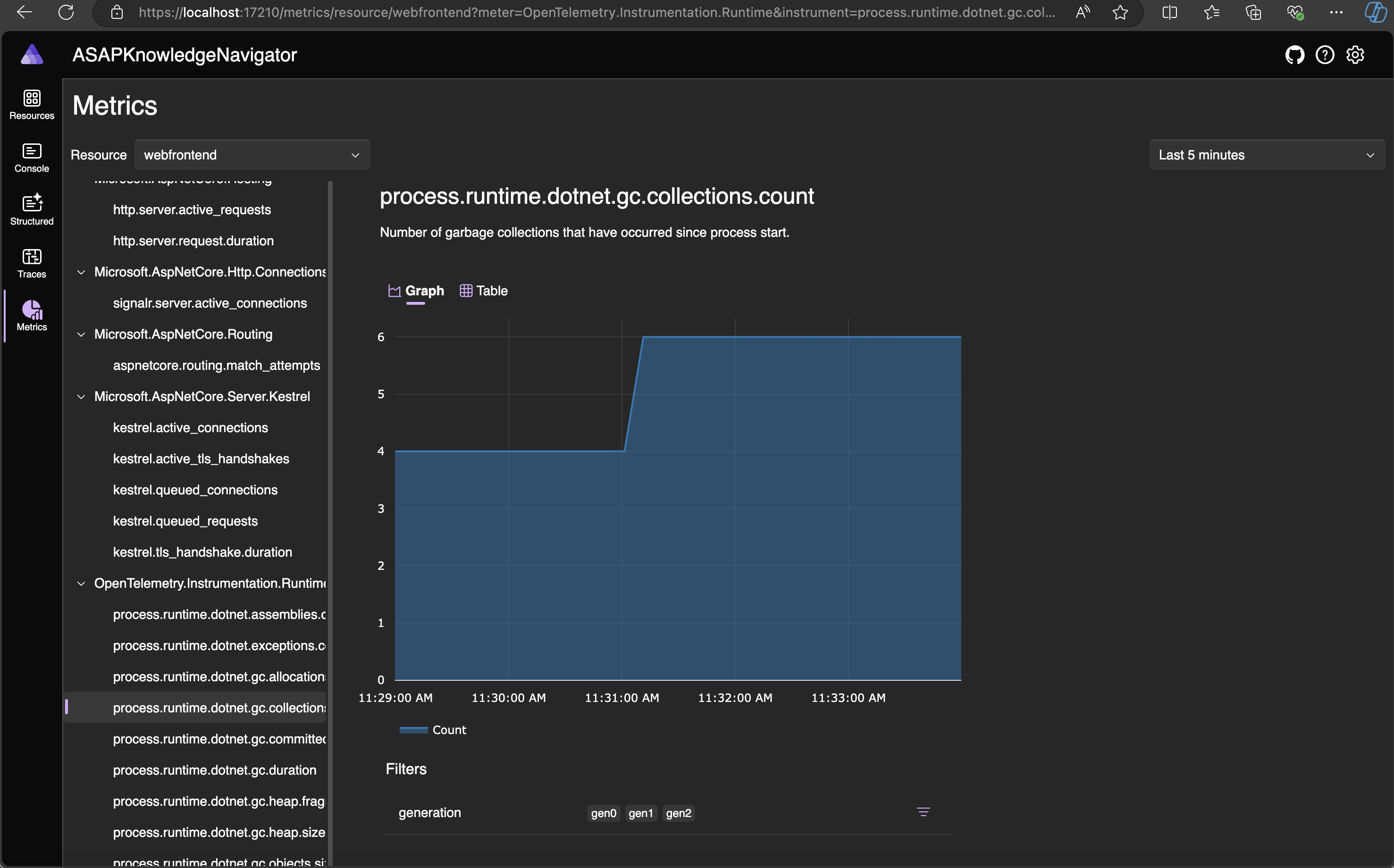
ASAP Knowledge Navigator: .NET garbage collection metrics over 5 minutes.
-
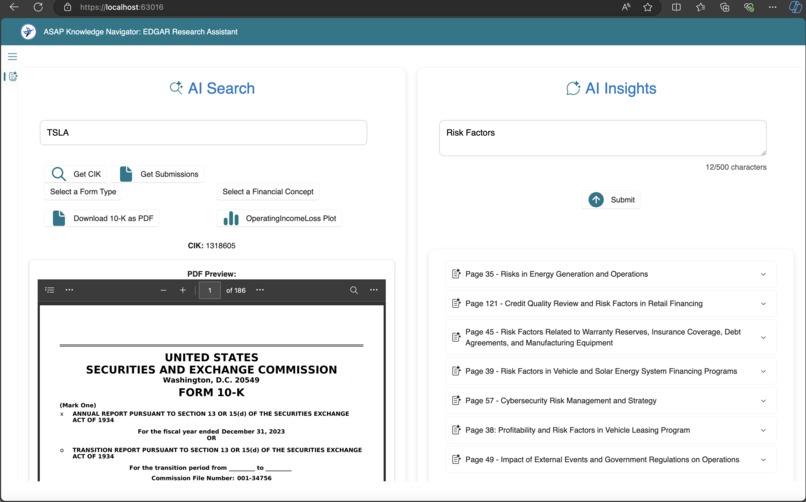
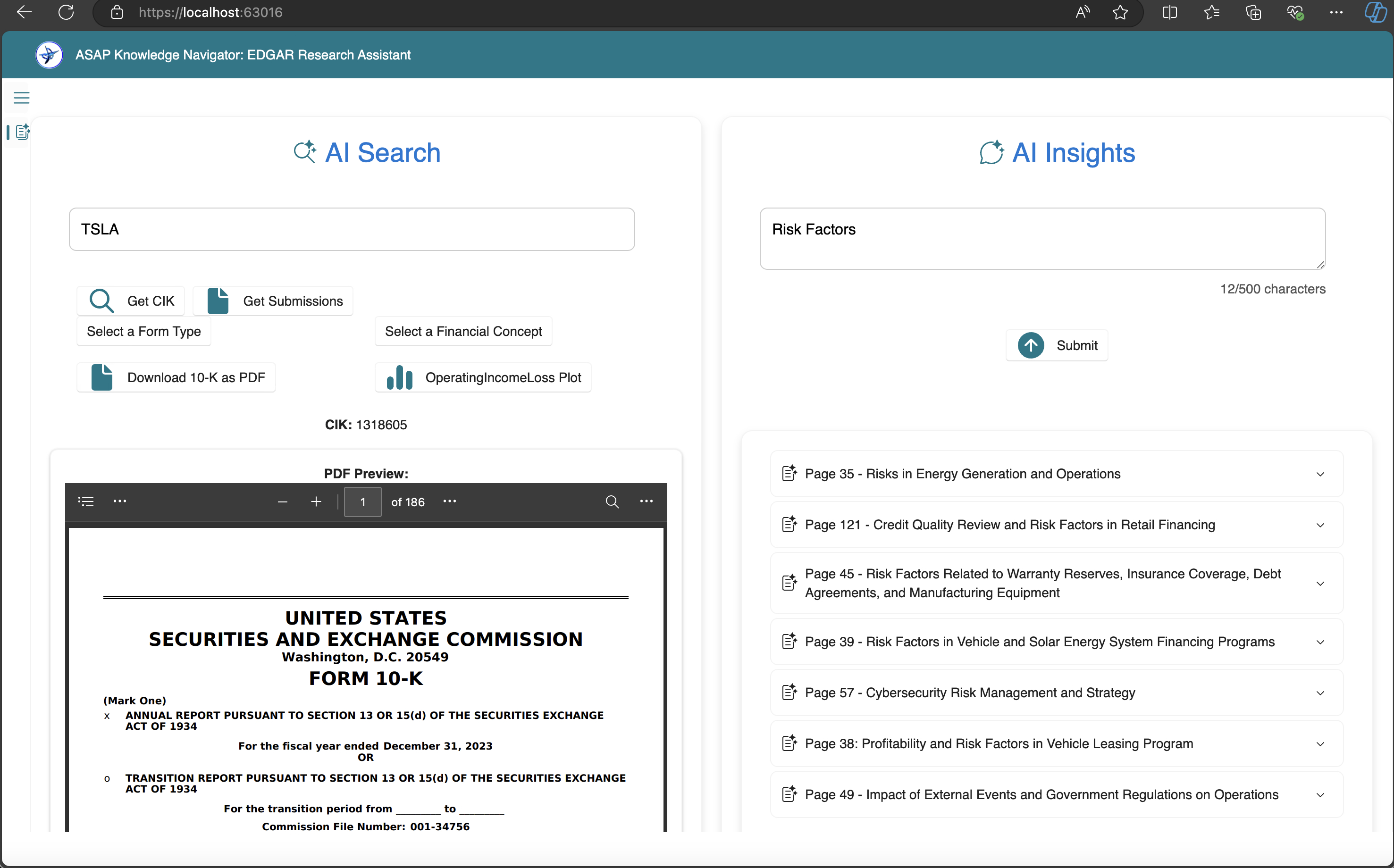
ASAP Knowledge Navigator: AI-powered EDGAR filing search and insights for TSLA.
-
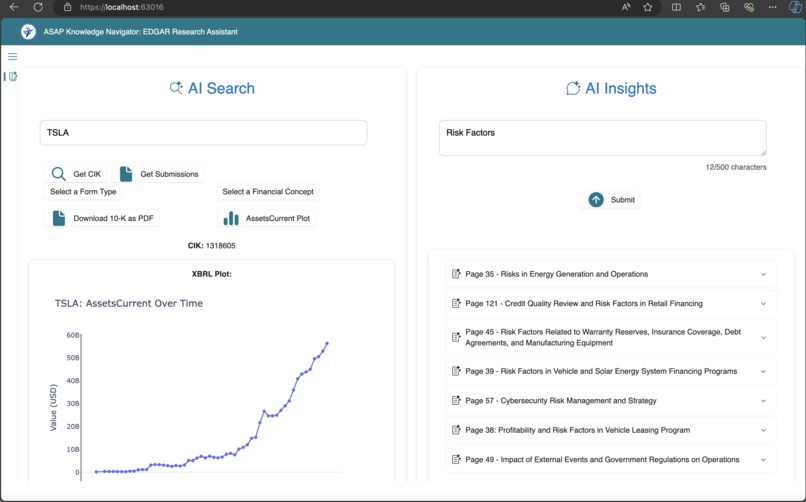
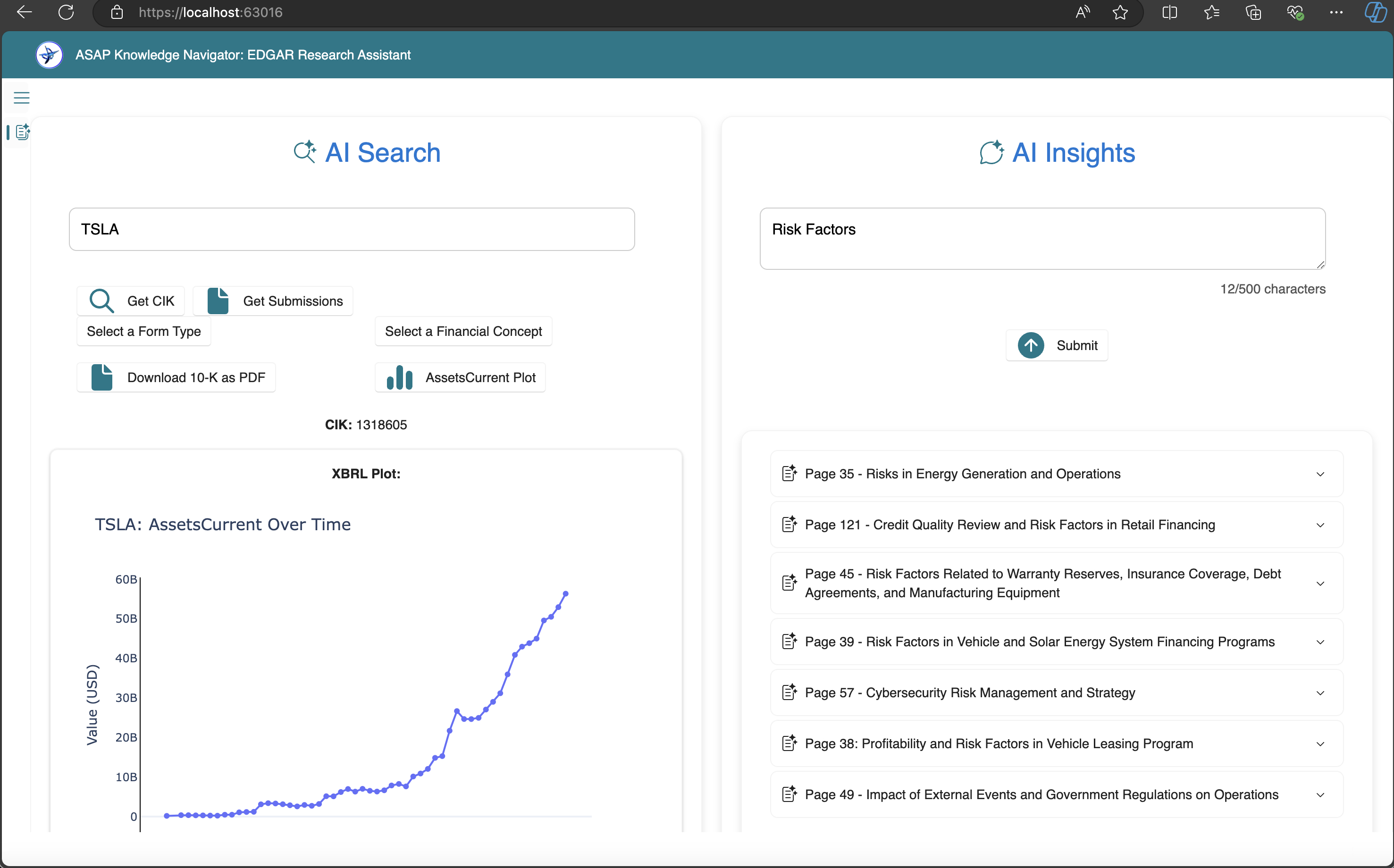
"ASAP Knowledge Navigator: TSLA's AssetsCurrent graph and risk factor insights."
-
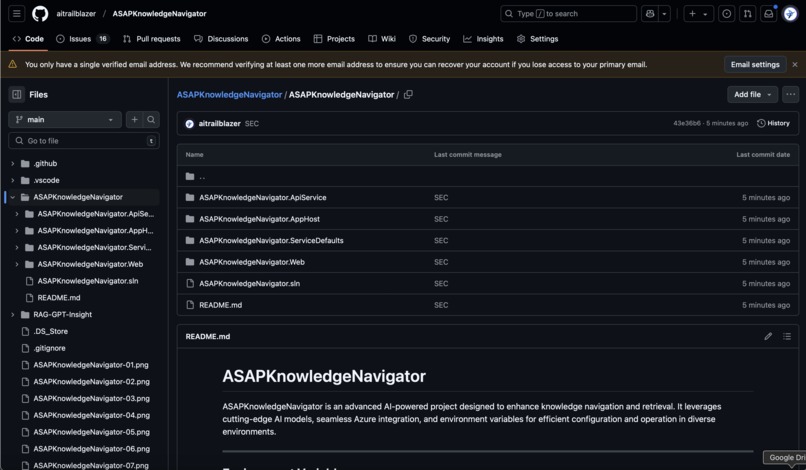
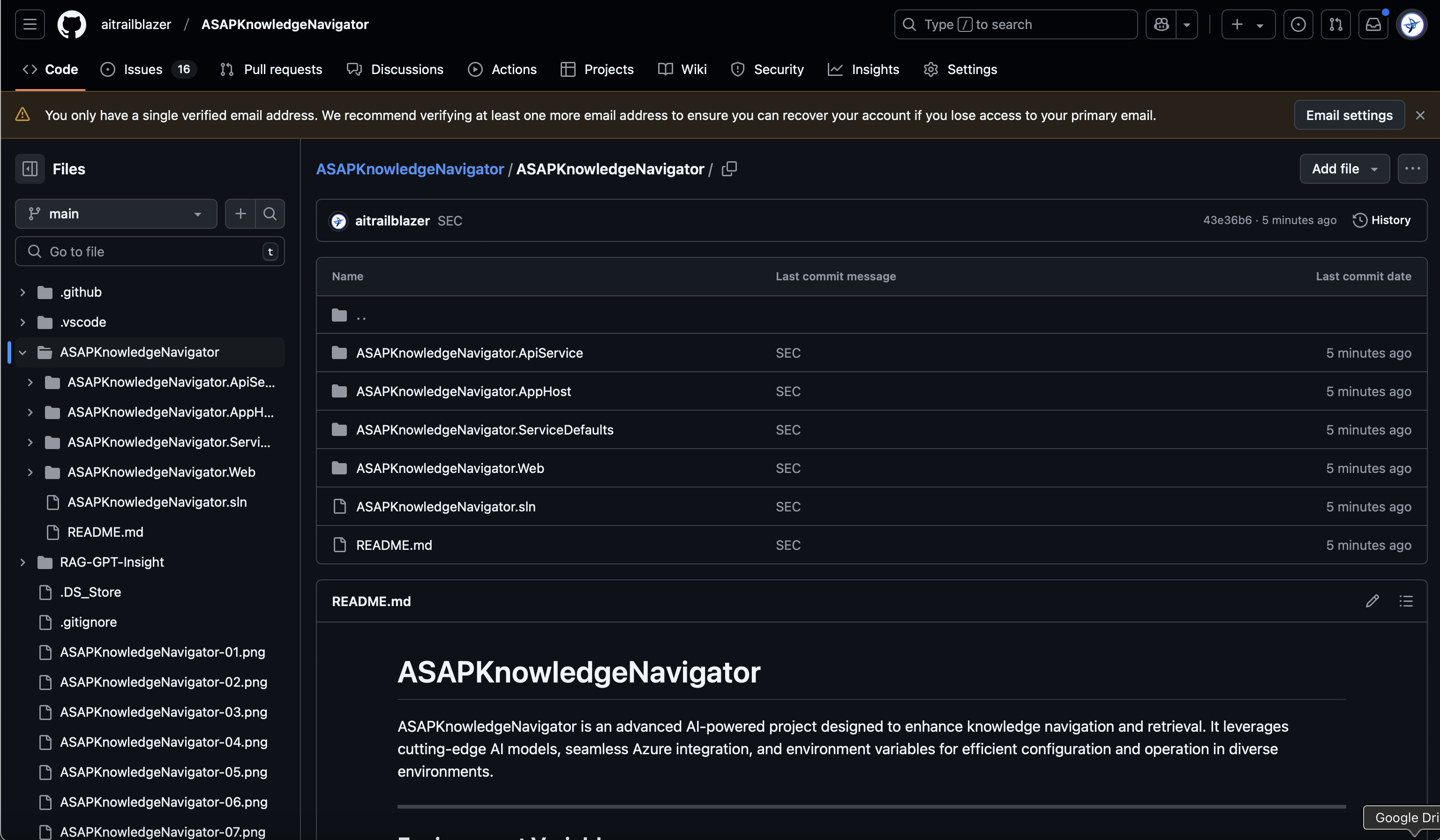
GitHub repository view of the ASAPKnowledgeNavigator project, showing the main project structure and README.
-
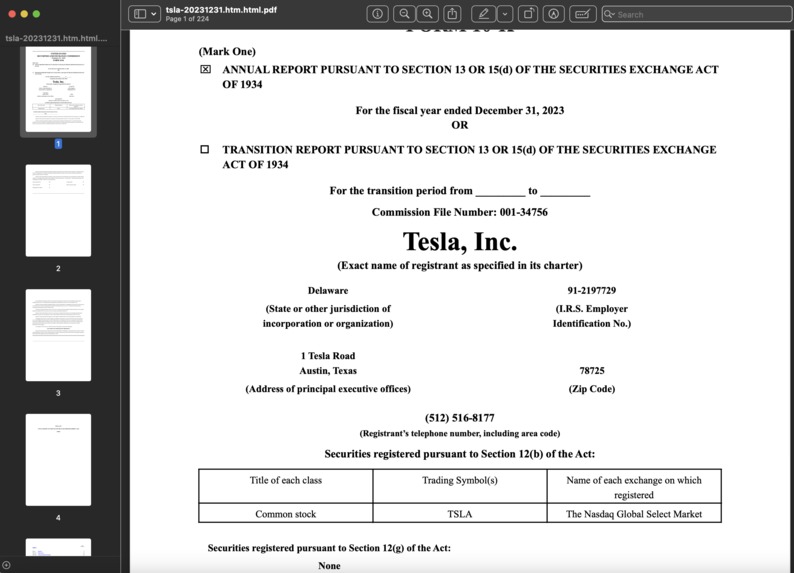
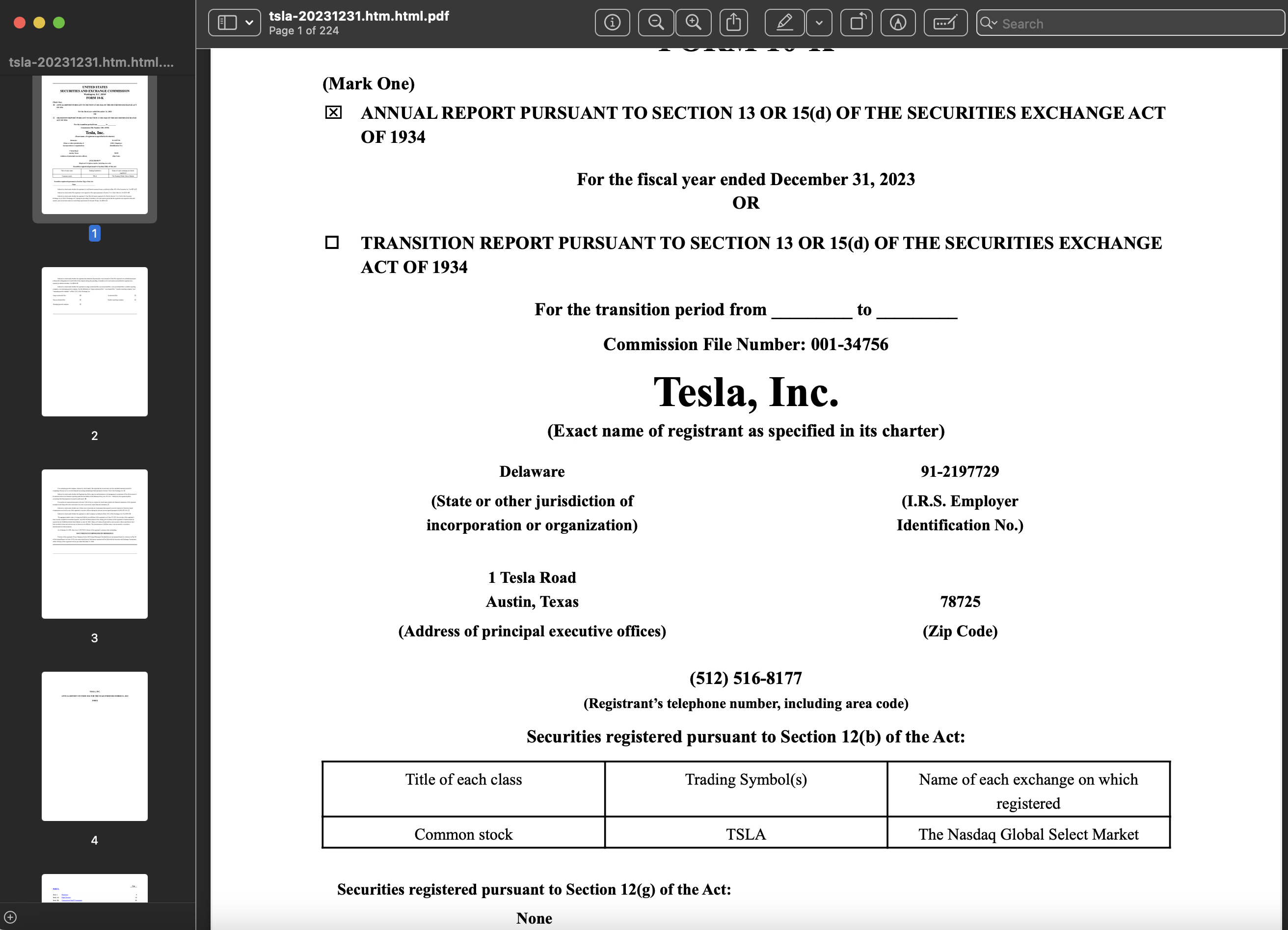
First page of Tesla, Inc.'s 10-K annual report for 2023 (PDF), showing standard SEC filing information.
-
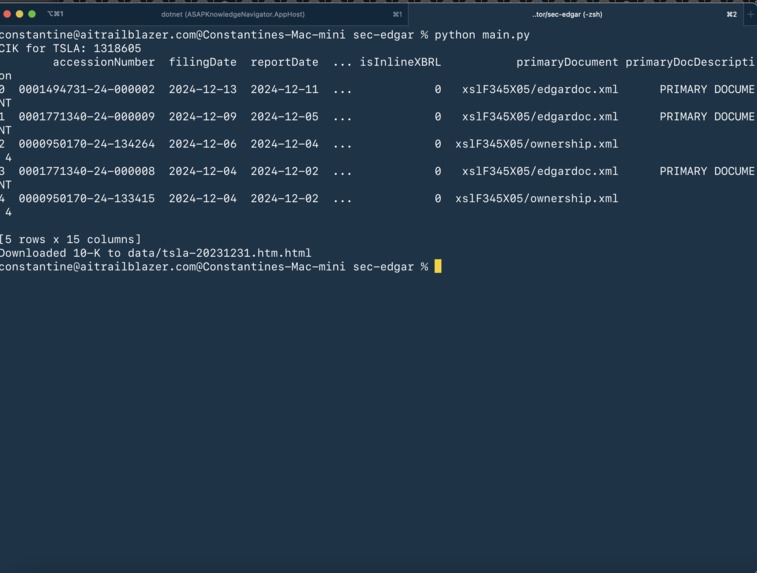
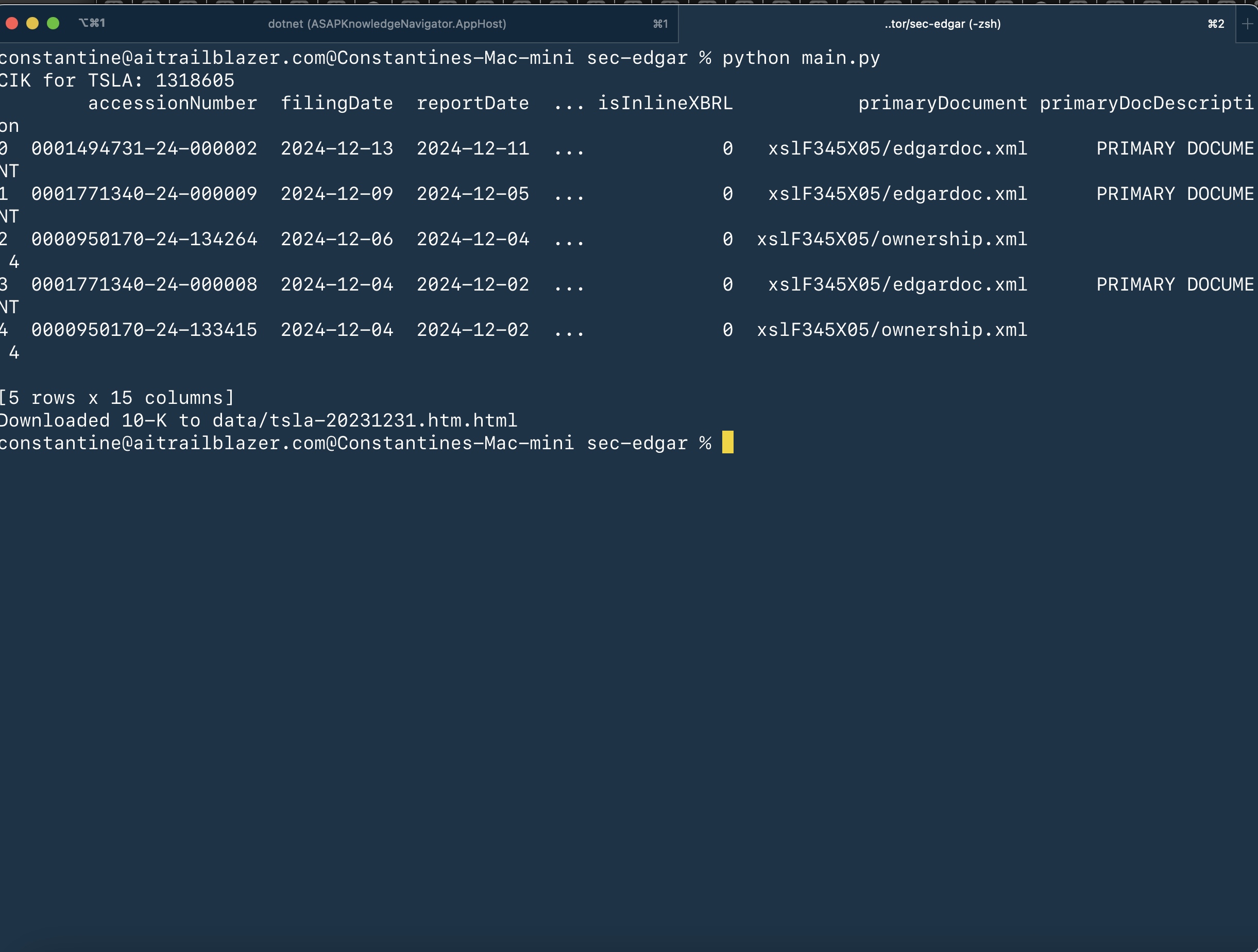
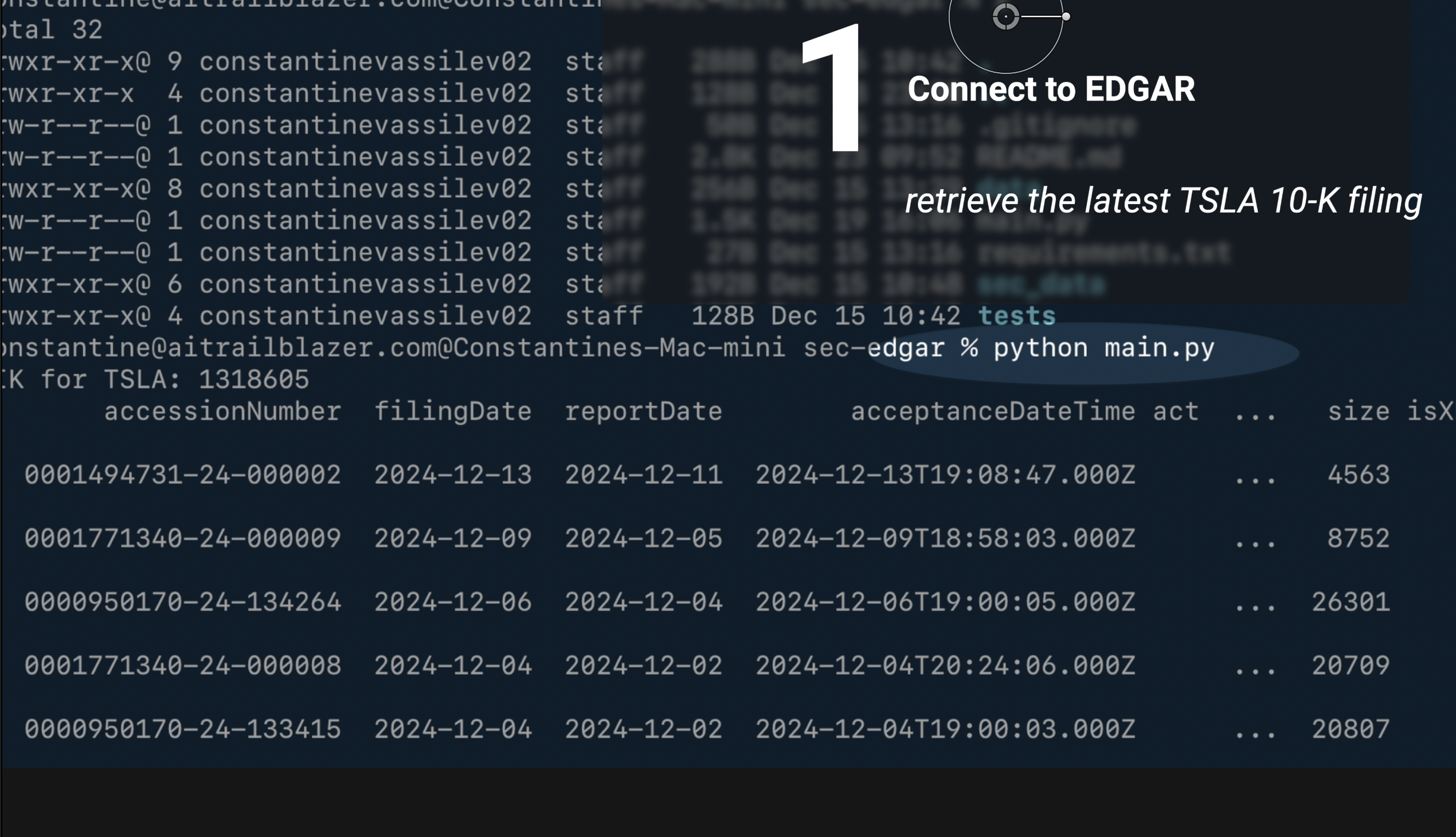
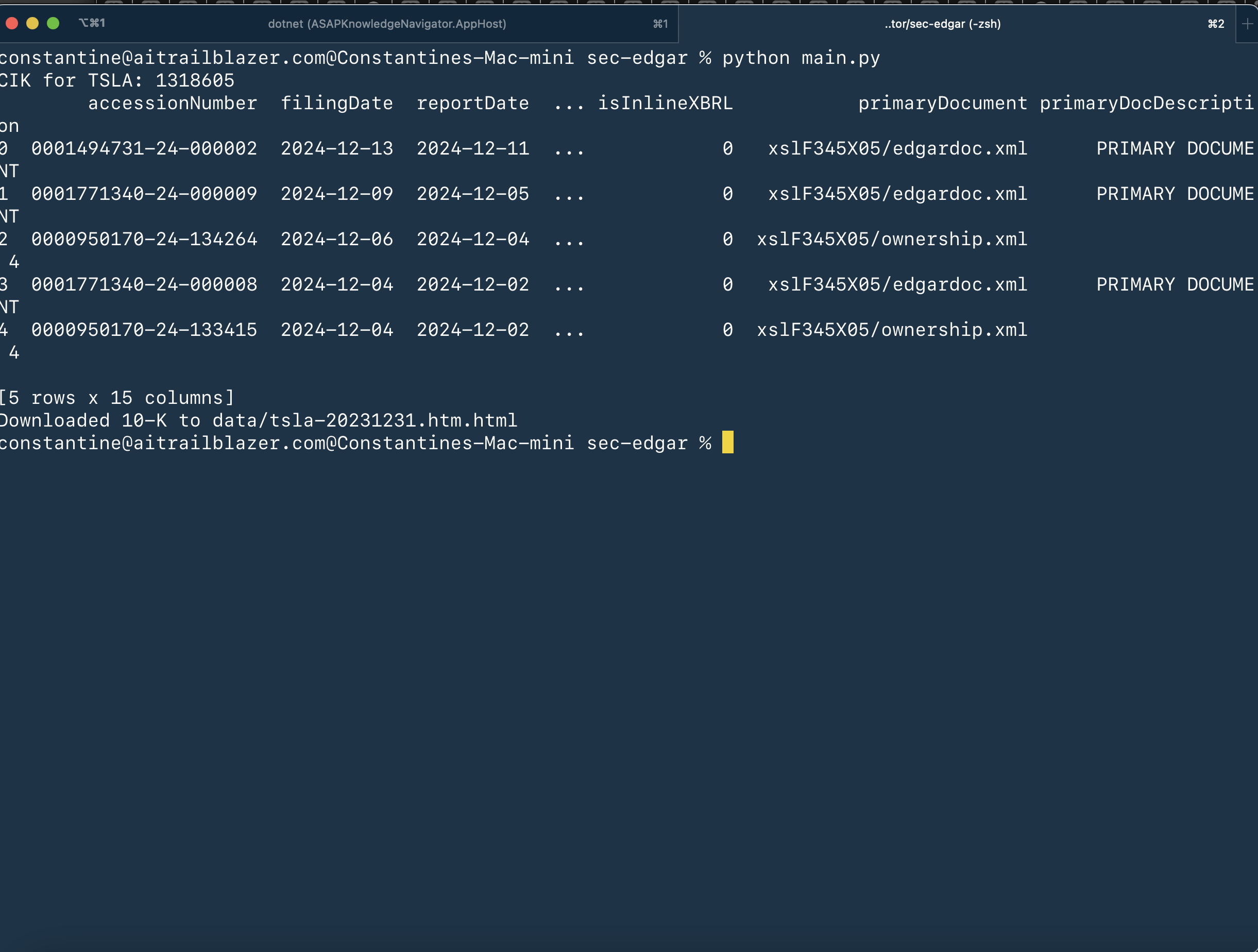
sec-edgar tool in action: Retrieving TSLA's CIK and downloading its 2023 10-K report.
-
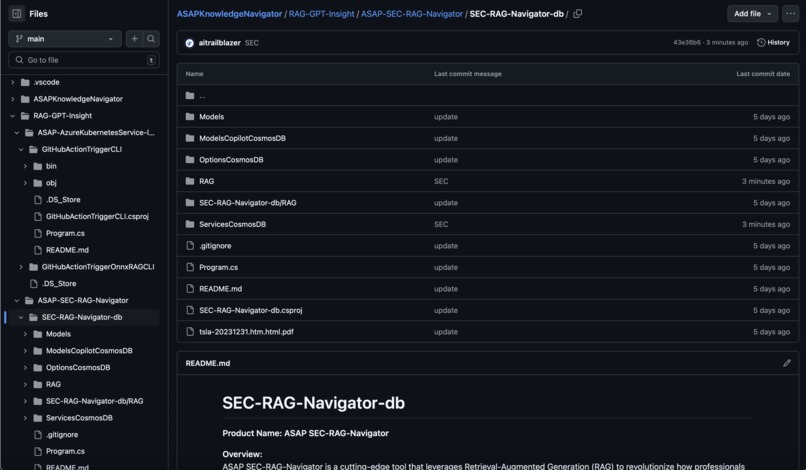
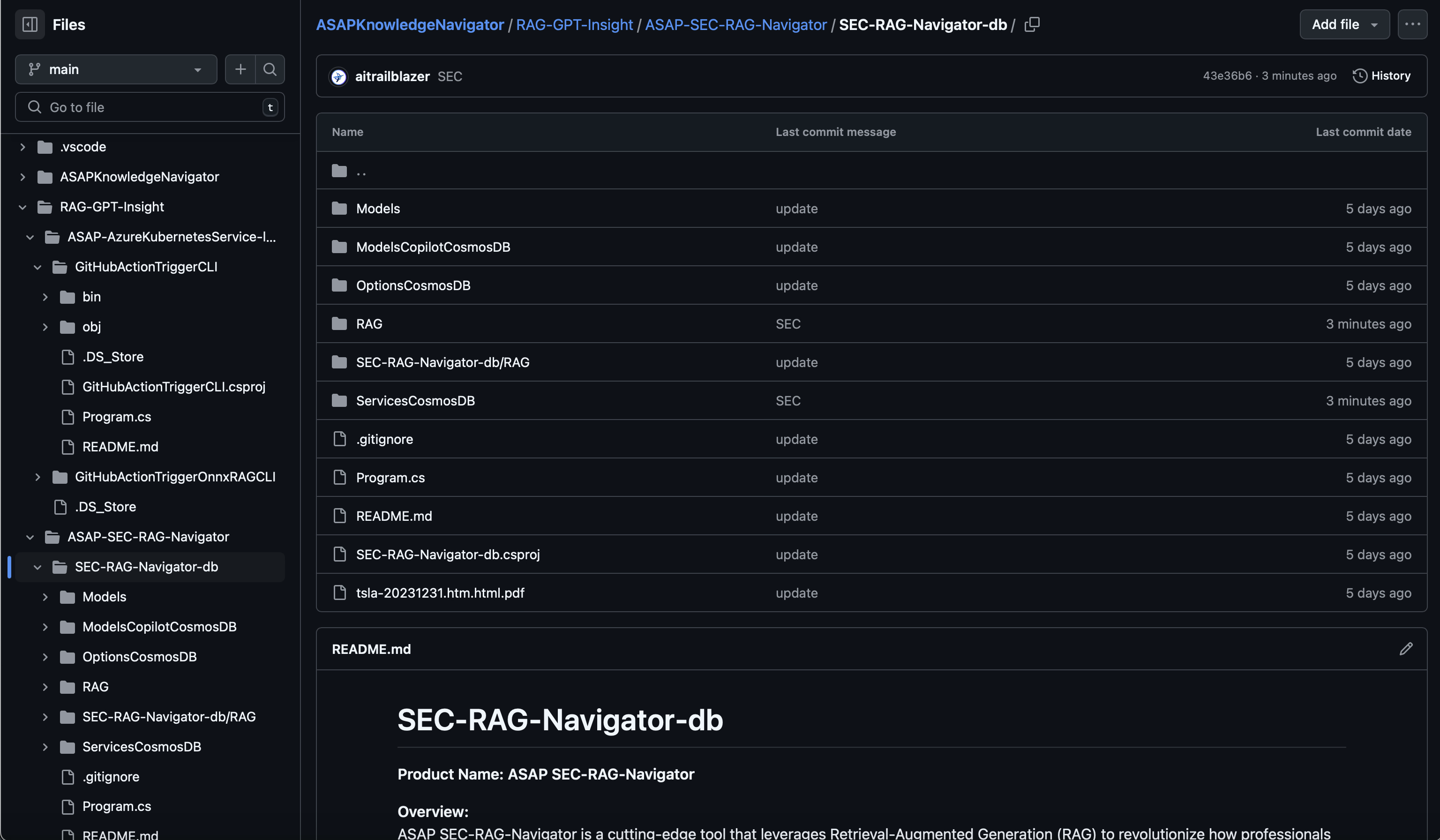
GitHub repository view of SEC-RAG-Navigator-db within ASAP Knowledge Navigator, showing project structure and README.
-
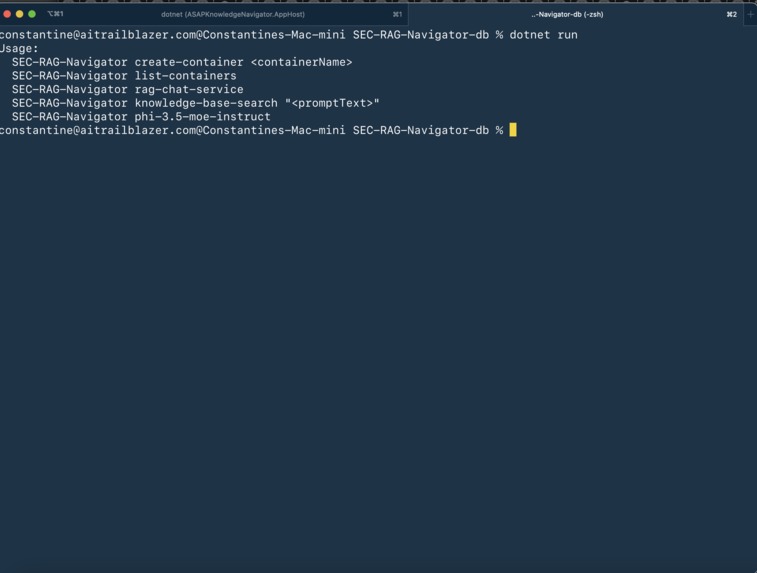
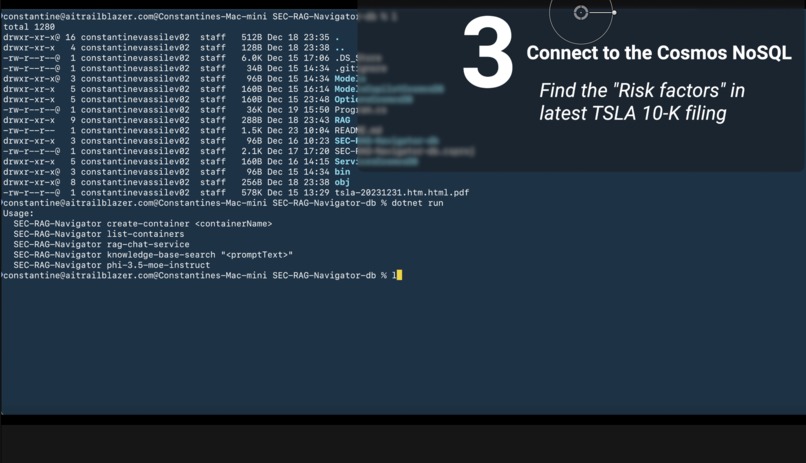
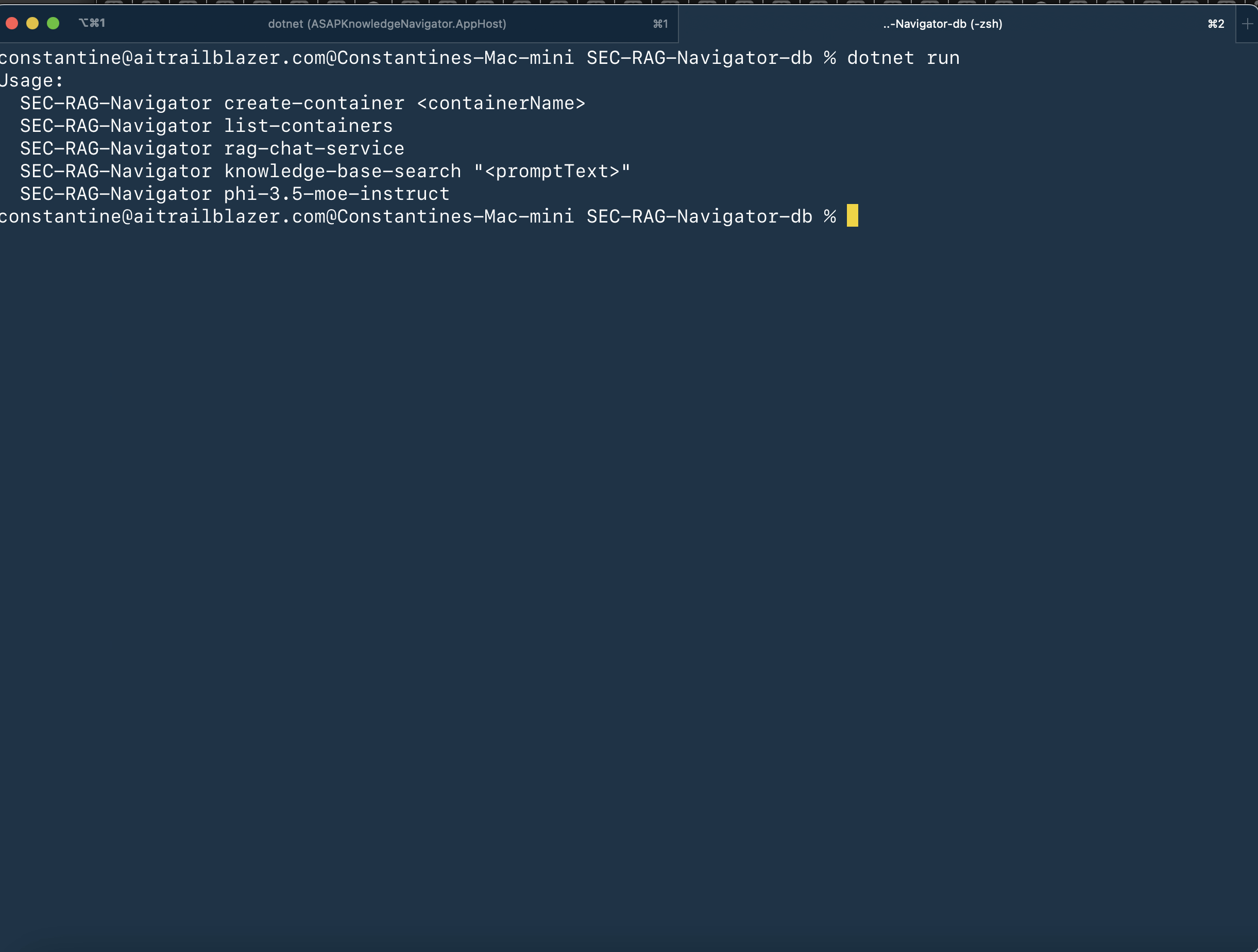
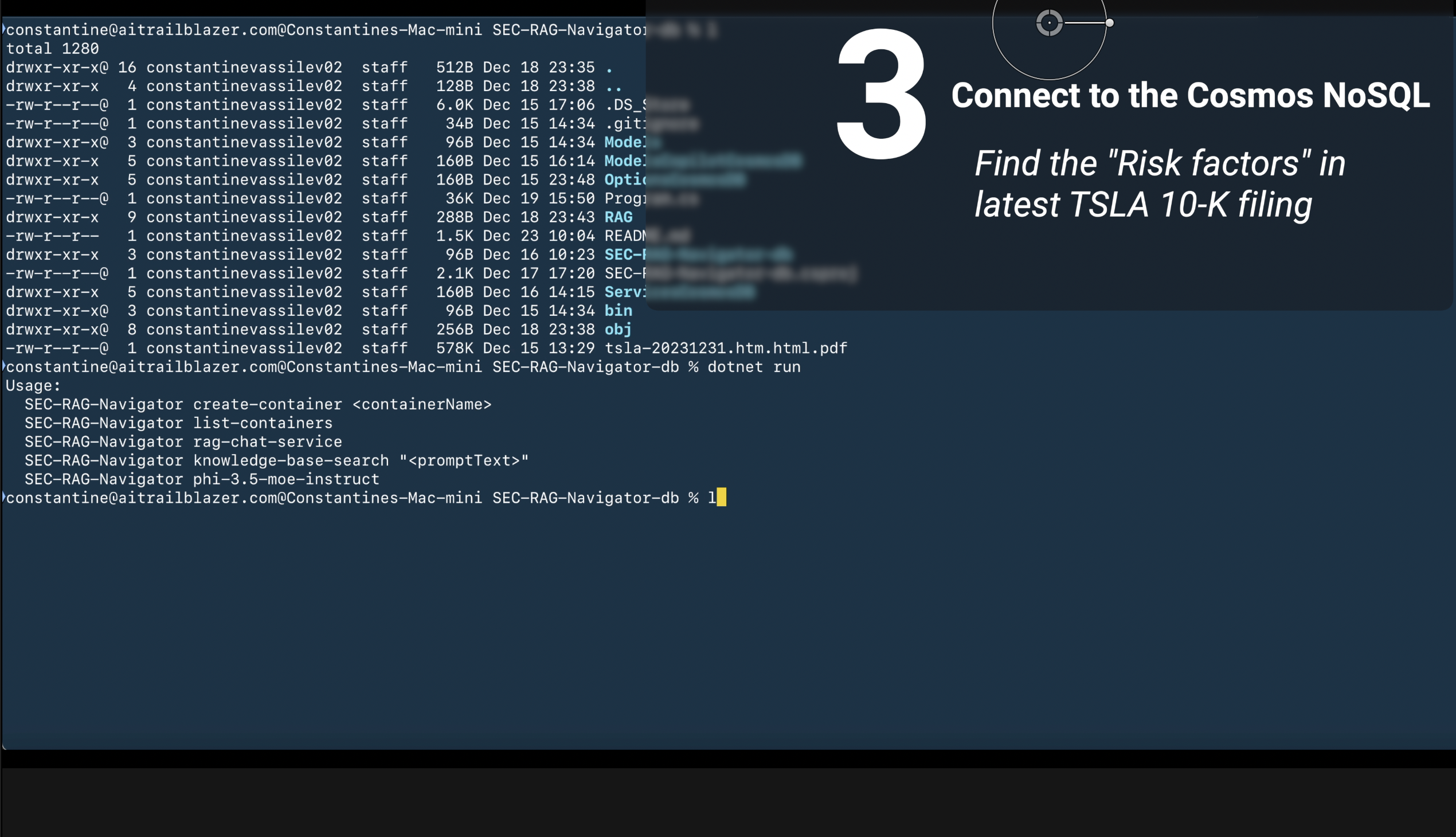
SEC-RAG-Navigator-db help output, showing available commands like create-container and knowledge-base-search.
-
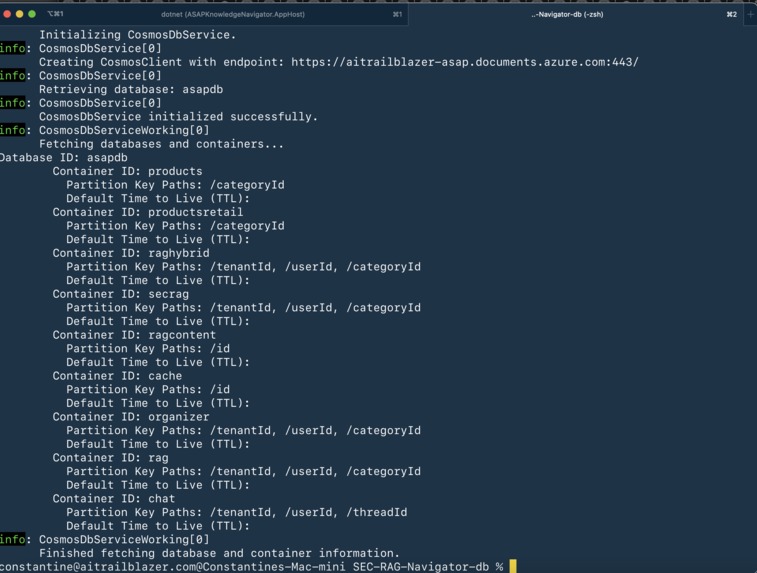
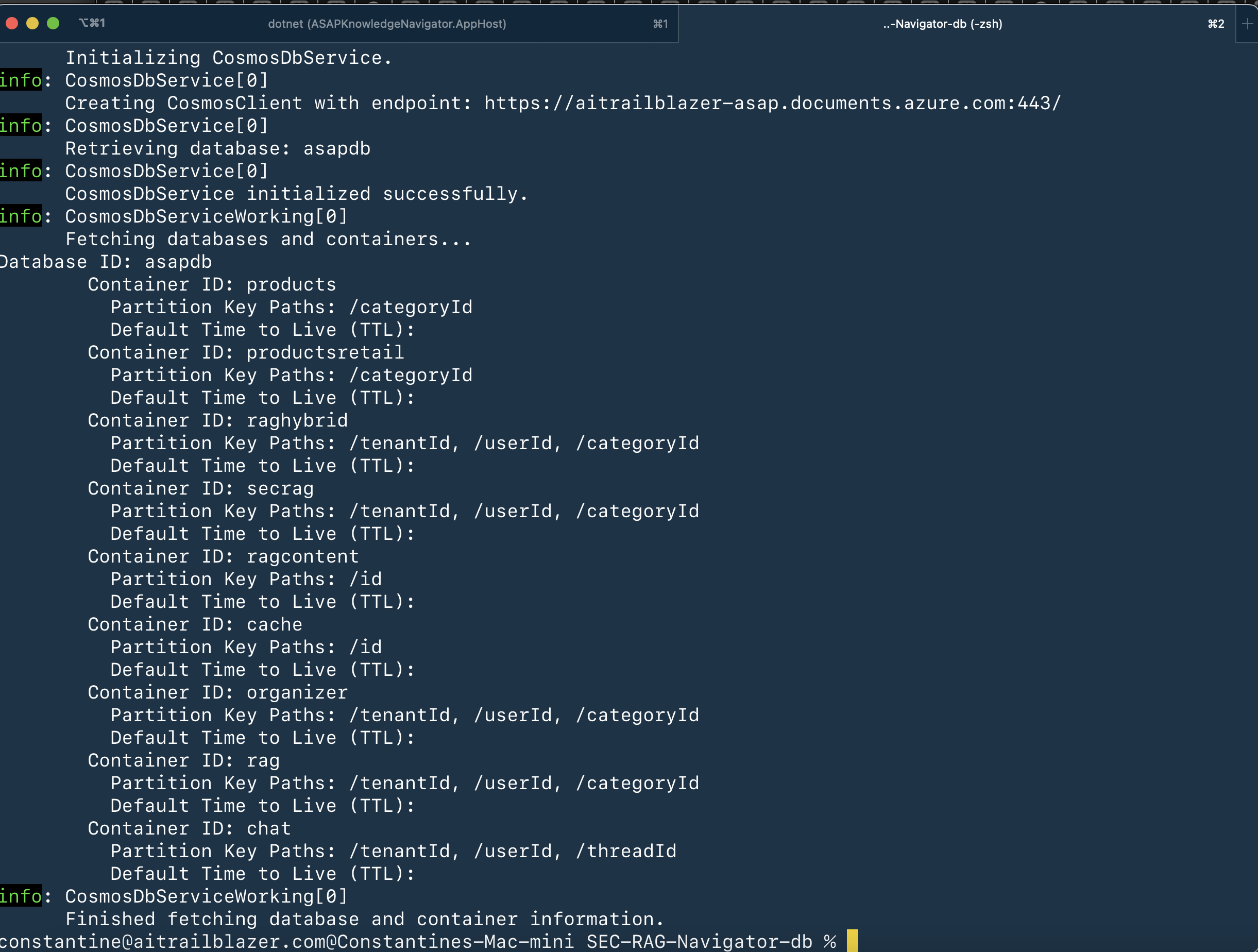
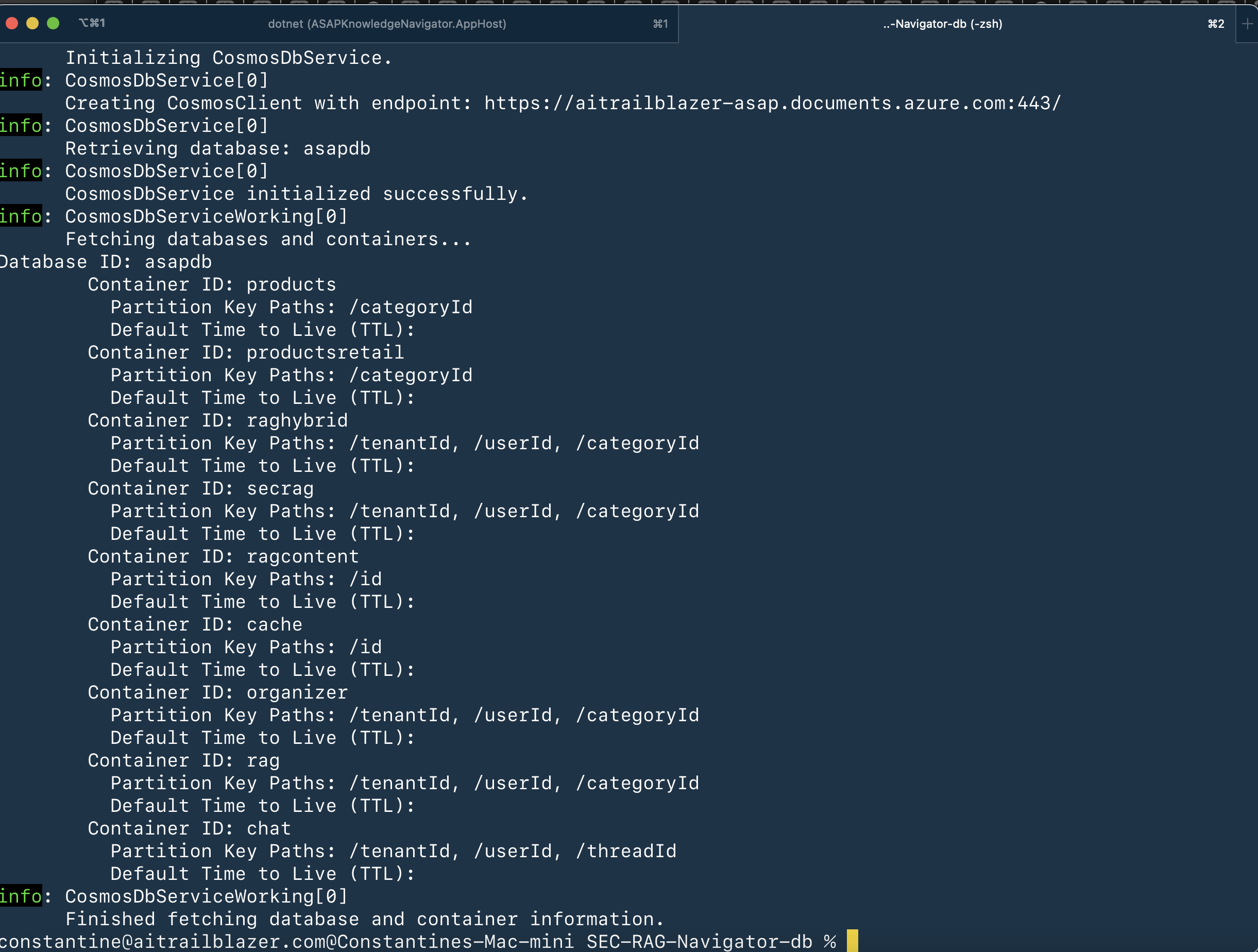
SEC-RAG-Navigator-db initializing connection to Azure Cosmos DB and retrieving database/container information.
-
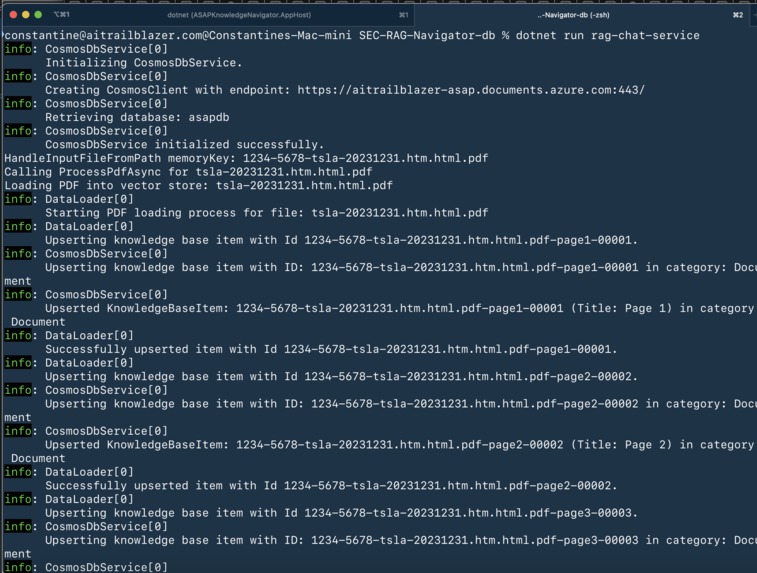
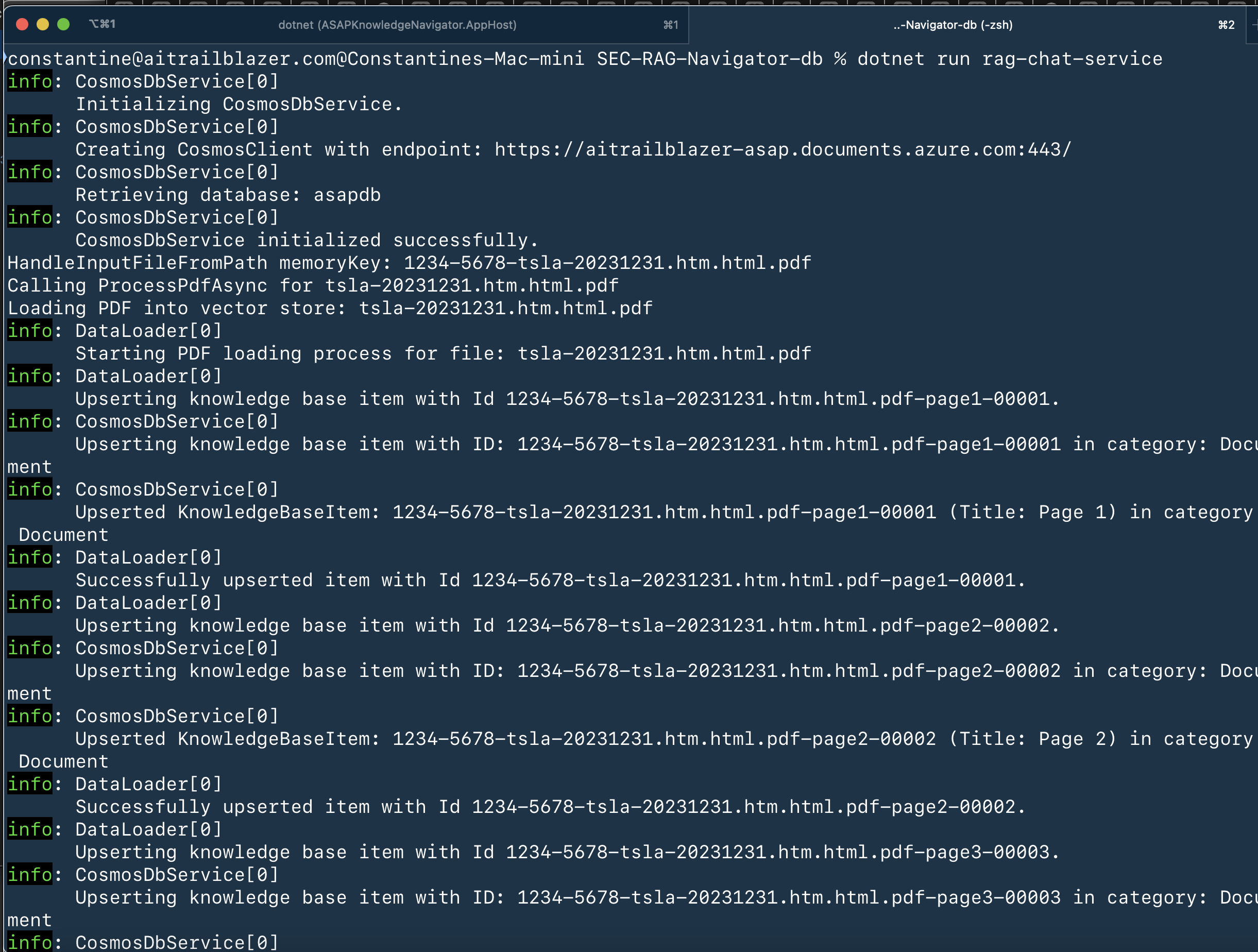
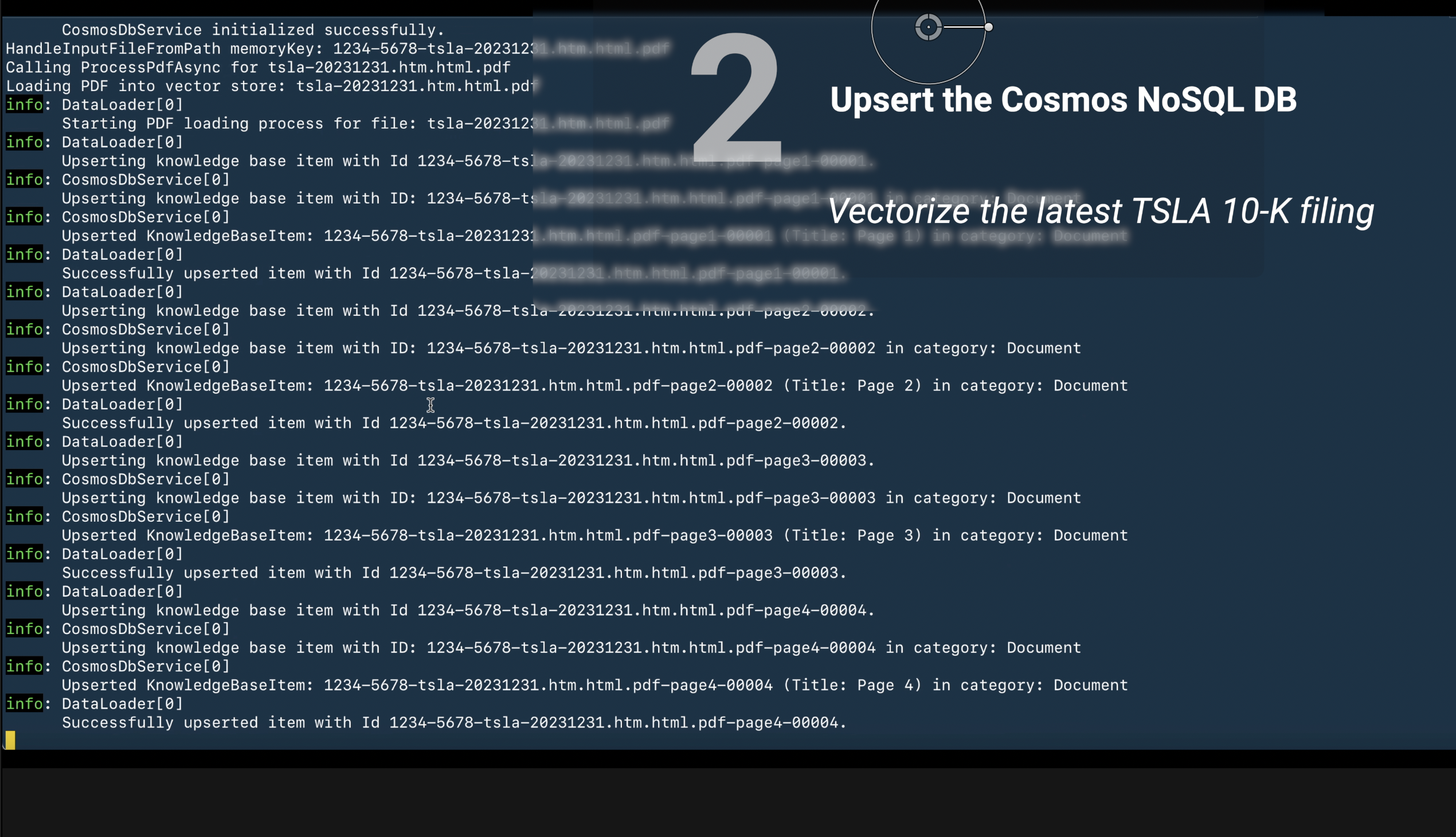
SEC-RAG-Navigator-db processing Tesla's 10-K PDF, adding pages as knowledge base items to Cosmos DB.
-
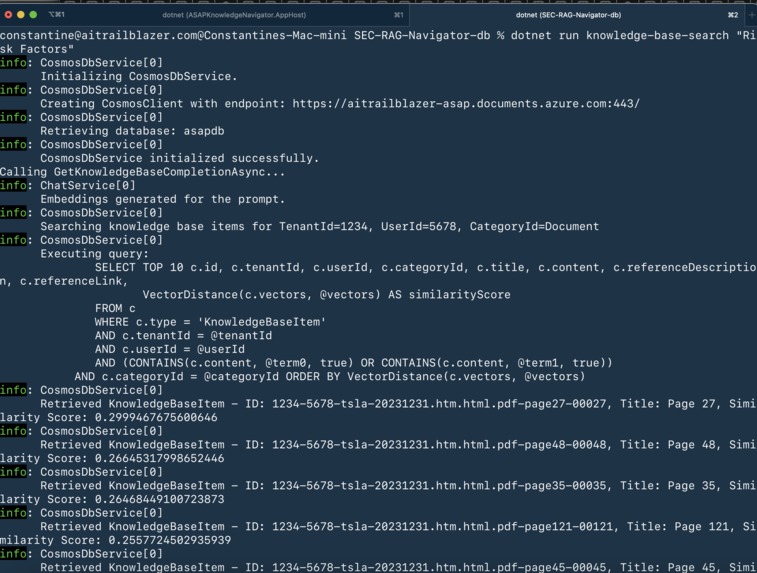
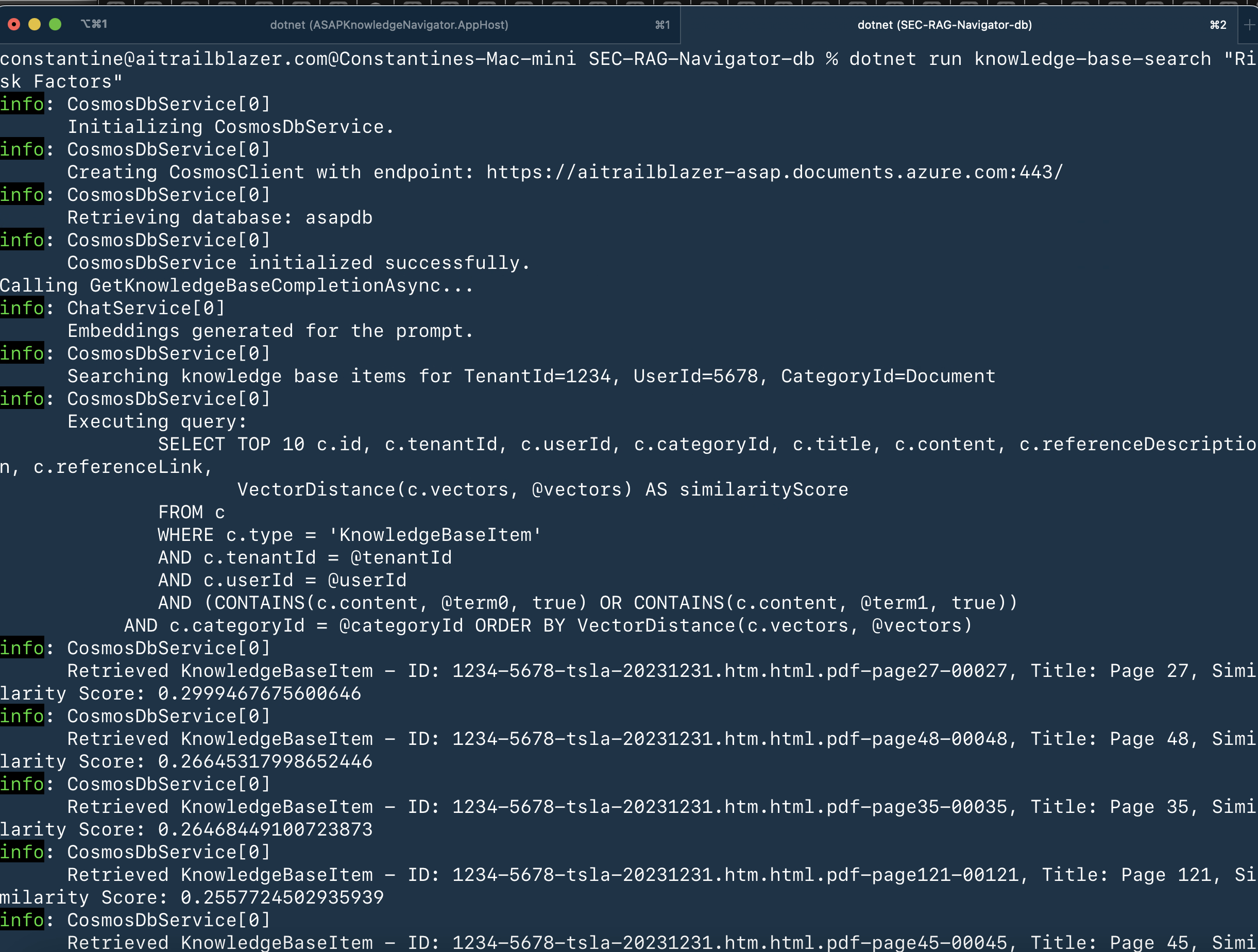
SEC-RAG-Navigator-db performing semantic search for "Risk Factors" in Cosmos DB, returning relevant document excerpts.
-
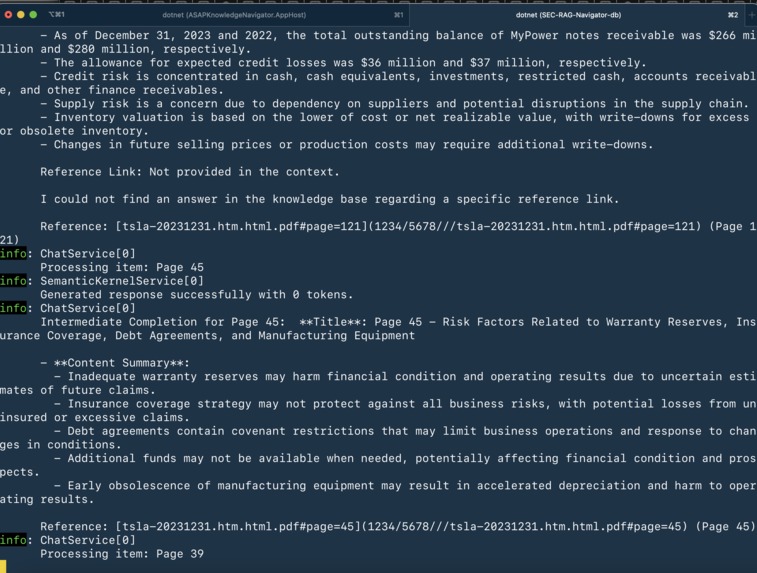
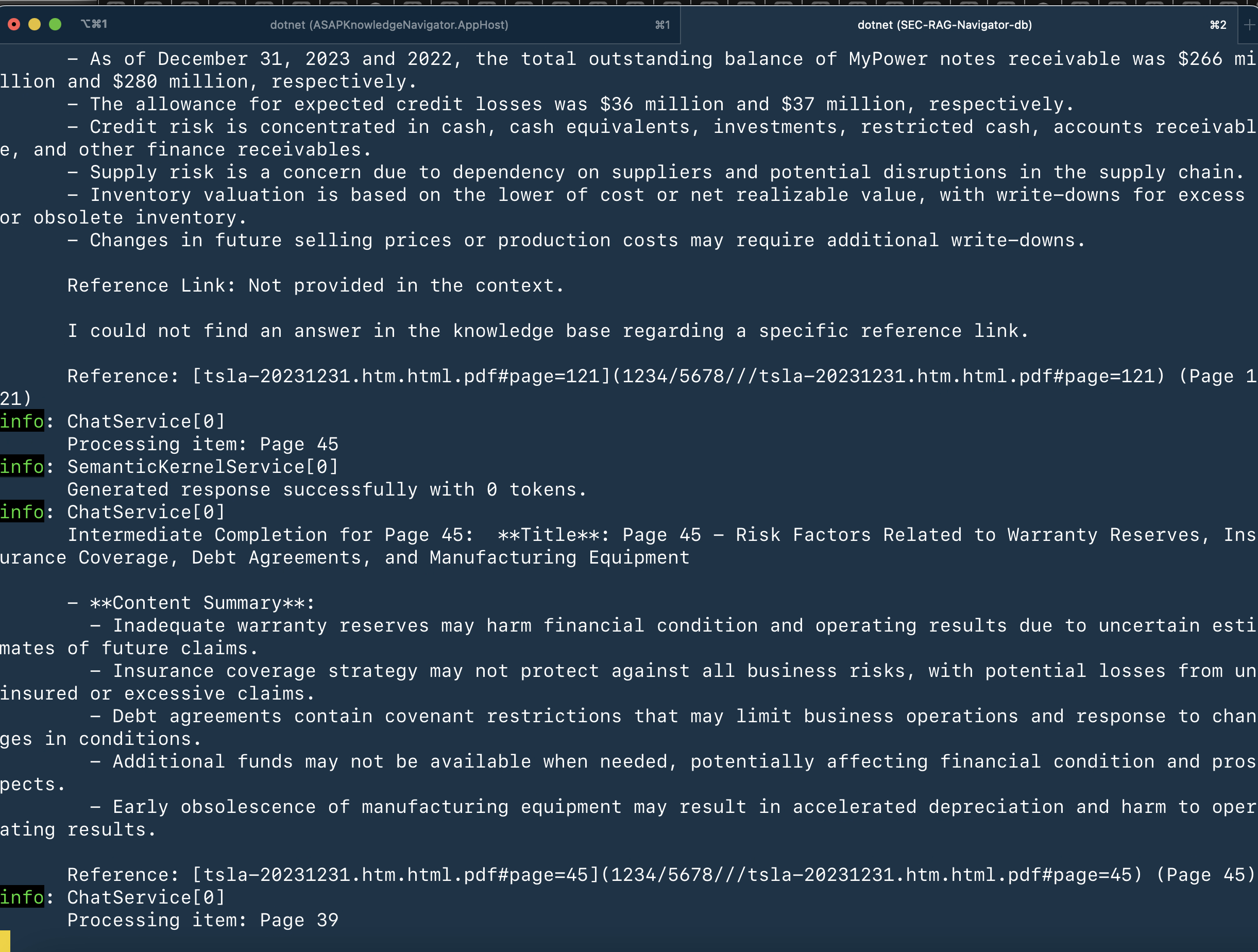
ChatService in SEC-RAG-Navigator-db summarizing "Risk Factors" from Tesla's 10-K (pages 121, 45, and 39).
-
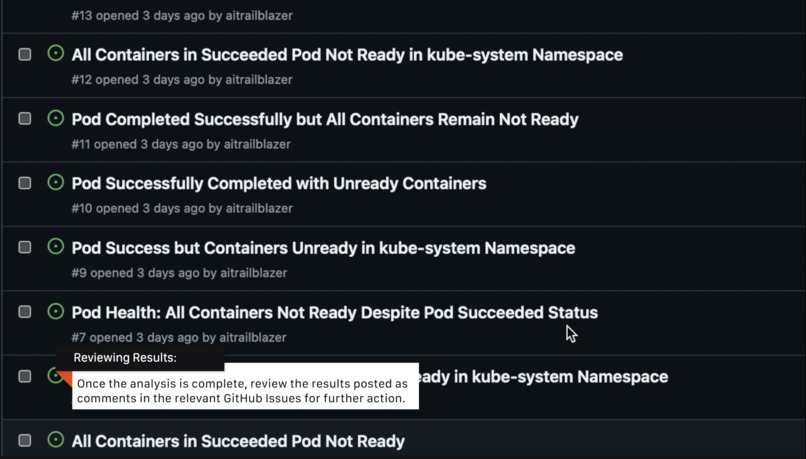
GitHub issue: ACI provider pod failure analysis and review.
-
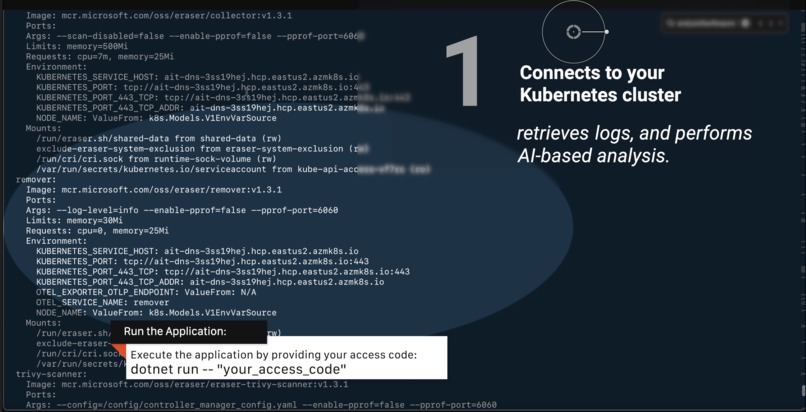
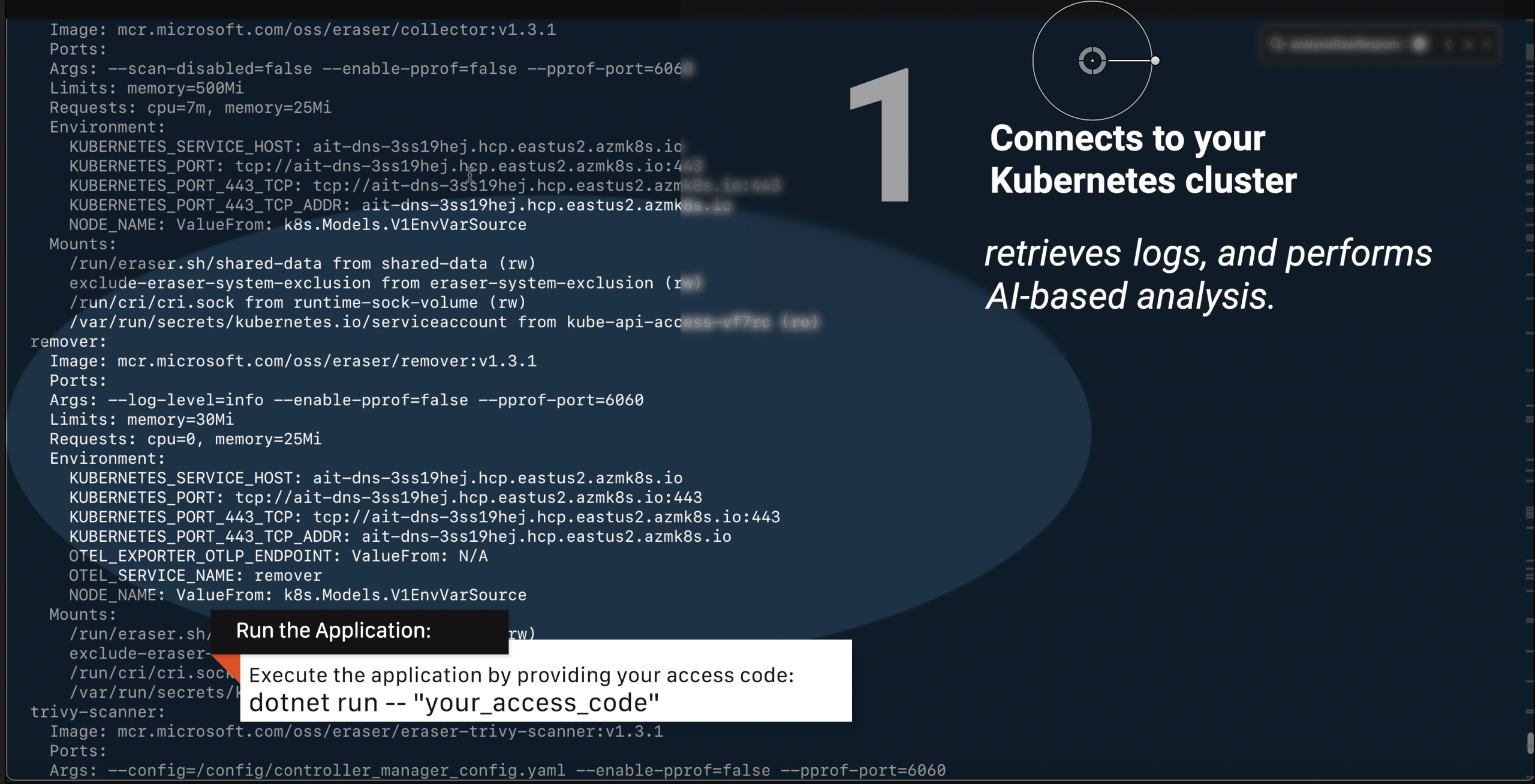
Connects to your Kubernetes cluster for log retrieval and AI-powered analysis.
-
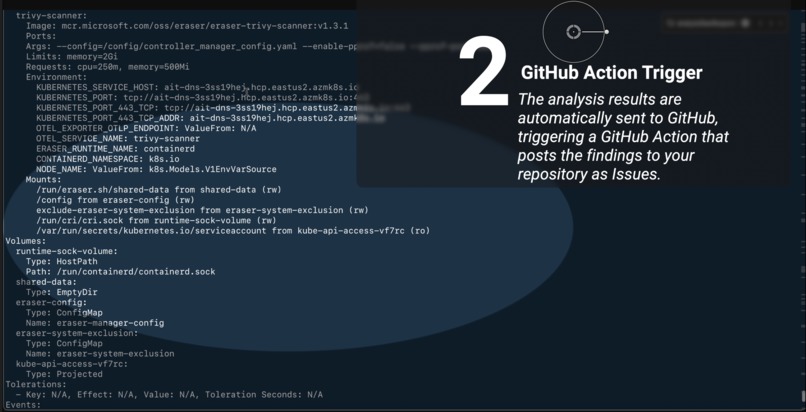
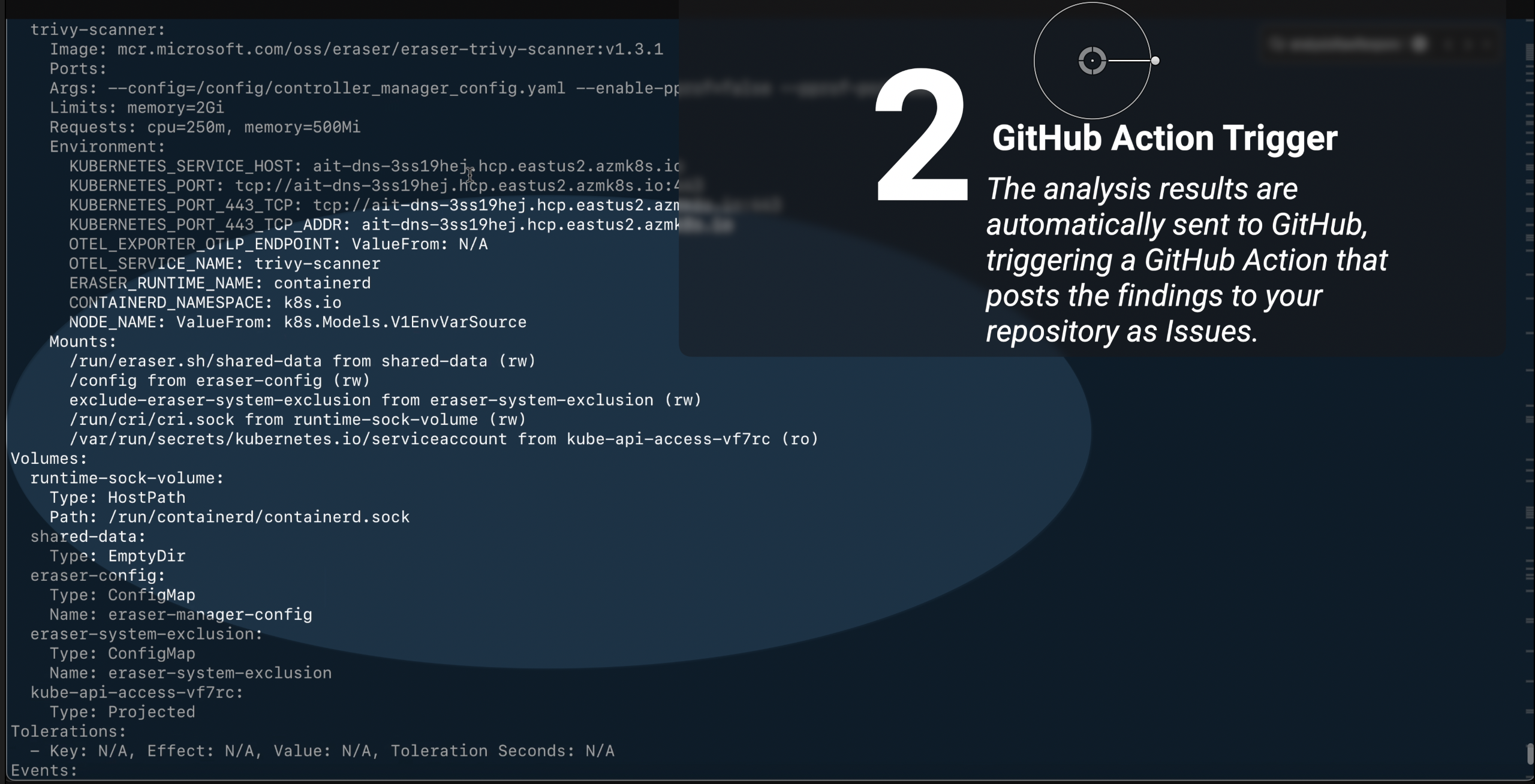
GitHub Action triggers to post AI-driven findings as repository issues.
-
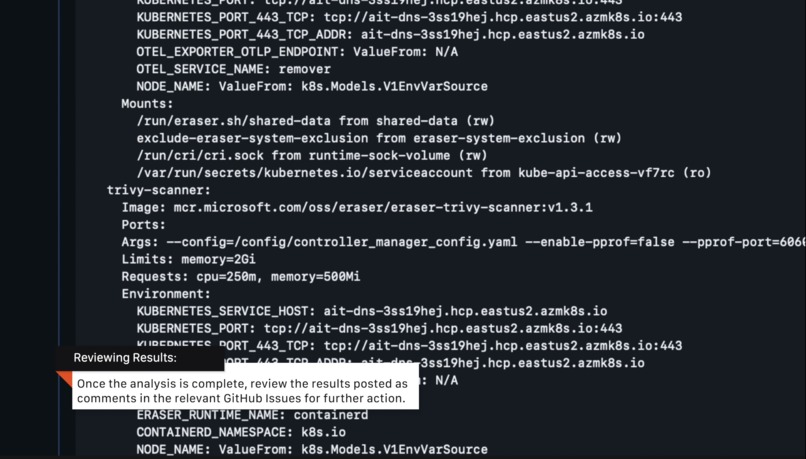
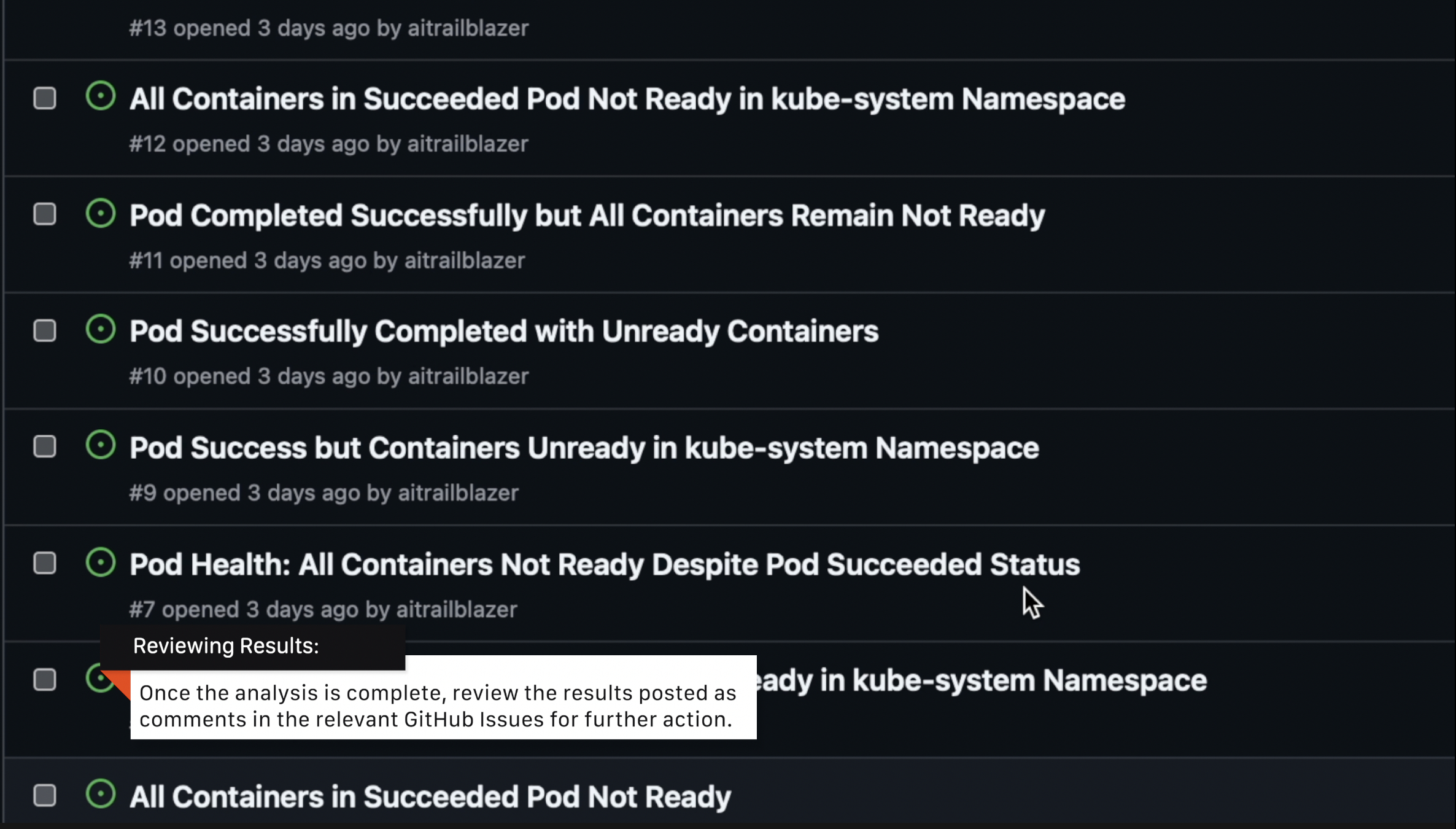
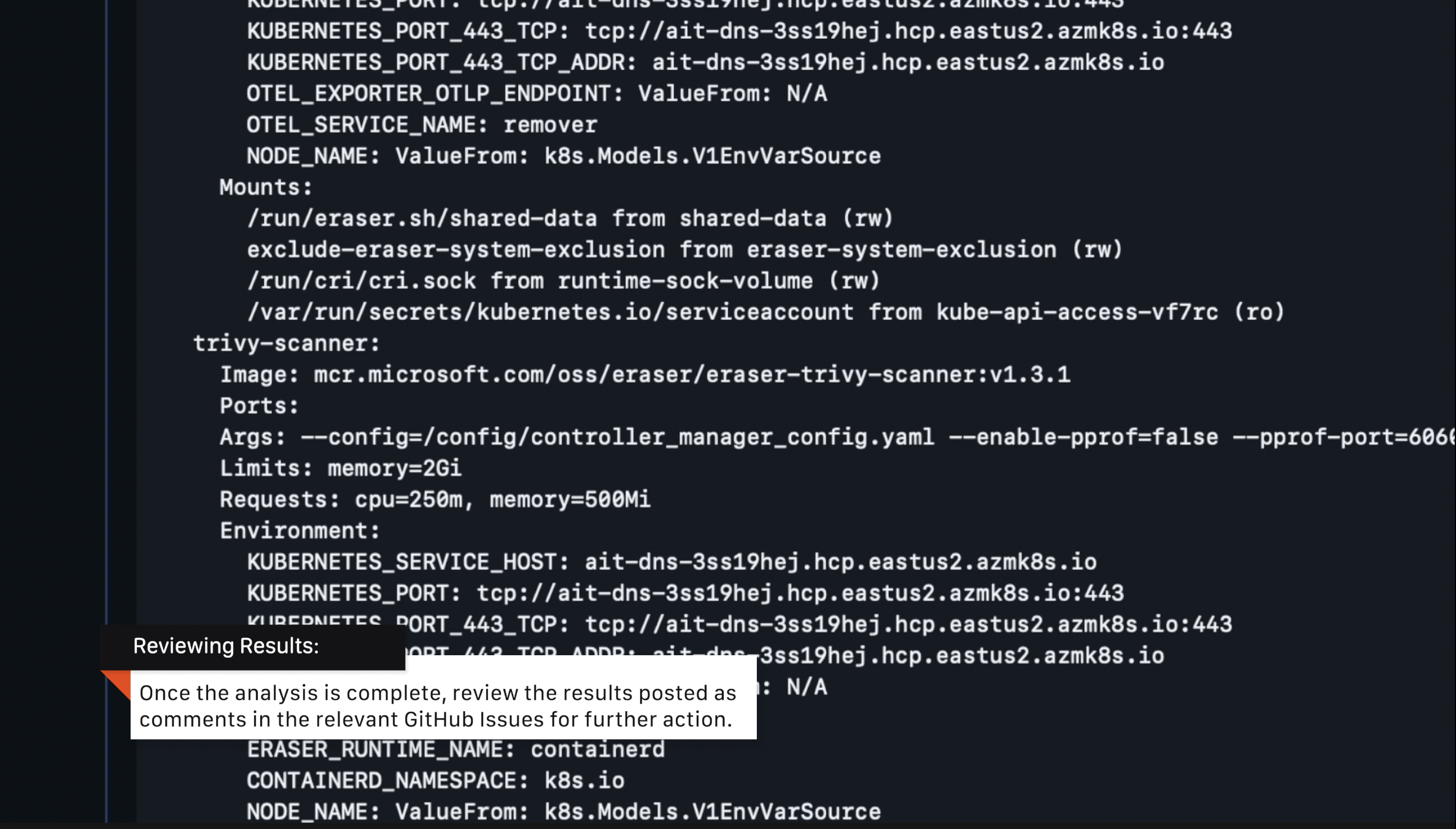
Review Kubernetes pod analysis results posted as GitHub issues.
-
Kubernetes pod configuration for AI-driven log analysis
-
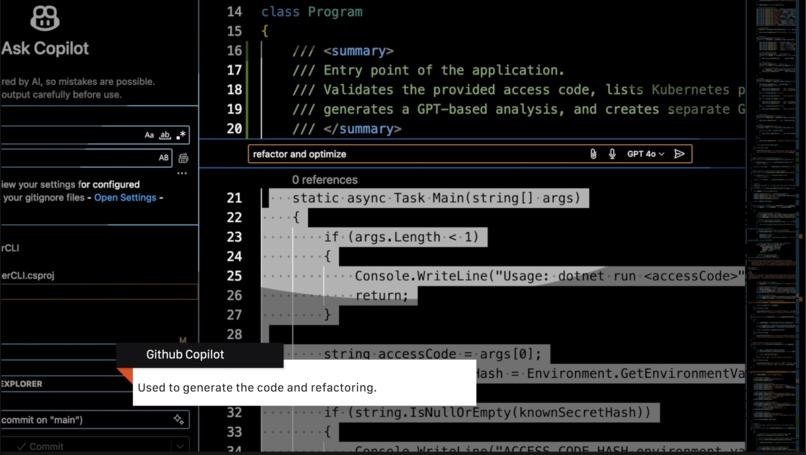
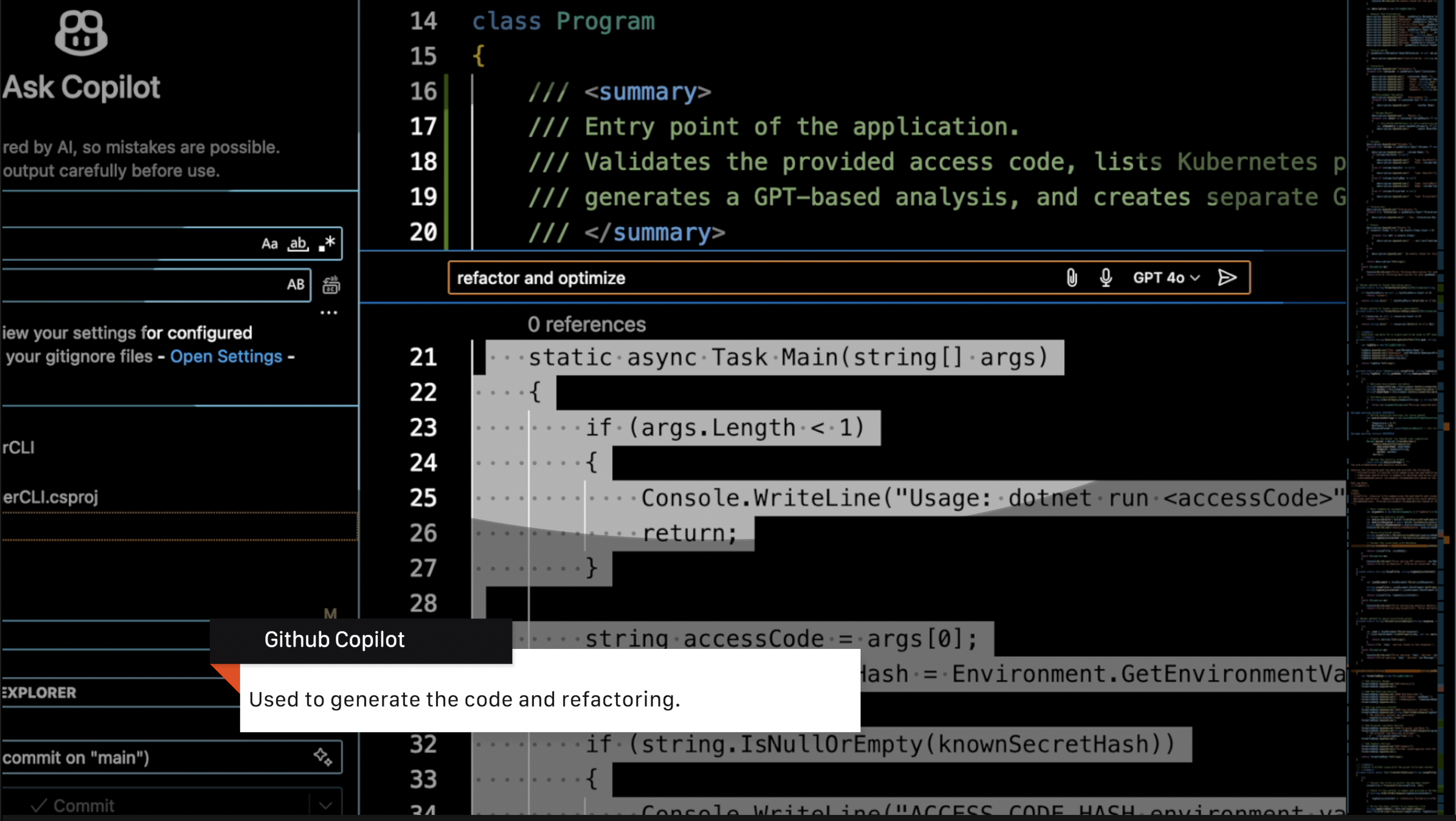
GitHub Copilot generates and refactors Kubernetes analysis code.
-
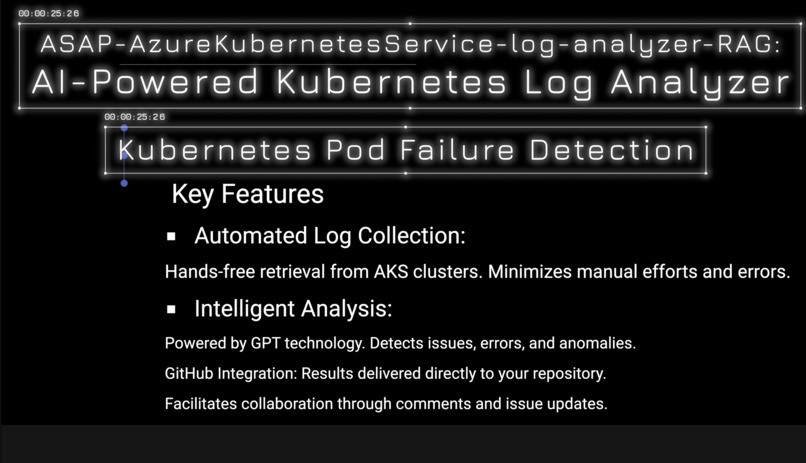
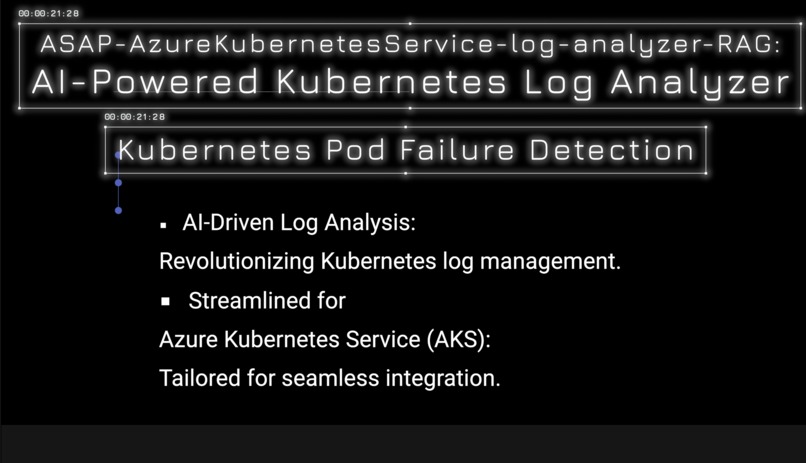
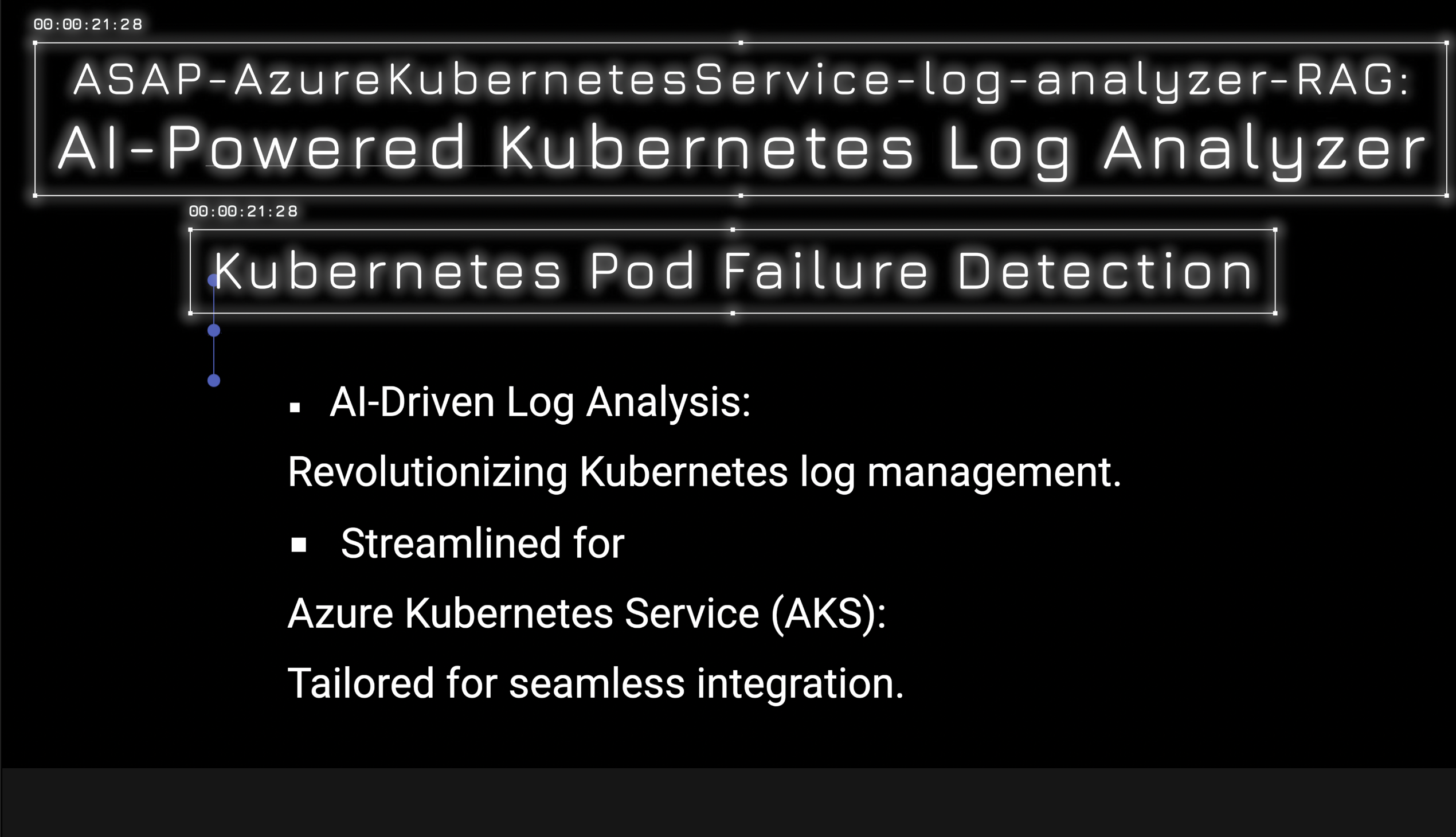
AI-powered Kubernetes log analyzer for seamless AKS integration.Automated log collection and intelligent analysis for Kubernetes clusters.
-
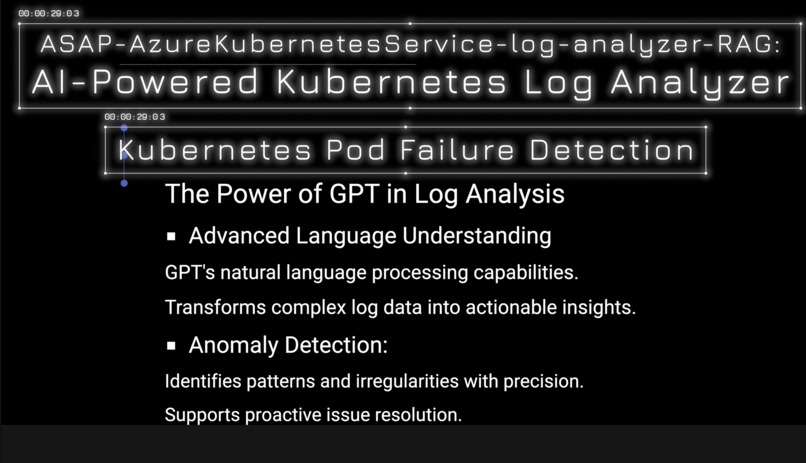
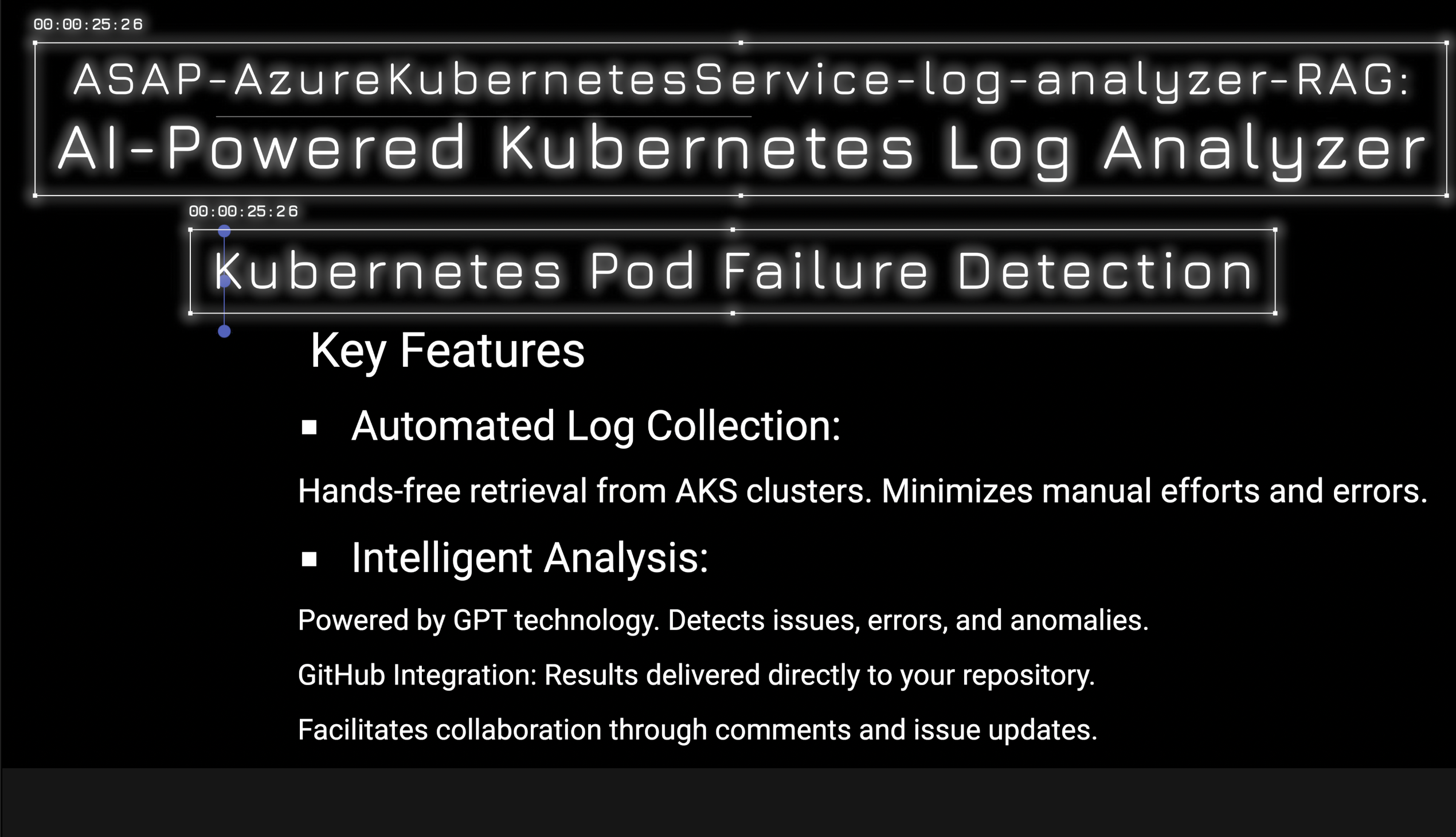
Automated log collection and intelligent analysis for Kubernetes clusters.
-
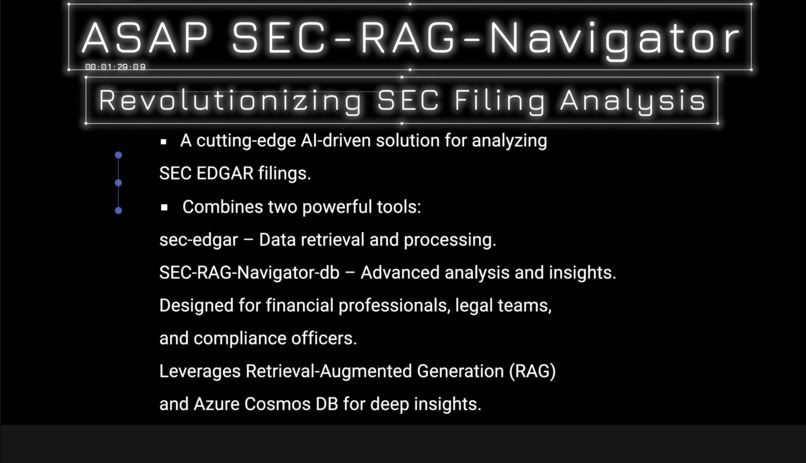
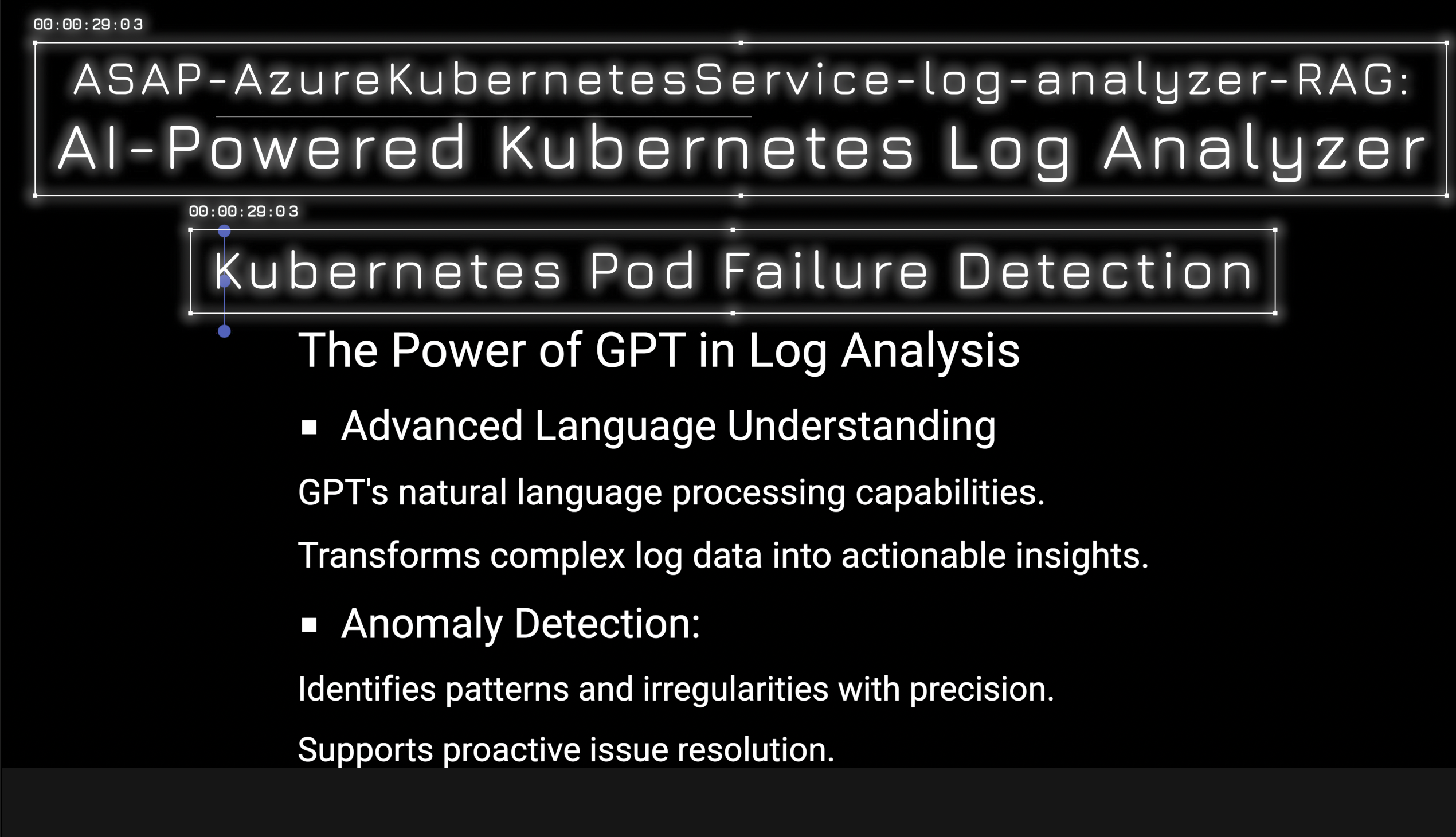
GPT transforms log data into actionable insights for anomaly detection.
-
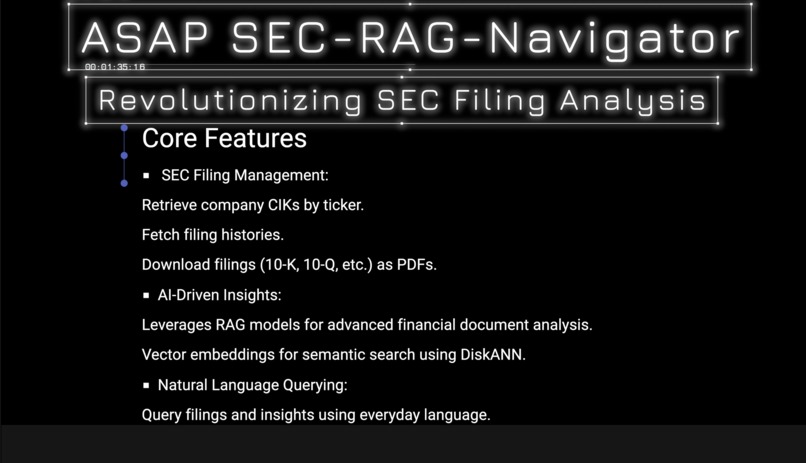
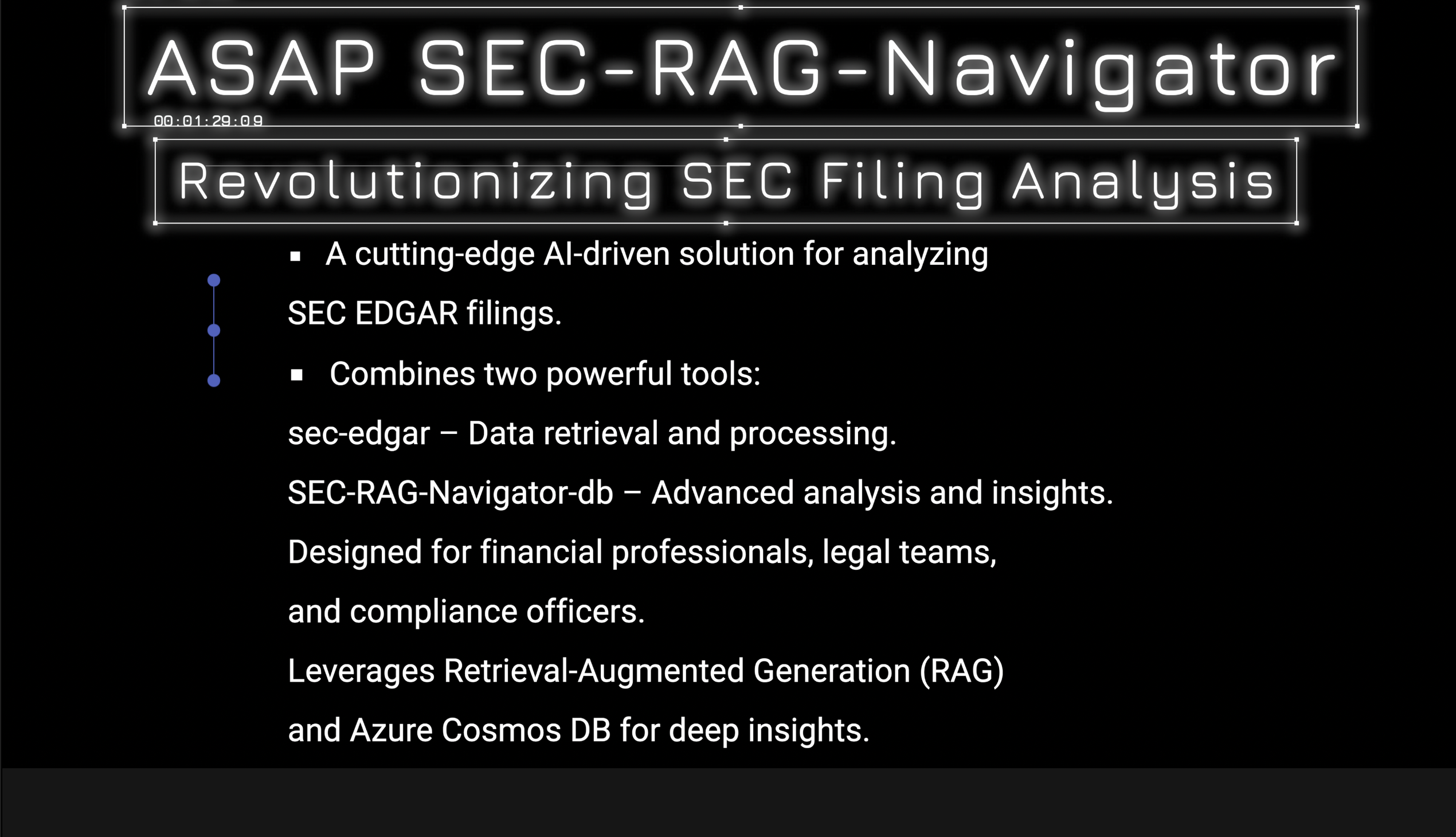
ASAP SEC-RAG Navigator: AI-driven solution for SEC filing analysis
-
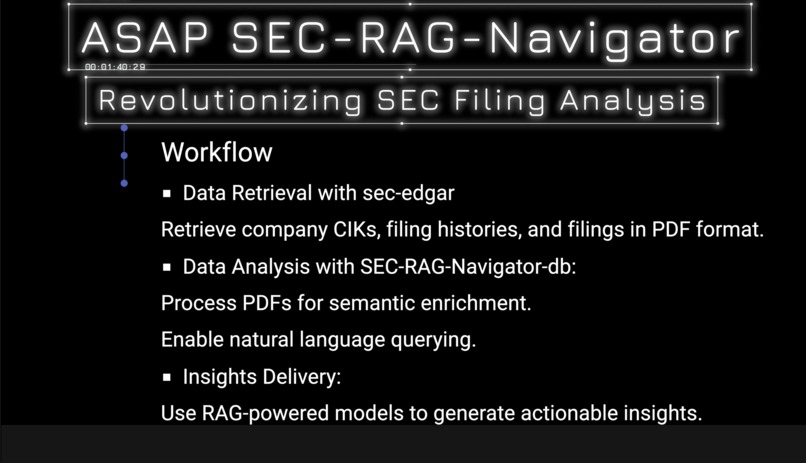
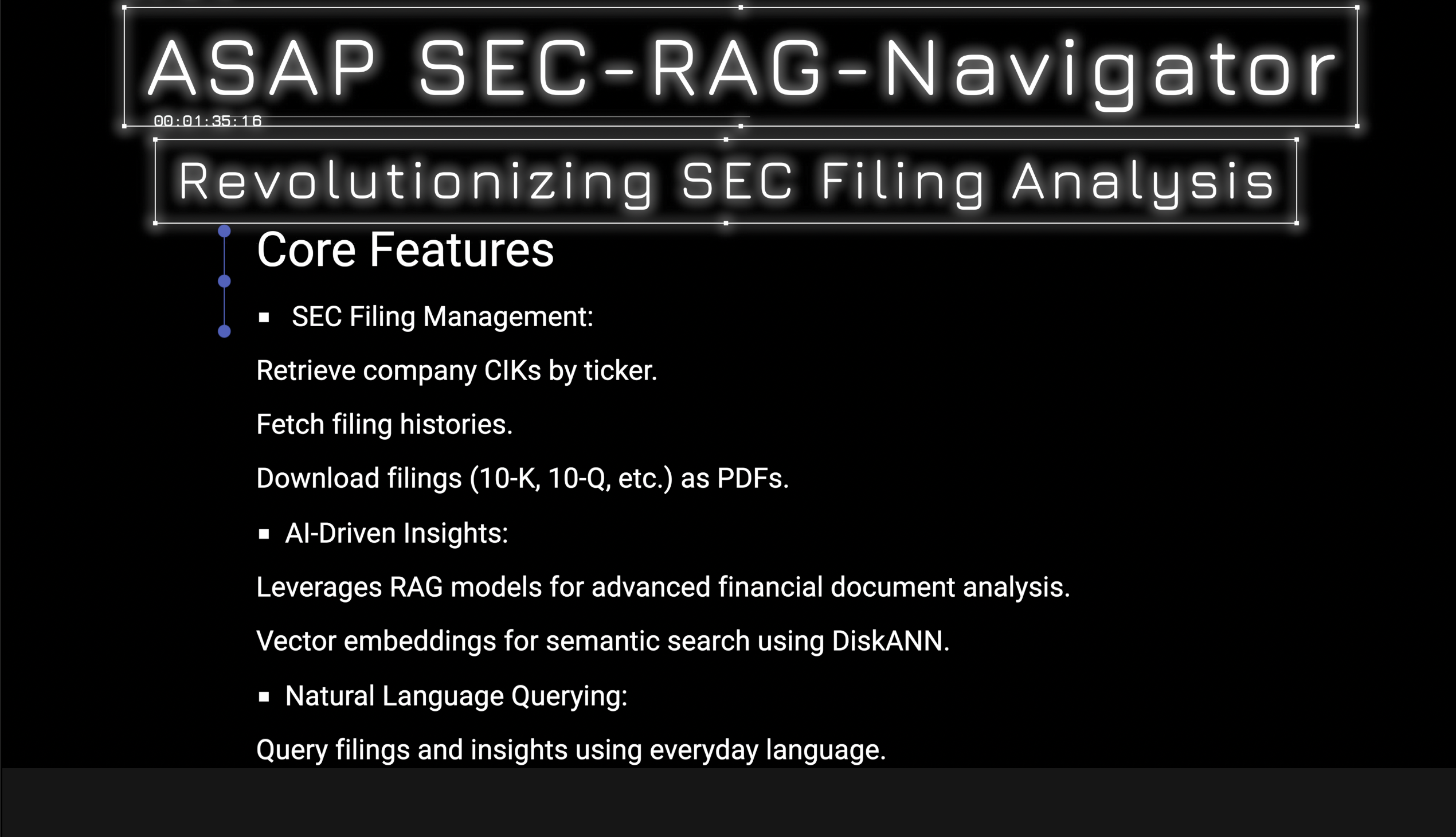
Core features: SEC filing management, AI-driven insights, and natural language querying.
-
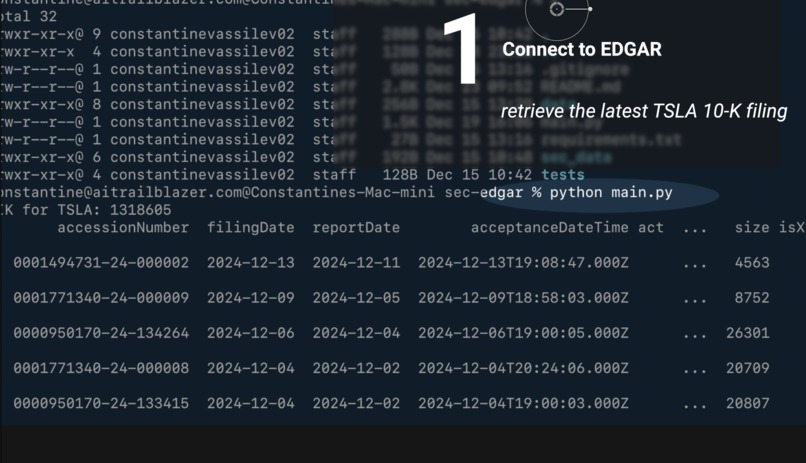
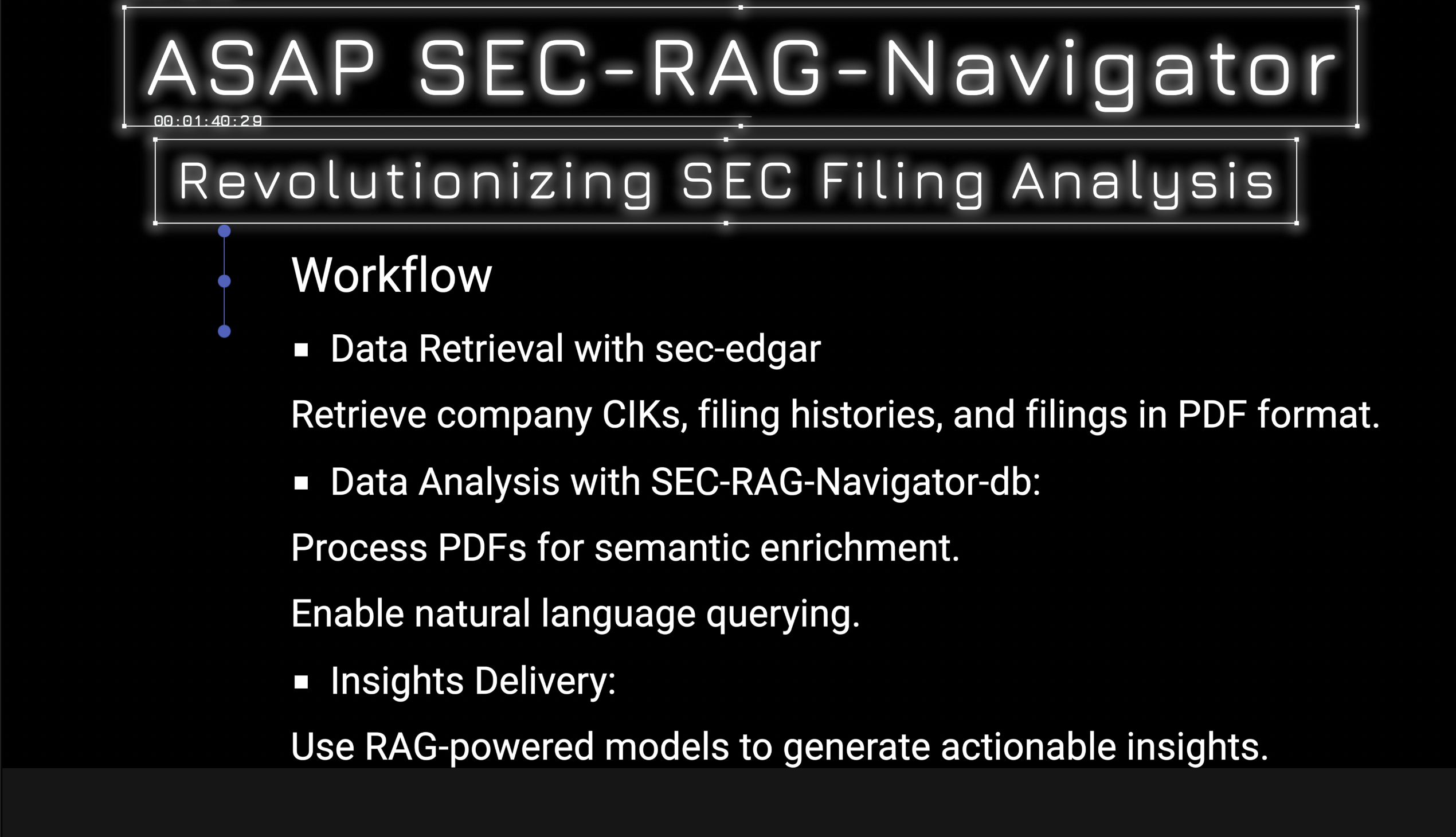
SEC-RAG Navigator Workflow: Data retrieval to actionable insights.
-
Fetch latest Tesla 10-K filing via EDGAR.
-
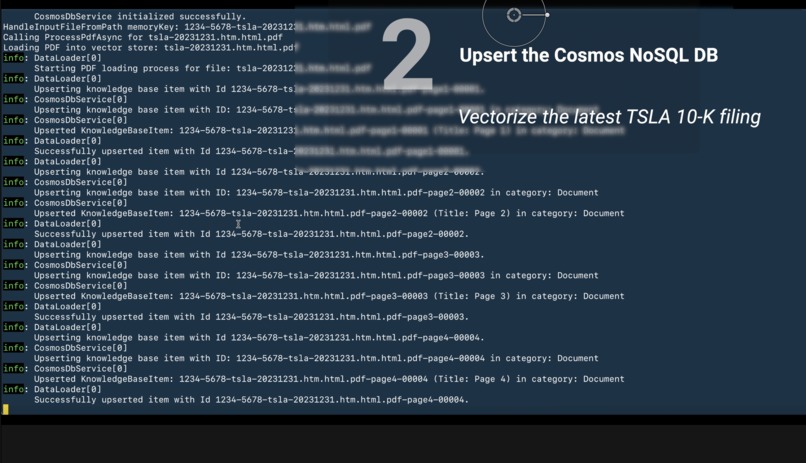
Upserting Tesla 10-K into Cosmos DB.
-
EDGAR Research Assistant leveraging .NET 9 and Azure
ASAP Knowledge Navigator: Revolutionizing Knowledge Retrieval and Insight Generation with RAG
Transforming industries by delivering actionable insights through Retrieval-Augmented Generation (RAG), simplifying complex challenges such as Kubernetes diagnostics and SEC filings into intelligent strategies.
Overview of Projects
ASAP Knowledge Navigator is a comprehensive initiative composed of three primary projects, each targeting specific challenges and applications:
ASAP SEC-RAG-Navigator: Command-Line Tools
Tools to streamline SEC EDGAR filings retrieval, analysis, and management using RAG and advanced AI.ASAP Knowledge Navigator - .NET 9 Aspire Project
A robust .NET 9-based platform offering intuitive user interfaces and natural language search capabilities for SEC filings.ASAP-AzureKubernetesService-Log-Analyzer-RAG: Command-Line Tools
Tools focused on Kubernetes pod failure detection, analysis, and issue resolution through semantic log analysis and RAG techniques.
Inspiration
The ASAP Knowledge Navigator project was created to showcase how Retrieval-Augmented Generation (RAG) can transform knowledge retrieval and insight generation across various industries. From streamlining the analysis of regulatory filings such as SEC EDGAR to simplifying technical operations like Kubernetes management, this versatile tool proves its value in diverse applications. By combining RAG with Azure's robust infrastructure, the platform leverages scalable computing power, seamless integration capabilities, and enterprise-grade security to tackle complex challenges with advanced AI. This combination ensures efficient, actionable solutions tailored to specific industry needs. EDGAR and Kubernetes are just two examples of the many ways ASAP Knowledge Navigator can make a meaningful impact.
Addressing Common and Domain-Specific Challenges Through AI and Automation
The ASAP Knowledge Navigator tackles diverse challenges by leveraging its core strengths of automation, AI-driven insights, and optimization to address both common and domain-specific pain points. Whether streamlining SEC EDGAR filings analysis or simplifying Kubernetes management, the platform demonstrates its adaptability across industries.
For SEC EDGAR filings, ASAP Knowledge Navigator showcases its strength in managing complex financial and regulatory data. It automates manual data extraction, reducing time and effort for analysts. With AI-powered analysis, the platform simplifies the interpretation of financial information, while real-time updates keep users informed about regulatory changes.
In contrast, for Kubernetes, the platform addresses the technical complexities of system operations. It automates the detection and resolution of pod failures, minimizing downtime and enhancing reliability. Additionally, it streamlines configuration and management with AI-driven insights and optimizes resource utilization to lower costs. The platform also bolsters security by implementing best practices and leveraging AI to identify and mitigate potential threats.
What ties these use cases together is the platform’s ability to automate repetitive tasks, generate actionable insights, and optimize processes. At the same time, it tailors its solutions to the unique needs of each domain, whether addressing the regulatory complexities of SEC filings other the technical intricacies of Kubernetes. This versatility showcases how ASAP Knowledge Navigator effectively adapts to diverse industries while maintaining its core value of efficiency and precision.
Addressing SEC EDGAR Filings Pain Points:
- Manual Data Extraction: ASAP Knowledge Navigator automates data extraction, saving time and effort.
- Complex Financial Data: AI-powered analysis simplifies the understanding of complex financial data.
- Staying Updated with Regulatory Changes: The platform provides real-time updates on SEC regulations and filings.
Addressing Kubernetes and SEC Pain Points
- Complex Configuration and Management: ASAP Knowledge Navigator simplifies Kubernetes management through automation and AI-driven insights.
- Pod Failures and Troubleshooting: The platform automates the detection and resolution of pod failures, reducing downtime.
- Resource Utilization and Optimization: AI-powered optimization techniques help improve resource utilization and reduce costs.
- Security and Compliance: The platform incorporates security best practices and leverages AI to identify and mitigate threats.
What It Does
How ASAP Knowledge Navigator Leverages RAG for Enhanced Knowledge Retrieval
ASAP Knowledge Navigator employs Retrieval-Augmented Generation (RAG) to elevate knowledge retrieval and insight generation. It combines the strengths of advanced retrieval techniques with the generative capabilities of large language models (LLMs). This synergy allows ASAP Knowledge Navigator to go beyond traditional knowledge retrieval methods, offering a more intelligent and comprehensive approach to information access and analysis.
Instead of simply retrieving documents based on keywords, ASAP Knowledge Navigator utilizes RAG to understand the context and intent behind user queries. This enables the platform to:
- Access and synthesize information from diverse sources: RAG enables the platform to connect to various data repositories, including internal documents, databases, and external knowledge sources. This provides a comprehensive view of information, enabling more holistic analysis.
- Deliver precise and relevant answers: By retrieving contextually relevant information from a vast knowledge base, ASAP Knowledge Navigator minimizes errors and inaccuracies, ensuring reliable and trustworthy insights. This reduces the risk of misinformation.
- Generate personalized responses: RAG allows the platform to consider user preferences, needs, and context, tailoring responses and recommendations for a more personalized experience. This increases user satisfaction.
- Provide deeper understanding and insights: By grounding AI responses in factual information and identifying relationships within data through contextual data enrichment and knowledge graphs, ASAP Knowledge Navigator facilitates more insightful analysis and decision-making. This contextual understanding helps the AI models generate more accurate and relevant responses. Furthermore, by enhancing prompts with relevant context from the knowledge graph, ASAP Knowledge Navigator ensures that the AI models have the necessary information to generate precise and insightful answers.
- Reduce hallucinations and improve accuracy: By validating AI-generated responses against a knowledge model, ASAP Knowledge Navigator ensures the reliability and trustworthiness of information. This minimizes the risk of AI "hallucinations" or generating factually incorrect information.
AI-Driven Analytics with ASAP Knowledge Navigator
ASAP Knowledge Navigator leverages AI-driven analytics to provide users with deeper insights and more efficient analysis capabilities. This approach is particularly valuable in complex domains like Kubernetes diagnostics and SEC EDGAR filings analysis. By applying AI algorithms and machine learning models, ASAP Knowledge Navigator can:
- Identify patterns and anomalies: AI-driven analytics can detect subtle patterns and anomalies in data that might be missed by traditional analysis methods. This enables proactive identification of potential issues and risks.
- Predict future trends: By analyzing historical data and identifying trends, AI algorithms can provide insights into future trends, enabling organizations to anticipate challenges and opportunities.
- Automate data analysis: AI can automate various data analysis tasks, such as data cleaning, normalization, and feature extraction. This frees up human analysts to focus on higher-level tasks.
- Generate actionable insights: AI-driven analytics can translate complex data into actionable insights, providing users with clear and concise recommendations for decision-making.
ASAP Knowledge Navigator for SEC EDGAR Filings Analysis
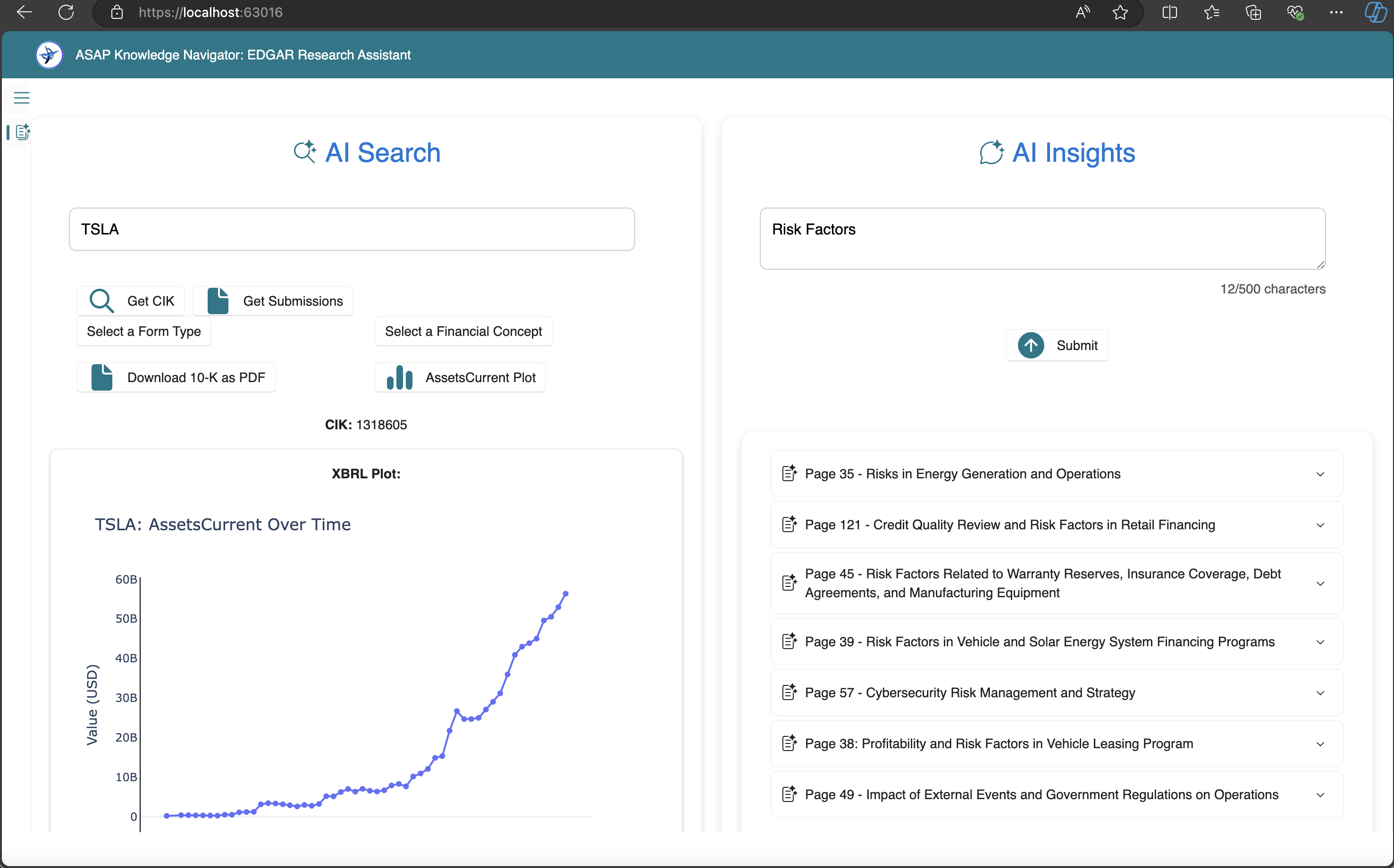
Analyzing SEC EDGAR filings can be a time-consuming and complex task. ASAP Knowledge Navigator can streamline this process by:
- Automating the retrieval and processing of EDGAR filings: This eliminates the need for manual searches and data extraction, saving time and resources and allowing analysts to focus on higher-level tasks.
- Extracting key information and identifying trends: ASAP Knowledge Navigator can analyze filings to identify relevant data points, such as financial performance, risk factors, and corporate governance information. This provides a comprehensive view of a company's financial health and operations.
- Financial Performance Metrics: Automatically extracts and analyzes key financial data, including revenue, profit margins, earnings per share (EPS), and other relevant indicators.
- Risk Factors: Identifies and categorizes potential risks disclosed in the filings, such as market risks, competitive risks, regulatory risks, and operational risks.
- Management Discussion and Analysis (MD&A): Processes and summarizes management's perspective on the company's financial condition, results of operations, and future prospects.
- Corporate Governance Information: Extracts details about the company's board of directors, executive compensation, ownership structure, and related party transactions.
- Legal Proceedings: Identifies and summarizes any significant legal proceedings or litigation involving the company.
- Mergers and Acquisitions (M&A) Activity: Extracts information related to any M&A transactions, including deal terms, valuations, and strategic rationale.
- Sentiment Analysis: Applies natural language processing (NLP) to gauge the sentiment and tone of the filings, providing insights into management's confidence and outlook.
- Trend Analysis: Tracks key data points over time to identify trends and patterns in the company's performance and disclosures.
- Anomaly Detection: Flags any unusual or inconsistent data points that may warrant further investigation.
- Industry Comparisons: Benchmarks the company's financial performance and risk factors against industry peers using external data sources.
- Generating insights and reports: The platform can summarize key findings, highlight trends, and provide actionable insights to support investment decisions and research. This capability enables analysts to quickly understand the key takeaways from EDGAR filings and make informed decisions.
- Improving EDGAR data access: ASAP Knowledge Navigator can address the limitations of real-time access to EDGAR data by providing efficient retrieval and processing capabilities. This can help users overcome the delays associated with accessing new filings and obtain the information they need more quickly.
- Simplifying EDGAR searches: ASAP Knowledge Navigator can simplify the process of searching EDGAR filings by providing tools and functionalities that streamline the search process and make it easier to find relevant information. This can save users time and effort while ensuring they can access the specific filings they need.
- Providing context and history: ASAP Knowledge Navigator can provide users with context and history about the EDGAR system, including its significance, the mandatory electronic filing requirement, and who administers it. This background information can help users understand the importance of EDGAR filings and how to use them effectively.
Use Cases for AI-Powered SEC Filing Analysis with ASAP Knowledge Navigator
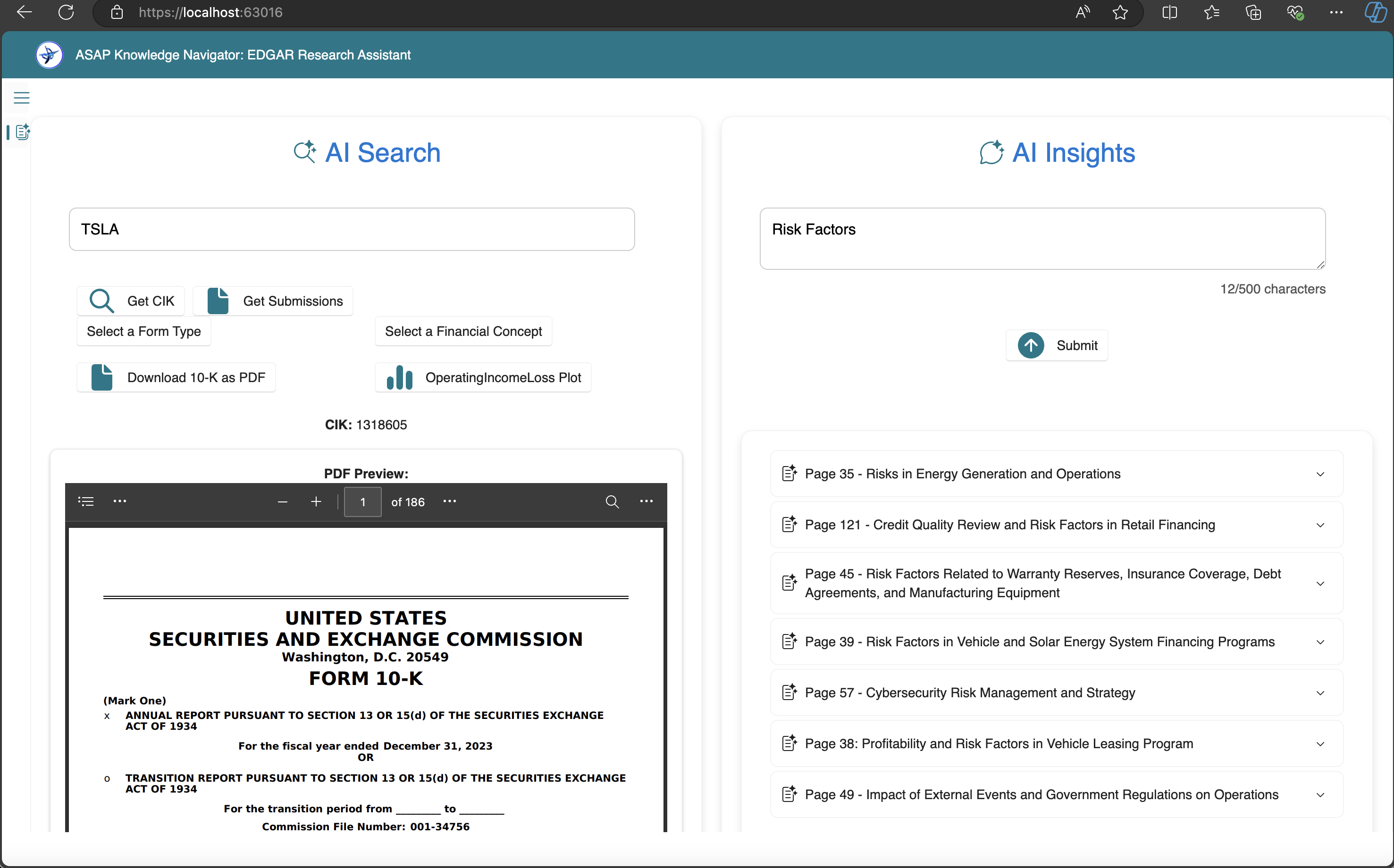
ASAP Knowledge Navigator's innovative approach to analyzing SEC EDGAR filings solves several critical challenges for users. These capabilities are best illustrated through practical use cases:
1. Automated Data Extraction and Analysis:
- Use Case 1: Rapid Due Diligence for Mergers and Acquisitions (M&A): An investment banker needs to quickly assess the financial health of a target company for a potential acquisition. They use ASAP Knowledge Navigator, which automatically extracts and analyzes key financial metrics (revenue, profit margins, debt levels, etc.) from years of the target's 10-K and 10-Q filings. The platform compares these metrics against industry benchmarks and historical trends, providing the banker with a comprehensive financial overview in minutes instead of weeks, enabling faster and more informed decision-making.
- Use Case 2: Real-Time Risk Monitoring for Portfolio Management: A portfolio manager needs to constantly monitor the risk exposure of their holdings. They utilize ASAP Knowledge Navigator, which continuously analyzes 8-K filings of companies in their portfolio. The system flags any mentions of significant events like legal proceedings, regulatory changes, or operational disruptions in real-time, allowing the manager to proactively adjust their portfolio and mitigate potential losses.
- Use Case 3: Comprehensive Extraction of Management's Discussion and Analysis (MD&A): A financial analyst seeks to understand a company's strategic direction and management's outlook. ASAP Knowledge Navigator analyzes the MD&A sections of SEC filings, extracting key themes, opinions, and forward-looking statements. This provides the analyst with valuable insights into the company's future plans and potential challenges, all summarized and presented in an easily digestible format.
- Use Case 4: Efficient Identification of Risk Factors: A compliance officer needs to assess the risks associated with investing in a particular company. ASAP Knowledge Navigator automatically extracts and categorizes all the risk factors disclosed in the company's SEC filings. This allows the compliance officer to quickly understand the potential downsides and make informed recommendations, while also ensuring compliance with internal and external regulations.
2. Sentiment Analysis and Predictive Modeling:
- Use Case 5: Predicting Stock Price Movements: A hedge fund analyst uses ASAP Knowledge Navigator to analyze the sentiment (positive, negative, neutral) expressed in the Management Discussion and Analysis (MD&A) sections of 10-K and 10-Q reports. The platform correlates these sentiment shifts with historical stock price data, helping the analyst identify potential leading indicators of short-term stock price fluctuations and potentially adjust trading strategies accordingly.
- Use Case 6: Assessing Credit Risk: A loan officer at a bank uses ASAP Knowledge Navigator to analyze the language used in a company's SEC filings. The platform identifies subtle indicators of financial distress, such as increasing mentions of liquidity concerns or declining revenues. This allows the loan officer to proactively assess and manage the credit risk associated with lending to that company.
- Use Case 7: Identifying Potential Investment Opportunities: An investor is looking for emerging companies with high growth potential. ASAP Knowledge Navigator analyzes the sentiment expressed in the SEC filings of companies in a specific sector, identifying those with consistently positive and optimistic language about their future prospects. This helps the investor pinpoint promising investment opportunities before they become widely recognized.
3. Fraud Detection and Anomaly Detection:
- Use Case 8: Identifying Accounting Irregularities: An auditor uses ASAP Knowledge Navigator to scan through a company's financial statements in SEC filings. The platform automatically compares the numbers to industry averages and historical trends, flagging unusual patterns or inconsistencies that may indicate accounting manipulation or fraud. This enables the auditor to focus their efforts on the most critical areas and conduct a more thorough investigation.
- Use Case 9: Detecting Potential Insider Trading: A regulatory body utilizes ASAP Knowledge Navigator to monitor SEC filings (specifically Form 4, which details insider transactions) and compares them with news sentiment and market movements. The system flags unusual trading patterns that occur in conjunction with non-public information, helping to identify potential instances of insider trading and initiate further investigation.
- Use Case 10: Uncovering Inconsistent Disclosures: An investigative journalist uses ASAP Knowledge Navigator to compare statements made in different sections of an SEC filing, or across multiple filings over time. The platform highlights inconsistencies in a company's disclosures, helping the journalist uncover potential attempts to mislead or obfuscate information, leading to more impactful and accurate reporting.
4. Knowledge Graphs and Relationship Extraction:
- Use Case 11: Mapping Supply Chain Risks: A supply chain manager uses ASAP Knowledge Navigator to analyze the SEC filings of their key suppliers. The platform builds a knowledge graph that reveals the relationships between their suppliers, their sub-suppliers, and any mentioned risks. This allows the manager to quickly identify potential vulnerabilities in their supply chain, such as over-reliance on a single supplier in a geopolitically unstable region.
- Use Case 12: Understanding Complex Corporate Ownership Structures: An investor uses ASAP Knowledge Navigator to unravel the intricate ownership structure of a multinational corporation. The platform constructs a knowledge graph from SEC filings that clearly shows the relationships between subsidiaries, joint ventures, and beneficial owners. This helps the investor understand the true control and influence within the corporate network before making an investment decision.
- Use Case 13: Identifying Potential Conflicts of Interest: A governance analyst uses ASAP Knowledge Navigator to analyze SEC filings related to board members and executives of a public company. The platform creates a knowledge graph that reveals connections between these individuals and external entities (e.g., other companies, consulting firms). This helps the analyst identify potential conflicts of interest that may not be explicitly disclosed, promoting greater transparency and accountability.
5. Personalized Insights and Recommendations:
- Use Case 14: Tailored Investment Reports: An individual investor uses ASAP Knowledge Navigator and defines their specific investment criteria (e.g., industry, market cap, ESG scores). The platform analyzes relevant SEC filings and generates a personalized report highlighting companies that match the investor's preferences, along with key insights and relevant data points, empowering them to make informed investment choices aligned with their goals.
- Use Case 15: Customized News Alerts for Analysts: A financial analyst sets up ASAP Knowledge Navigator to track specific keywords and topics related to their area of expertise. The platform continuously monitors SEC filings and delivers personalized alerts whenever new information relevant to the analyst's interests is published. This ensures the analyst stays up-to-date on critical developments without having to manually sift through vast amounts of data.
- Use Case 16: Executive Summaries for Board Members: A board member with limited time uses ASAP Knowledge Navigator to quickly grasp the key takeaways from a company's lengthy SEC filings. The platform automatically generates concise summaries of financial performance, risk factors, and strategic initiatives, tailored to the board member's specific needs, allowing them to efficiently prepare for board meetings and fulfill their oversight responsibilities.
- Use Case 17: On-Demand Company Profiles for Business Development: A sales executive uses ASAP Knowledge Navigator to prepare for a meeting with a potential client. They input the client's company name, and the platform generates a comprehensive profile based on SEC filings and other relevant data sources. This profile includes financial performance, key executives, recent news, and potential risks, equipping the sales executive with valuable insights to tailor their pitch and build a stronger relationship.
Project Components
The ASAP Knowledge Navigator project encompasses several innovative tools designed to tackle industry-specific challenges. Here's a breakdown of each component:
1. ASAP SEC-RAG-Navigator: command-line tools
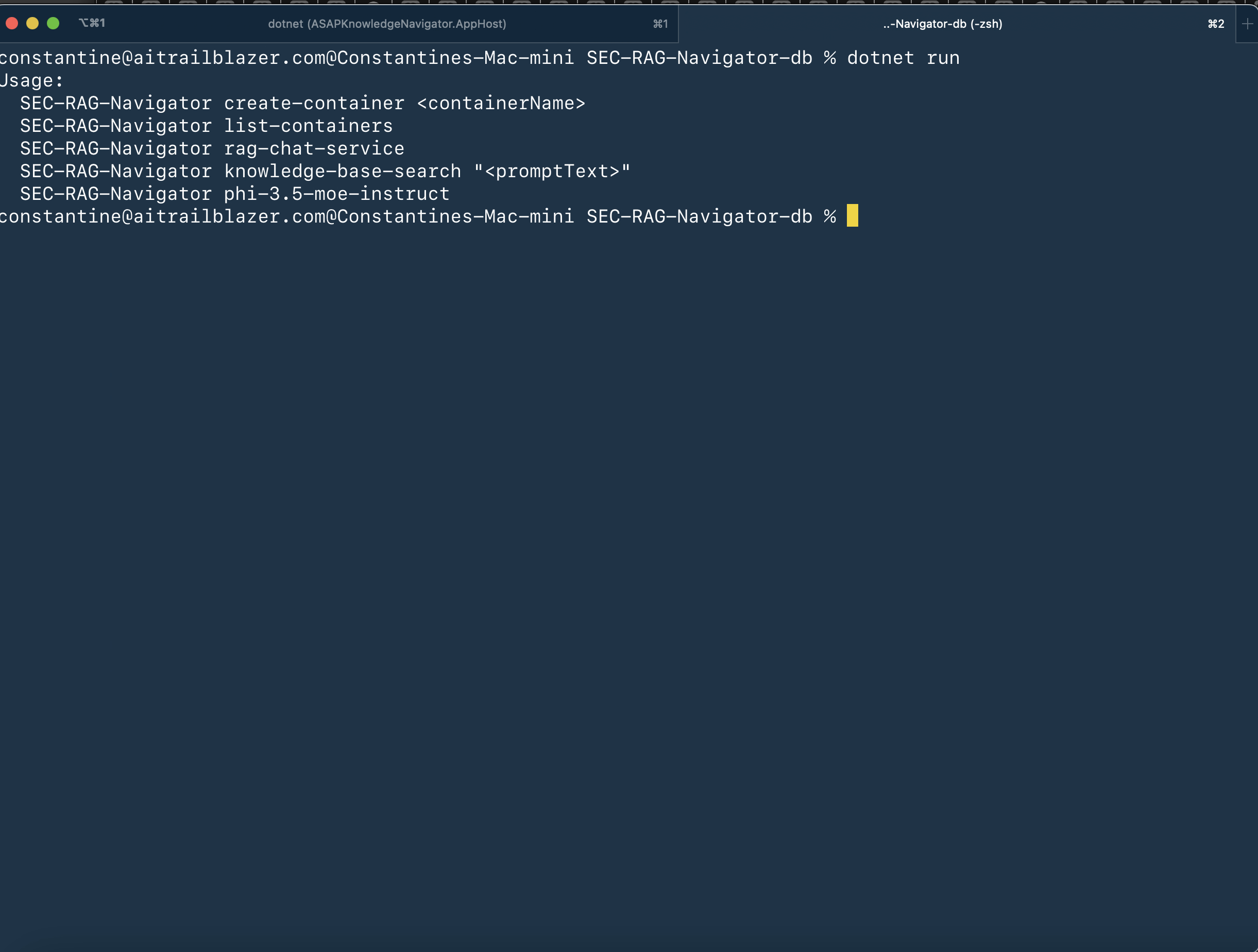
Overview
ASAP SEC-RAG-Navigator is a comprehensive solution designed to streamline the retrieval, processing, and analysis of SEC EDGAR filings. It consists of two powerful tools—sec-edgar and SEC-RAG-Navigator-db—that leverage Retrieval-Augmented Generation (RAG) and advanced AI to transform complex financial data into actionable insights.
Tool 1: sec-edgar
Functionality:
sec-edgar is a command-line tool that interfaces with the SEC EDGAR RESTful APIs to retrieve and process financial filings efficiently.
Core Functionalities:
- Retrieve Company CIKs by Ticker: Quickly fetch a company's Central Index Key (CIK) using its ticker symbol, simplifying data retrieval.
- Fetch Filing Histories: Access historical filing data for comprehensive financial analysis.
- Download Specific Filings: Extract filings such as 10-K, 10-Q, and 8-K in PDF format, enabling offline analysis and integration into workflows.
Benefits:
- Provides the foundational capabilities needed to access raw financial data directly from SEC EDGAR.
- Simplifies the process of obtaining and managing financial filings.
Tool 2: SEC-RAG-Navigator-db
Functionality:
SEC-RAG-Navigator-db extends the capabilities of sec-edgar by analyzing the retrieved filings, enriching them with vector embeddings, and enabling semantic search and conversational insights.
Core Functionalities:
- Ingest and Analyze Filings: Processes PDF filings generated by
sec-edgarfor semantic enrichment. - Vector Embedding and Storage: Generates vector embeddings using DiskANN indexing and stores them in Azure Cosmos DB for efficient semantic searches.
- AI-Powered RAG Insights: Utilizes Retrieval-Augmented Generation (RAG) models to provide deeper analysis and contextual understanding of financial documents.
- Natural Language Querying: Enables professionals to query filings and extract insights using everyday language.
Benefits:
- Transforms raw financial data into actionable intelligence.
- Empowers decision-makers with precise and real-time insights.
Key Features
SEC Filing Management:
- Retrieves and processes filings using SEC EDGAR RESTful APIs.
- Stores filings in Azure Cosmos DB with semantic enrichment for advanced queries.
AI-Driven Insights:
- Employs RAG models for detailed analysis of filings.
- Generates actionable insights from complex financial data.
Natural Language Search:
- Facilitates easy querying of SEC filings using natural language.
Vector Embedding and Semantic Search:
- Leverages DiskANN for high-performance indexing.
- Enables semantic search for quick and accurate information retrieval.
Scalability and Integration:
- Designed to handle growing data demands.
- Integrates seamlessly with Azure Cosmos DB and Azure AI services.
Benefits
- Time Efficiency: Automates data retrieval and analysis, reducing manual workload.
- Enhanced Accuracy: Ensures precision in extracting and interpreting financial insights.
- Real-Time Decision-Making: Provides actionable insights quickly, enabling immediate responses.
- Cost Reduction: Minimizes expenses related to data processing and manual analysis.
- Improved Strategic Decisions: Empowers users with deeper insights to make informed choices.
Target Audience
- Financial Analysts: Quickly access and analyze SEC filings for detailed reports.
- Investors: Make informed decisions based on real-time insights into company filings.
- Compliance Officers: Monitor filings for regulatory adherence efficiently.
- Legal Professionals: Access detailed financial and compliance data for case preparation.
How It Works
Data Retrieval with
sec-edgar:- Retrieve company CIKs, filing histories, and specific filings in PDF format.
Data Analysis with
SEC-RAG-Navigator-db:- Process retrieved filings for vector embedding and semantic analysis.
- Perform natural language queries to extract actionable insights.
Semantic Insights:
- Use RAG models to transform raw filings into enriched, AI-powered insights.
2. ASAP Knowledge Navigator - .net 9 Aspire project
ASAP Knowledge Navigator is an advanced AI-powered project designed to enhance knowledge navigation and retrieval. It builds upon the foundation laid by SEC-EDGAR-WS and SEC-RAG-Navigator-db, providing a user-friendly interface for querying and interacting with SEC filings. Leveraging .NET 9 Aspire for cutting-edge front-end and back-end development and Fluent UI for a modern and intuitive user experience, this tool enables users to perform natural language searches like:
- "What are the risk factors in the latest 10-K filing of TSLA?"
ASAP Knowledge Navigator seamlessly integrates with other tools in the suite, enabling users to quickly find and understand critical financial and regulatory information.
SEC-EDGAR-WS
SEC-EDGAR-WS is a Python-based web service designed to streamline the retrieval and processing of financial data from the SEC EDGAR RESTful APIs. It supports critical features such as company identification, filing history retrieval, and specific filing downloads, with built-in support for HTML and PDF exports. The service is containerized using Docker, making it easy to integrate into larger applications like .NET Aspire solutions.
Key Features
Retrieve Company CIKs by Ticker
Easily fetch a company's Central Index Key (CIK) using its stock ticker for further analysis.Filing History Retrieval
Access a company's complete filing history, including detailed form types like 10-K, 10-Q, and 8-K.Download and Save Filings
Export filings as HTML or PDF documents using WeasyPrint for streamlined accessibility.XBRL Data Processing
Query and visualize specific financial concepts from filings, with support for data plotting.RESTful Endpoints
User-friendly API endpoints provide seamless access to all features, making it easy to integrate into other systems or workflows.
Technology Stack
- Backend: Python
- Deployment: Dockerized for container-based builds and integration.
- API Framework: Flask (or FastAPI, if preferred for async operations).
- PDF Rendering: WeasyPrint
- Visualization: XBRL plotting for data insights.
Integration with .NET Aspire and ASAP Knowledge Navigator
SEC-EDGAR-WS is a foundational component of the broader ASAP Knowledge Navigator project, providing back-end support for querying and analyzing SEC filings. Its seamless Docker-based integration allows .NET Aspire applications to interact with Python-based APIs, unlocking advanced financial search capabilities. Users can perform natural language queries such as:
- "What are the recent 10-K risk factors for TSLA?"
- "Show the assets trend for AAPL over the last three years."
This integration is powered by .NET 9 Aspire, which enables advanced front-end and back-end development. By containerizing Python-based services using Dockerfiles, the project ensures compatibility and scalability. This approach allows for the integration of applications written in languages not natively supported by .NET Aspire, creating a cohesive and flexible ecosystem for diverse development needs.
go-sec-edgar-ws
go-sec-edgar-ws is a Go-based web service dedicated to converting HTML documents into PDF format. This service is particularly useful for transforming SEC filing documents retrieved by SEC-EDGAR-WS into PDFs, enhancing document accessibility and distribution. Containerized with Docker, it integrates seamlessly into larger applications, including those built with .NET Aspire.
Key Features
HTML to PDF Conversion
Efficiently convert HTML documents into high-quality PDFs, facilitating easy sharing and printing of SEC filings.RESTful API
Provides straightforward endpoints for submitting HTML content and receiving PDF outputs, simplifying integration into various workflows.Performance and Scalability
Built with Go, the service offers robust performance and can handle multiple conversion requests concurrently.
Technology Stack
- Backend: Go
- Deployment: Dockerized for container-based builds and integration.
- API Framework: Standard library net/http
- PDF Rendering: Utilizes third-party Go libraries for PDF generation.
Integration with SEC-EDGAR-WS and .NET Aspire
go-sec-edgar-ws complements SEC-EDGAR-WS by providing an efficient solution for converting retrieved HTML filings into PDF format. Through Docker-based containerization, it integrates smoothly with .NET Aspire applications, enabling features such as:
- Automated conversion of SEC filings into PDFs upon retrieval.
- On-demand HTML to PDF conversion via API calls.
- Enhanced document management workflows within the .NET Aspire ecosystem.
This integration ensures that applications can offer comprehensive document processing capabilities, catering to diverse user needs.
Azure Resources Used
- Azure OpenAI Service: Facilitates natural language processing tasks such as text completion and embeddings.
- Azure Cosmos DB: Stores globally distributed knowledge base data with multi-model capabilities.
- Azure Container Registry (ACR): Hosts container images for deployment.
- Azure Container Apps Environment: Runs containerized applications using Azure Container Apps.
- Log Analytics Workspace: Collects logs from various Azure services for monitoring and diagnostics.
- User Assigned Managed Identity: Provides secure authentication without embedding credentials in code.
By incorporating SEC-EDGAR-WS, go-sec-edgar-ws, and the overarching ASAP Knowledge Navigator, developers can create a robust, scalable, and user-friendly platform for accessing, analyzing, and managing SEC filings and related financial documents.
ASAP Knowledge Navigator for Kubernetes Pod Failure Detection and Analysis
Kubernetes, a popular container orchestration platform, can present challenges in monitoring and troubleshooting pod failures. ASAP Knowledge Navigator can be instrumental in addressing these challenges by:
- Providing real-time monitoring and AI-driven analytics: This enables DevOps and SRE teams to gain multi-dimensional visibility into the health of Kubernetes environments and detect performance issues in real-time. This capability allows teams to proactively address issues and minimize downtime.
- Correlating interdependencies among Kubernetes components: ASAP Knowledge Navigator can help identify the root cause of pod failures by analyzing the relationships between nodes, pods, containers, and services. This holistic view of the Kubernetes environment enables more effective troubleshooting and faster resolution of issues.
- Automating troubleshooting and reducing MTTR: By providing insights into pod status and resource utilization, ASAP Knowledge Navigator can help teams quickly identify and resolve issues, minimizing downtime and ensuring the smooth operation of applications.
- Debugging pods in a completed state: ASAP Knowledge Navigator can assist in debugging Kubernetes pods that are in a completed state, helping identify the reasons for their completion and facilitating troubleshooting. This capability is valuable for understanding the lifecycle of pods and ensuring their proper functioning.
- Understanding pod failures: ASAP Knowledge Navigator provides information about the different causes and states of Kubernetes pod failures. This enables users to gain a deeper understanding of the challenges involved in managing Kubernetes pods and develop effective strategies for preventing and addressing failures.
- Addressing pod health check challenges: ASAP Knowledge Navigator can help organizations overcome challenges related to pod health checks, such as those faced by Pipedrive Infra, where pod health checks would sometimes fail without any apparent reason. By providing real-time monitoring and AI-driven analytics, ASAP Knowledge Navigator can help identify the root cause of such failures and ensure the reliability of applications.
3. ASAP-AzureKubernetesService-log-analyzer-RAG: command-line tools
Kubernetes Pod Failure Detection and Analysis
This segment features two powerful tools for automating the detection, analysis, and resolution of Kubernetes pod failures:
Tool: GitHubActionTriggerCLI
Functionality:
GitHubActionTriggerCLI is a feature-rich C# application designed to automate the detection and reporting of failing Kubernetes pods. It integrates seamlessly with GitHub Actions to analyze Kubernetes clusters, creating GitHub issues for failing pods and thereby reducing manual intervention.
Key Features:
- Advanced Semantic Log Analysis: Utilizes Azure OpenAI's GPT models to accurately identify the root causes of pod failures by understanding the context and meaning of log data.
- Efficient Data Retrieval: Employs Azure Cosmos DB NoSQL with DiskANN for high-performance vector-based indexing and retrieval of log data, enabling quick and actionable insights into complex system issues.
- Automated Issue Creation: Automatically generates GitHub issues with detailed information about pod failures, allowing DevOps teams to track and resolve issues efficiently.
Outcome:
- Streamlines troubleshooting processes by automating the identification and reporting of pod failures.
- Reduces manual workload for DevOps teams, enabling them to focus on higher-value tasks.
- Enhances system reliability by facilitating proactive issue resolution.
- Accelerates IT operations through faster diagnostics and problem-solving.
Tool: GitHubActionTriggerOnnxRAGCLI
Functionality:
GitHubActionTriggerOnnxRAGCLI is a local-first, high-performance command-line tool optimized for rapid prototyping and domain-specific troubleshooting. It leverages Retrieval-Augmented Generation (RAG) techniques and ONNX models to provide accurate, context-aware answers while operating entirely on local infrastructure.
Key Features:
- Rapid Prototyping: Facilitates quick development and testing of AI models in a local environment, ideal for iterative development and experimentation.
- Seamless Integration: Integrates smoothly with GitHub Actions workflows and supports Azure Kubernetes Service (AKS) log analysis scenarios for efficient troubleshooting and issue resolution.
- Scalability: Provides a clear pathway for converting local prototypes into scalable, cloud-based Azure deployments, supporting smooth transitions from development to production.
- Data Privacy: Maintains computations locally, ensuring data privacy and control without reliance on external services.
Outcome:
- Accelerates development cycles through rapid prototyping and testing.
- Enhances troubleshooting efficiency with quick, context-aware insights.
- Ensures data privacy through local-first processing.
- Provides a seamless pathway to scalable Azure deployments for broader use.
Challenges We Ran Into
- Integration Complexity: Harmonizing diverse tech stacks, including .NET, Python, and various Azure services, presented significant integration challenges. Ensuring seamless communication and data flow between components required careful planning and iterative testing.
- Security and Compliance: Protecting sensitive data, especially in the financial domain, while adhering to regulatory standards (e.g., GDPR, SEC regulations) demanded rigorous security protocols and continuous monitoring.
- Optimizing Prompt Engineering and Vectorization: Achieving the desired accuracy and relevance in responses required sophisticated prompt engineering techniques and careful management of vector embeddings within Cosmos DB. This involved iterative experimentation and refinement to ensure the system effectively understood and responded to user queries.
- Scalability: Ensuring the system could handle large volumes of data and scale according to demand without performance degradation required careful architecture design and load testing.
- Data Privacy: Maintaining data privacy, especially when dealing with personally identifiable information (PII) and sensitive financial data, was a critical challenge that necessitated strict data handling practices.
What We Learned
- Azure's Versatility: Azure's comprehensive suite of services provides a robust and scalable infrastructure capable of supporting diverse applications, from containerized microservices to serverless functions and AI/ML workloads.
- RAG's Power: Retrieval-Augmented Generation demonstrated a remarkable ability to extract meaningful insights from unstructured data, significantly improving the accuracy and relevance of AI-generated responses.
- Development Acceleration: GitHub Copilot and other AI-assisted development tools substantially streamlined development cycles, aided in prompt engineering and vectorization refinement, and helped overcome complex coding challenges.
- Iterative Feedback: Continuous feedback loops and iterative development were crucial for performance improvement, prompt and vectorization tuning, and addressing edge cases.
- Solo Development with GitHub Copilot: This project was executed by a single developer, showcasing the power of leveraging AI tools like GitHub Copilot for enhanced productivity and capability in tackling complex projects. GitHub Copilot acted as a virtual collaborator, significantly accelerating the development process and making it possible for one person to manage the breadth and depth of this initiative.
What's Next for ASAP Knowledge Navigator
- Industry Expansion: Explore and develop applications of the RAG framework in other sectors such as healthcare (analyzing patient records, medical research), education (personalized learning, content summarization), and legal (case law analysis, contract review).
- Enhanced User Experience: Build intuitive dashboards and user interfaces to make actionable insights more accessible to end-users, enabling them to interact with the system and gain valuable insights effortlessly.
- Community Collaboration: Foster open-source contributions to enhance the project's capabilities, promote innovation, and ensure scalability. Encourage community involvement in developing new features and addressing emerging challenges.
- Advanced Prompt Engineering and Vectorization Techniques: Continuously refine prompt engineering strategies and explore more sophisticated vectorization methods to improve the accuracy, relevance, and context-awareness of the system's responses.
- Multilingual Support: Extend the system's capabilities to support multiple languages, making it accessible to a global audience and expanding its applicability in diverse markets.
Strategic Validation of ASAP Knowledge Navigator
Core Drivers Validation
Financial Analytics (SEC Filings):
- Driver: Simplifying regulatory complexity and transforming vast amounts of unstructured financial data into actionable insights.
- Validation: Proven utility in extracting structured data from unstructured filings, aligning with compliance needs, and enabling more informed decision-making.
- Risk: Potential gaps in domain-specific nuance; mitigated by expert-in-the-loop validation, incorporating feedback from financial experts, and refining prompts and vectorization strategies to capture industry-specific terminology.
Technical Diagnostics (Kubernetes):
- Driver: Automating log analysis and issue resolution to improve system reliability and reduce downtime.
- Validation: The integration of Azure OpenAI and DiskANN demonstrates measurable efficiency gains, significantly reducing manual intervention and accelerating problem resolution.
- Risk (Continued): Over-reliance on semantic search accuracy; mitigated by continuous refinement of prompt engineering, incorporating human-in-the-loop validation, and diversifying data used for vectorization.
Technologies Used in ASAP Knowledge Navigator
Development Languages & Frameworks
- .NET 9.0 SDK: For building applications with C#, F#, and Visual Basic.
- .NET 9 Aspire: Framework for cloud-native, resilient, and observable applications (using C#).
- Python 3.x: Scripting, data processing, and AI model integration.
- .NET 9 C#: Primary language for backend development.
- Go (Golang): For backend services like HTML to PDF conversion.
- Blazor: Framework for building interactive web UIs using C# and .NET.
Frontend Technologies
- Fluent UI: UX frameworks for creating cross-platform user experiences.
- Blazor Components: For building reusable, interactive components in the web frontend.
AI & Machine Learning
- Azure OpenAI Service: For natural language processing, text completion, and embeddings.
- Microsoft.SemanticKernel: Library for AI applications with NLP and semantic search.
- Microsoft.ML.OnnxRuntime: High-performance ONNX model engine.
- Microsoft.ML.OnnxRuntimeGenAI: Enhances ONNX Runtime with generative AI.
- Microsoft.SemanticKernel.Connectors.Onnx: ONNX model integration with Semantic Kernel.
- DiskANN: High-performance vector indexing and similarity search in Azure Cosmos DB.
- ONNX Models: Deployment of various machine learning models.
- Sophisticated Prompt Engineering: For accuracy and relevance in AI responses.
- Vectorization Techniques: For contextual AI understanding and search optimization.
LLM Models Used
- Azure OpenAI Models: Custom-deployed versions of OpenAI's GPT models for enhanced control and scalability.
- GPT-4o: Advanced text completion and generative AI for deep analysis and insights.
- Phi-3.5-MoE-instruct: Lightweight and efficient for processing natural language queries and retrieval tasks with Mixture of Experts architecture.
- Custom ONNX-Based LLMs: Phi-3.5-MoE-instruct. Optimized for specific use cases like SEC filings and Kubernetes diagnostics.
Cloud & Infrastructure
- Microsoft Azure:
- Azure AI Foundry: Building, training, and deploying scalable AI solutions.
- Azure Kubernetes Service (AKS): For containerized application management.
- Azure Container Apps: Running microservices.
- Azure Container Registry (ACR): Hosting container images.
- Azure Cosmos DB: NoSQL database for storing filings and vector embeddings.
- Log Analytics Workspace: Logs collection and diagnostics.
- User Assigned Managed Identity: Secure Azure resource authentication.
DevOps & Automation
- GitHub Actions: CI/CD pipelines for automating builds, tests, and deployments.
- KubernetesClient: .NET library for Kubernetes cluster interaction.
Other Tools & Libraries
- SEC EDGAR RESTful APIs: For retrieving financial filings data.
- Docker: Containerization for microservices and app deployments.
- WeasyPrint: For rendering PDFs in Python applications.
Additional Key Tools
- GitHub Copilot: AI-powered coding assistant for development (using C#, Python, Go, and Blazor).
- Log Analytics: Monitoring Azure services and logs.
--
Built With
- aifabric
- aks
- azure
- c#
- gpt-4o
- kubernetes
- semantickernel
- service


Log in or sign up for Devpost to join the conversation.