-
-
Introduction
-
Problem statement
-
Architecture
-
Proposed solution
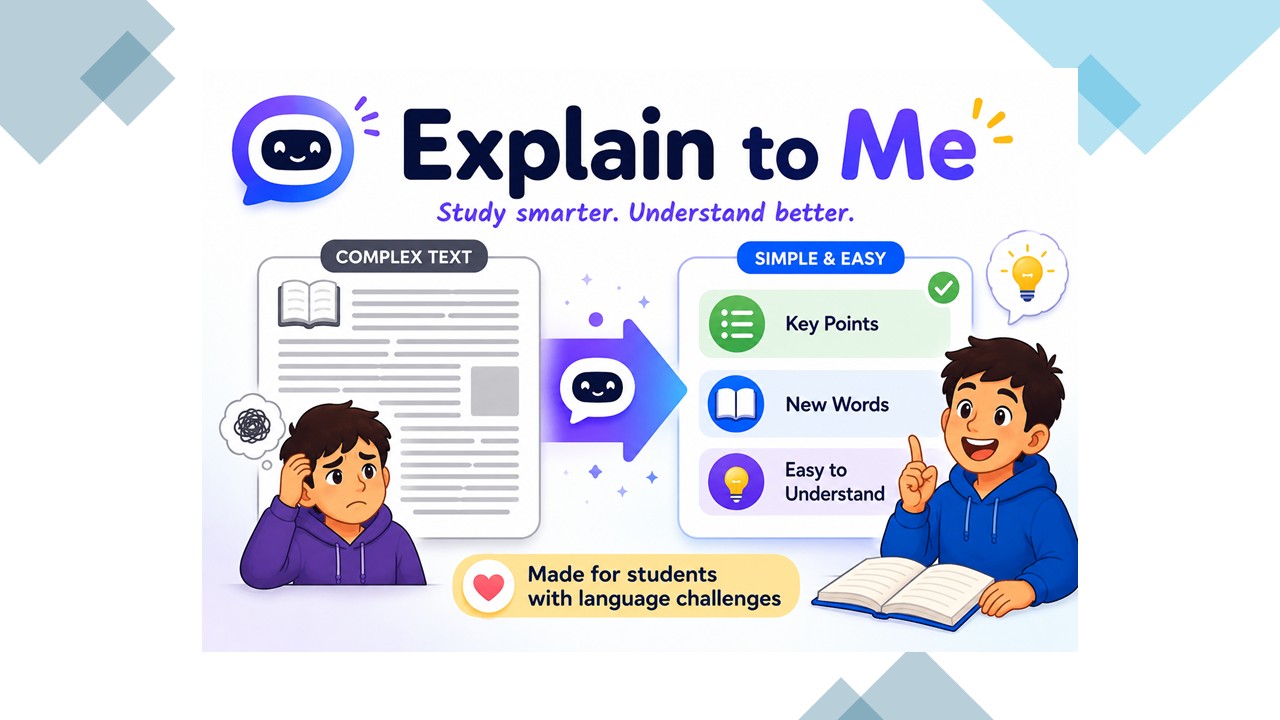
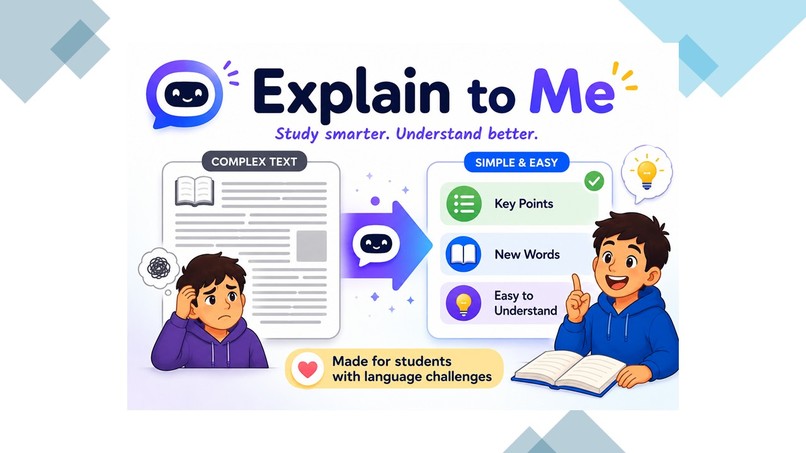
Explain to Me – AI Study Assistant for Students with Language Challenges
Inspiration
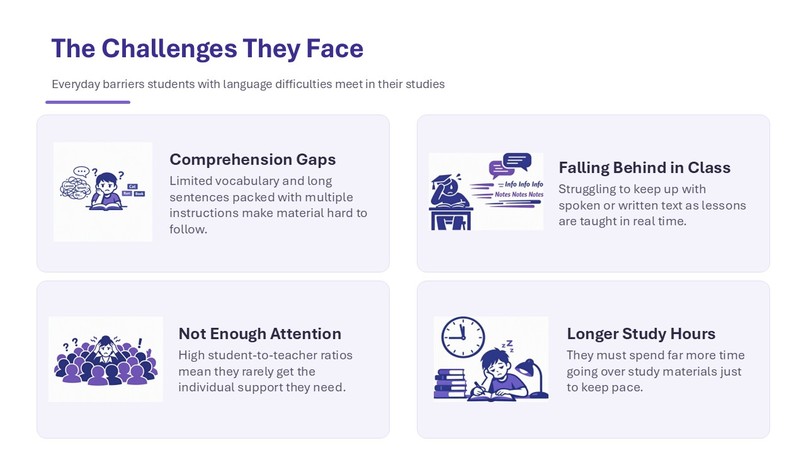
This project was inspired by my own experience supporting a child with language challenges. I have seen firsthand how difficult it can be to understand textbooks written with complex vocabulary and long explanations, even when the underlying concepts are well within the student's ability.
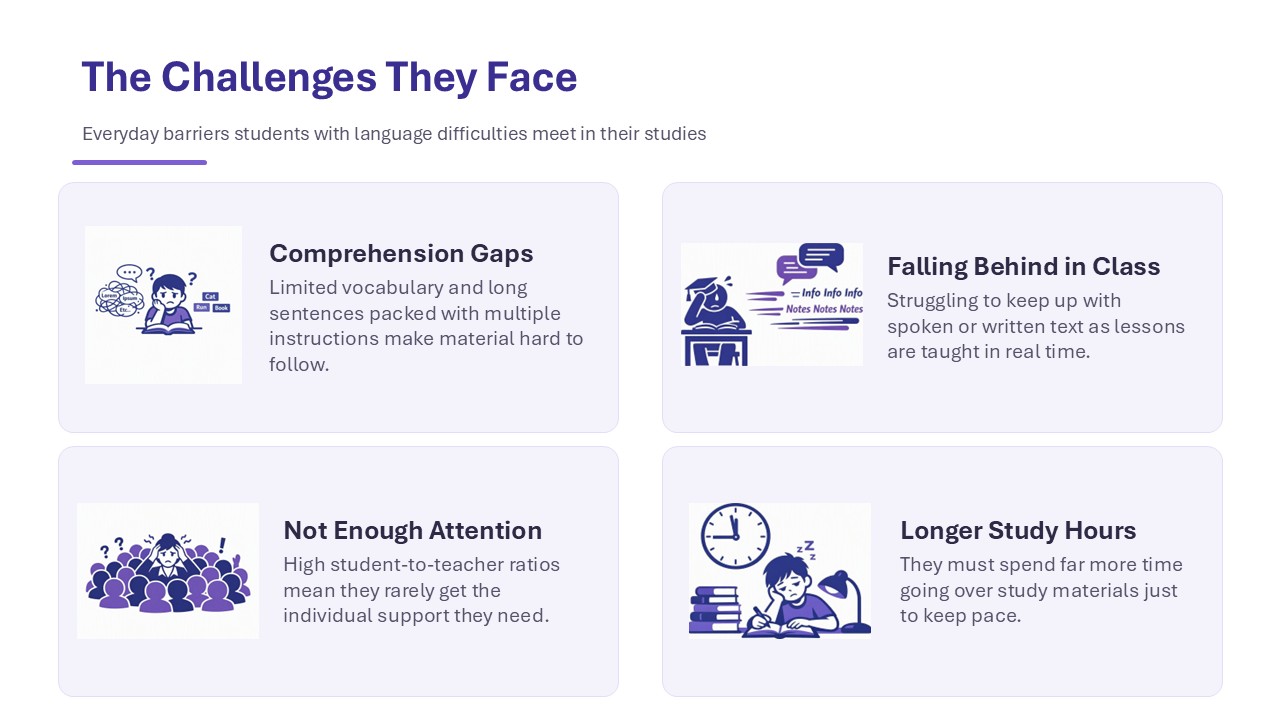
Many students who struggle with language and comprehension rely on special tutors who explain concepts using simpler language. Unfortunately, not every student has access to that kind of support.
This project explores how Large Language Models can provide similar assistance by helping students understand concepts in simpler language while also giving them opportunities to practice what they have learned.
The goal is not to replace a teacher, but to provide an accessible study companion for students who need additional language support outside the classroom.
What the Project Does
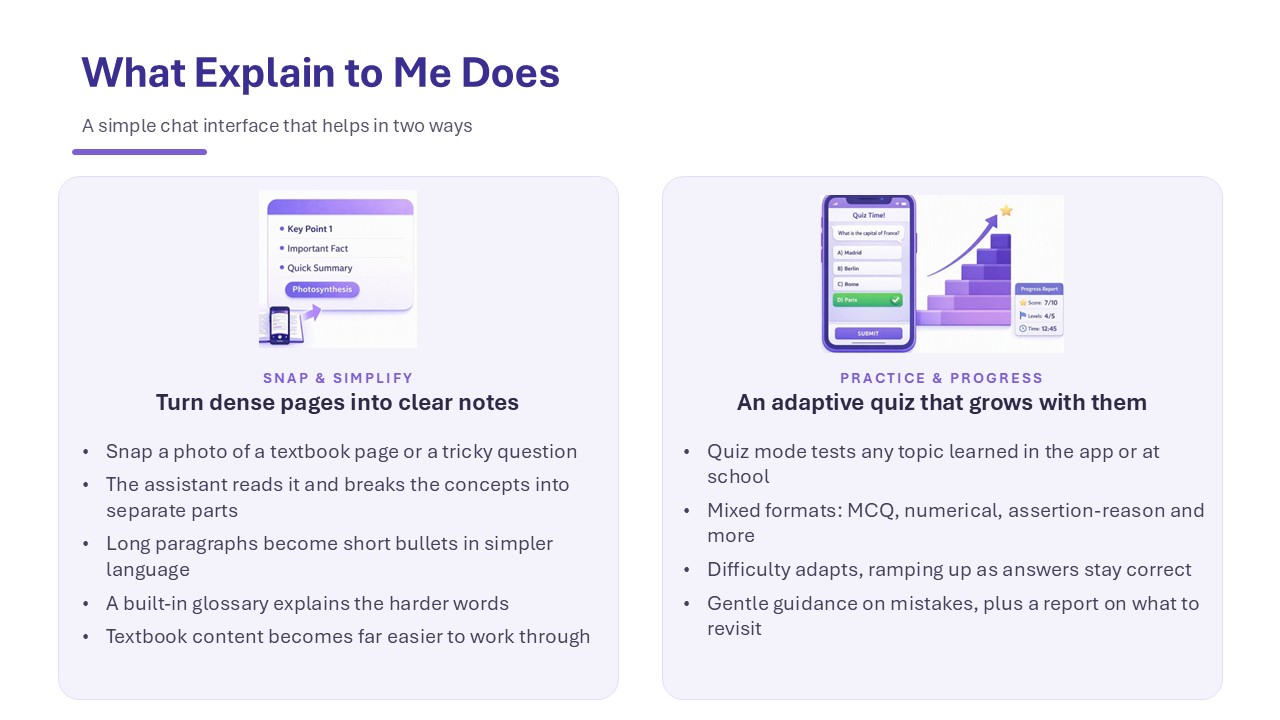
Explain to Me helps students with language and comprehension challenges in two key ways.
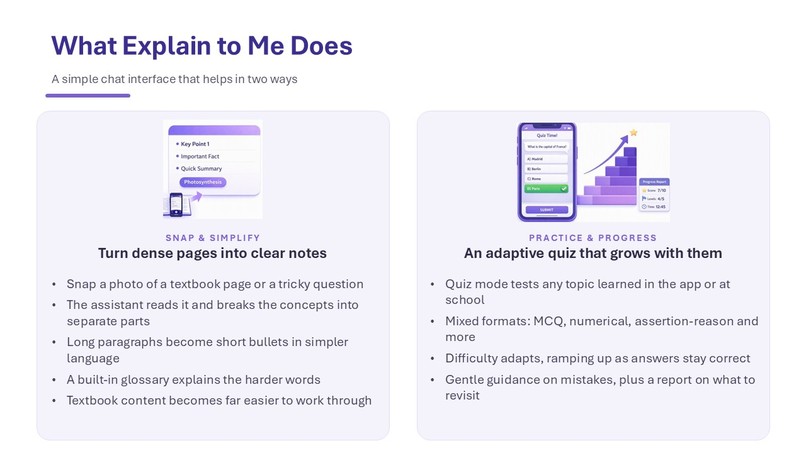
📖 Simplifying Textbook Content
Students can take a picture of a textbook page and upload it to the application.
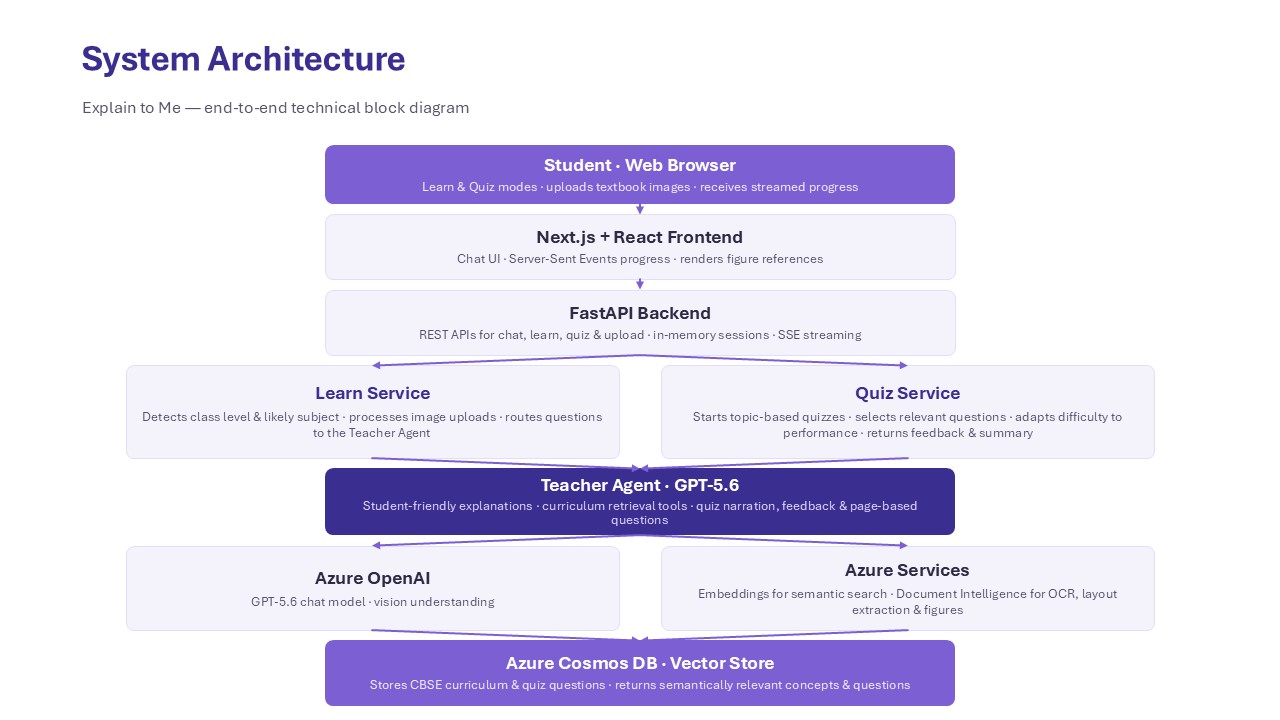
Using Azure Document Intelligence, the text is extracted and passed to GPT 5.6, which understands the content and rewrites it into language that is easier to understand.
Instead of returning another long paragraph, the assistant:
- Breaks concepts into smaller sections
- Presents information using bullet points
- Simplifies vocabulary and sentence structure
- Provides a glossary for difficult words
This enables students to focus on understanding the concepts instead of struggling with complex language.
📝 Adaptive Quiz Practice
Understanding a concept is only the first step. Students also need opportunities to test what they have learned.
To support this, the application includes a question bank for the Grade 9 CBSE Science and Social Science curriculum, containing multiple question types such as:
- Multiple Choice Questions
- Numerical problems
- Assertion–Reason questions
- Other curriculum-specific question formats
When a student selects a topic, GPT 5.6 acts as an adaptive tutor throughout the quiz.
Instead of presenting a fixed sequence of questions, it continuously monitors the student's progress and adapts the learning experience.
- Students answering correctly receive progressively more challenging questions.
- Students who struggle receive simplified explanations, guidance, and encouragement before moving on.
- Incorrect answers become learning opportunities rather than simply being marked wrong.
- At the end of the quiz, the assistant generates a summary highlighting topics that require additional practice.
The objective is to make the experience feel like learning with a patient tutor rather than completing a traditional question bank.
How We Built It
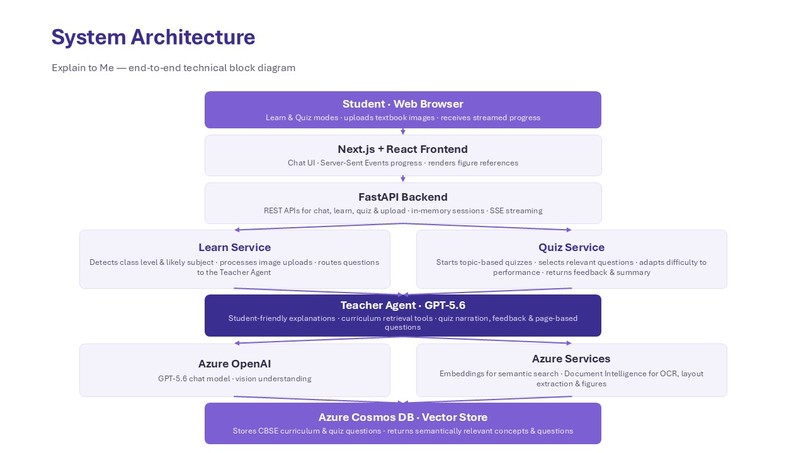
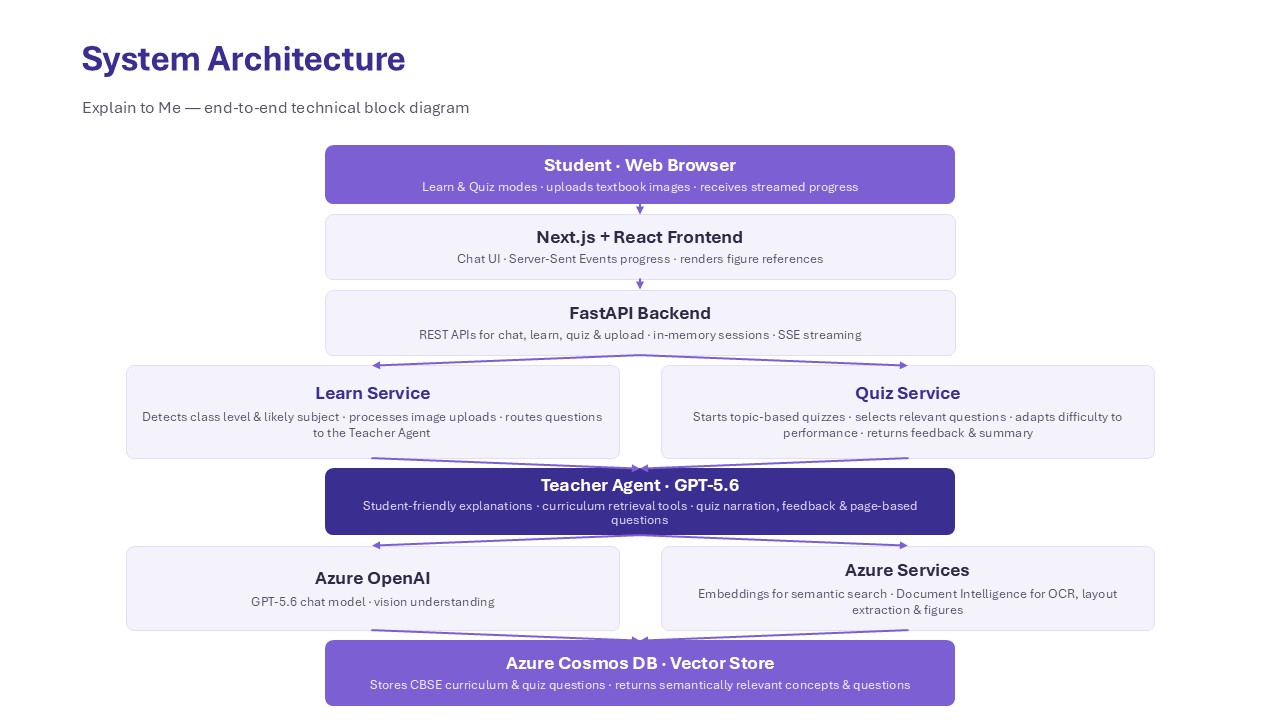
The application consists of:
- React frontend
- FastAPI backend
- Azure Document Intelligence for extracting textbook content
- GPT 5.6 for understanding content, simplifying explanations, managing quiz interactions, evaluating student responses, and generating personalized feedback
The curriculum question banks were pre-generated using course materials, synthetically generated questions, and other sources.
As I already had a clear understanding of the student interactions I wanted, I used Codex extensively during development by providing detailed implementation instructions and iterating on both the frontend and backend.
Codex was particularly helpful in:
- Building the React chat interface and backend integration
- Integrating Azure Document Intelligence with GPT 5.6 to simplify uploaded textbook pages
- Iterating on the conversation flow and refining the user experience through multiple development cycles
- Handling edge cases encountered during real student interactions
Solution Architecture
The architecture below illustrates how textbook content and quiz interactions flow through the system, with GPT 5.6 acting as the central intelligence for content understanding, adaptive tutoring, and personalized feedback.
Why GPT 5.6
GPT 5.6 is the intelligence behind the Study Assistant and powers nearly every stage of the student's learning experience.
It is responsible for:
- Reading and understanding textbook content extracted using Azure Document Intelligence.
- Simplifying complex explanations while preserving the original meaning by breaking concepts into smaller sections, using simpler language, bullet points, and generating a glossary for difficult words.
- Maintaining conversational context throughout the interaction so the assistant remembers what the student has learned, previous responses, and where they are in the quiz.
- Evaluating student answers by understanding free-form responses, identifying mistakes, and providing constructive feedback in language appropriate to the student's level.
- Orchestrating the quiz flow by adapting question difficulty based on the student's performance, deciding when to provide hints, reinforce concepts, or move on to the next question.
- Generating personalized learning summaries that highlight areas requiring additional practice at the end of each quiz session.
These capabilities allow the Study Assistant to provide an adaptive, tutor-like learning experience rather than a fixed sequence of explanations and questions.
Challenges We Faced
The biggest challenge was not building the AI—it was designing conversations that felt natural for students.
Students rarely follow a perfect flow. They may want to:
- Skip a question
- Exit a quiz midway
- Ask for additional hints
- Recover after giving an incorrect answer
- Continue learning without becoming frustrated
Designing these interactions required multiple iterations of the chat experience and remains an ongoing process as we gather feedback from students.
What We Learned
Building this project reinforced that creating an effective educational assistant is about much more than generating accurate answers.
The learning experience depends on presenting information in a way that matches the student's level of understanding while maintaining context, adapting to their progress, and providing guidance that builds confidence.
Designing these interactions proved to be just as important as implementing the underlying AI capabilities.
What's Next
There are several areas we would like to expand.
These include:
- Student profiles for long-term progress tracking
- The ability to resume learning from where a student previously stopped
- Collecting feedback from more students to improve the learning experience and conversation flow
As more students use the application, their feedback will help shape future iterations of the Study Assistant.
Closing
Every student deserves explanations they can understand.
Explain to Me explores how GPT 5.6 and Codex can make learning more accessible for students with language and comprehension challenges by simplifying textbook content, adapting practice sessions to each learner, and providing personalized guidance—all while complementing, rather than replacing, the role of teachers.

Log in or sign up for Devpost to join the conversation.