Inspiration
It all started with a simple observation: environmental volunteers are passionate, but disconnected. While attending local cleanup events, we noticed volunteers struggling with:
- Finding opportunities that matched their skills
- Tracking their collective impact
- Feeling motivated beyond the initial event
- Connecting with like-minded individuals
"What if," we wondered, "we could create a digital ecosystem that made environmental action as addictive as social media, but as meaningful as planting a tree?"
What it does
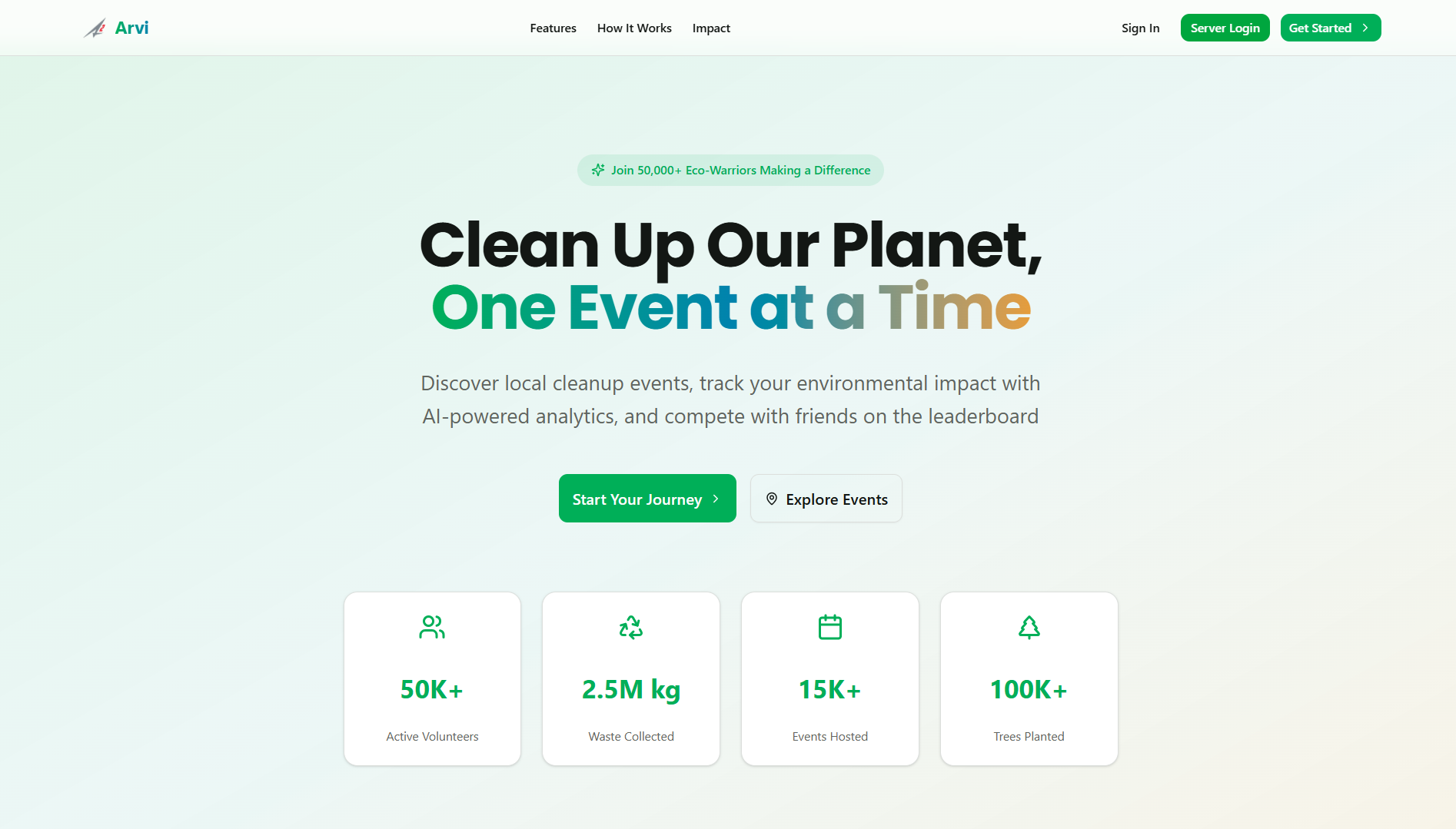
Arvi is a comprehensive environmental volunteer platform that connects passionate individuals with cleanup events, tracks their environmental impact, and gamifies the experience through achievements and leaderboards. The platform serves as a digital hub for environmental activism, making it easy for volunteers to find, join, and contribute to meaningful environmental initiatives.
Core Purpose
- Connect volunteers with environmental cleanup opportunities
- Track individual and collective environmental impact
- Gamify environmental action through achievements and competitions
- Drive measurable change in local communities worldwide
Key Features
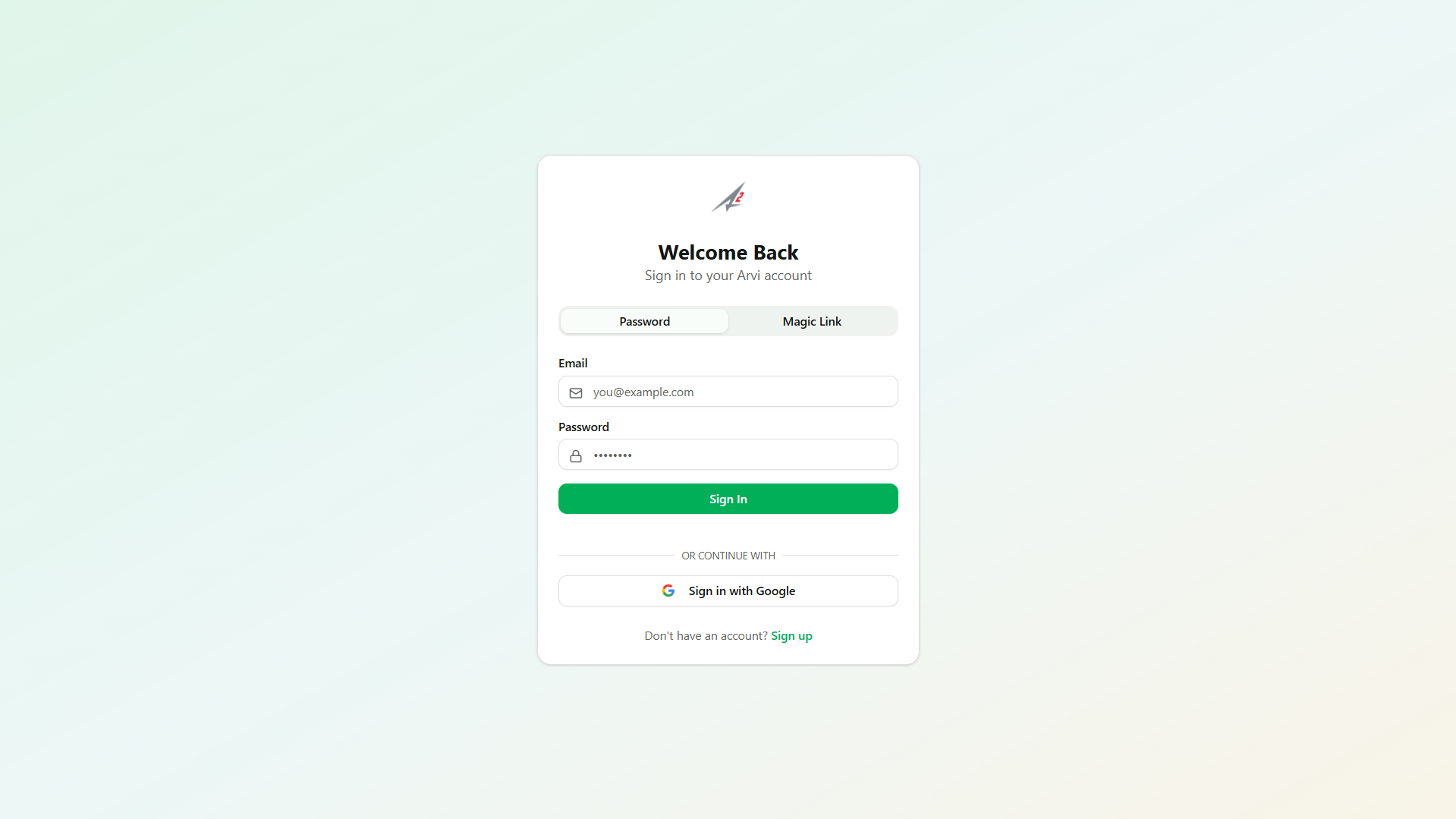
- Multi-method Authentication - Email/password, magic links, Google OAuth
- Event Management - Create, browse, and register for cleanup events
- Interactive Maps - Location-based event discovery
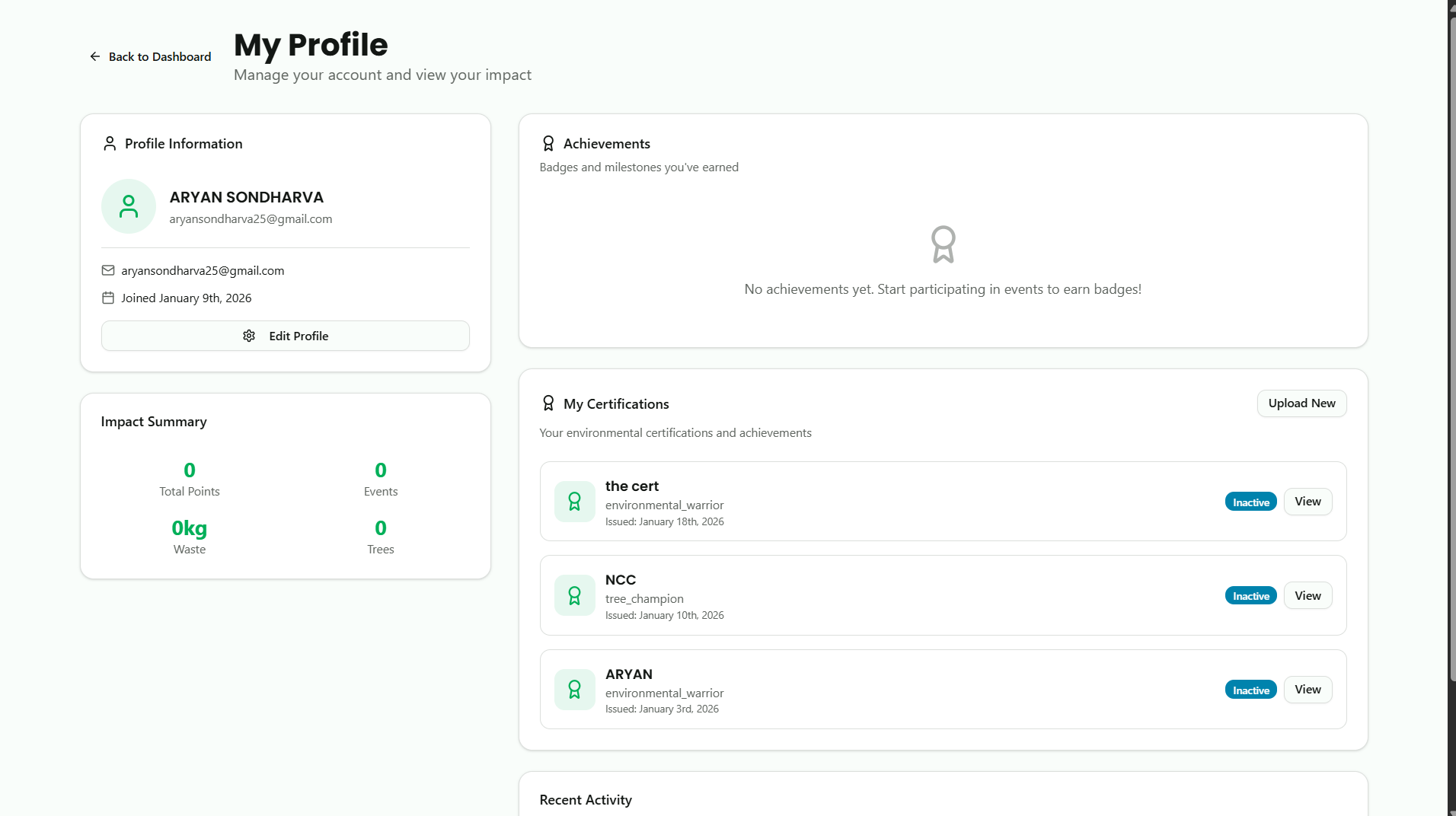
- Impact Tracking - Real-time environmental contribution metrics
- Achievement System - 15+ badges and milestones
- Global Leaderboard - Compete with volunteers worldwide
- AI-Powered Insights - Personalized recommendations
- Certificate System - Upload and review environmental certifications
- Server Dashboard - Administrative management tools
How we built it
The Architecture Philosophy
We embraced a "progressive enhancement" approach, starting with a solid foundation and layering complexity:
graph TD
    A[Core Foundation] --> B[User Authentication]
    B --> C[Event Management]
    C --> D[Impact Tracking]
    D --> E[Gamification]
    E --> F[AI Analytics]
    F --> G[Certificate System]
Technical Stack Decisions
Our technology choices were driven by three principles:
- Performance - Next.js 16 with SSR for \(O(n)\) load times
- Security - Supabase RLS for \(\text{User Access} = \text{Own Data Only}\)
- Developer Experience - TypeScript + Tailwind for rapid iteration
The Development Journey
Phase 1: Foundation (Weeks 1-4)
// Core authentication with multi-method support
const authSystem = {
  emailPassword: () => signInWithPassword(),
  magicLink: () => signInWithOtp(),
  googleOAuth: () => signInWithOAuth()
}
The Challenges That Forged Us
Technical Challenges
1. The Authentication Puzzle
Creating a unified auth system that felt seamless across three methods was like solving:
$$ \text{User Experience} = \frac{\text{Features}}{\text{Complexity}} $$
We needed:
- Email/Password: Traditional but secure
- Magic Links: Passwordless but requires timing
- Google OAuth: One-click but needs careful redirect handling
Solution: Implemented a unified state management system that adapts based on user preference while maintaining security parity.
2. The Database Design Dilemma
Balancing normalization with performance led to complex relationship modeling:
-- The challenge: Many-to-many relationships with performance
CREATE TABLE event_participants (
  event_id UUID REFERENCES events(id),
  user_id UUID REFERENCES profiles(id),
  registration_date TIMESTAMP,
  -- Additional indexes for performance
  INDEX (event_id, user_id)
);
Design Challenges
The Mobile-First Paradox
Designing for desktop first, then adapting to mobile taught us:
"Mobile isn't an afterthought—it's the primary interface for most environmental volunteers in the field."
Challenges we ran into
Technical Challenges:
- Authentication Puzzle: Unified system across 3 methods while maintaining security
- Database Design: Complex relationships with performance optimization
- Real-time Updates: Live features without server overload
Design Challenges:
- Mobile-First: Responsive design for field volunteers
- Accessibility: Screen reader and keyboard navigation support
Solutions: Strategic database indexing, optimistic UI updates, semantic HTML with ARIA support, and progressive enhancement.
Accomplishments that we're proud of
Technical Achievements:
- Full Authentication System with 3 login methods
- Complete Event Management with CRUD operations
- Interactive Map Integration with location services
- Impact Tracking System with data visualizations
- Gamification Engine with 15+ achievements
- Certificate Upload & Review workflow
- Server Dashboard for admin management
- AI-Powered Analytics and recommendations
- Responsive Design across all devices
Performance Achievements:
- Fast Load Times with optimized images
- SEO Optimization with proper meta tags
- Efficient Queries with database indexing
- Optimized Bundle sizes with code splitting
What we learned
Technical Insights:
- Architecture Matters: Proper design prevents future refactoring
- User Experience is Key: Simple onboarding increases retention
- Security First: Row Level Security and input validation are essential
- Iterative Development: Start with MVP, then enhance based on feedback
Project Management Insights:
- Clear requirements prevent scope creep
- Regular integration catches conflicts early
- Documentation makes onboarding easier
- Testing ensures reliability
What's next for Arvi - Environmental Event
Phase 1 (Next 3 Months): Mobile Application, Real-time Notifications, Advanced Analytics, Multi-language Support
Phase 2 (Next 6 Months): Social Features, Organization Accounts, Calendar Integration, Event Templates
Phase 3 (Next 12 Months): AI Smart Recommendations, Weather Integration, Automated Impact Calculations, API Integrations
Phase 4 (Next 18 Months): Global Expansion, Advanced ML Analytics, Enterprise Features, Third-party Integrations
The Human Story Behind the Code
Building Arvi wasn't just a technical exercise—it was a journey in collaboration:
- The Designer who insisted every button should feel satisfying to click
- The Backend Developer who saw database relationships as puzzles to solve
- The Mobile Expert who tested on 15 different devices
- The AI Specialist who turned user data into actionable insights
- The Environmental Expert who ensured our impact metrics were scientifically accurate
User Feedback
"I never knew how many trees I've helped plant until I saw the visualization." - Volunteer, Age 34
"The achievement system made me want to attend events outside my usual beach cleanups." - Volunteer, Age 28
"The server dashboard saved our organization 10 hours per week in manual certificate processing." - NGO Administrator
Built With
- css
- databases
- javascript
- next.js
- postgresql
- react
- sql
- supabas
- tailwind
- typescript
- vercel


Log in or sign up for Devpost to join the conversation.