Inspiration
We were inspired by the gap between the skills of artisans and their access to modern markets. Many artisans create high-quality traditional products but face difficulties in creating digital listings, understanding market prices, reaching larger buyers, and fulfilling bulk orders because of limited digital access and production capacity.
We wanted to build something beyond a basic marketplace. Our idea was to help artisans create, sell, collaborate, and grow while also creating additional work opportunities within the artisan community.
What it does
Artisan is an AI-powered platform designed around the complete artisan selling journey.
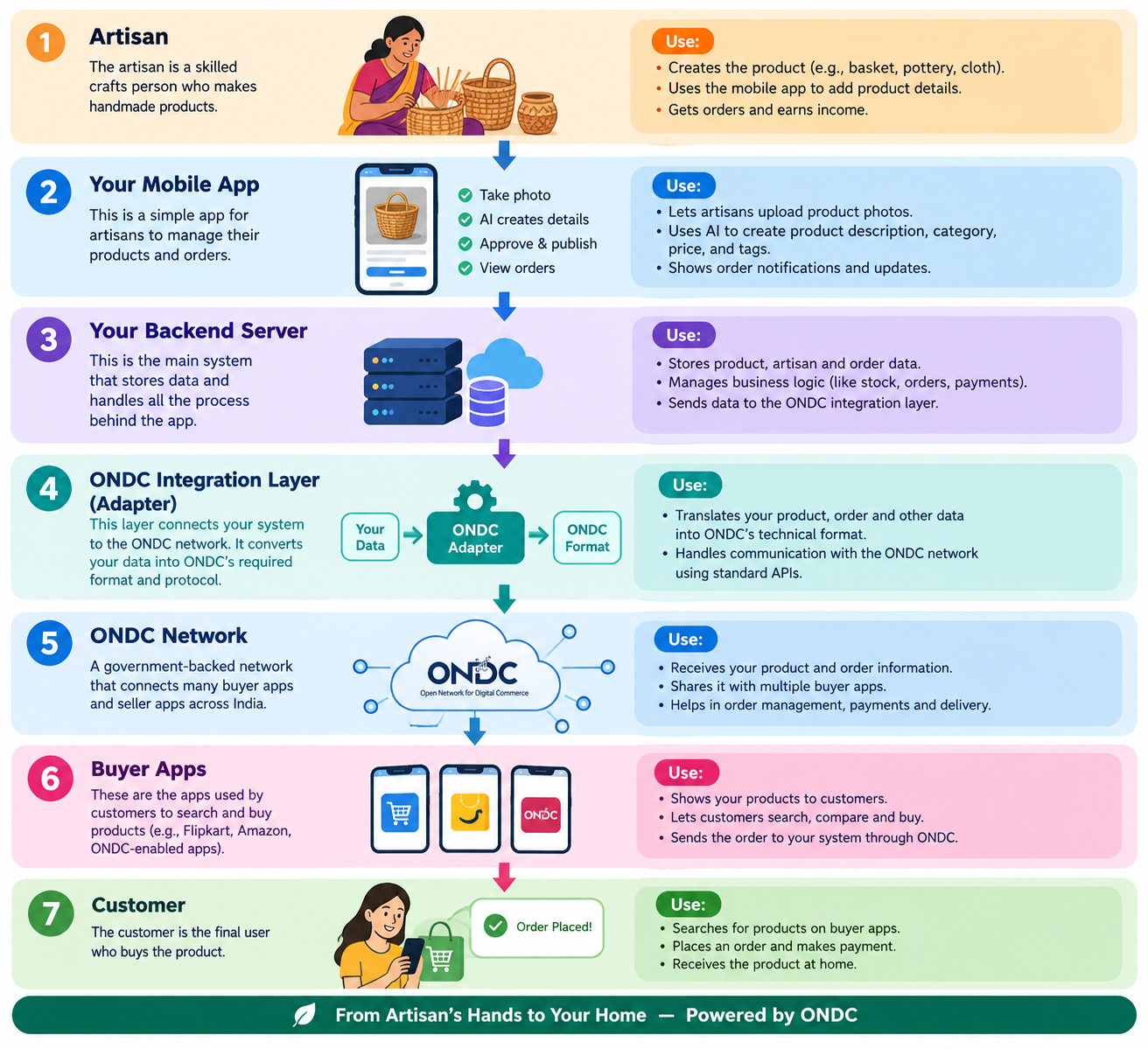
- AI Smart Cataloging: Upload a product photo and AI generates the product name, description, category, tags, and other catalog details.
- Voice & Local-Language Support: Artisans can listen to and verify AI-generated information using voice, reducing dependence on typing.
- Smart Pricing: Market signals and product information are used to suggest a suitable price range.
- Market Linkage: A product can be published through an API-based layer to connected commerce platforms, reducing repeated listing work.
- Individual & Bulk Selling: Artisans can handle normal customer orders as well as larger institutional or bulk opportunities.
- Artisan Employment Network: When a bulk order is too large for one artisan, they can post a production collaboration request. Other skilled artisans can receive notifications and apply to help fulfil the order.
- Trend Intelligence: The system analyzes market trends and matches them with an artisan's skills to suggest what they could make next.
Our core journey is:
Create → List → Sell → Scale → Collaborate → Grow
How we built it
We designed the platform with a mobile-first interface connected to a Python FastAPI backend.
We use PostgreSQL for structured information such as artisan profiles, products, orders, skills, pricing information, and collaboration requests.
The AI layer is designed to handle:
- Image-based product understanding
- AI catalog generation
- Product recommendations
- Pricing intelligence
- Trend analysis
- Voice-based interaction
The backend exposes APIs that connect the mobile application with these AI services, the database, and external commerce platforms.
For the market-linkage demonstration, we designed an API integration layer that can connect with compatible commerce systems such as a controlled Bagisto instance.
Challenges we ran into
The biggest challenge was designing a solution that was both technically realistic and simple enough for artisans to use.
We also had to think carefully about market and trend data. Not every online marketplace provides unrestricted access to its data, so we designed our architecture around legally accessible APIs, datasets, and controlled data sources rather than assuming unlimited scraping access.
Another challenge was bulk-order fulfilment. We realized that giving an artisan a large order does not solve the problem if they cannot produce the required quantity. This led to our Artisan Employment & Collaboration Network, where additional skilled artisans can be connected to production opportunities.
We also had to balance AI automation with human control. AI provides suggestions, but the artisan makes the final decisions about their product, price, and collaboration.
Accomplishments that we're proud of
We are proud that our solution goes beyond simply putting artisan products online.
We connected multiple real-world problems into one workflow:
Digital cataloging → Market access → Bulk orders → Production collaboration → Employment opportunities → Trend-based future production
We are especially proud of the bulk-order collaboration concept because one large order can potentially create work opportunities for multiple skilled artisans instead of benefiting only the original seller.
We also designed the system around voice and local-language accessibility, making digital commerce more approachable for users who may not be comfortable with traditional apps.
What we learned
We learned that solving a real-world problem is not just about adding AI features. Every technology needs to solve a specific user problem.
We learned how to think about:
- Designing for users with limited digital literacy
- Combining AI with human verification
- Building API-based systems
- Connecting market demand with production capacity
- Creating employment opportunities through collaboration
- Making AI recommendations explainable and practical
- Designing a solution that can grow beyond a single marketplace
Most importantly, we learned to focus on the complete artisan journey rather than one isolated problem.
What's next for Artisan
Our next step is to move from a prototype toward a deployable platform.
We plan to:
- Add more regional languages and voice capabilities.
- Integrate more verified market and trend data sources.
- Improve AI-based pricing and product recommendations.
- Build stronger artisan and worker verification.
- Develop secure payment and order-management workflows.
- Expand bulk-order and production collaboration features.
- Connect with more compatible commerce platforms.
- Pilot the platform with real artisan communities and use their feedback to improve the experience.
Our long-term vision is to create a system where market demand can reach artisans directly, large orders can create additional livelihood opportunities, and traditional skills can grow with changing customer demand.
Built With
- ai
- analytics
- api
- computer
- data
- fastapi
- generative
- learning
- machine
- natural-language-processing
- postgresql
- python
- recognition
- recommendation
- rest
- speech
- systems
- tts
- vision

Log in or sign up for Devpost to join the conversation.