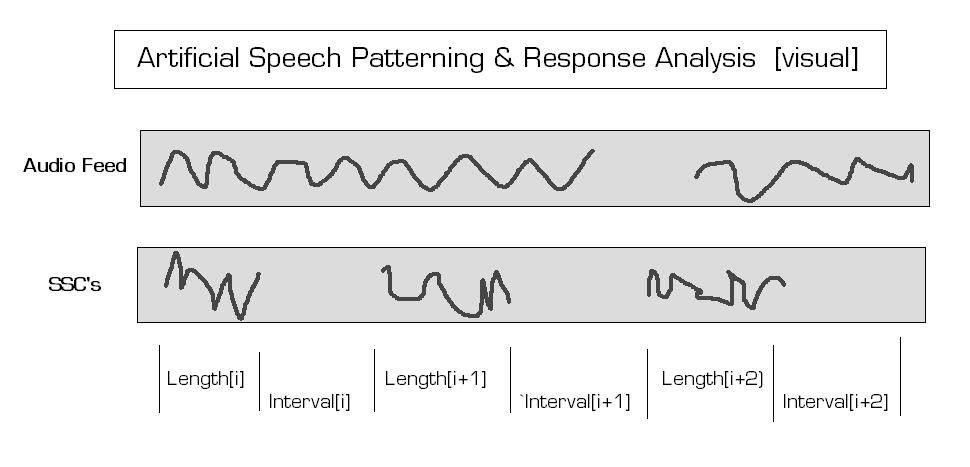
- Begin recording call audio into a buffer.
- Have a pool of 10 different "stimuli sound clips", such as the human voice saying the beginning of various words ((he)y, excu(se), uh, wel(l), plea(se), wai(t) .
- Randomize six values: length[0,1,2], interval[0,1,2] each with a value between .10 and 1.00 seconds.
- Randomly choose stimuli sound clips; play each SSC[i] for length[i] and then wait interval[i] and record all audio feed data.
- Compare caller's sound levels during length[i] of ssc[i] and during interfal[i] to get Humanity Response Ratio (which can be from -1 to 0 to 1 and even multiplied values)
- Hypothetical Examples of HRR = -0.55, caller spoke less when SSC was in length[i] and more when it was in interval[i] - sure sign of robot or very rude human. or HRR = 1.0, meaning it's a human because they stopped speaking while SSC played to avoid rude interruption.)
- The threshold for human is arbitrarily chosen based on testing and research.
- The process can be repeated several times per run to get more accurate reading.
- Each SSC[i] and length[i] and interval[i] is recorded into input layer of artificial neural network;
- Individual HRR's and means are inserted into another layer of artificial neural network.
- Other audio data like average frequency, frequency density, call lengths, etc are iknserted into another layer of ANN.
- Output is trained by a controlled environment and human tester to effectively "teach" the computer to tell the difference in the caller's mannerisms and speech patterns and provide accurate probabilities of human source or artificial source.
Artificial Speech Patterning & Response Analysis
Updates

Leave feedback in the comments!
Log in or sign up for Devpost to join the conversation.