Artifex: A Production-Grade Multi-Agent AI Platform for Foster Care Intelligence
Problem Statement
Foster care systems worldwide face significant operational and decision-making challenges. Social workers and child welfare agencies are responsible for evaluating referrals, assessing risk, matching children with suitable foster families, monitoring placements, and intervening when issues arise. These processes are often fragmented across multiple systems, heavily dependent on manual coordination, and constrained by limited resources.
As a result, agencies frequently encounter several critical problems:
- Suboptimal placement decisions, where children are matched with families that may not fully meet their emotional, educational, cultural, or medical needs.
- Delayed identification of placement risks, causing warning signs to go unnoticed until a crisis occurs.
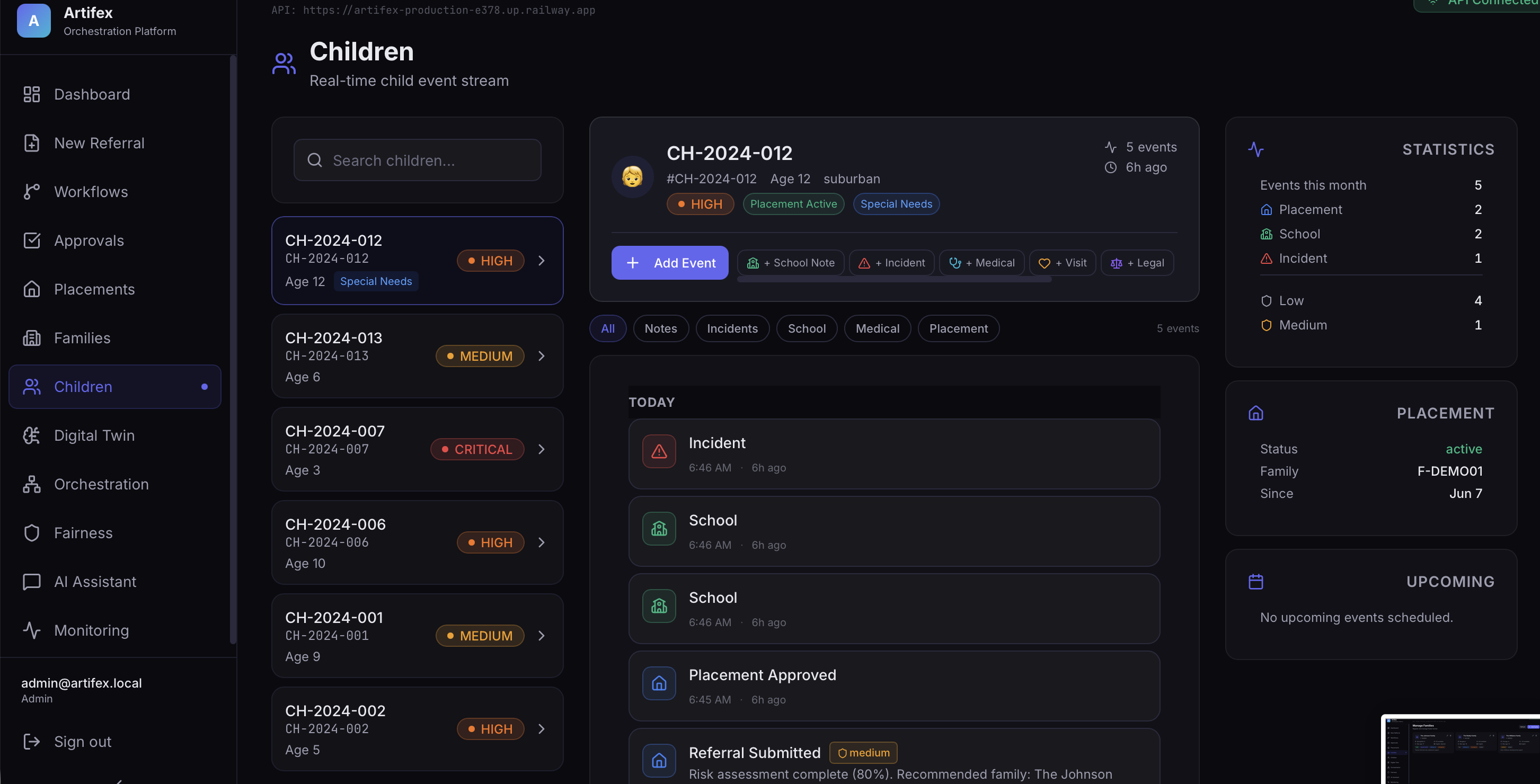
- Lack of real-time visibility into ongoing cases, making it difficult for stakeholders to coordinate interventions effectively.
- Algorithmic bias and fairness concerns in AI-assisted decision-making systems.
- Limited transparency and accountability, reducing trust in automated recommendations.
- Siloed workflows and disconnected databases, creating inefficiencies throughout the foster care lifecycle.
These challenges directly affect placement stability, child well-being, operational efficiency, and long-term outcomes for vulnerable children.
Project Objective
Artifex aims to transform foster care decision-making through an intelligent, transparent, and scalable AI-powered platform that combines agentic AI, machine learning, workflow orchestration, and real-time monitoring.
The primary objectives of Artifex are:
- Improve foster family matching through data-driven recommendations.
- Detect placement risks before disruptions occur.
- Provide continuous monitoring and early intervention capabilities.
- Enable collaboration between AI systems and human decision-makers.
- Ensure fairness, transparency, explainability, and accountability in every recommendation.
- Demonstrate how production-grade multi-agent AI systems can solve complex real-world social impact challenges.
Rather than replacing social workers, Artifex acts as an intelligent decision-support system that augments human expertise and helps agencies make more informed decisions.
Proposed Solution
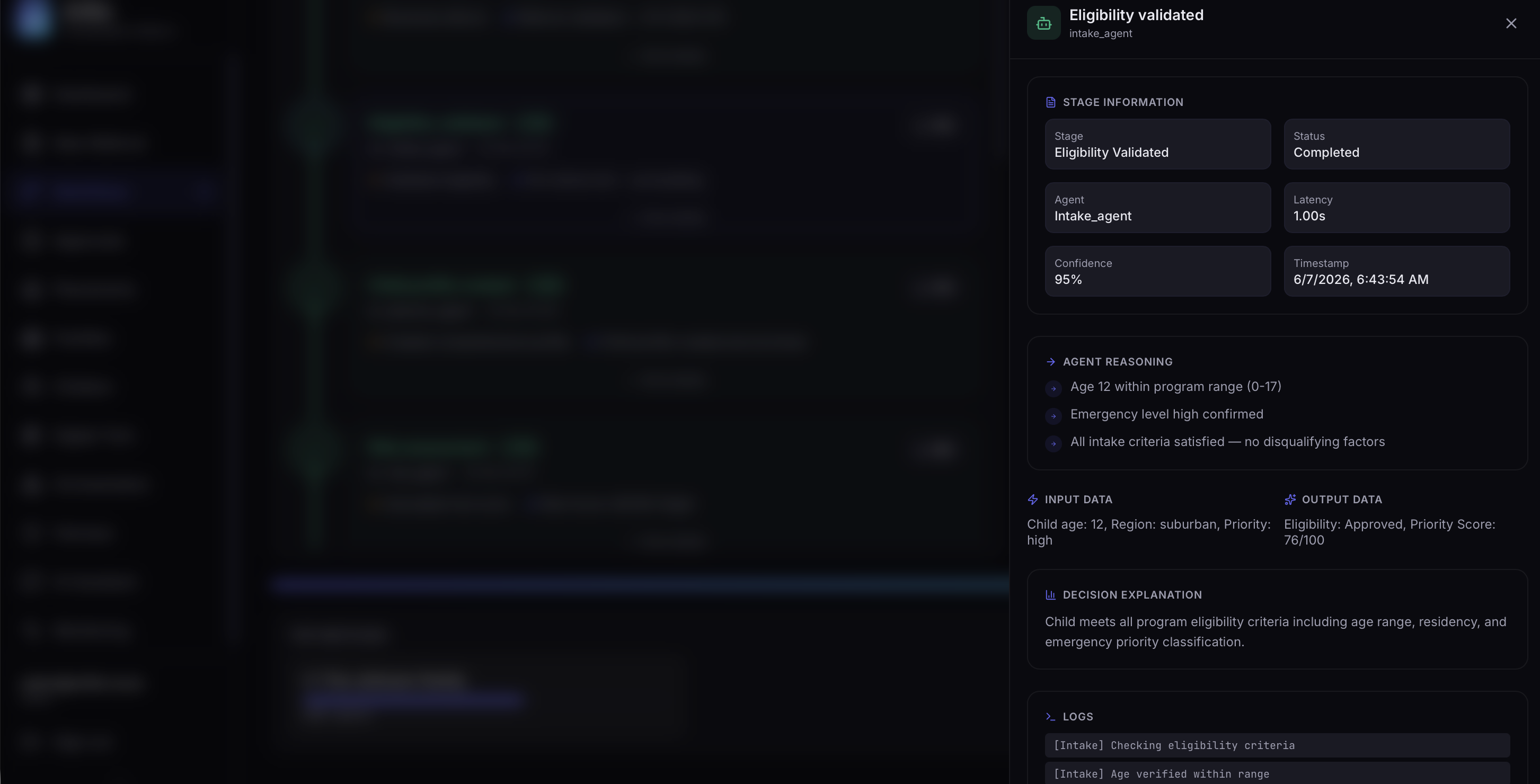
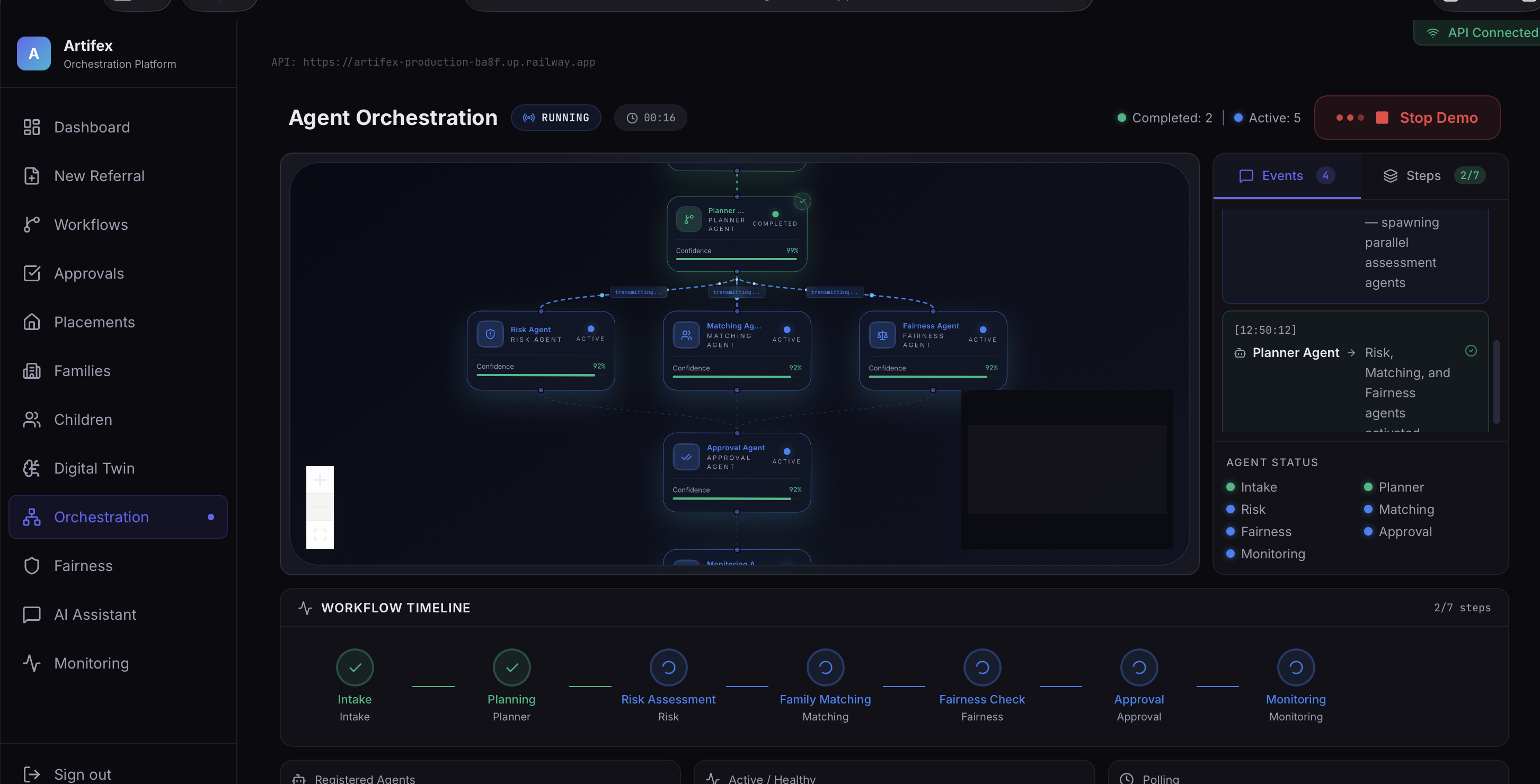
Artifex is a fault-tolerant, self-healing, multi-agent AI platform that orchestrates specialized AI agents through durable workflows and event-driven communication.
The system combines:
- Agentic AI orchestration
- Machine learning prediction models
- Real-time workflow automation
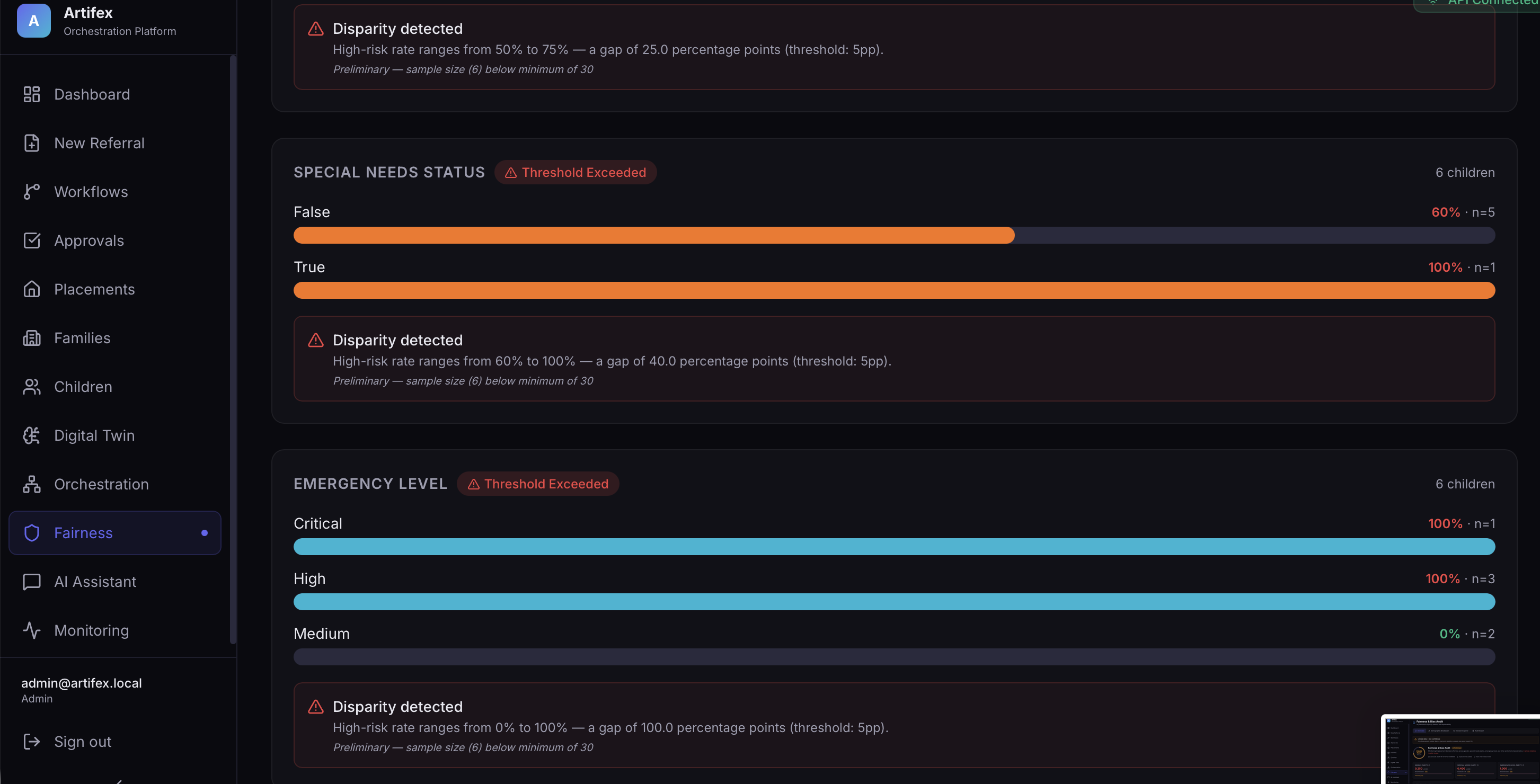
- Fairness auditing
- Explainable AI
- Human-in-the-loop governance
- Digital twin simulation
- Tamper-evident AI decision auditing
The platform serves as a unified intelligence layer across the entire foster care lifecycle.
System Architecture
Multi-Agent AI Swarm
Artifex employs a swarm of specialized AI agents that collaborate to solve complex tasks.
These include:
- Planner Agents for task decomposition
- Executor Agents for task execution
- Retriever Agents for knowledge retrieval
- Validator Agents for quality assurance
- Recovery Agents for fault correction
- Dispatcher Agents for workload optimization
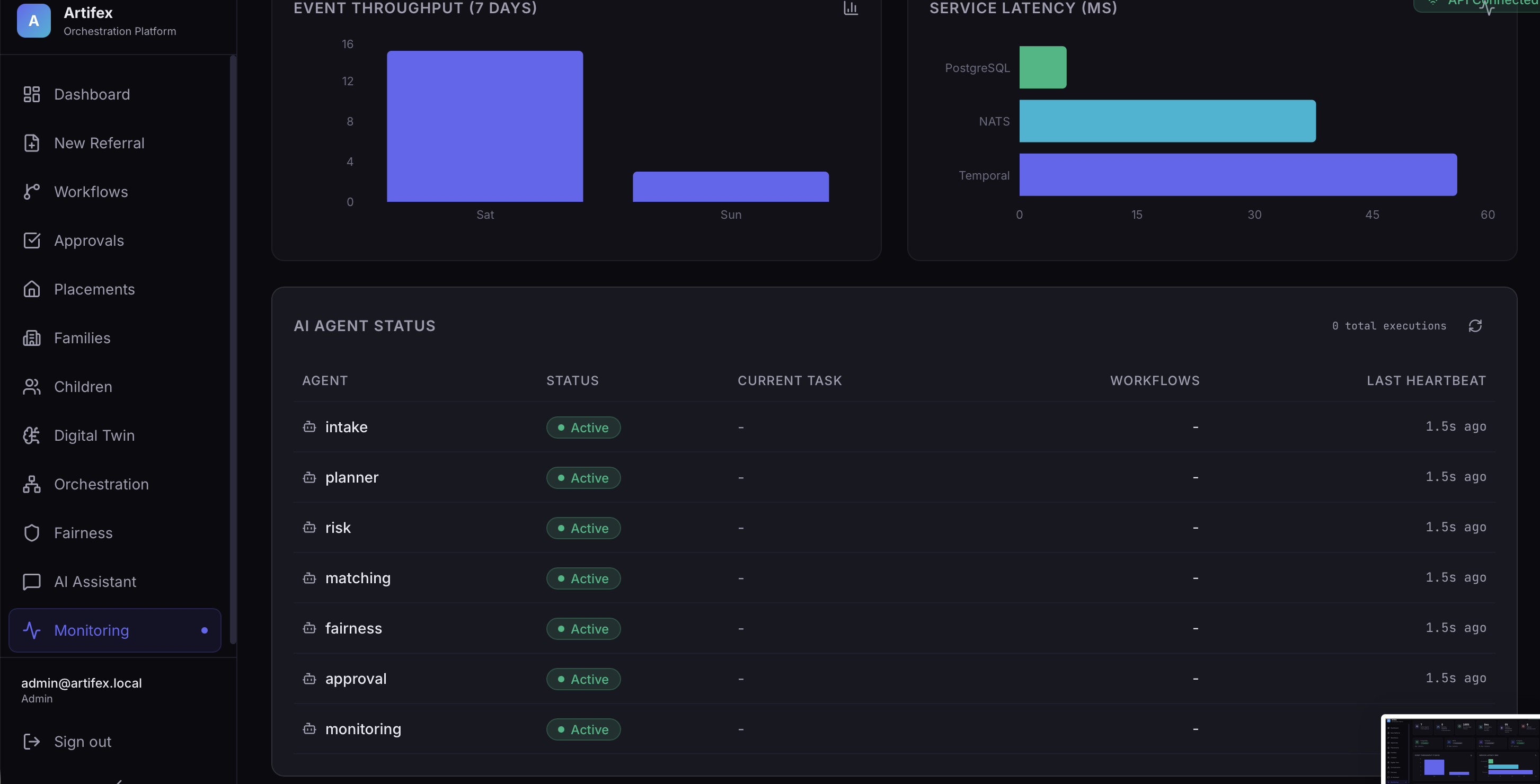
- Supervisor Agents for health monitoring
- Swarm Managers for dynamic team formation
- Domain Specialists for foster care intelligence
Unlike traditional AI systems that rely on a single model, Artifex uses collaborative AI agents capable of planning, validating, recovering from failures, and self-organizing into specialized teams.
Durable Workflow Orchestration
The platform uses workflow orchestration to manage long-running foster care processes.
Core workflows include:
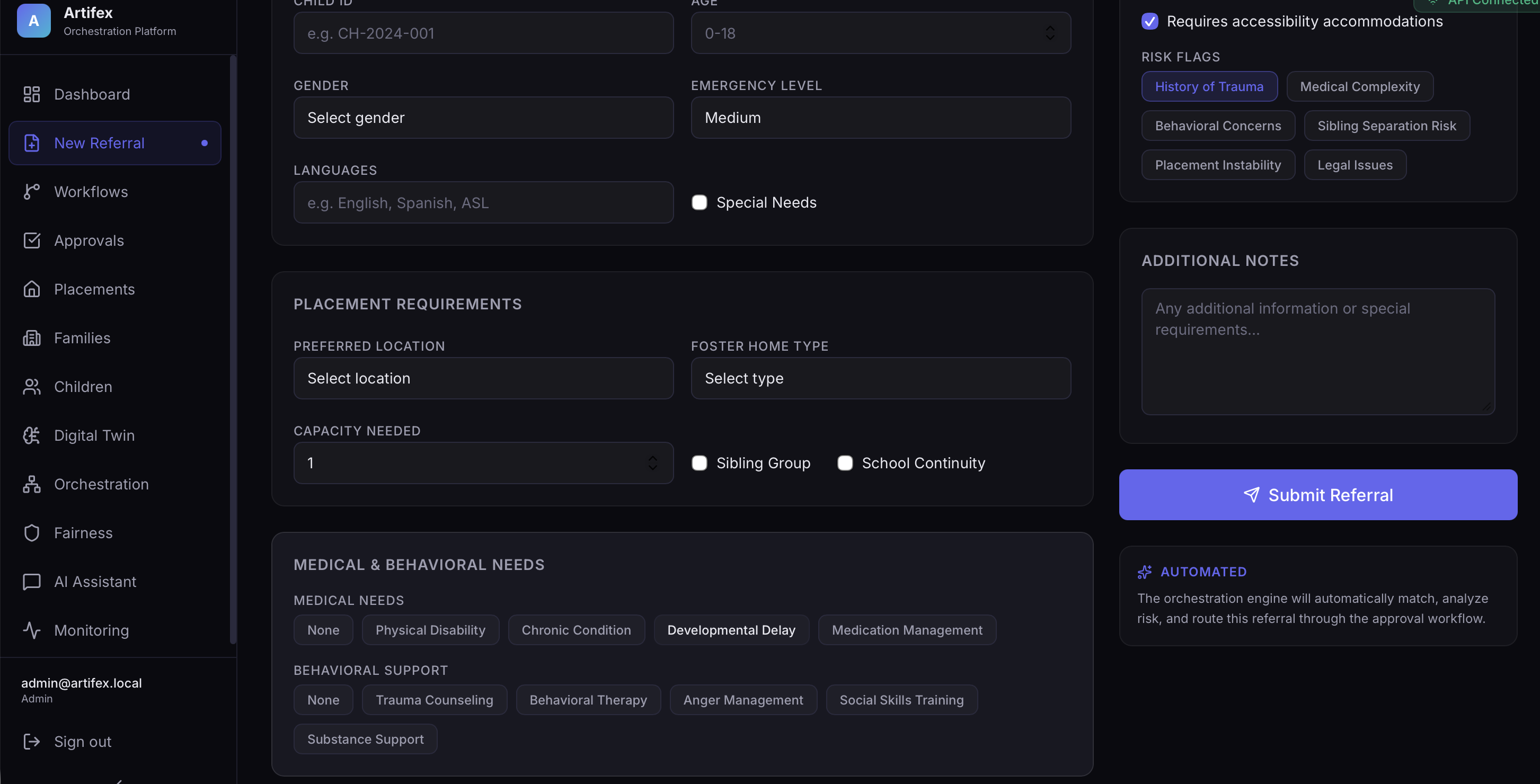
- Referral Processing
- Eligibility Assessment
- Risk Assessment
- Placement Matching
- Human Approval
- Continuous Monitoring
- Weekly Check-ins
- Risk Alerting
- Case Closure
Workflows are designed to survive failures, restarts, and long periods of inactivity while maintaining complete state consistency.
Event-Driven Real-Time Architecture
Artifex uses an event-driven architecture where components communicate through a messaging layer.
Workflow events are streamed in real time to dashboards using:
- Event Bus Communication
- WebSocket Broadcasting
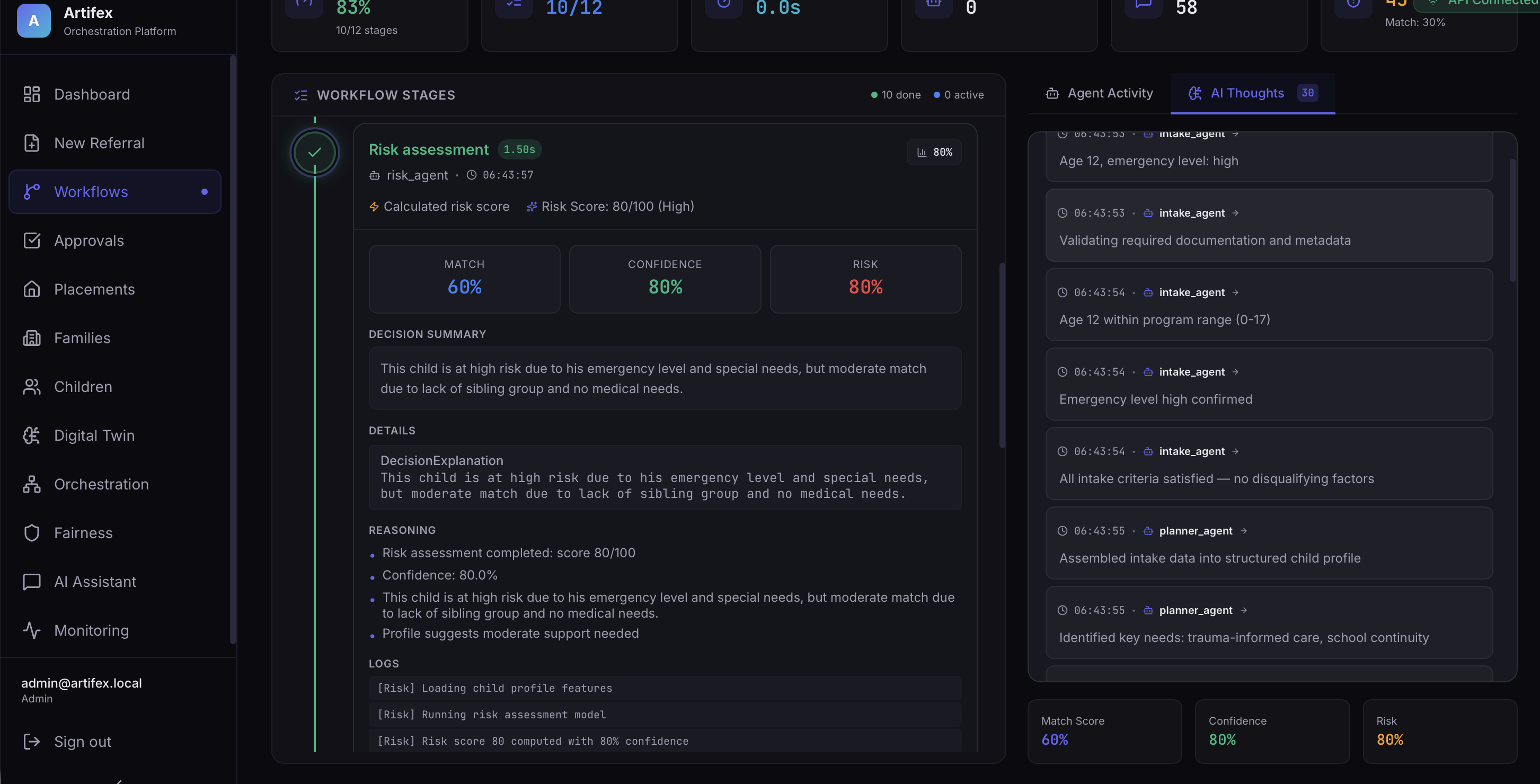
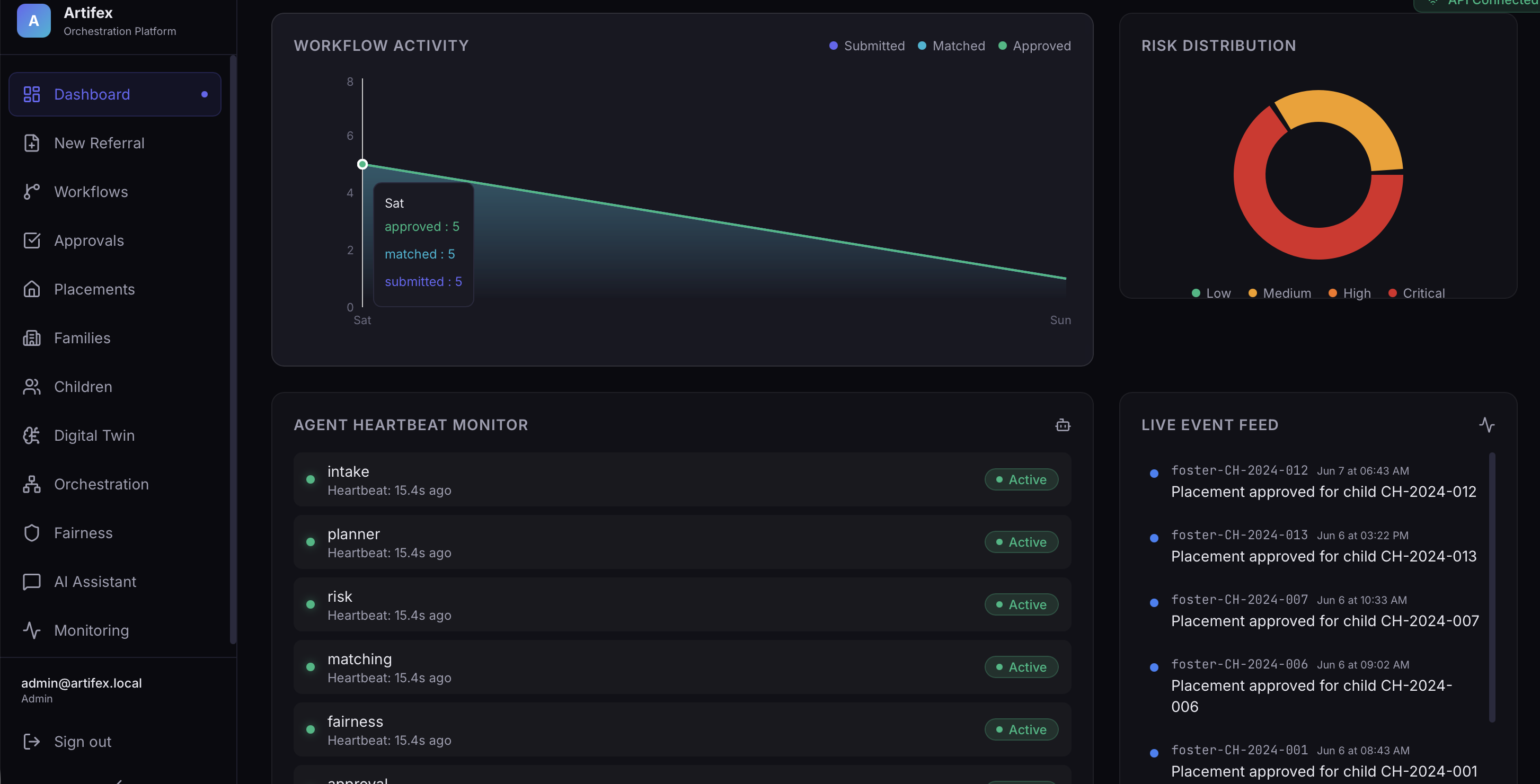
- Live Workflow Timelines
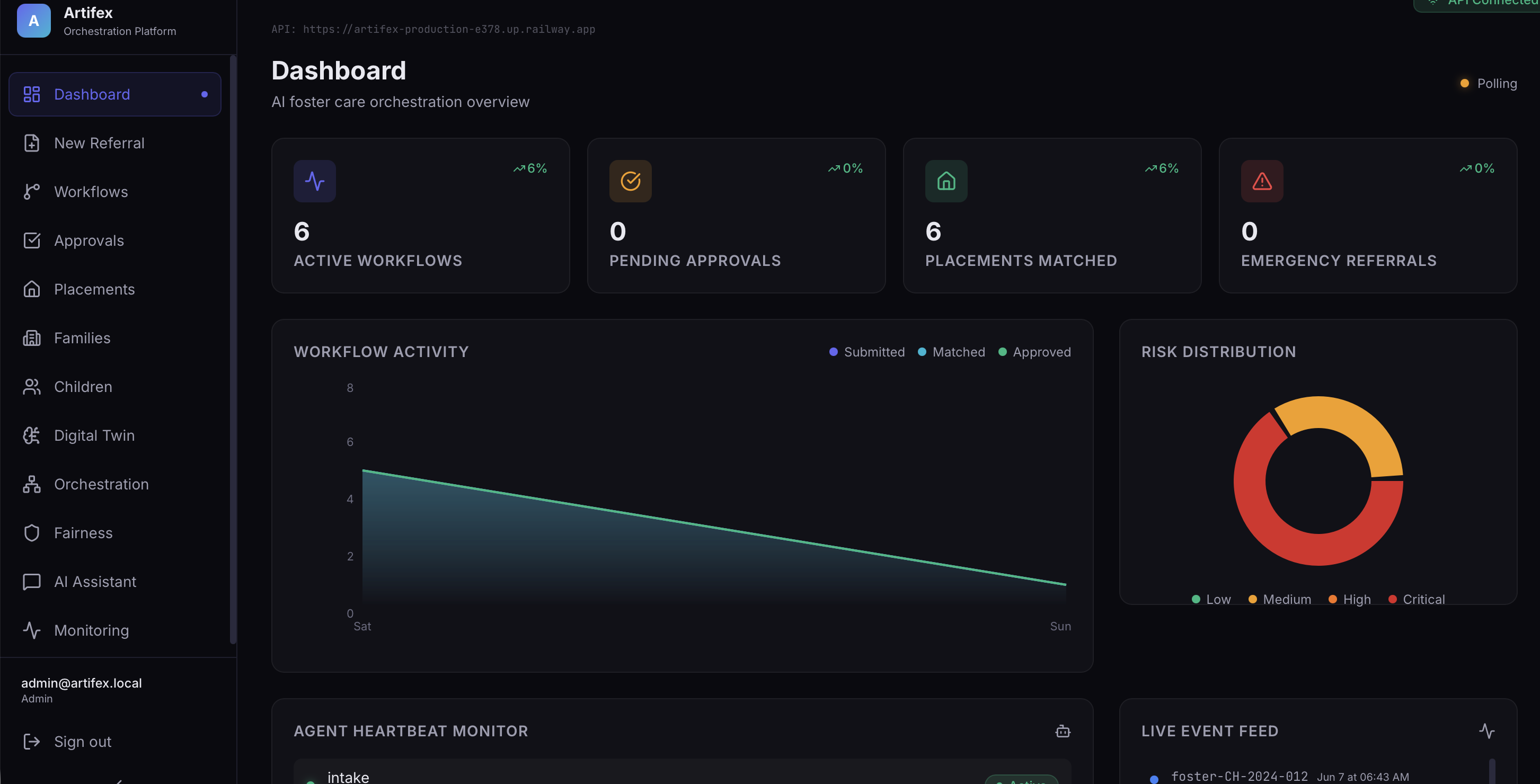
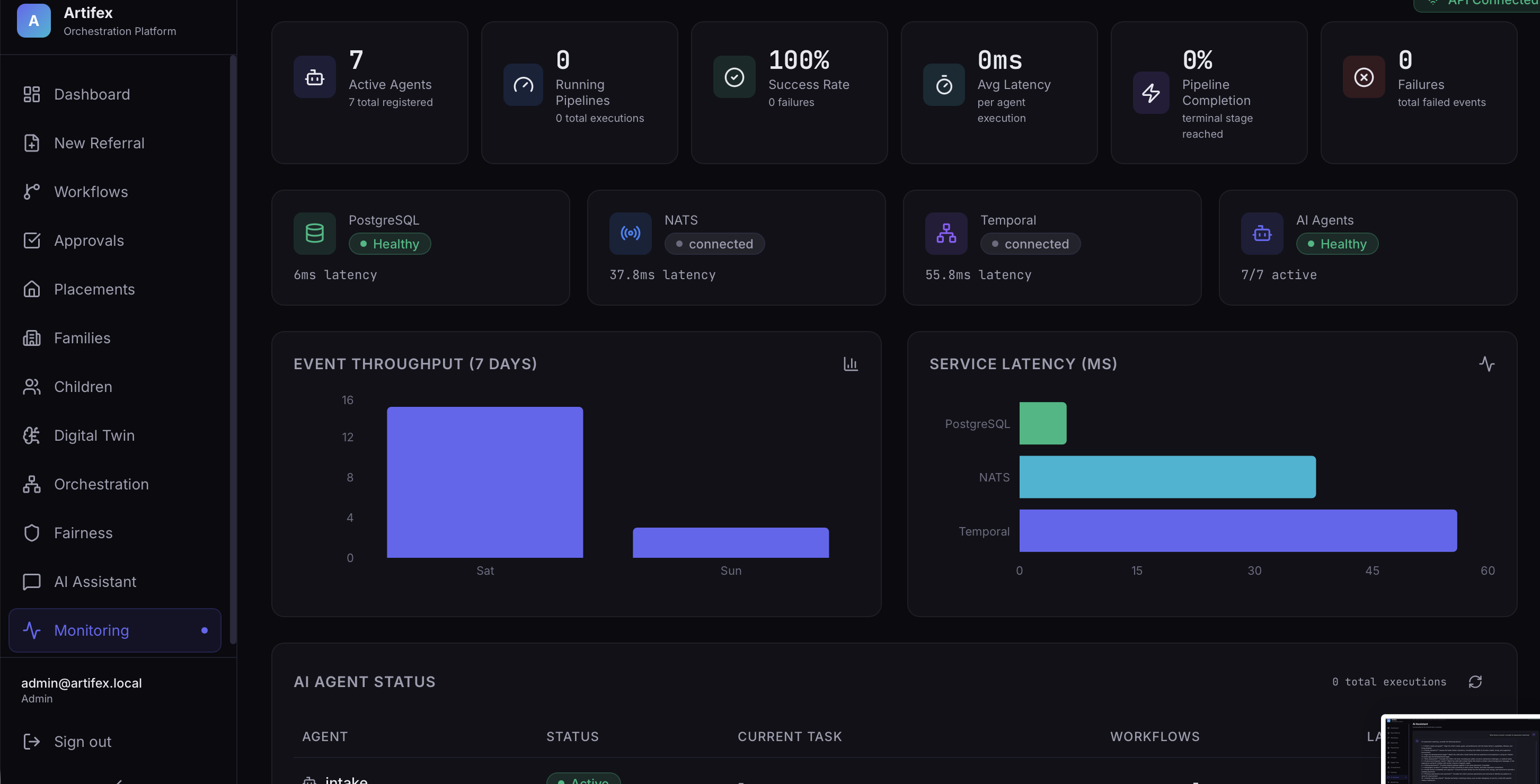
- Real-Time Monitoring Dashboards
This enables caseworkers and supervisors to monitor placement progress and emerging risks as they happen.
Methodology
1. Data Collection and Processing
The platform utilizes foster care datasets and historical placement records to train predictive models and generate recommendations.
The preprocessing pipeline includes:
- Data cleaning
- Feature engineering
- Missing value handling
- Demographic analysis
- Model validation
- Bias assessment
2. Placement Matching Engine
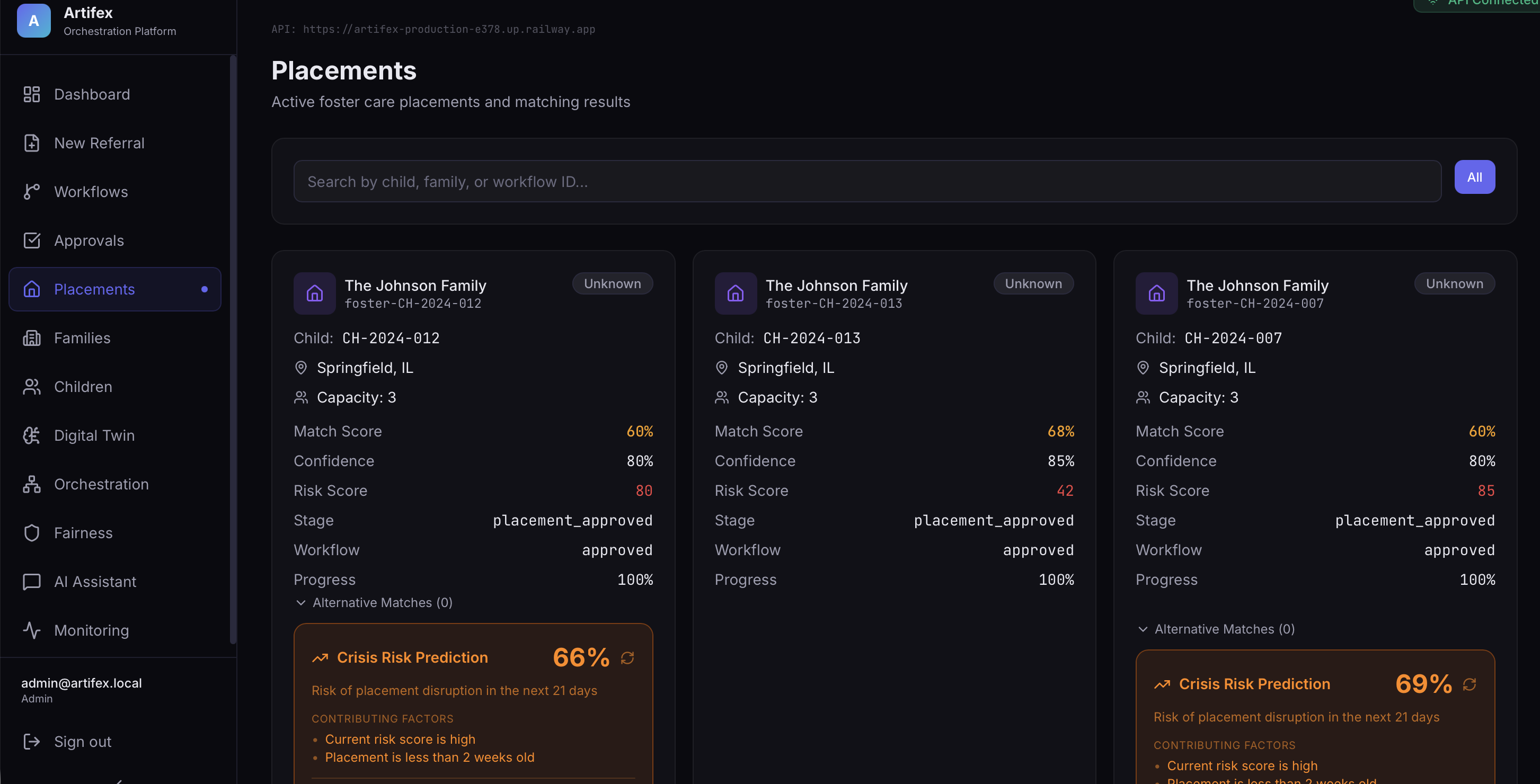
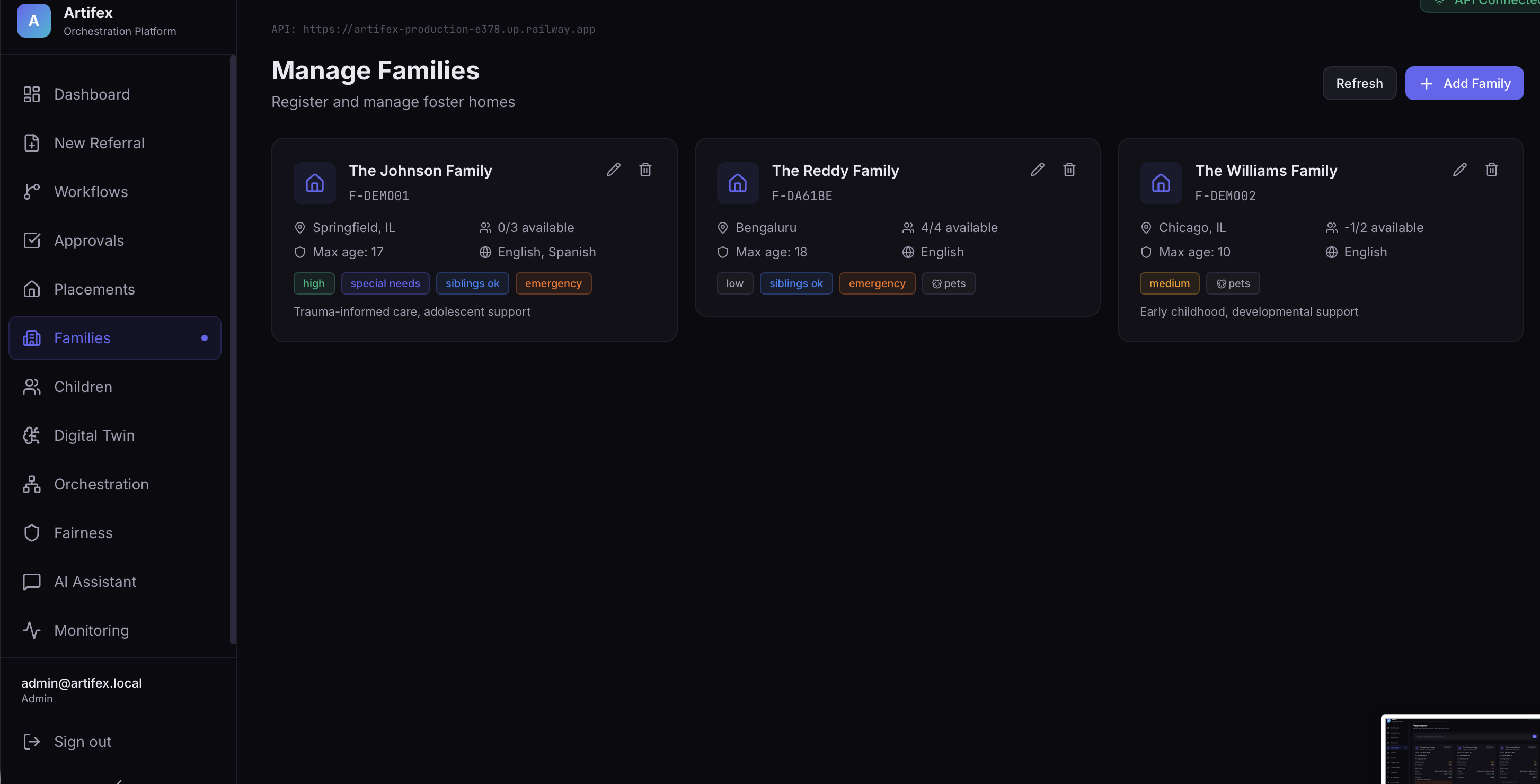
Artifex uses machine learning models to evaluate compatibility between children and available foster families.
Matching criteria include:
- Age compatibility
- Geographic proximity
- Language preferences
- Special care requirements
- Family capacity
- Historical placement outcomes
- Behavioral indicators
The system ranks potential placements and generates explainable recommendations with confidence scores.
3. Risk Prediction and Monitoring
Following placement, the platform continuously evaluates risk factors to identify cases that may require intervention.
The risk engine analyzes:
- Placement history
- Child characteristics
- Family attributes
- Weekly check-ins
- Behavioral trends
- Sentiment indicators
High-risk cases trigger alerts and recommendations for further review.
4. Multi-Model Validation
To reduce false positives and increase reliability, critical alerts are independently validated by multiple AI models.
A consensus mechanism evaluates:
- Placement recommendations
- Risk alerts
- Crisis predictions
This approach increases confidence and improves decision quality.
5. Fairness Auditing
Responsible AI is a core component of Artifex.
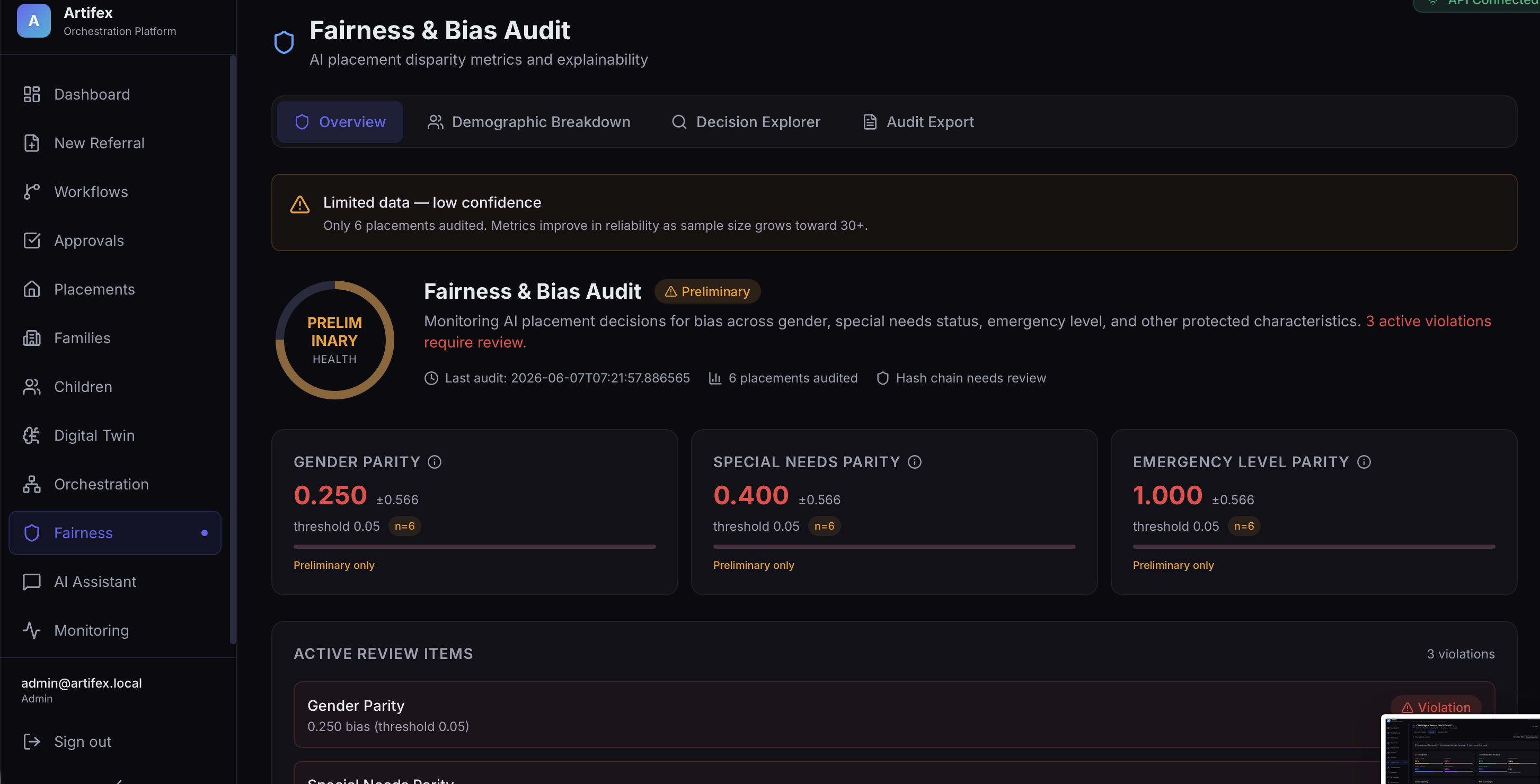
The platform continuously monitors fairness metrics including:
- Demographic parity
- Equalized odds
- Calibration metrics
- Individual fairness
- Bias drift detection
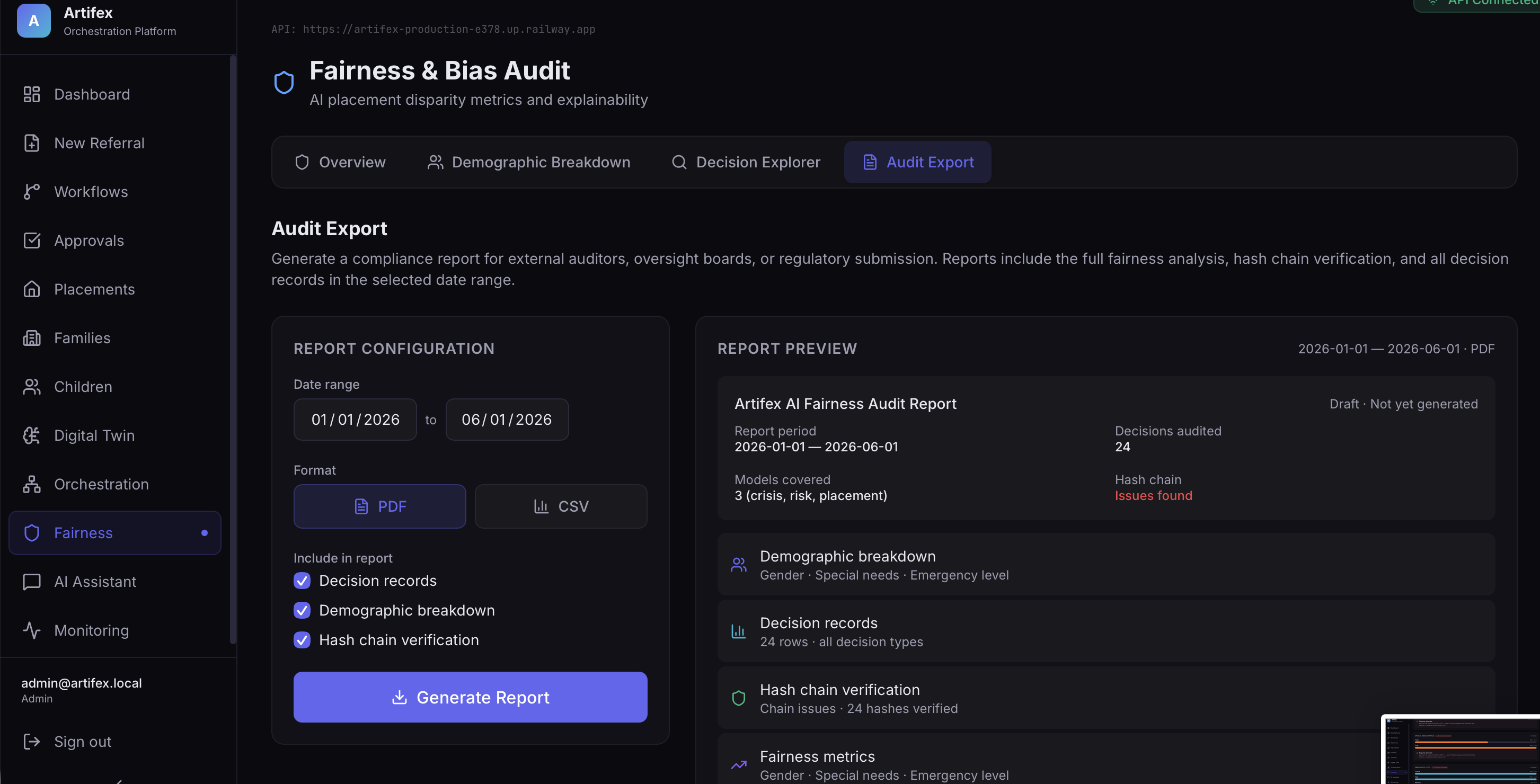
Automated fairness workflows run periodically and generate audit reports for compliance teams.
6. Human-in-the-Loop Governance
Critical decisions remain under human supervision.
Human reviewers can:
- Approve recommendations
- Override AI decisions
- Trigger manual reviews
- Investigate risk alerts
Every override and decision is recorded for accountability and traceability.
7. Explainability and AI Audit Trail
Every AI-generated recommendation is accompanied by:
- Confidence scores
- Feature-based explanations
- Workflow history
- Validation outcomes
Artifex also maintains a tamper-evident audit trail using cryptographic hash chaining, ensuring that AI decisions remain transparent, verifiable, and compliant with governance requirements.
8. Digital Twin Simulation
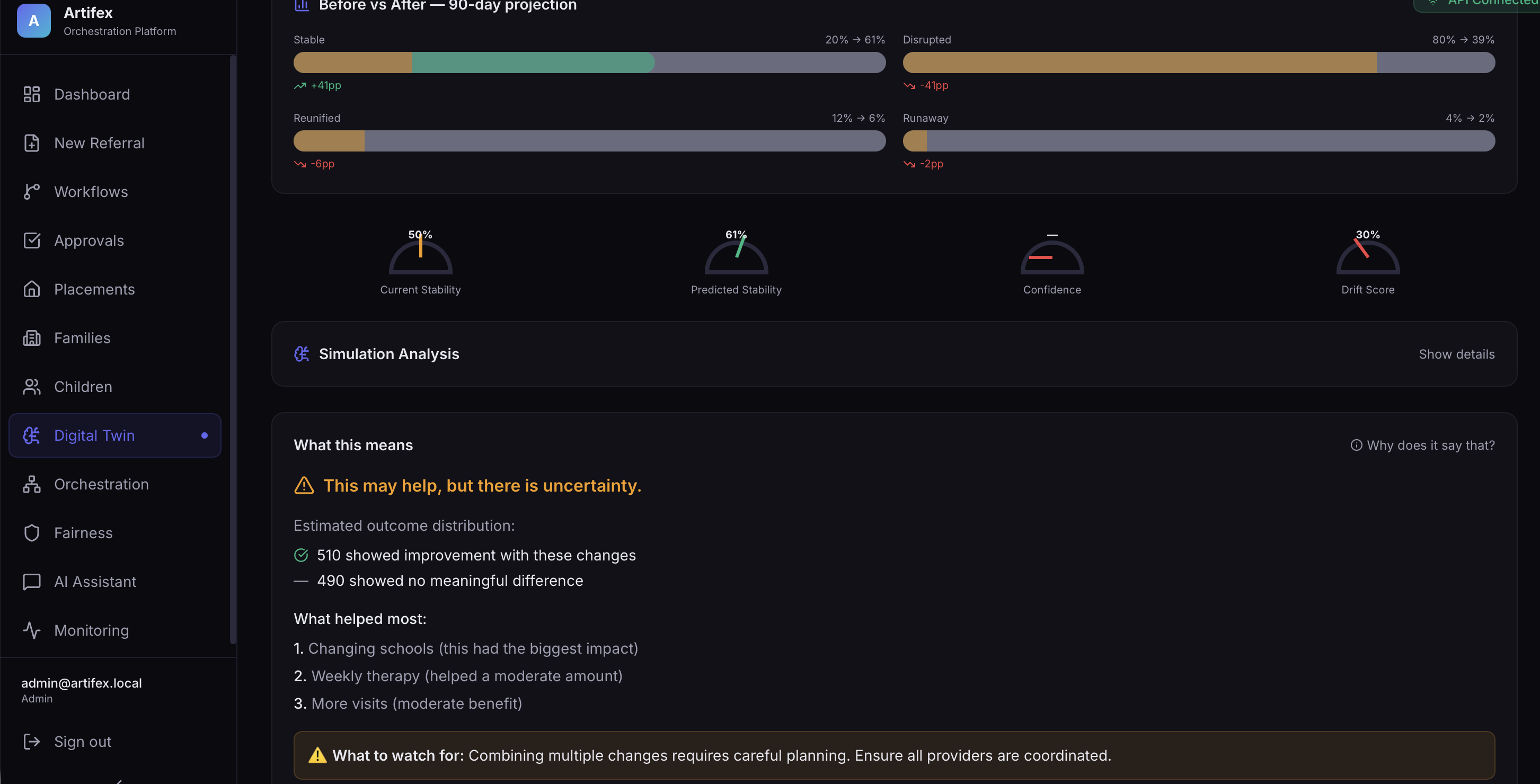
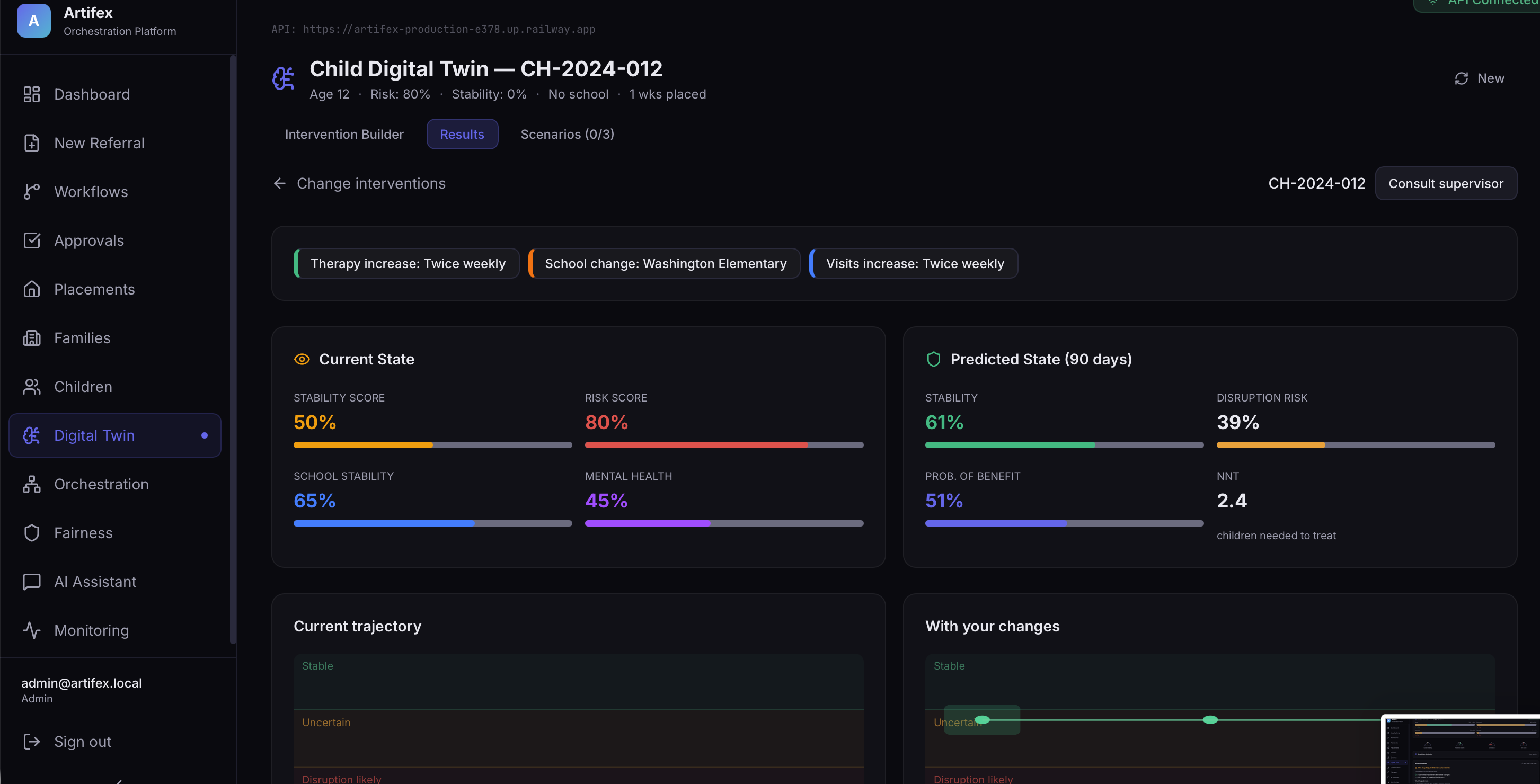
Artifex incorporates a Digital Twin simulation engine that allows agencies to evaluate potential interventions before applying them in the real world.
The simulation system can:
- Generate counterfactual scenarios
- Estimate intervention effectiveness
- Model future placement outcomes
- Analyze uncertainty and sensitivity
This enables proactive decision-making and strategic planning.
Scope of the Solution
Current Scope
The current implementation provides:
- Multi-agent orchestration
- Foster care workflow automation
- Placement recommendation engine
- Risk prediction system
- Fairness auditing
- AI decision tracking
- Real-time event streaming
- Workflow visualization
- Digital twin simulation
- Human approval workflows
- Interactive dashboards
- Monitoring and observability
Future Scope
Potential future enhancements include:
- Government welfare system integration
- Mobile applications for field workers
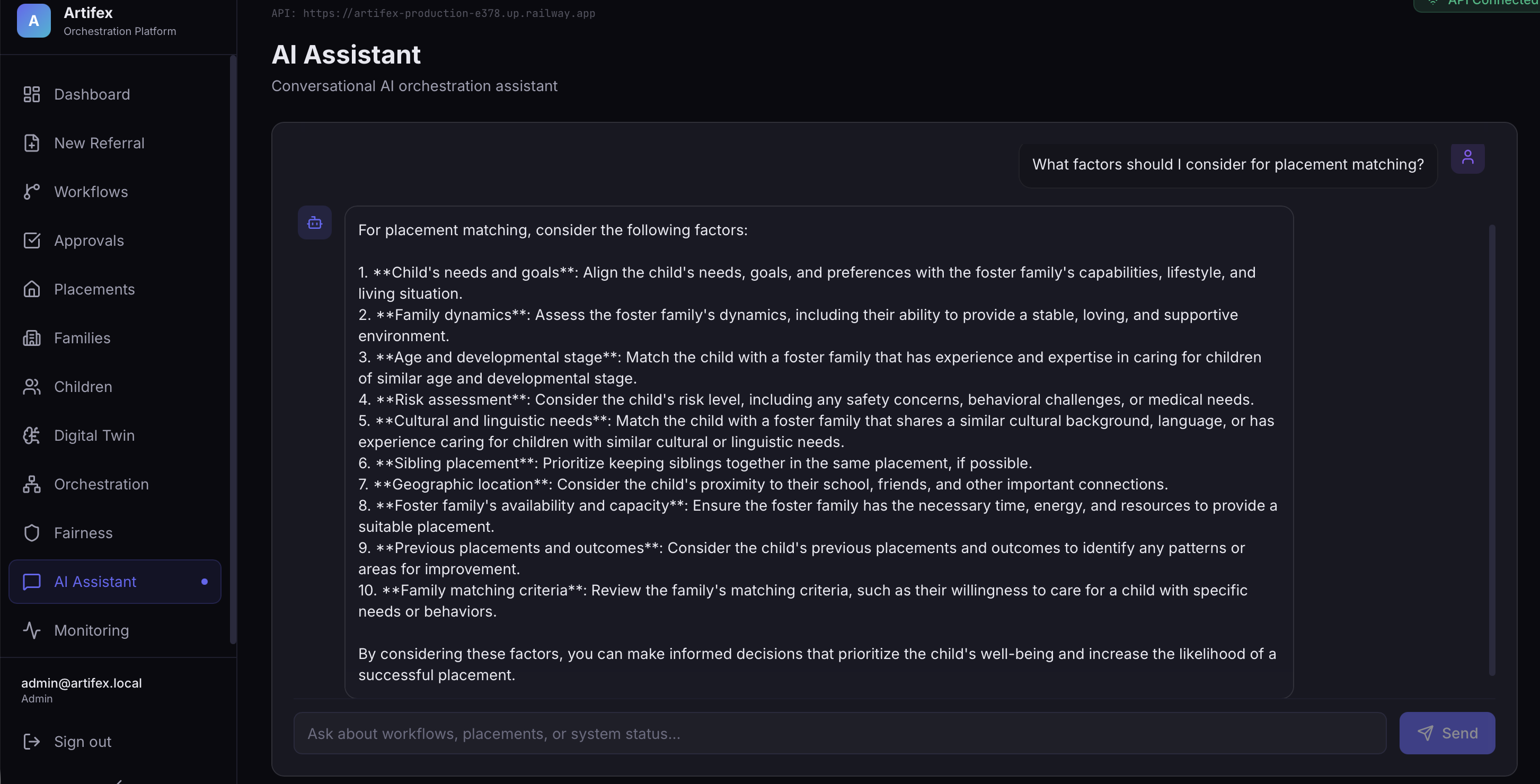
- Advanced generative AI copilots
- Resource allocation optimization
- Cross-agency collaboration networks
- Expanded causal simulation capabilities
- Cloud-native deployment on Azure and other hyperscale platforms
Innovation and Technical Contributions
Artifex introduces several innovations:
- Production-grade Agentic AI architecture
- Self-healing multi-agent swarms
- Real-time workflow orchestration
- Human-centered AI governance
- Automated fairness auditing
- Multi-model consensus validation
- Tamper-evident AI decision logging
- Digital twin simulation for foster care planning
- Event-driven real-time intelligence systems
The project demonstrates how modern AI systems can move beyond chatbots and become reliable operational partners for mission-critical decision-making.
Expected Impact
Artifex seeks to improve foster care outcomes by:
- Increasing placement stability
- Reducing placement disruptions
- Identifying risks earlier
- Supporting social workers with intelligent recommendations
- Improving operational efficiency
- Enhancing fairness and transparency
- Building trust in AI-assisted decision-making
By combining agentic AI, machine learning, workflow automation, and human oversight, Artifex provides a scalable blueprint for the future of intelligent child welfare systems and demonstrates how AI can create meaningful social impact while remaining transparent, accountable, and human-centered.
Built With
- agentic-ai
- digital-twin
- docker
- event-driven
- explainable-ai
- fairness-auditing
- fastapi
- grafana
- groq
- kubernetes
- langgraph
- multi-agent-systems
- nats
- opentelemetry
- postgresql
- prometheus
- qdrant
- react
- responsible-ai
- temporal
- typescript
- websockets
- xgboost

Log in or sign up for Devpost to join the conversation.