-
-
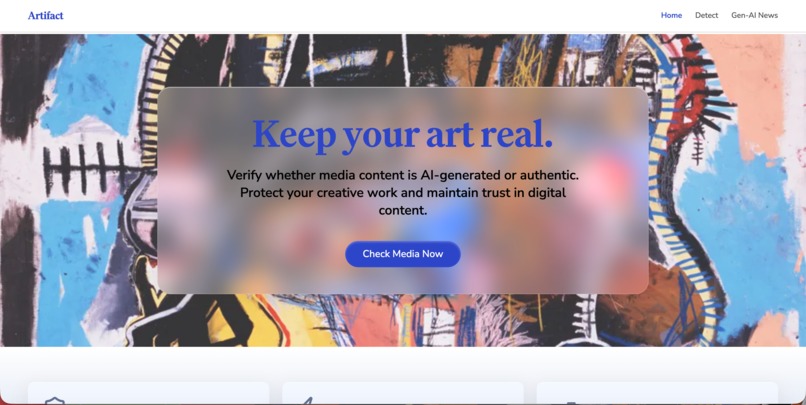
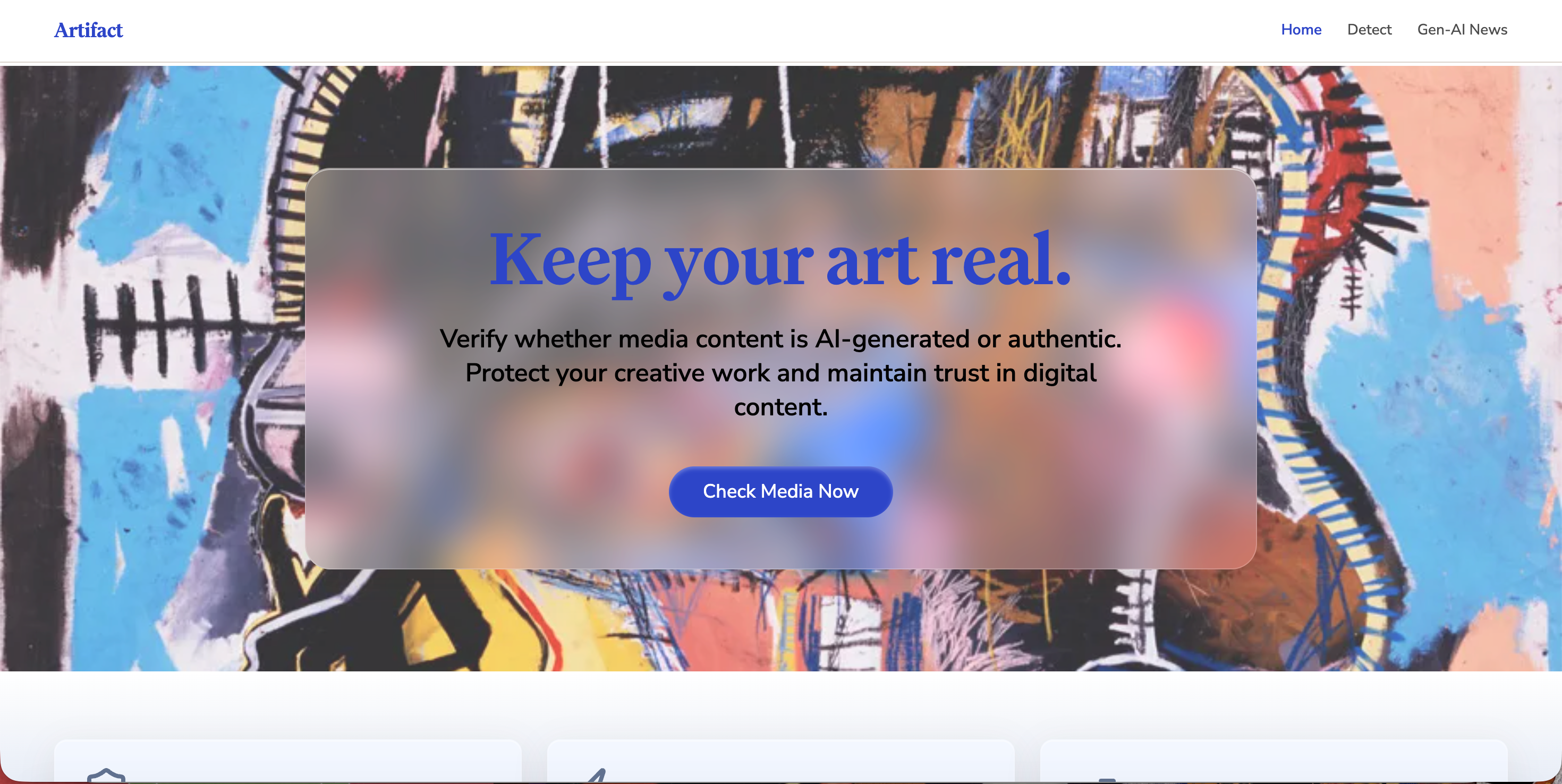
Keep your art real.
Inspiration
With the rise of tools like Sora AI, the internet is being flooded with AI-generated videos — many of which blur the line between creativity and misinformation. We noticed how difficult it’s become for users to tell what’s real and what’s artificially created. This inspired us to build Artifact, a tool that helps bring transparency and accountability back to digital media.
What it does
Artifact analyzes videos to determine whether they are AI-generated or authentic. Users can upload a clip or provide an input, and our system classifies it with high accuracy using a frame-by-frame approach. Alongside detection, Artifact also curates a feed of verified AI-generated content, allowing users to explore how synthetic media is evolving in real time.
How we built it
We combined two computer vision models for image classification, using a frame segmentation pipeline to analyze videos at the micro level. Our backend processes each frame, computes classification scores, and aggregates the results to deliver a final verdict. For the frontend, we used Snapdev to create a clean, responsive interface that makes interacting with the model fast and intuitive.
Challenges we ran into
One of the biggest challenges was the lack of robust datasets for AI-generated video detection. Most open datasets are focused on static deepfakes or images, so we had to adapt and generate our own samples. Additionally, optimizing model performance across multiple architectures proved difficult given limited time and resources.
Accomplishments that we're proud of
We’re proud of achieving high accuracy and reliability despite limited data and time. Building a working prototype that not only detects AI-generated videos but also curates verified content is something we’re really excited about. It represents a meaningful step toward restoring trust in digital media.
What we learned
We learned to persevere through uncertainty — when existing solutions or datasets didn’t meet our needs, we created our own. This project taught us valuable lessons in problem-solving, dataset engineering, and model fine-tuning, as well as the importance of teamwork when innovating in new and undefined problem spaces.
What's next for Artifact
Our next step is to enable video link verification, allowing users to paste URLs instead of uploading files. However, implementing this safely without violating copyright restrictions is a challenge we’ll need to navigate carefully. Long-term, we hope to expand Artifact into a browser plugin or public verification API, empowering everyone to validate digital media effortlessly.
Built With
- claude
- cv
- huggingface
- node.js
- python
- pytorch
- react
- snapdev
- tailwindcss
- toolhouse
- typescript


Log in or sign up for Devpost to join the conversation.