-
-
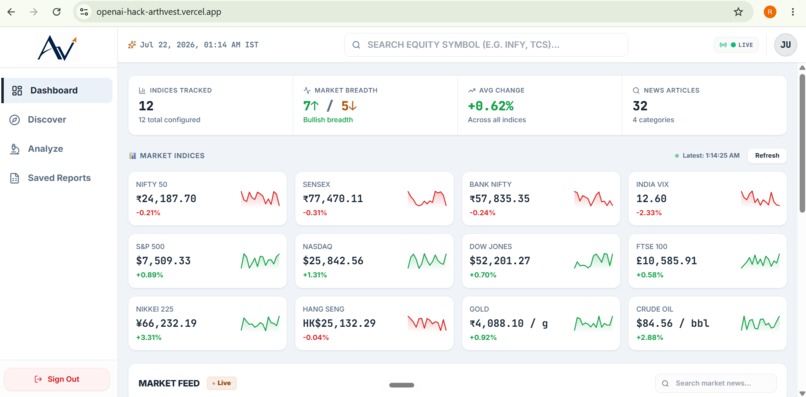
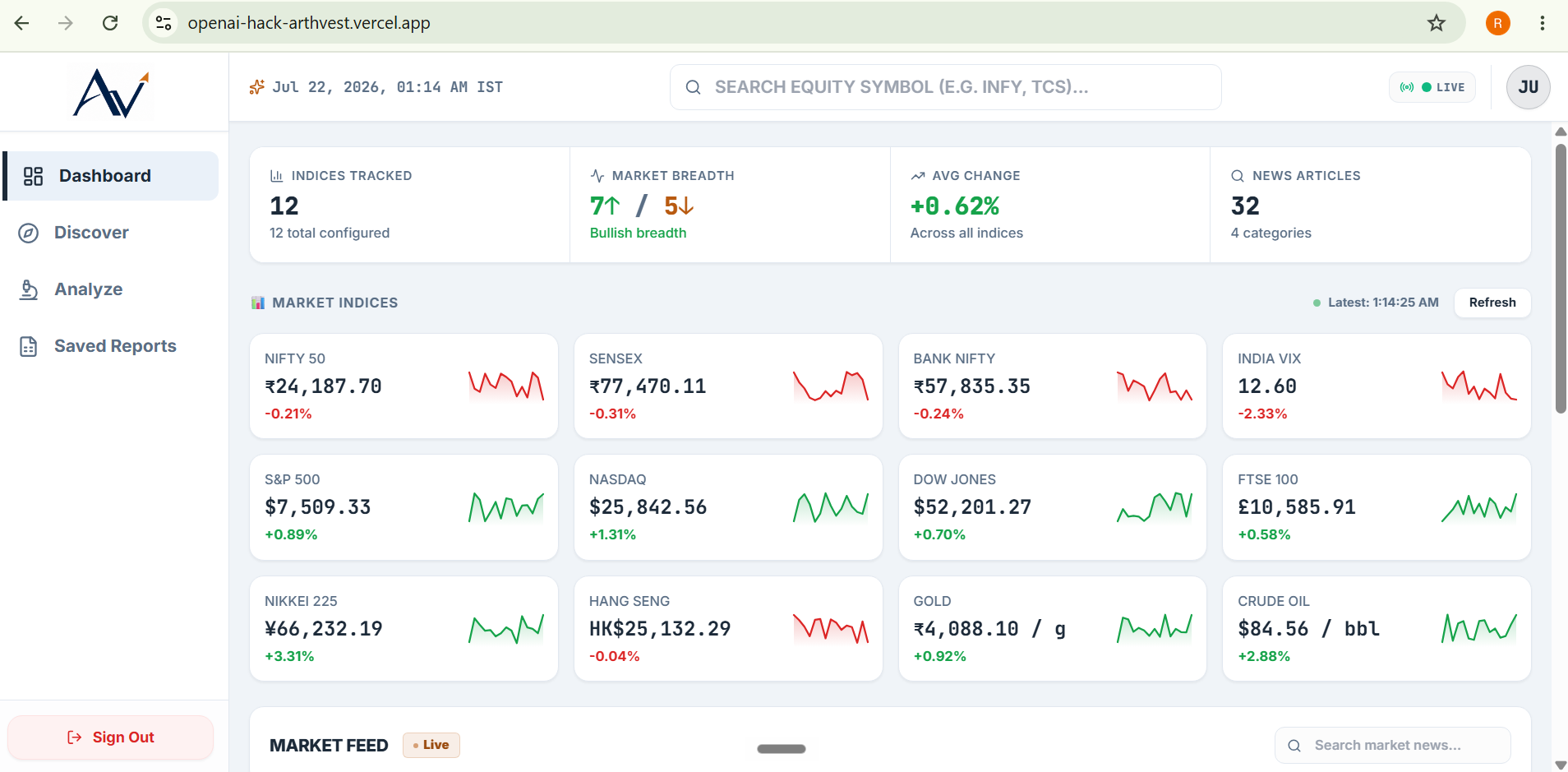
Dashboard
-
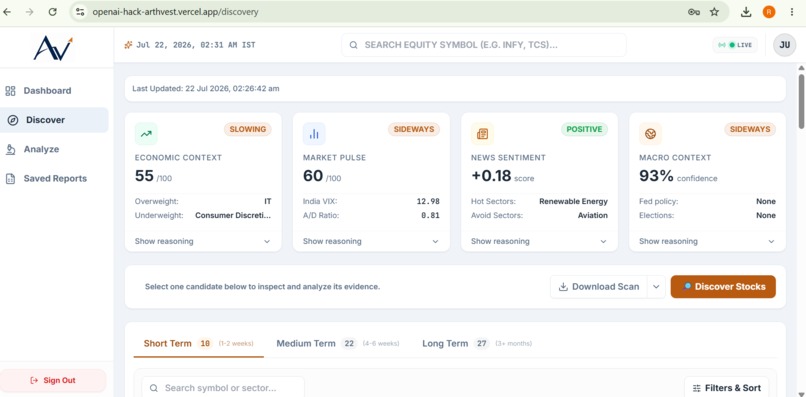
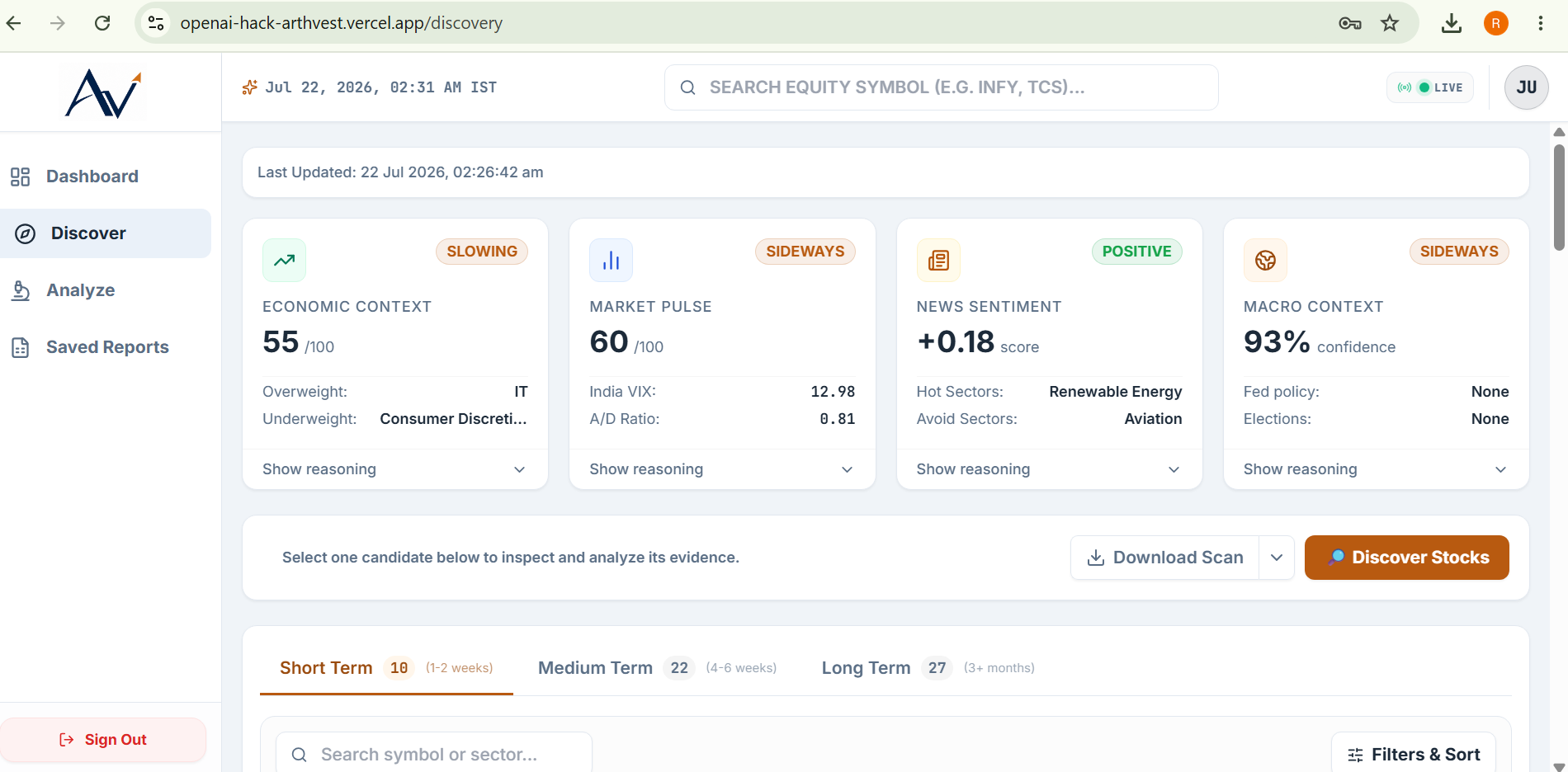
Discovery
-
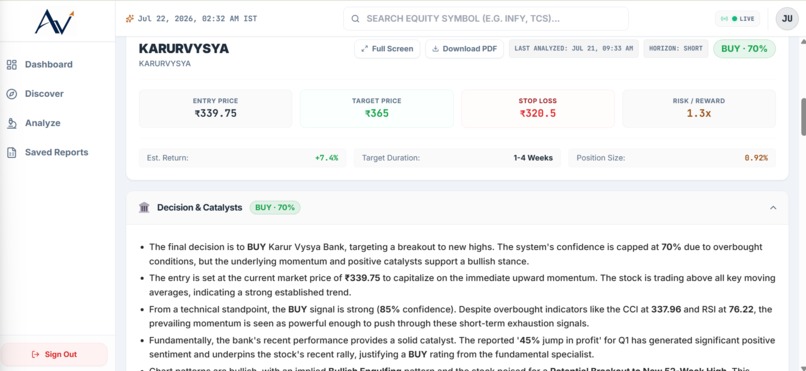
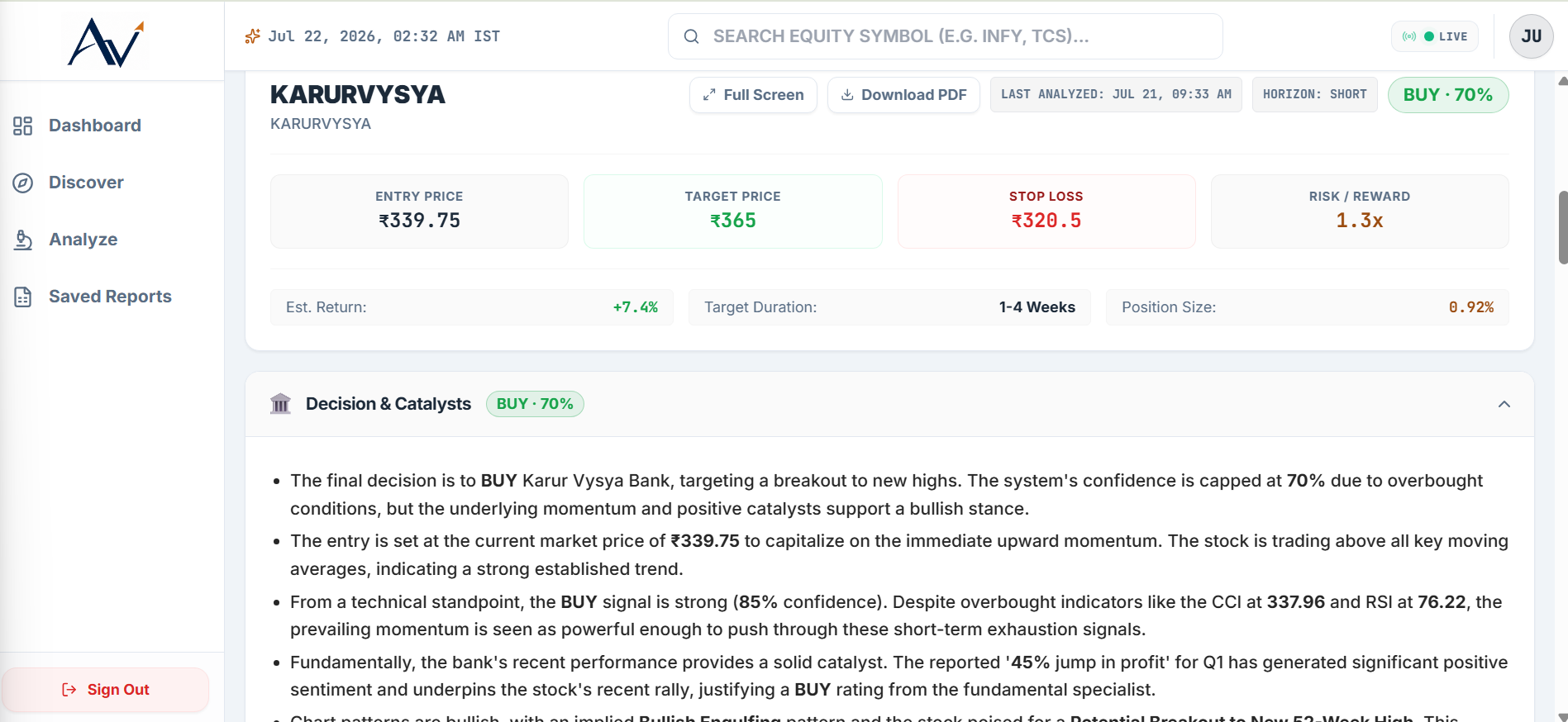
Analysis
-
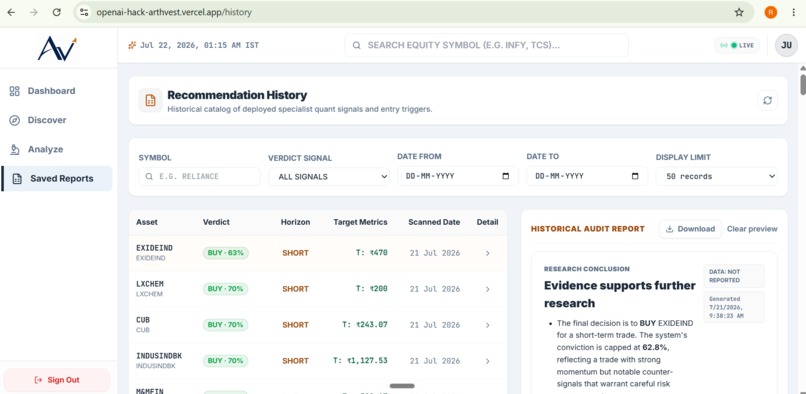
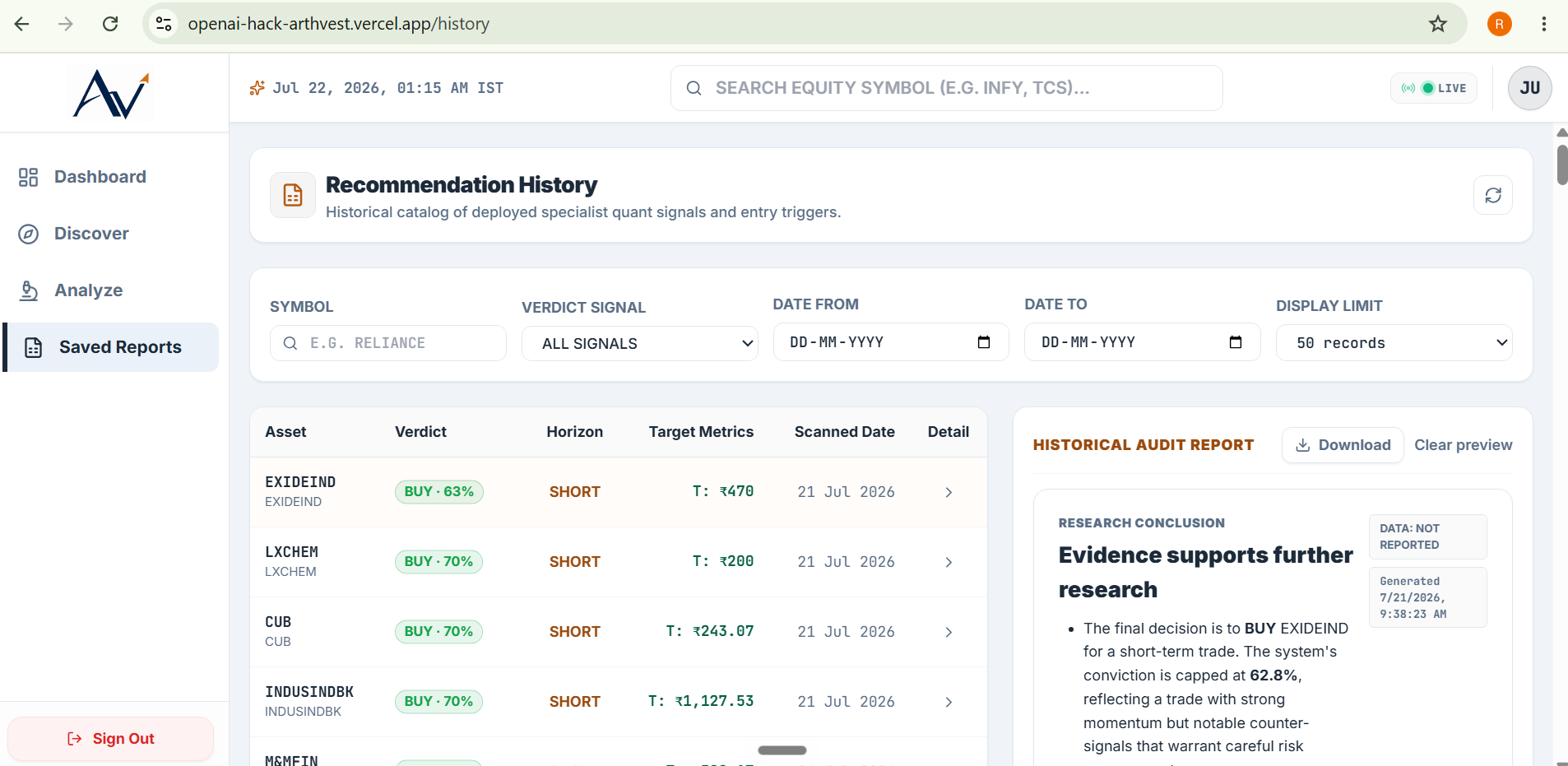
Reports
💡 Inspiration
Investment research is fragmented across dashboards, charts, news, filings, and personal notes. Researchers spend too much time collecting information and still struggle to explain why a conclusion should be trusted.
We built ArthVest to transform this process into one structured, explainable AI research workflow.
🚀 What it does
ArthVest coordinates specialized agents to:
- 🔍 Discover opportunities using economic, market, and news context.
- 📊 Analyze fundamentals, technical indicators, sentiment, and chart patterns.
- ⚖️ Compare independent bull and bear arguments.
- 🛡️ Validate confidence, risk, and contradictory evidence.
- 🎯 Produce a
BUY,SELL, orWAITresearch verdict. - 📄 Save the complete evidence-backed report.
When the evidence is insufficient, ArthVest returns WAIT instead of creating false confidence.
⚡ Work & Productivity
We selected Work & Productivity because ArthVest helps analysts complete complex research faster and more consistently.
It reduces movement between disconnected tools, automates evidence collection, and preserves each analysis as a reusable work product.
🏗️ How we built it
ArthVest has two LangGraph workflows:
- Discovery: Economic → Market Pulse → News → Macro Context → Planner → Discovery
- Analysis: Context → Planner → Parallel Specialists → Merge → Horizon Check → Debate → Decision → Validation
The specialist agents independently analyze technical, fundamental, sentiment, and chart evidence before their findings are combined.
The application uses React and TypeScript on the frontend, with FastAPI, PostgreSQL/Supabase, LangGraph, and OpenAI models on the backend.
🧠 How GPT-5.6 is used
We route tasks according to reasoning difficulty:
- GPT-5.6 Terra with low reasoning handles discovery and broad evidence collection.
- GPT-5.6 Sol with medium reasoning handles planning and final synthesis.
- GPT-5.6 Sol with high reasoning handles the bull-versus-bear debate.
This provides fast evidence gathering while reserving deeper reasoning for the most important decisions.
🤖 How Codex was used
We created three focused Codex skills:
- Architect: designed the workflows, agent boundaries, shared state, reasoning tiers, and safety rules.
- Implement: built the frontend, backend, agent orchestration, model routing, persistence, telemetry, and reports.
- Test: verified model routing, verdict consistency, refusal behavior, safe rendering, backend checks, and frontend builds.
Our workflow was:
Architect → Implement → Test → Inspect results → Improve
GPT-5.6 powers the running product, while Codex helped us architect, implement, debug, test, and document it.
🧩 Challenges
Our main challenges were coordinating independent agents, handling conflicting evidence, managing incomplete market data, preventing unsupported confidence, and shipping the complete product in seven days.
We addressed these challenges with structured agent contracts, adversarial debate, deterministic validation, provider fallbacks, and the refusal-first WAIT outcome.
🎓 What we learned
We learned that reliable agent systems require more than strong prompts. They need clear responsibilities, structured data, validation, observability, and failure handling.
We also learned that maximum reasoning is unnecessary for every task. Lower reasoning works well for evidence gathering, while deeper reasoning should be reserved for synthesis and debate.
🔮 What's next
Next steps include richer citations, deeper company comparisons, larger evaluation datasets, collaborative research workspaces, and historical verdict evaluation.
⚠️ Responsible use
ArthVest supports research and education. It does not execute trades or provide personalized financial advice. Every output should be independently reviewed.
Built With
- api
- codex
- css
- fastapi
- gpt
- langchain
- langgraph
- mcp
- openai
- postgresql
- pydantic
- python
- query
- react
- sqlalchemy
- supabase
- tailwind
- tanstack
- typescript
- vite

Log in or sign up for Devpost to join the conversation.