-
-
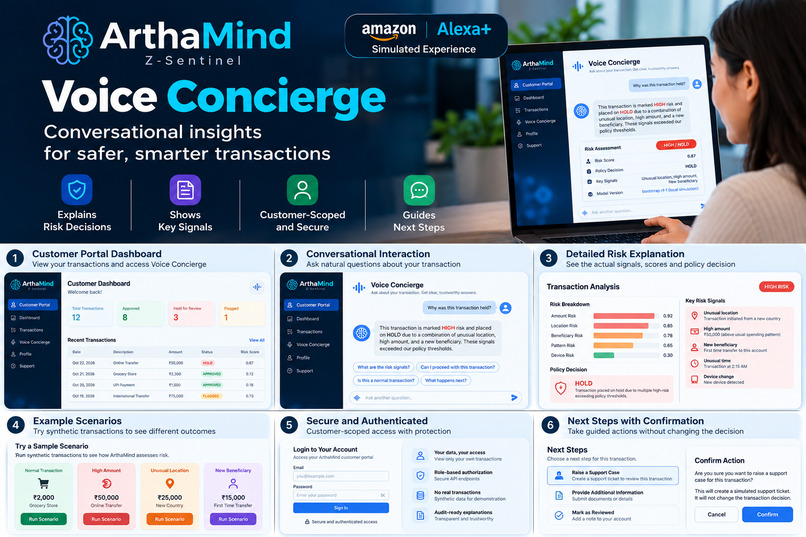
ArthaMind Voice Concierge: An Alexa+-style web simulation explaining transaction risks, key signals, and safe next steps with synthetic data
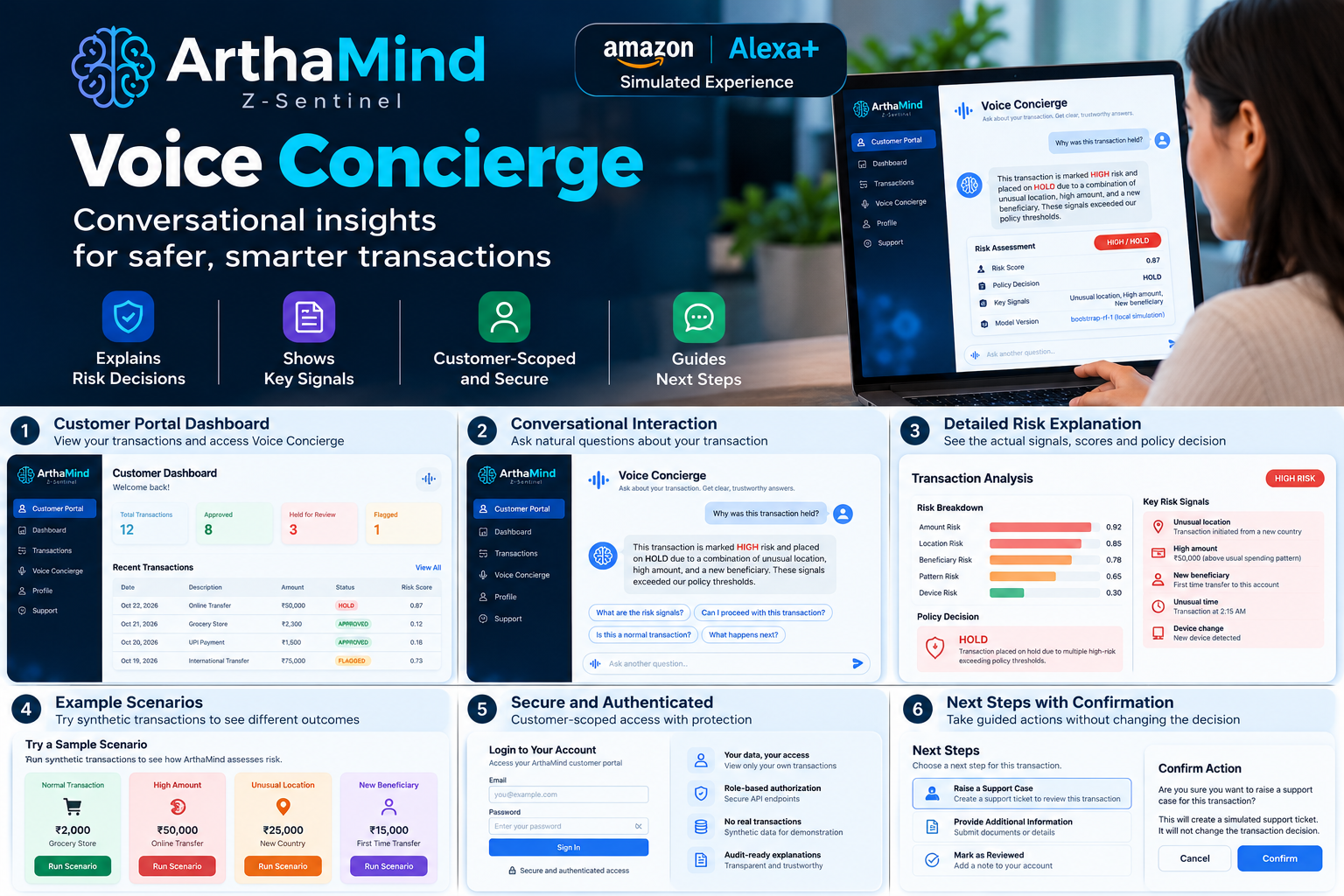
ArthaMind Voice Concierge
Inspiration
Financial transaction decisions can be difficult for customers to understand. When a transaction is held for review, people need a clear explanation of the risk signals behind that decision and a safe way to explore their next steps. ArthaMind Voice Concierge was created to make a transaction-risk assessment easier to understand through a conversational interface.
What it does
ArthaMind Voice Concierge extends ArthaMind Z-Sentinel, a synthetic transaction-risk assessment system, with an Alexa+-style web experience.
Customers can run synthetic transaction scenarios, ask why a transaction was approved or held, and inspect the recorded risk score, contributing signals, and deterministic policy decision. The companion explains the completed assessment rather than inventing financial facts or making a new transaction decision.
It also supports confirmation-gated simulated next steps, such as preparing a support case. These actions are recorded only inside the simulator and do not contact a bank, move money, or change the transaction decision.
How it was built
The frontend uses React, TypeScript, Vite, and Tailwind CSS. The backend uses Python, FastAPI, and the existing local machine-learning pipeline. Authenticated API endpoints enforce customer access and transaction ownership, while automated tests cover the scenario flows, explanations, authorization checks, invalid input, and confirmation requirements.
The Voice Concierge keeps model inference separate from deterministic policy. This distinction matters because a model's risk output and the final policy decision are related but not interchangeable. Explanations are grounded in the recorded assessment fields, and simulated next steps remain separate from the authoritative decision path.
Challenges and what we learned
A key challenge was making the conversation useful without allowing it to fabricate evidence or override the risk pipeline. We addressed this by grounding explanations in recorded assessment data, preserving authorization boundaries, and requiring confirmation for simulated follow-up actions.
The project also reinforced the importance of automated testing, reproducible local demonstrations, clear disclosure of model limitations, and designing AI-assisted interfaces with human oversight.
Hackathon update
ArthaMind existed before the hackathon submission period as a synthetic transaction-risk workflow. During the hackathon period, the project was significantly extended with the Voice Concierge frontend, authenticated companion endpoints, assessment-grounded explanations, customer ownership checks, confirmation-gated simulated actions, tests, and demonstration documentation.
Track and limitations
This submission uses the Alexa+ simulated-experience route. It is an Alexa+-style web simulation, not a direct Alexa+ device integration, partner-preview connection, or Amazon production-service integration.
All transaction scenarios are synthetic. The local model is an engineering demonstration, not a validated banking fraud-detection service. The application does not access real customer accounts, initiate payments, or perform real support actions.
Built With
- axios
- data
- docker
- fastapi
- github-actions
- jwt-authentication
- machine-learning
- postgresql
- pydantic
- pytest
- python
- react
- scikit-learn
- synthetic
- tailwind-css
- typescript
- vite
- vitest

Log in or sign up for Devpost to join the conversation.