Inspiration
India has 57 million registered MSMEs, but fewer than 0.3% export directly. Not for lack of product quality — leather from Kanpur, textiles from Tirupur and auto components from Pune already reach global buyers, just through middlemen who take the margin. Going direct means the HS code, the compliance documents, and knowing which market actually wants your product — today that means a ₹2 lakh/year consultant working by hand, or simply never trying.
I ran ~50 manufacturer interviews before writing serious code, and heard the same two problems every time: the paperwork, and not knowing where to sell. That's the gap ArthaFlow Global closes.
What it does
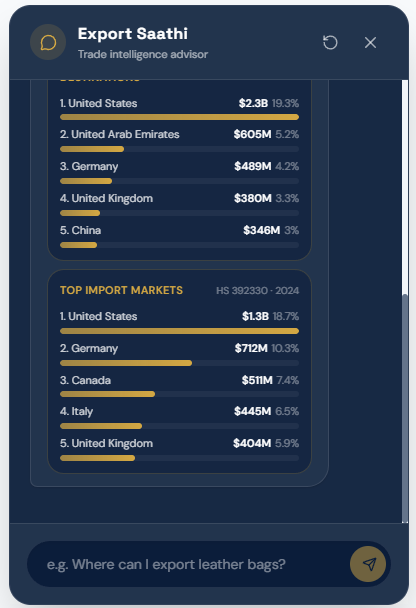
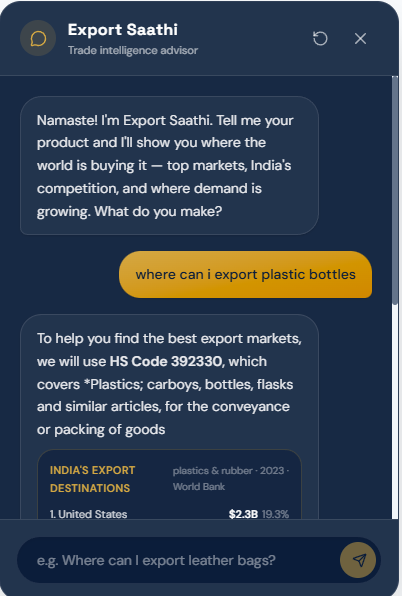
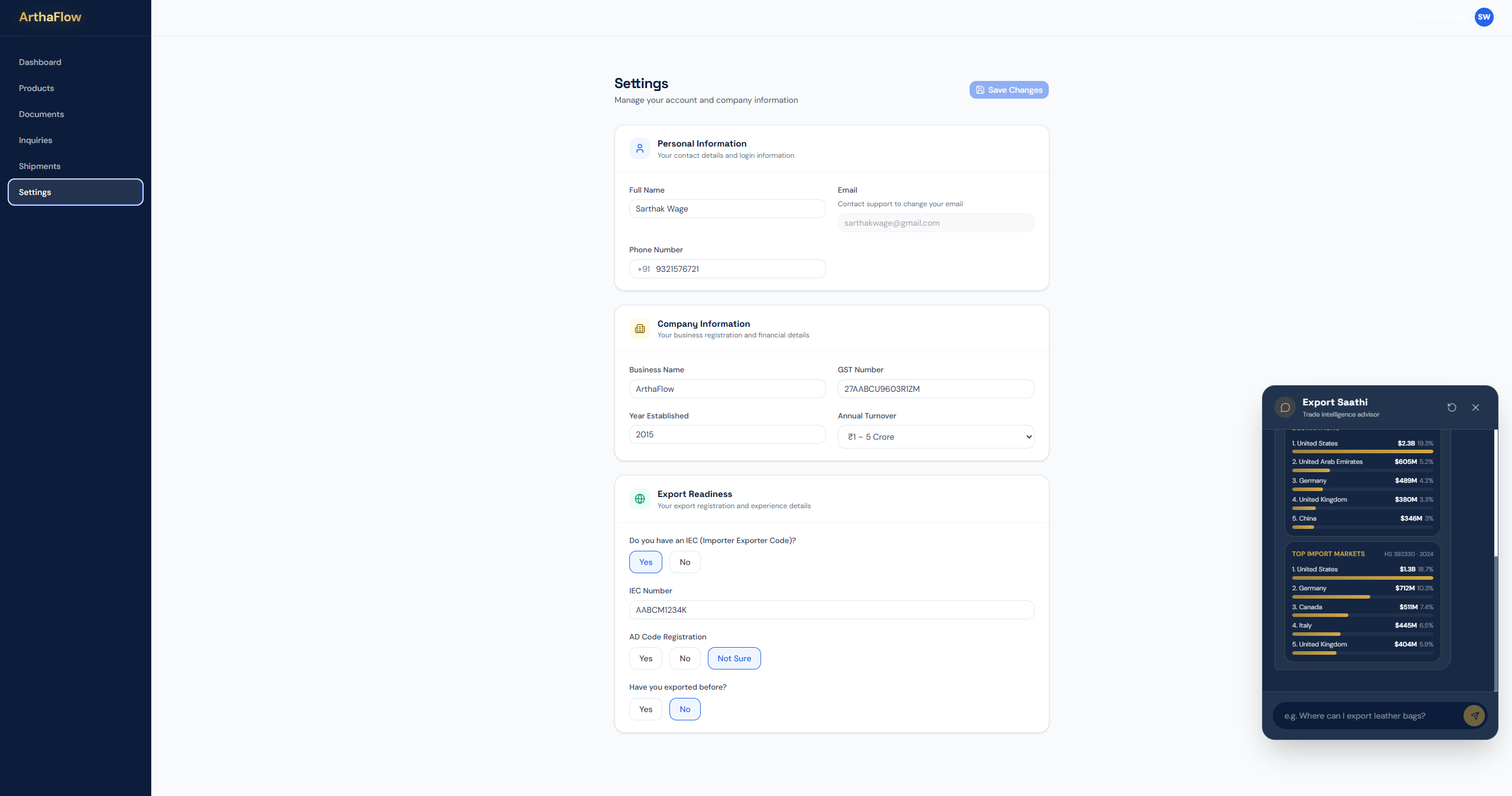
Export Saathi — the flagship. A tool-calling AI trade advisor that answers the question that comes before "help me export": where does the world actually want my product? Ask it in Hindi, Marathi or English, and it queries real trade data — UN Comtrade, World Bank WITS, and India's own DGCIS customs statistics — to tell a manufacturer which markets are growing, what duty their buyer will pay, and what they'll actually net after export rebates. It never generates a figure or an HS code itself; it retrieves and reasons over real data, so it structurally cannot hallucinate a market or a number.
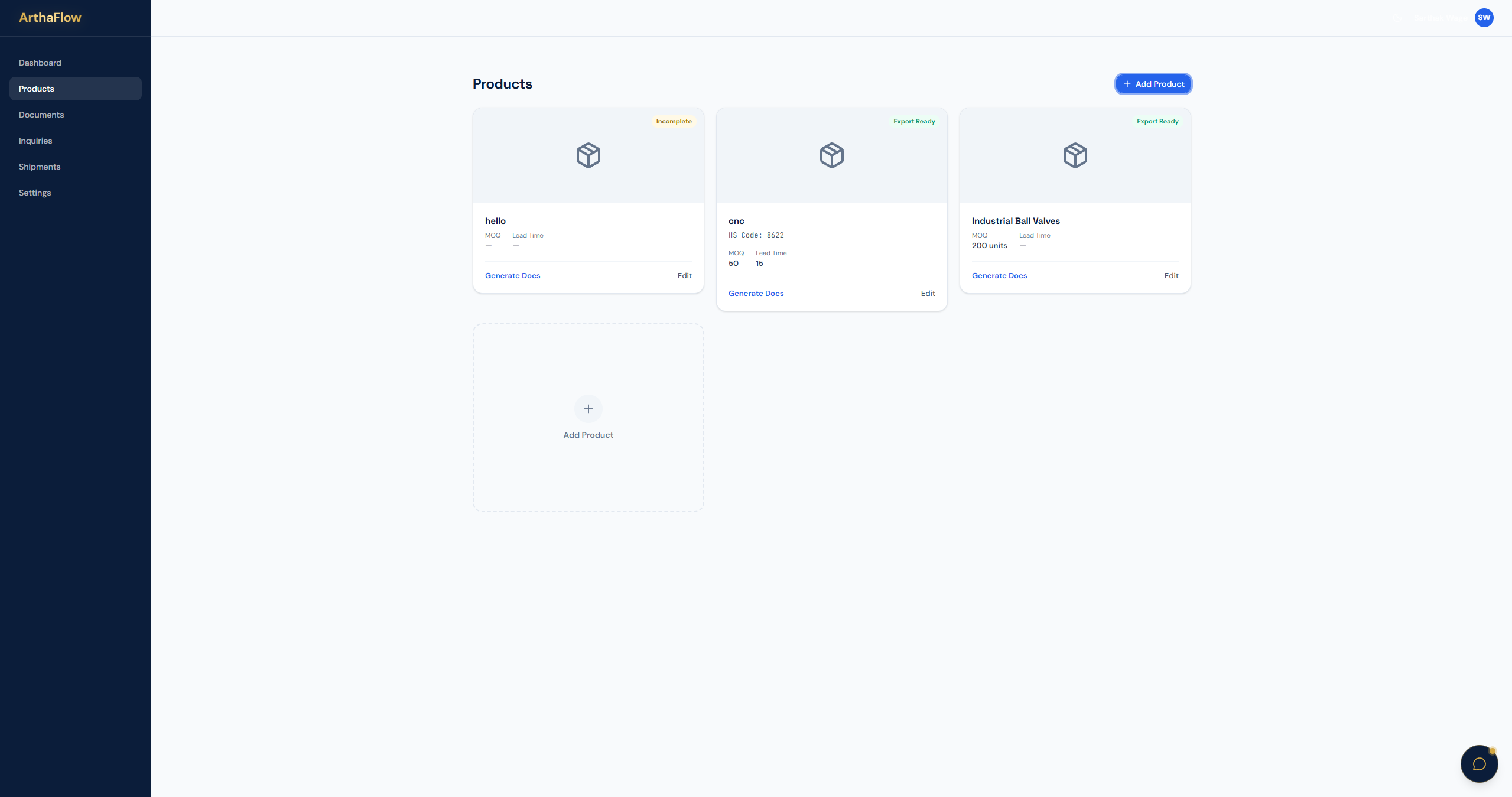
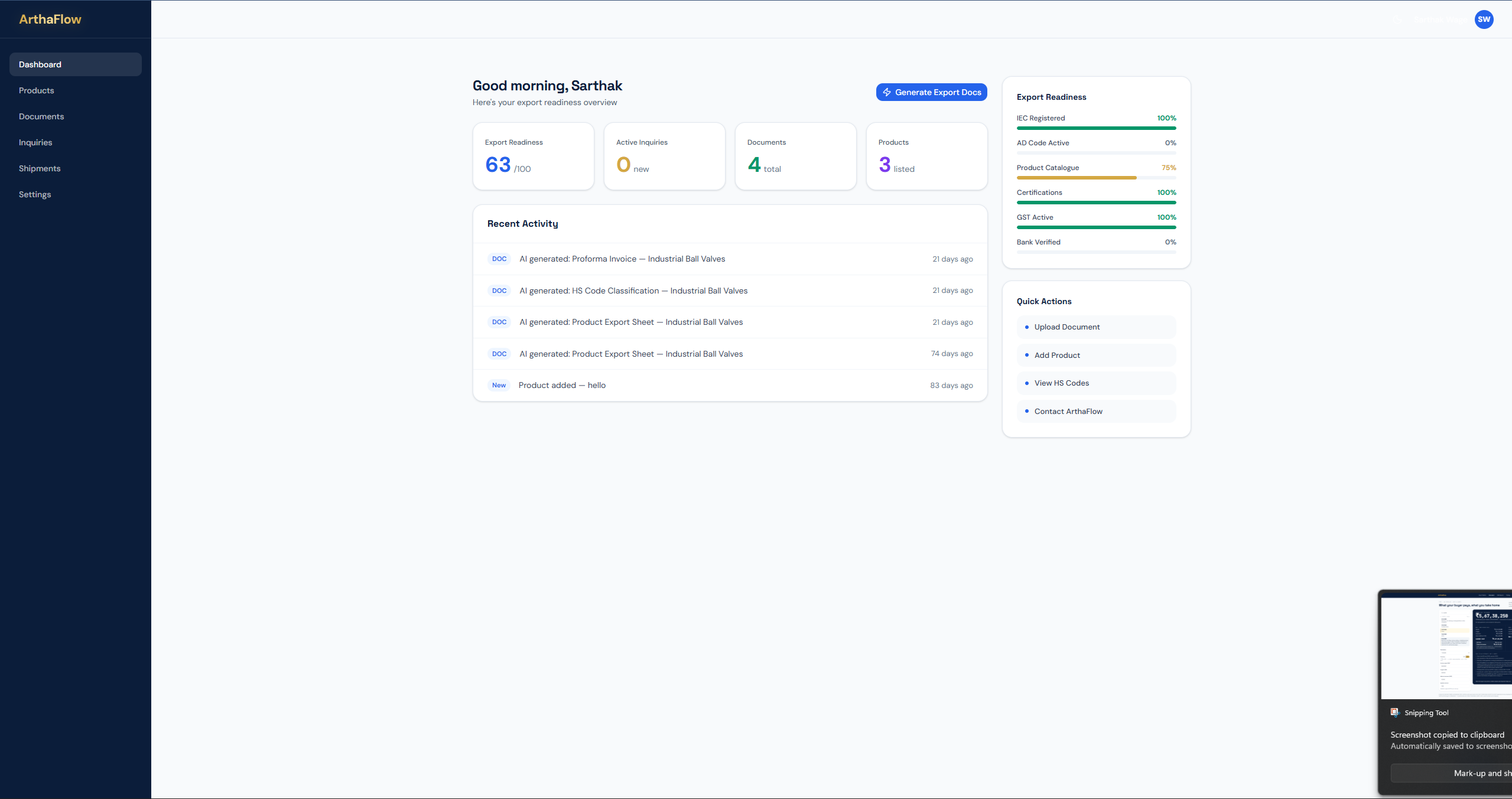
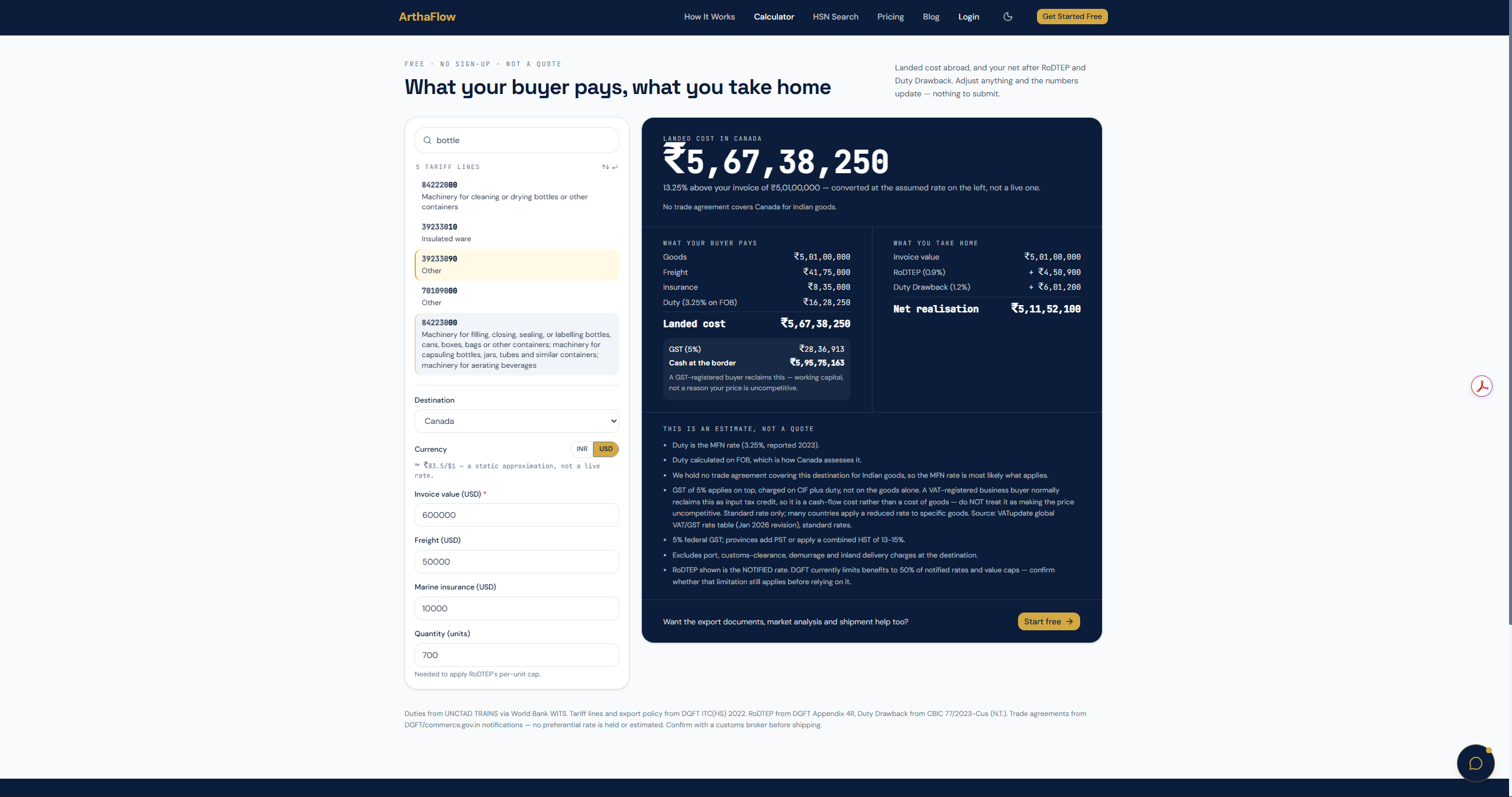
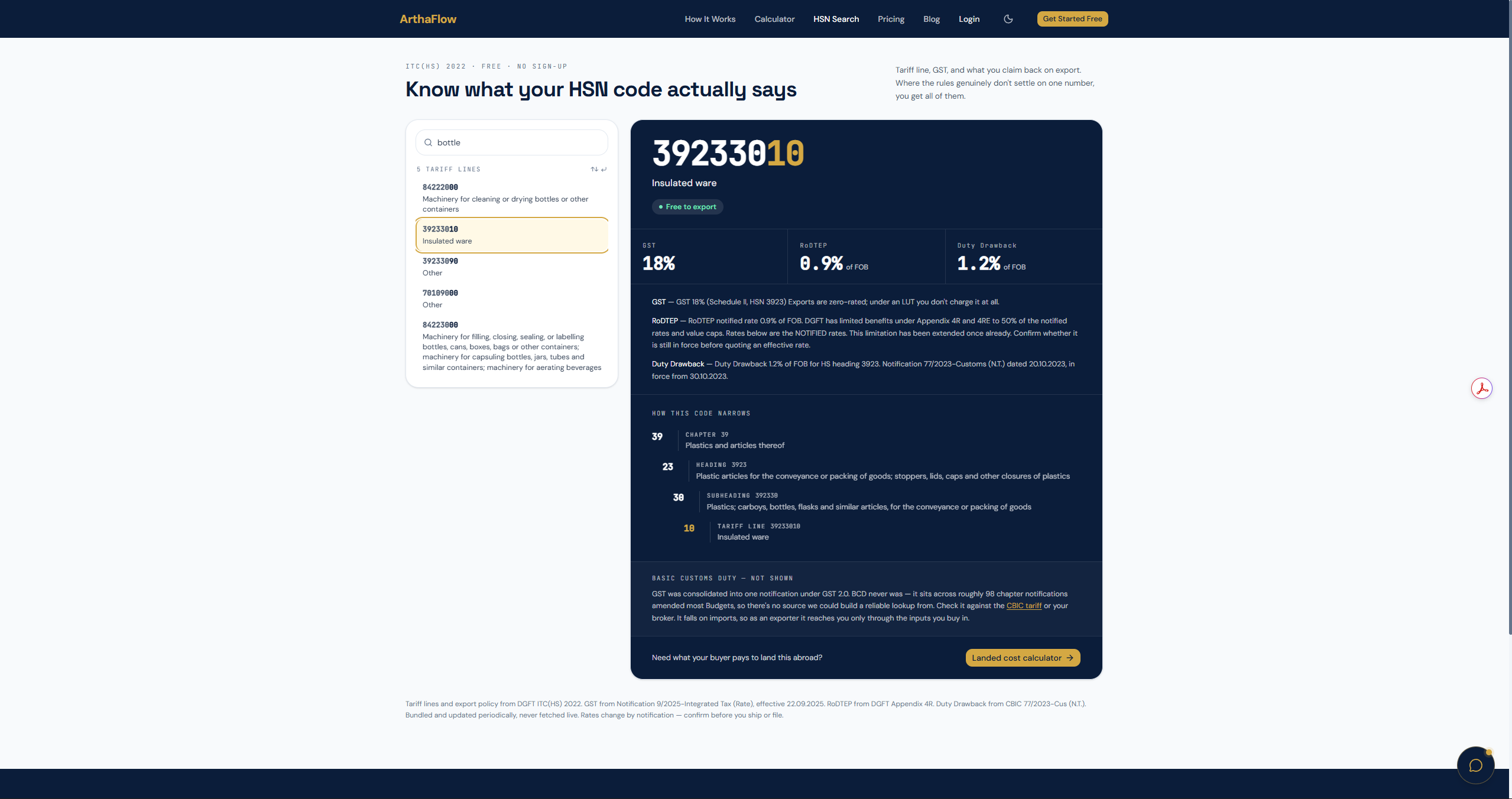
The Dashboard. Where Saathi's answer becomes action. HS classification against the real HS 2022 nomenclature — the model picks from a verified shortlist, it cannot invent a code. Every export document generated from that classification. A landed-cost engine covering 44 destinations, with RoDTEP and Duty Drawback rebate calculations.
The Partner Network. The same workflow connects outward to freight, cargo insurance and trade finance, so a manufacturer doesn't have to separately find and coordinate a forwarder, an insurer and a lender. One fulfilment partnership is signed today (warehousing plus a verified buyer database); freight, insurance and trade-finance partnerships are in active negotiation.
How I built it
Next.js 16 (App Router), React 19 and TypeScript on the frontend, Supabase/Postgres for auth and data with row-level security. Export Saathi runs on Groq (Llama 3.3 70B) as a tool-calling agent with nine callable trade tools.
The hardest technical work was the data layer, not the model. I discovered India has effectively zero holdings in UN Comtrade — the world's standard trade database — verified directly against Comtrade's own data-availability endpoint. I built a three-source fallback chain (India's own DGCIS data, mirror statistics from partner countries, World Bank WITS) so Saathi never has to guess, and I disclose which source produced every figure rather than presenting a World Bank estimate as if it were an exact HS-line number.
I also vendored and independently verified four government regulatory datasets myself: the HS 2022 nomenclature (6,939 entries), India's 8-digit ITC-HS export schedule (12,310 tariff lines), RoDTEP rebate rates (10,610 rates), and Duty Drawback (2,123 rates). My RoDTEP parser replays DGFT's full amendment chain and its output independently reproduces the government's own published amendment counts — 142 added, 50 omitted, 2 redescribed — which is how I know the parse is actually correct rather than assumed correct.
Challenges I ran into
Early on, Saathi classified a leather handbag as HS code 4102 — which is raw sheep hides. Ask it again and it gave a different wrong answer each time. Every number a manufacturer relies on derives from that code: which market to enter, what duty applies, what rebate they can claim. A wrong code doesn't throw an error, it produces a confidently wrong answer discovered only when cargo is held at port. I rebuilt classification as retrieve-then-choose against the real nomenclature so the model is structurally incapable of inventing a code — it can only select from a shortlist, or say it doesn't know.
I also learned that Duty Drawback and India's own ITC-HS tariff schedule don't join cleanly at the 8-digit level — zero of 340 sampled 8-digit drawback codes are valid ITC-HS codes. Presenting a drawback rate against a specific 8-digit line would be a fabricated join, so I resolve to the 4-digit heading instead and disclose the mismatch whenever a heading carries more than one rate.
Accomplishments that I'm proud of
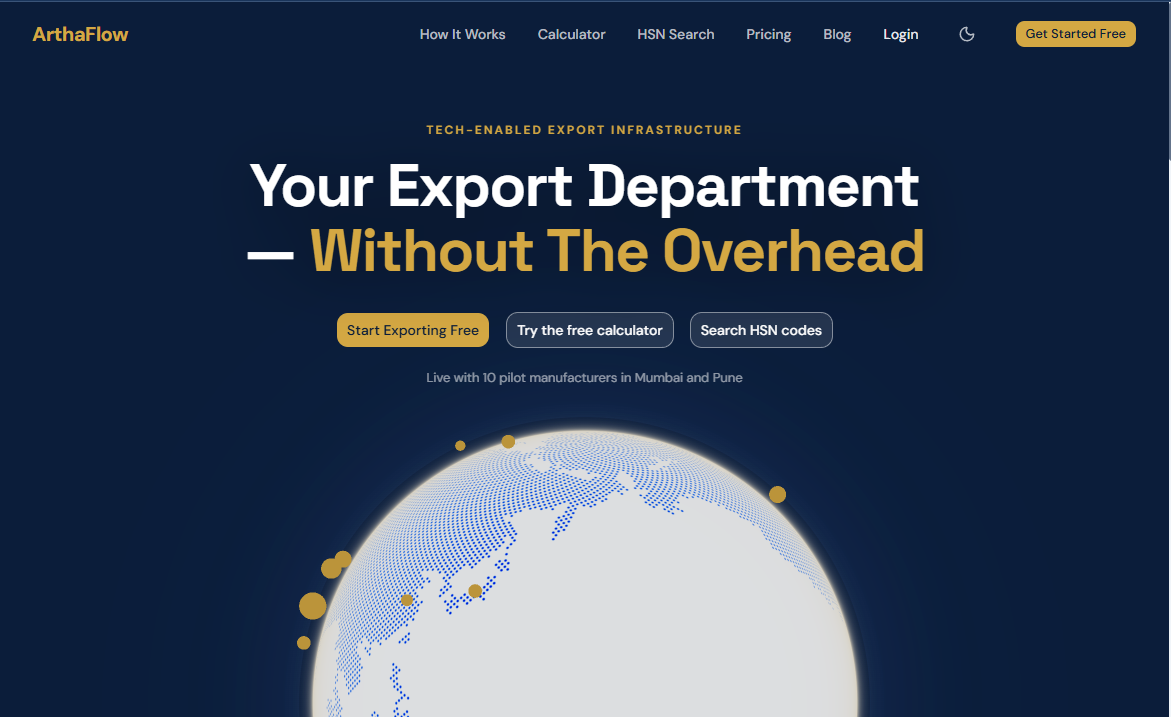
Live in production since May 2026, entirely self-funded, with 10 pilot manufacturers actively using the platform across Mumbai and Pune — 15 export documents generated so far, 14 of them in the last 30 days. I'm proudest of the discipline underneath the product: Saathi is only allowed to state a fact it can trace to a successful tool call in that conversation. If a data source fails, it says so instead of naming a plausible-sounding country. That rule has cost me flashier demos than competitors advertising "real-time AI trade intelligence" — and it's the only reason a manufacturer can put real inventory behind the answer.
What I learned
That the interesting problem in "AI for trade" isn't the model, it's the data underneath it. Two supposed AI trade-intelligence competitors in India are quietly serving World Bank chapter-group estimates or partner-reported mirror statistics as if they were exact figures, without disclosing it. Building the verification layer — replaying an amendment chain until it reproduces a government's own published counts, or proving a join between two classification systems is structurally invalid — was harder and less glamorous than building the chat interface, and it's the actual moat.
What's next for ArthaFlow Global
Converting the pilot cohort into paying customers around public launch, completing the freight/insurance/trade-finance partner integrations that are currently commercial-only, and expanding beyond Mumbai and Pune into more of India's manufacturing clusters.
Built With
- cobe
- groq
- llama-3.3
- lucide-react
- motion
- next.js
- postgresql
- python
- react
- row-level-security
- shadcn-ui
- sharp
- supabase
- tailwindcss
- typescript
- un-comtrade-api
- vercel
- vercel-ai-sdk
- world-bank-wits

Log in or sign up for Devpost to join the conversation.