-
-
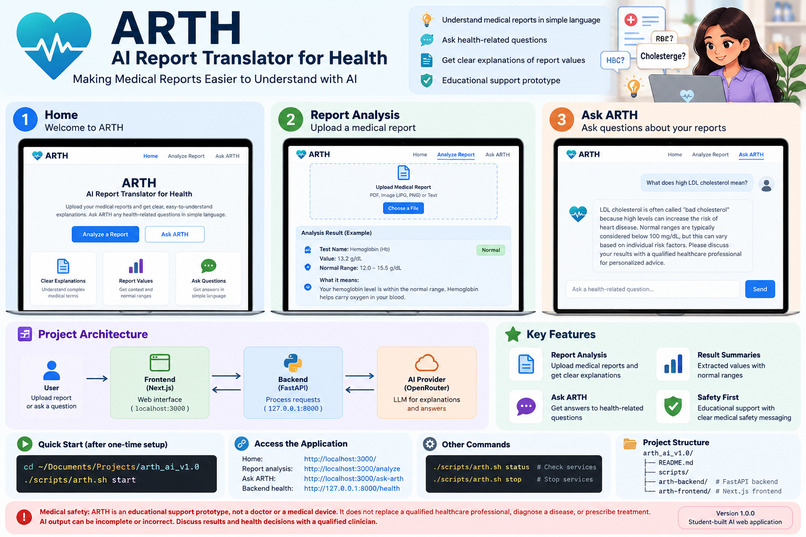
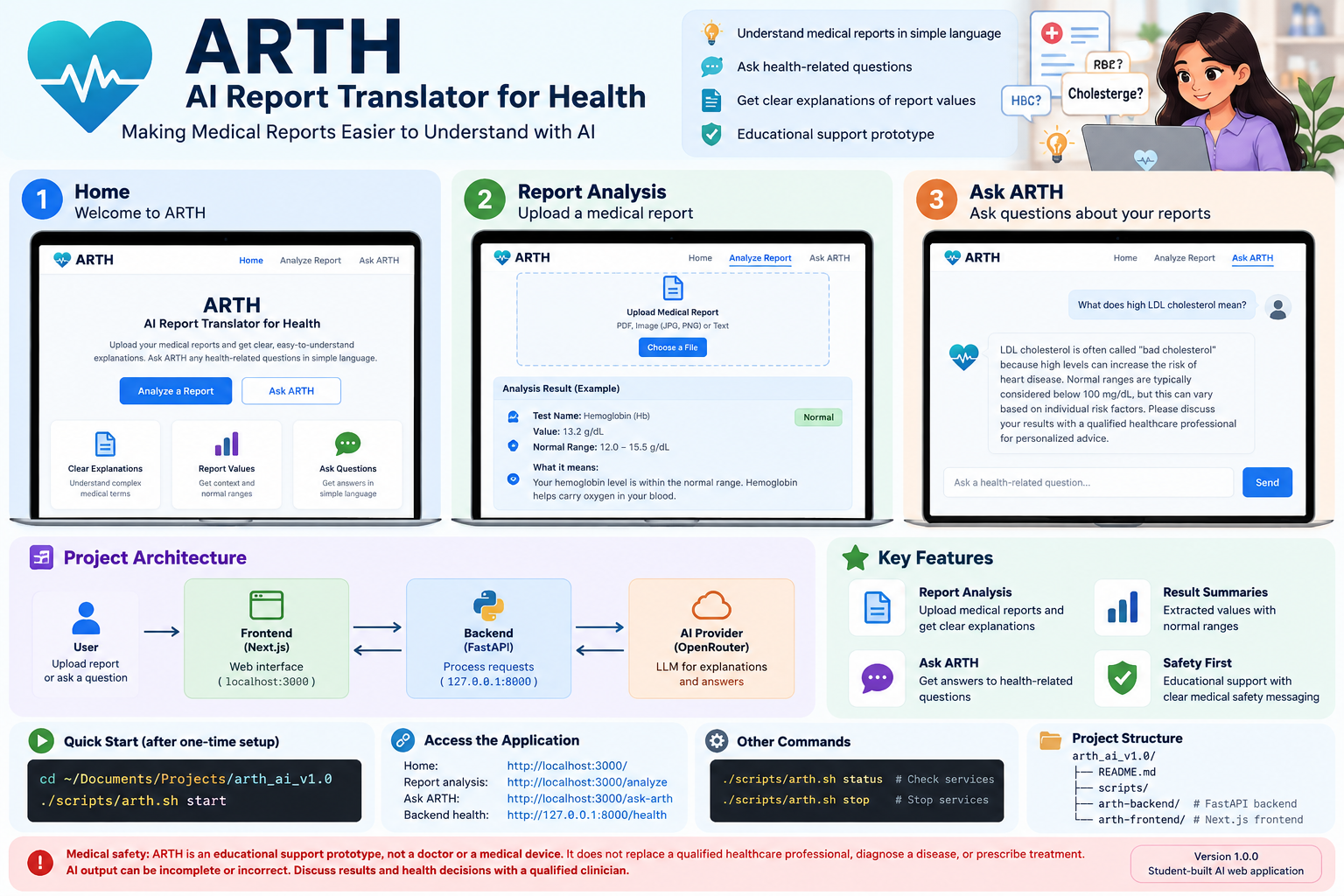
ARTH AI helps users understand medical reports through AI-powered explanations, report summaries, and interactive health Q&A.
Inspiration
Medical reports are often difficult for ordinary people to understand. They contain technical terminology, numerical values, and reference ranges that can leave patients confused or anxious. We wanted to build something that helps bridge the gap between medical information and everyday understanding.
That idea inspired ARTH AI (AI Report Translator for Health) — a student-built application designed to make medical reports easier to understand through AI-powered explanations and an interactive question-and-answer experience.
What it does
ARTH AI helps users understand the information presented in their medical reports through two core experiences:
- Report Analysis: Upload a supported medical report in PDF, PNG, or JPEG format to receive an AI-generated explanation.
- Understand Report Values: Present extracted report values and explanations, including reference ranges when available.
- Ask ARTH: Ask health-related questions or clarify medical terminology through an interactive conversational interface.
- Multilingual Support: Generate explanations in multiple languages, helping make medical information more accessible.
- Safety First: Clearly communicates that AI-generated explanations are educational, may be inaccurate, and should not replace advice from qualified healthcare professionals.
Our goal is to make medical information more approachable without replacing medical expertise.
How we built it
ARTH AI uses a web-based architecture with a frontend, backend API, and hosted AI provider.
- Frontend: Next.js and React provide the user interface for the home page, report analysis, and Ask ARTH.
- Backend: Python and FastAPI handle API requests, report processing, and communication with the AI provider.
- Document Processing: PyPDF supports PDF text extraction, while the frontend includes Tesseract.js for OCR-related functionality.
- AI Integration: The backend uses the OpenAI Python SDK with an OpenRouter-compatible API to generate explanations and conversational responses.
- Configuration: Environment variables keep API credentials separate from the source code.
- Developer Experience: A startup script simplifies launching, checking, and stopping the local frontend and backend services.
We focused on creating a practical, modular application that can be extended with better report extraction, validation, accessibility, and privacy controls.
Challenges we ran into
One of the key challenges was making complex medical information easier to understand without losing important context. Medical reports can contain technical terms, numerical results, different reference ranges, and information that requires professional interpretation.
We also had to bring together document processing, a web interface, backend API handling, and AI-provider configuration into a usable end-to-end application.
Another important challenge was responsible AI usage. An explanation that sounds confident is not necessarily correct, especially in a healthcare context. We therefore emphasized clear safety messaging, professional medical review, and avoiding claims that the application can diagnose conditions or prescribe treatment.
Accomplishments that we're proud of
We are proud to have built an end-to-end AI application that combines medical report analysis with an interactive question-and-answer experience.
Our key accomplishments include:
- Building a web interface with dedicated report-analysis and Ask ARTH experiences.
- Integrating a Python backend with a hosted AI provider.
- Supporting PDF and image-based report uploads in the application design.
- Incorporating multilingual instructions to make explanations more accessible.
- Adding medical-safety messaging throughout the user experience.
- Publishing the project as an open, publicly accessible GitHub repository for review and future development.
Most importantly, we turned an everyday problem—understanding medical reports—into a working student project with a clear purpose and opportunities for meaningful improvement.
What we learned
Building ARTH AI helped us understand how multiple components must work together to create a useful AI application. We gained practical experience integrating a modern web frontend, a Python API backend, document processing, and an external AI service.
We also learned that building an AI application involves more than connecting a model to an interface. Input quality, extraction accuracy, prompt design, error handling, configuration management, privacy, and user trust all matter.
Healthcare-related applications require particular care: AI should help people understand information, communicate uncertainty, and encourage appropriate professional guidance rather than replace clinical judgment.
What's next for ARTH AI?
Our next goal is to make ARTH AI more reliable, accessible, and useful.
Planned improvements include:
- Improving extraction and validation of medical report values.
- Handling missing, ambiguous, unreadable, or poorly formatted information more gracefully.
- Enhancing explanations of reference ranges and medical terminology.
- Expanding language and accessibility options.
- Strengthening automated testing, error handling, and privacy protections.
- Evaluating AI-generated explanations for accuracy, consistency, and safety.
- Improving deployment documentation and making the application easier to set up.
Our long-term vision is to make ARTH AI a trusted educational companion that helps people ask better questions about their medical reports and have more informed conversations with healthcare professionals. ARTH AI will remain a support tool—not a substitute for qualified medical care.
Built With
- ai-powered-medical-report-analysis
- api
- fastapi
- generative-ai
- healthcare
- llm
- medical-ai
- natural-language-processing
- nebius-token-factory
- next.js
- nvidia
- nvidia-nemotron
- python
- react
- rest
- typescript

Log in or sign up for Devpost to join the conversation.