Inspiration
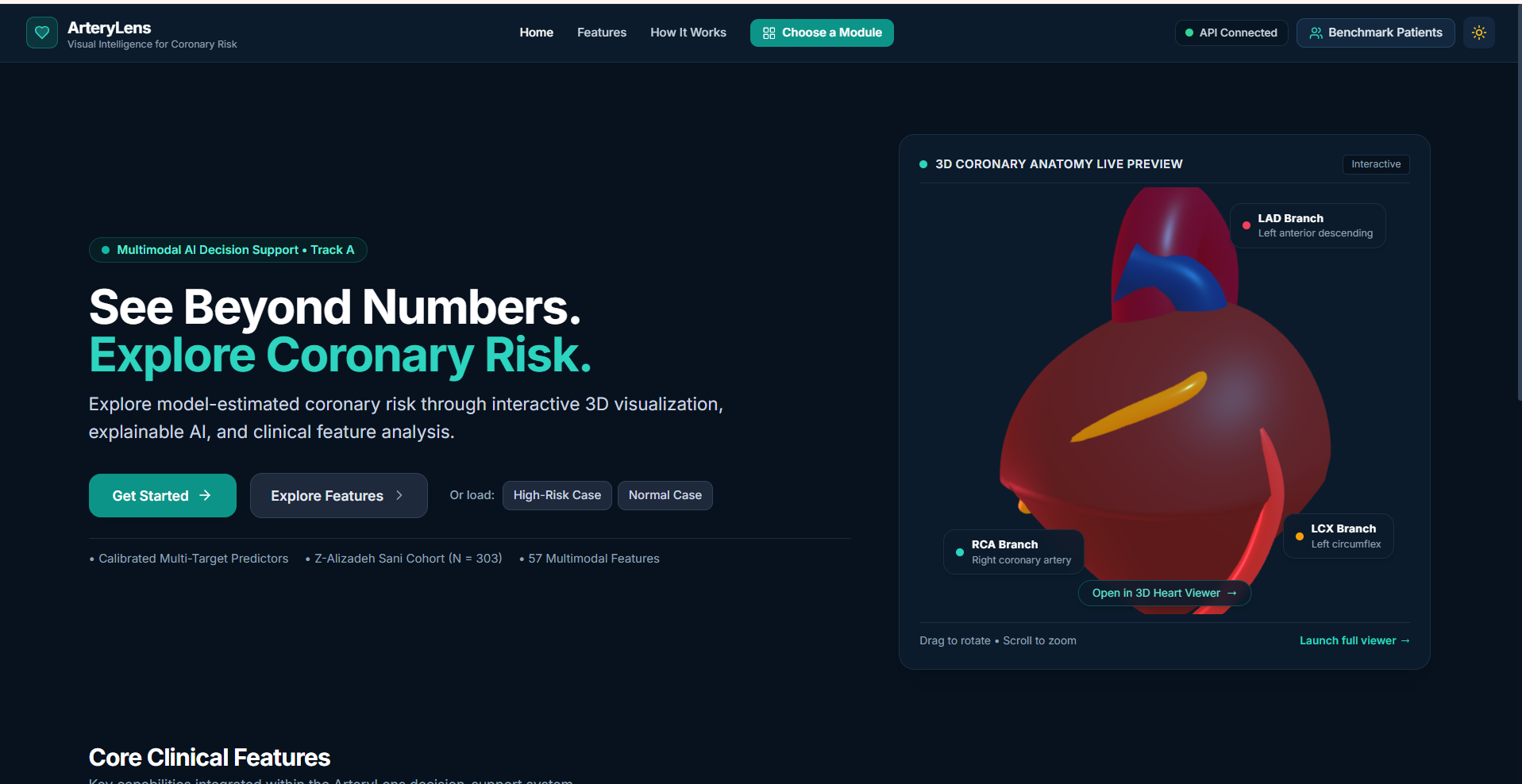
Cardiovascular diseases are a major global health concern, yet interpreting coronary artery disease risk from multiple clinical measurements can be challenging. We wanted to bridge the gap between AI predictions and human understanding by creating ArteryLens, a platform that transforms complex clinical data into interactive, explainable visual insights.
What it does
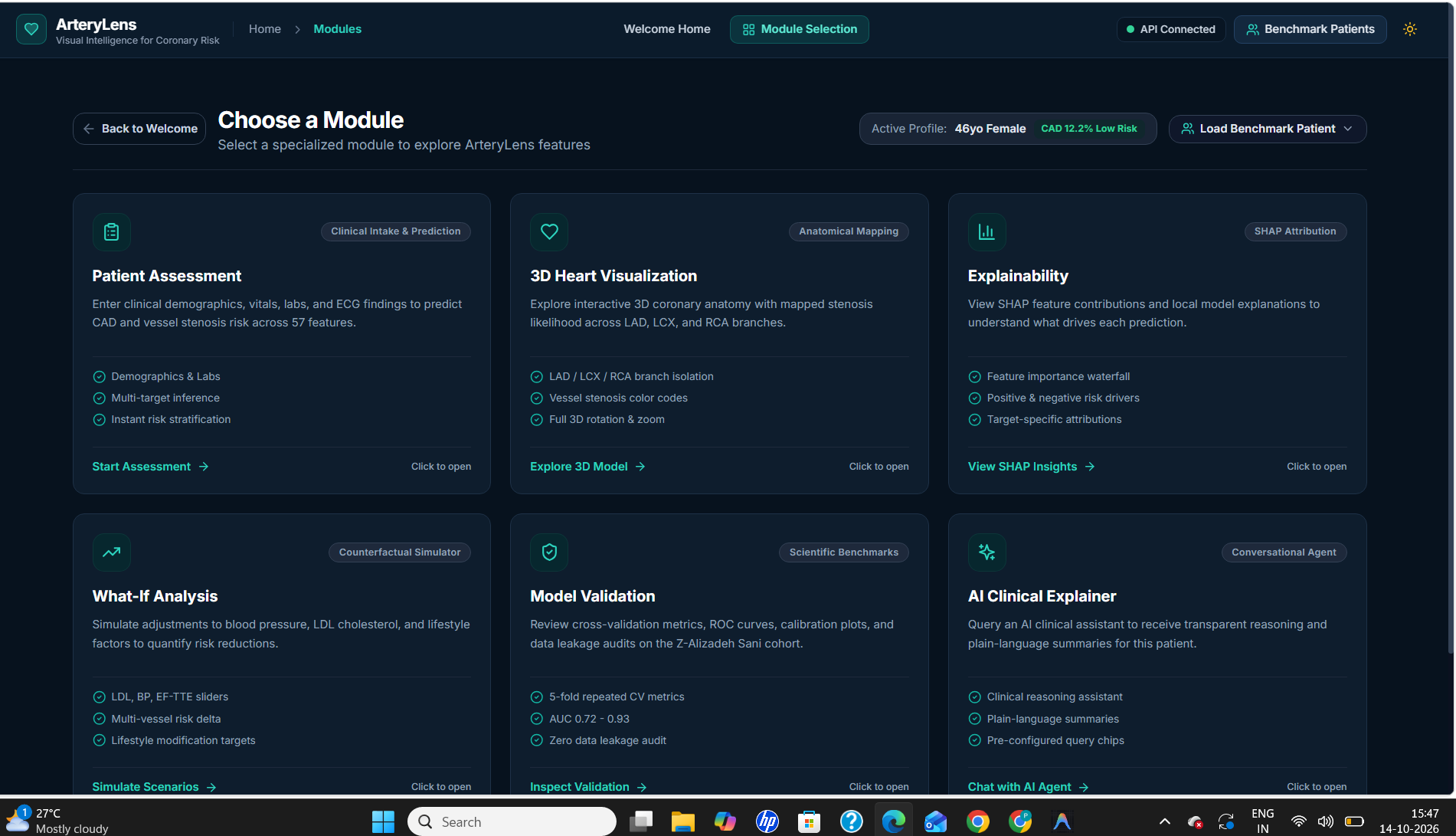
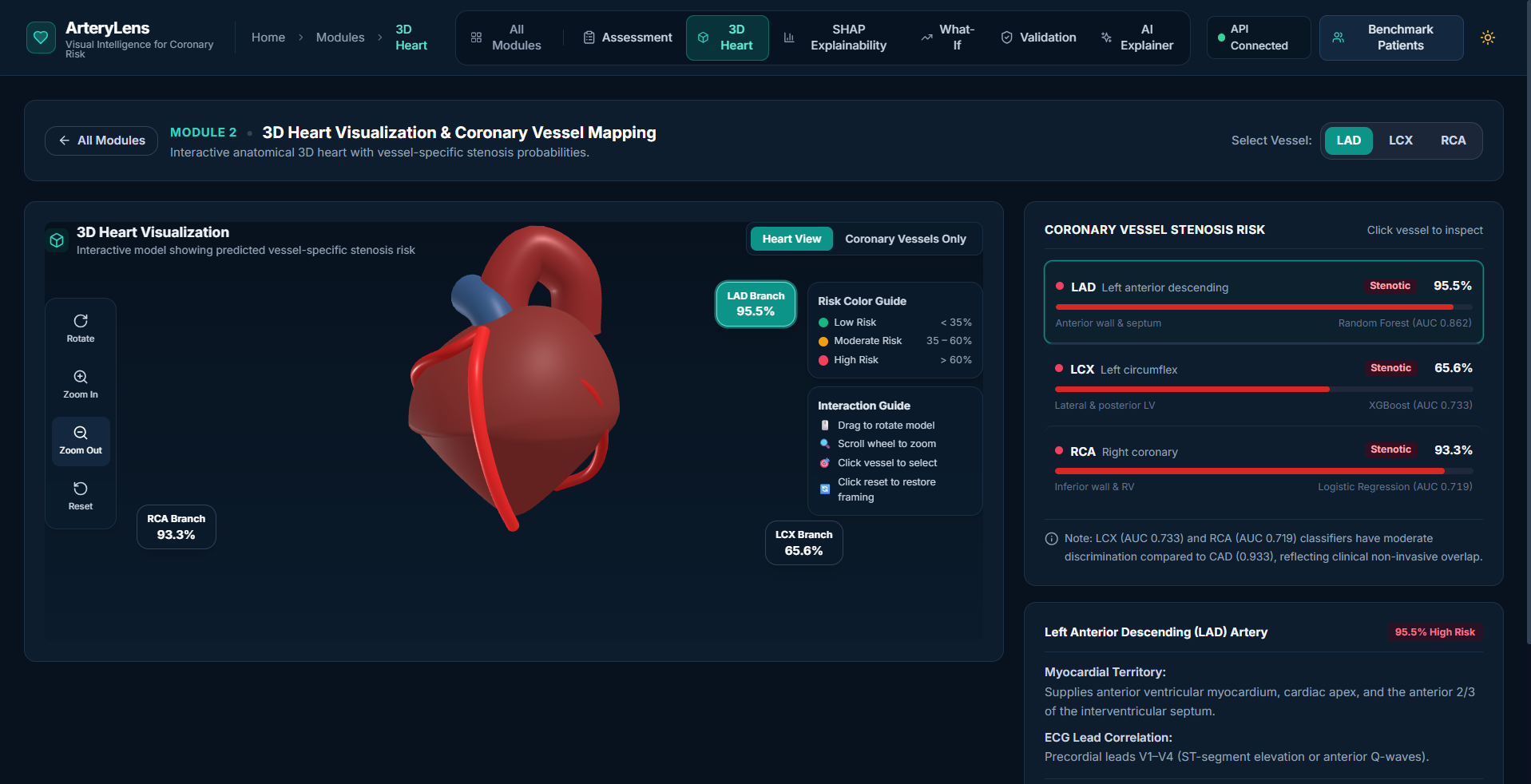
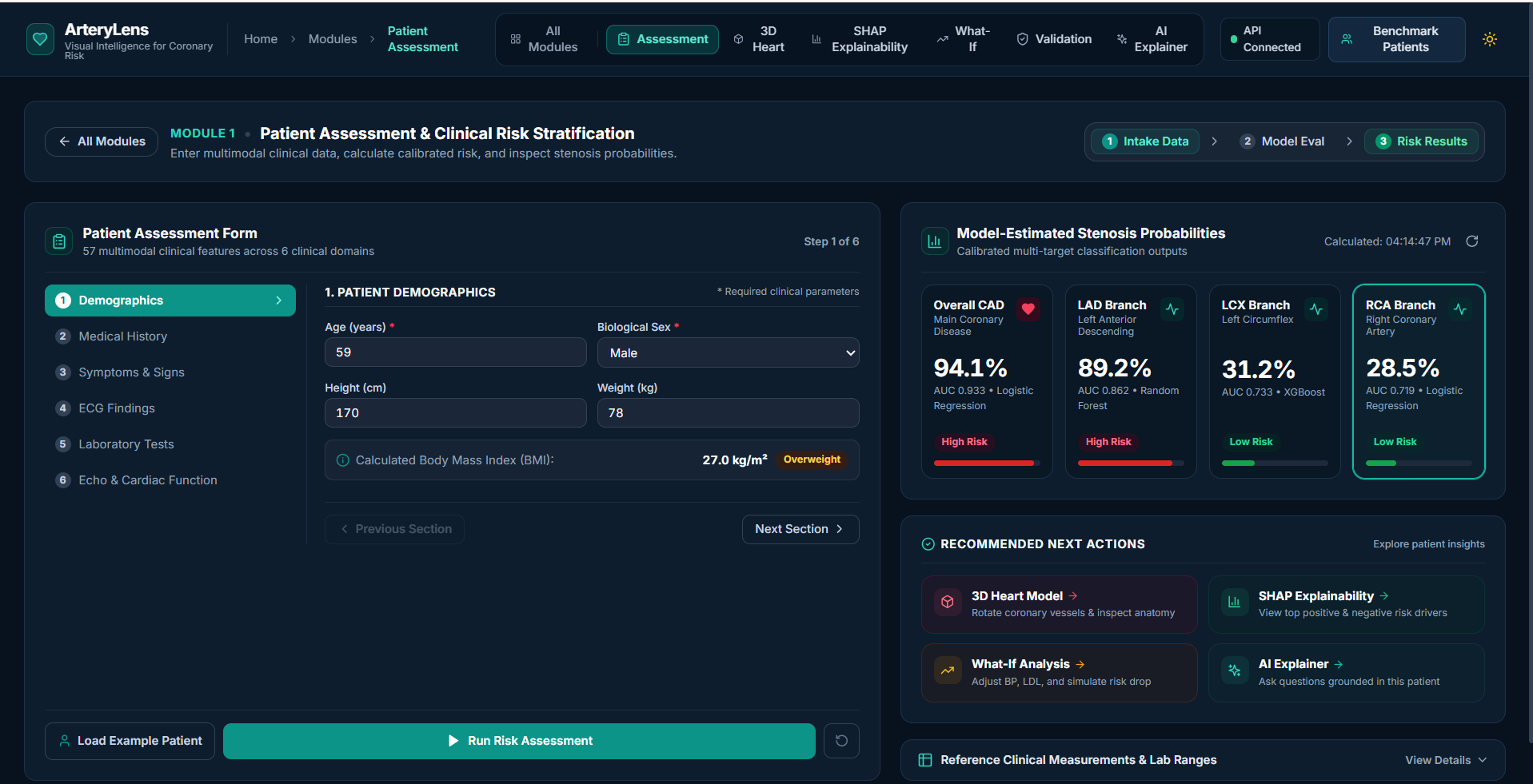
ArteryLens is an AI-powered cardiovascular risk visualization and prediction platform developed for the Multimodal AI Hackathon 2026 – Track A. It predicts coronary artery disease (CAD) risk and estimates vessel-specific risk for the left anterior descending (LAD), left circumflex (LCX), and right coronary artery (RCA).
Key features include:
- AI-powered risk prediction: Four trained machine learning models estimate CAD and vessel-specific risk from clinical inputs.
- Interactive 3D heart visualization: Explore cardiovascular risk through a 3D heart interface with risk-responsive vessel visualization.
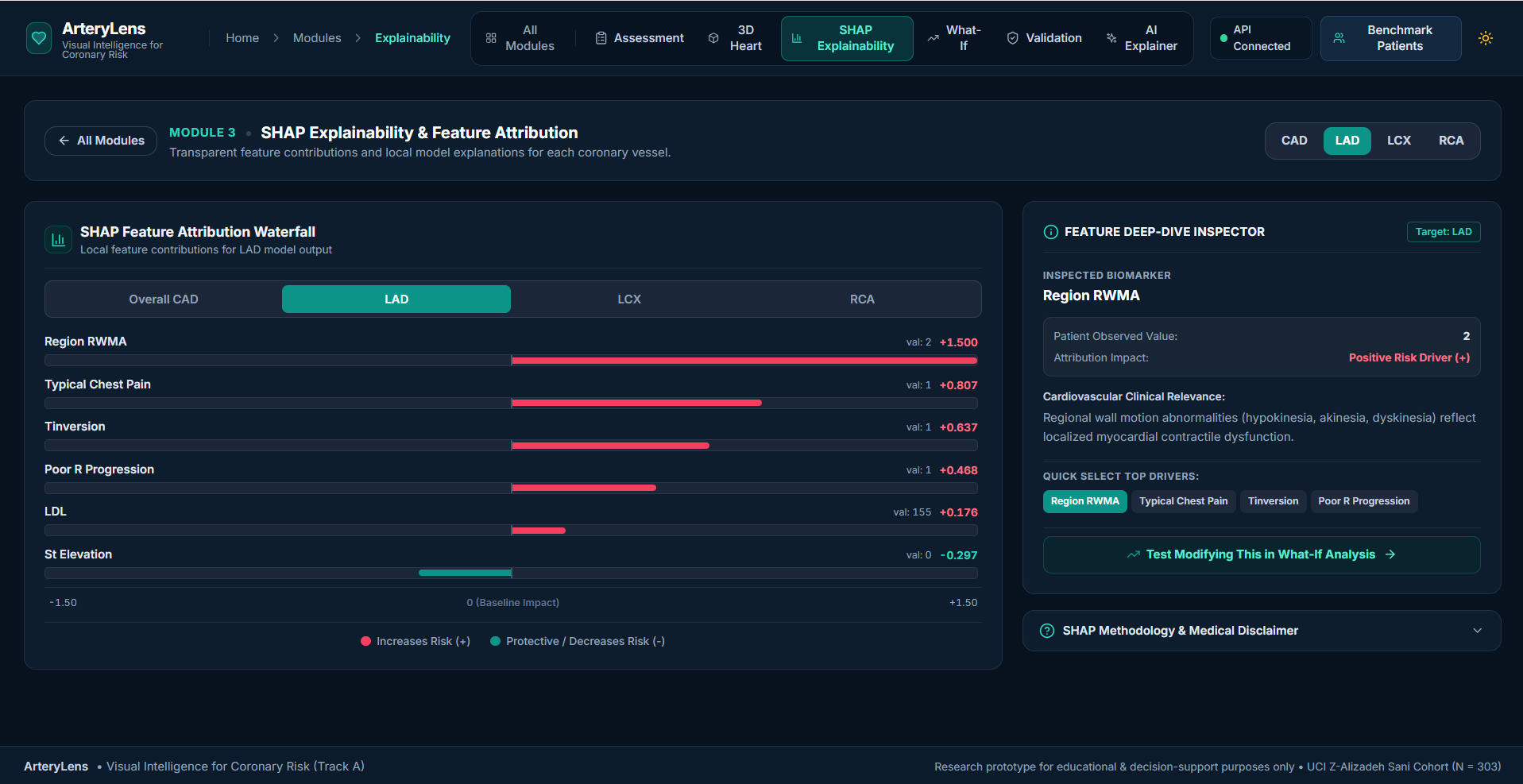
- Explainable AI: SHAP-based feature attribution helps users understand which clinical features influence predictions.
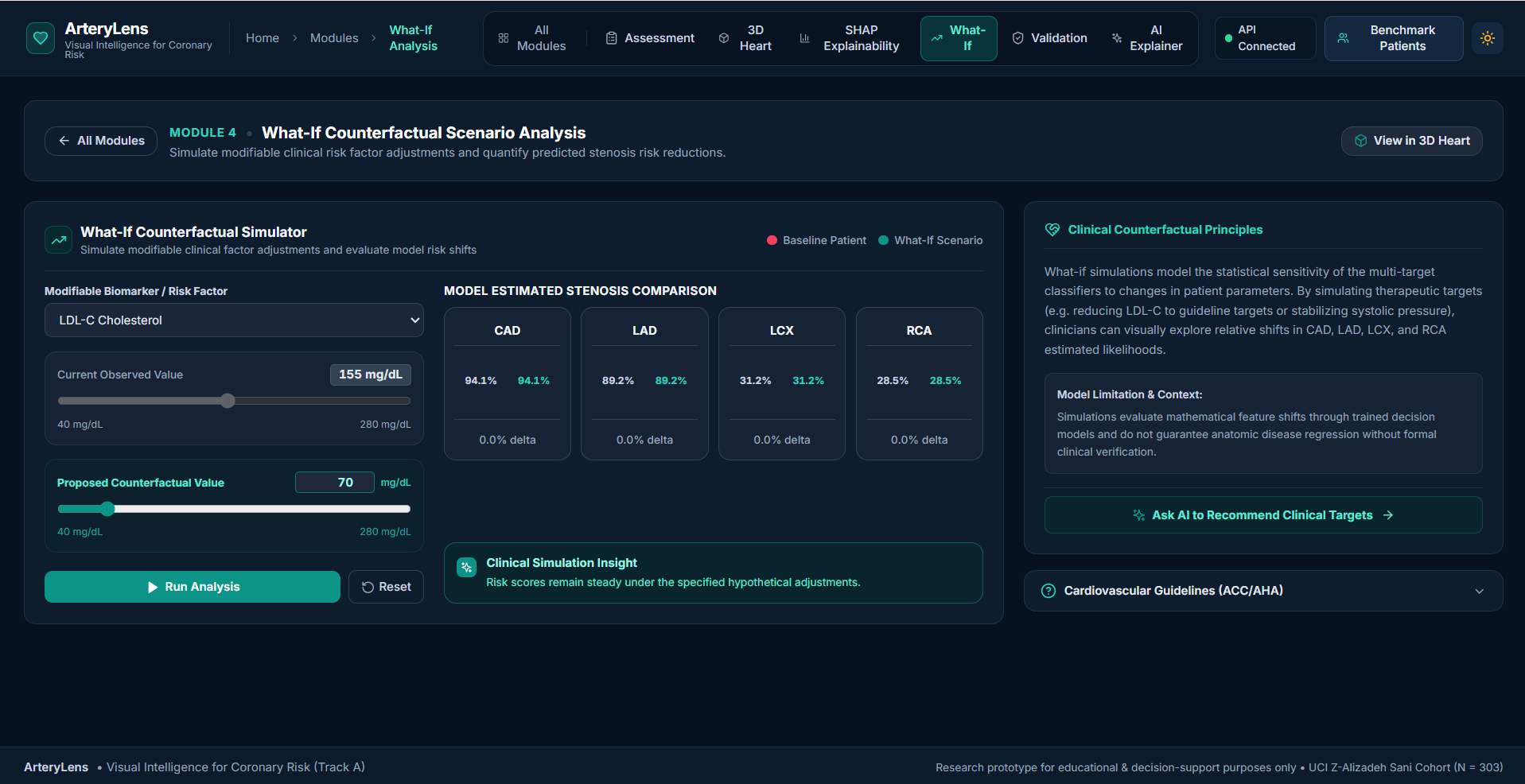
- What-if analysis: Explore how changes in patient inputs affect model predictions.
- AI clinical explainer: Provides conversational explanations of model outputs.
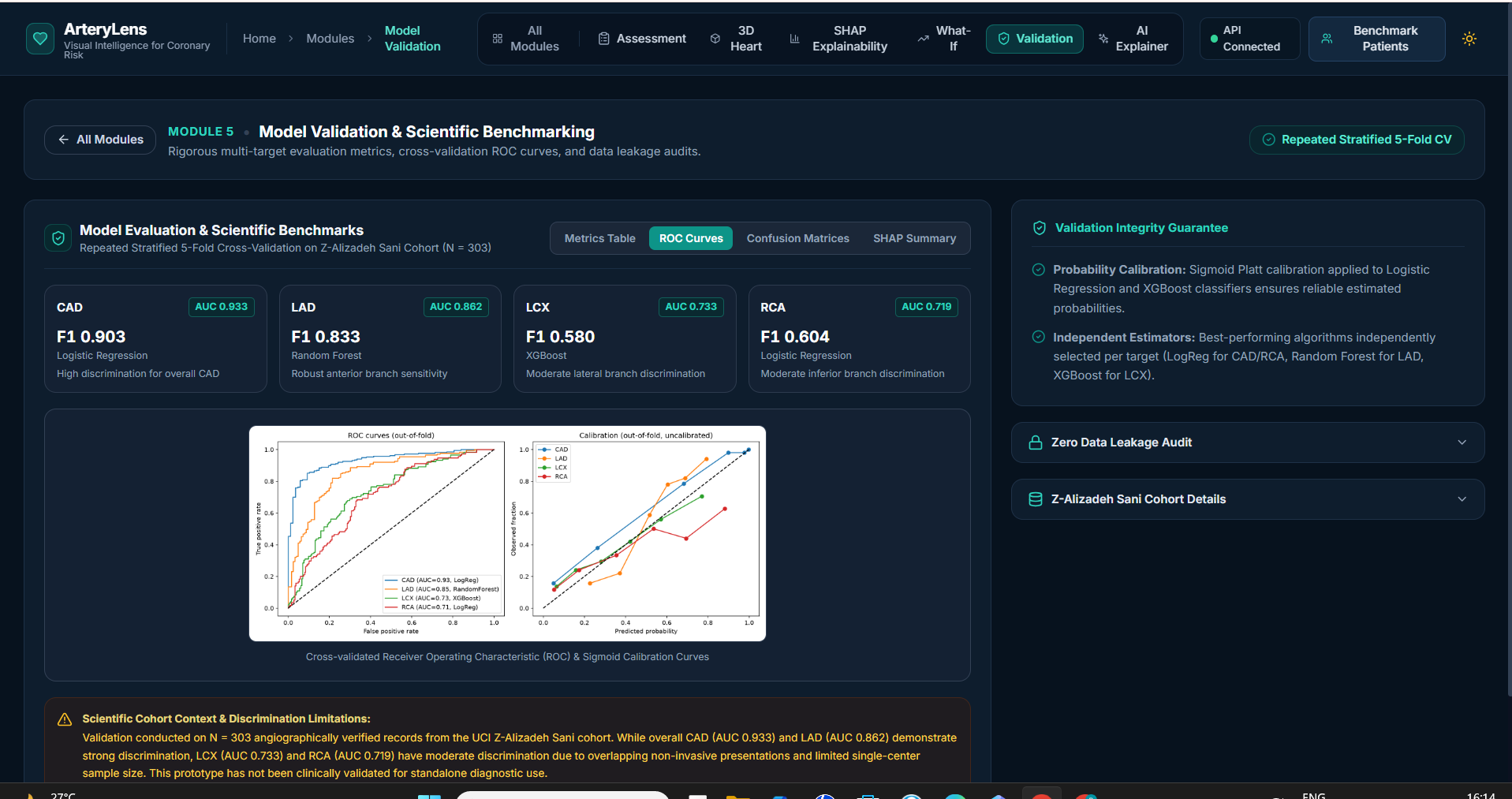
- Model validation: Presents available model evaluation metrics to support transparent assessment.
How we built it
We developed the frontend using React, TypeScript, Vite, and Three.js, with a Python FastAPI backend. The machine learning pipeline uses the Z-Alizadeh Sani coronary artery disease dataset, containing 303 records, and 57 non-invasive input features, including engineered clinical ratios.
We trained four models for CAD, LAD, LCX, and RCA prediction and applied probability calibration. SHAP explainers support feature-level interpretability, while FastAPI endpoints connect predictions, explanations, what-if analysis, and the AI assistant to the frontend.
We also focused on data integrity by excluding angiography-related target fields from model inputs to reduce data leakage and maintaining consistent preprocessing between training and inference.
Challenges we ran into
Our main challenges were preventing data leakage, maintaining consistent feature ordering, integrating multiple machine learning models with the frontend, and making complex model outputs understandable. Connecting predicted risk to an interactive 3D visualization also required care to avoid presenting model estimates as confirmed anatomical findings.
Accomplishments that we're proud of
- Integrated four cardiovascular risk prediction models into one application.
- Built an interactive 3D heart experience for exploring predicted coronary risk.
- Integrated SHAP explanations to improve model transparency.
- Connected prediction, explanation, what-if analysis, and conversational assistance through a FastAPI backend.
- Developed a unified interface combining machine learning, visualization, and explainability in a single research prototype.
What we learned
We learned that building useful healthcare AI requires more than model accuracy. Data leakage prevention, consistent preprocessing, calibrated predictions, explainability, clear visualization, and responsible communication are equally important. We also learned how to integrate a machine learning pipeline with a full-stack application to make its outputs easier to explore.
What's next for ArteryLens: Visual Intelligence for Coronary Risk
We plan to evaluate ArteryLens on larger and more diverse datasets, perform external validation, improve uncertainty communication, and gather usability feedback from healthcare professionals. Future development will focus on strengthening robustness, transparency, and suitability for research workflows.
Disclaimer: ArteryLens is a research prototype and is not a clinically validated diagnostic system. Its predictions are intended for research and demonstration purposes only and must not replace professional medical advice or clinical judgment.
Built With
- ai
- api
- data
- explainable
- fastapi
- forest
- learning
- logistic
- machine
- numpy
- pandas
- python
- random
- react
- regression
- rest
- scikit-learn
- shap
- three.js
- typescript
- visualization
- vite
- xgboost

Log in or sign up for Devpost to join the conversation.