-
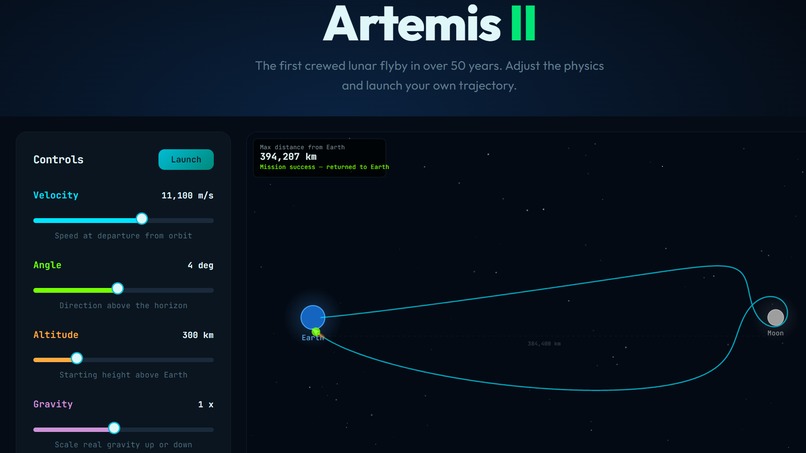
Example preset
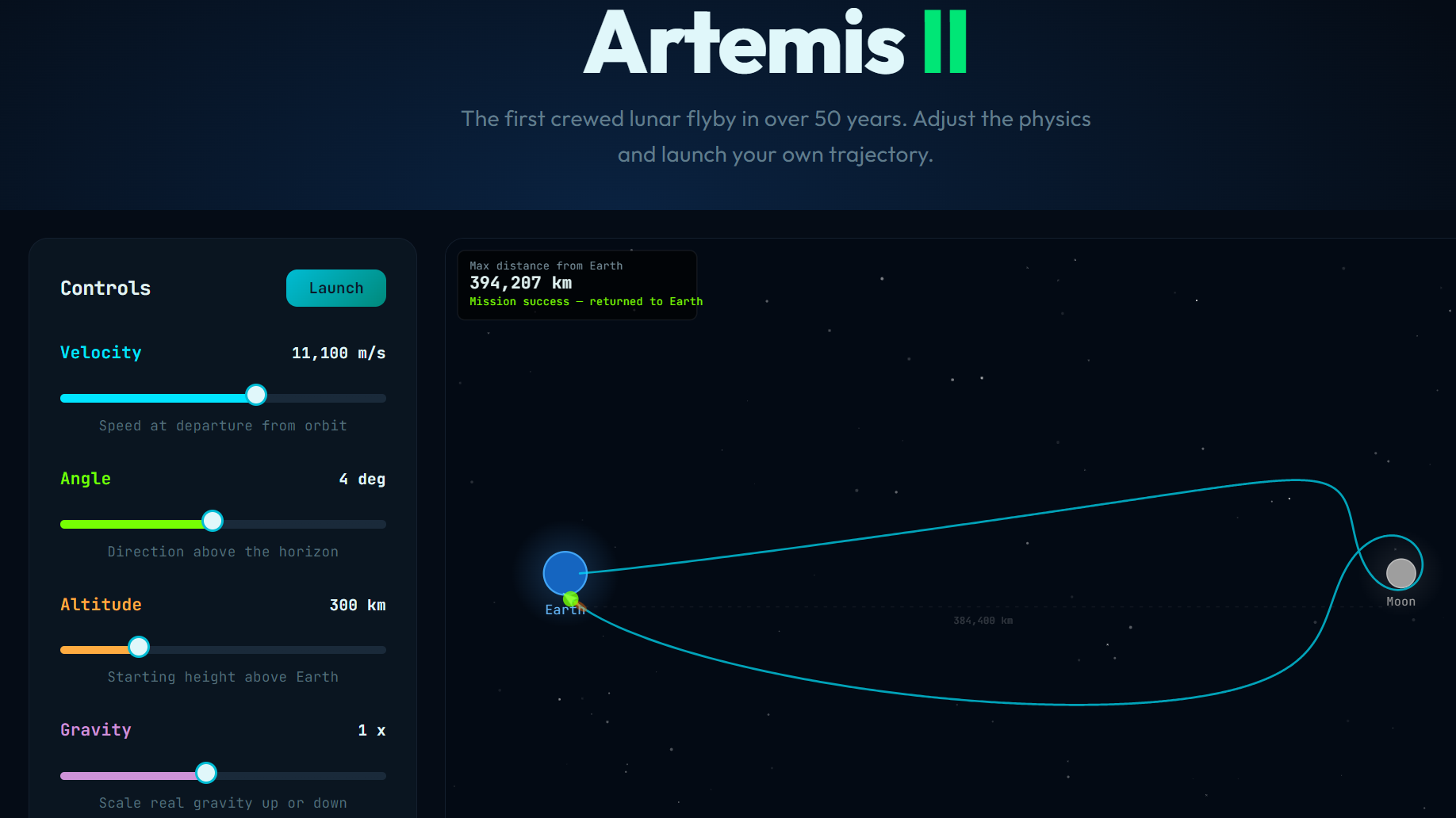
Inspiration
Artemis II launched on April 1, 2026, the first crewed mission beyond low Earth orbit in over 50 years. We watched the coverage and kept asking ourselves: how does a spacecraft actually get to the Moon and back? What decides whether it curves around and comes home or flies off into nothing? We wanted to make those questions answerable for anyone, not just aerospace engineers. The hackathon theme "Explore the Unknown" was just perfect timing.
What it does
Artemis II Physics Simulator is an interactive educational tool that lets users experiment with the core physics behind a lunar trajectory. You can adjust four variables (velocity, launch angle, altitude, and gravitational force) and watch a spacecraft's path update in real time. Built-in scenario presets let users jump between interesting cases like "Stable Orbit," "Moon Transfer," and "Overshoot" to build intuition. The visualization supports zoom and pan so users can follow trajectories at any scale.
How we built it
We started with research, understanding the Artemis II free-return trajectory and identifying the simplified physics concepts that would be both accurate and teachable. We implemented a 2D gravitational simulation using Euler numerical integration, computing the pull from both Earth and Moon at every timestep to update the spacecraft's velocity and position. The frontend is built with React and Vite, with the backend just vanilla javascript.
Challenges we ran into
Picking the right idea took longer than expected. None of us are physics majors, so translating real orbital mechanics into a simplified but honest model required significant research. We had to understand which equations mattered (gravitational acceleration, orbital velocity, escape velocity) and which simplifications were acceptable (2D instead of 3D, ignoring the Sun's gravity and atmospheric drag). Handling trajectories that extend far beyond the Moon was tricky, so we adjusted the view (zoom/pan) so users could follow long trajectories without the visualization cropping or becoming unreadable. Getting the animation timing, zoom behavior, and scale-compensated rendering to all work together smoothly took many passes.
Accomplishments that we're proud of
We built a working physics simulator from scratch that computes gravitational forces from two bodies and produces realistic trajectory shapes. We're also proud that the result is something we can use to educate other students. The interface is clean enough that someone with no physics background can drag a slider, watch the rocket fly, and start building real intuition about why spacecraft follow curved paths.
What we learned
Physics equations (orbital velocity, escape velocity, gravity) to enable a lunar slingshot.
What's next for Artemis II Physics Simulator
We want to extend the simulation to support deeper missions. The next step is using the Moon as a gravitational launchpad, simulating a trajectory that slingshots around the Moon and continues outward toward other destinations in the solar system, the way real interplanetary missions use gravity assists to reach Mars, Jupiter, and beyond. We'd also like to add a 3D visualization mode, incorporate the Sun's gravity for longer-duration trajectories, and build guided challenge scenarios where users try to hit specific targets like stable lunar orbit or a Mars transfer window.
Built With
- javascript
- react
- vite


Log in or sign up for Devpost to join the conversation.