About the project
Artemis CapCom turns a Twitch chat into a small science game that is fun to watch. The host launches a lunar signal challenge. Viewers type !vote a or !vote b to choose the synthetic signal they think will ring longest. Twenty seconds later, ballots lock, an accelerated comparison runs, and the exact model reveals the answer. Correct picks earn points on the Houston honor roll.
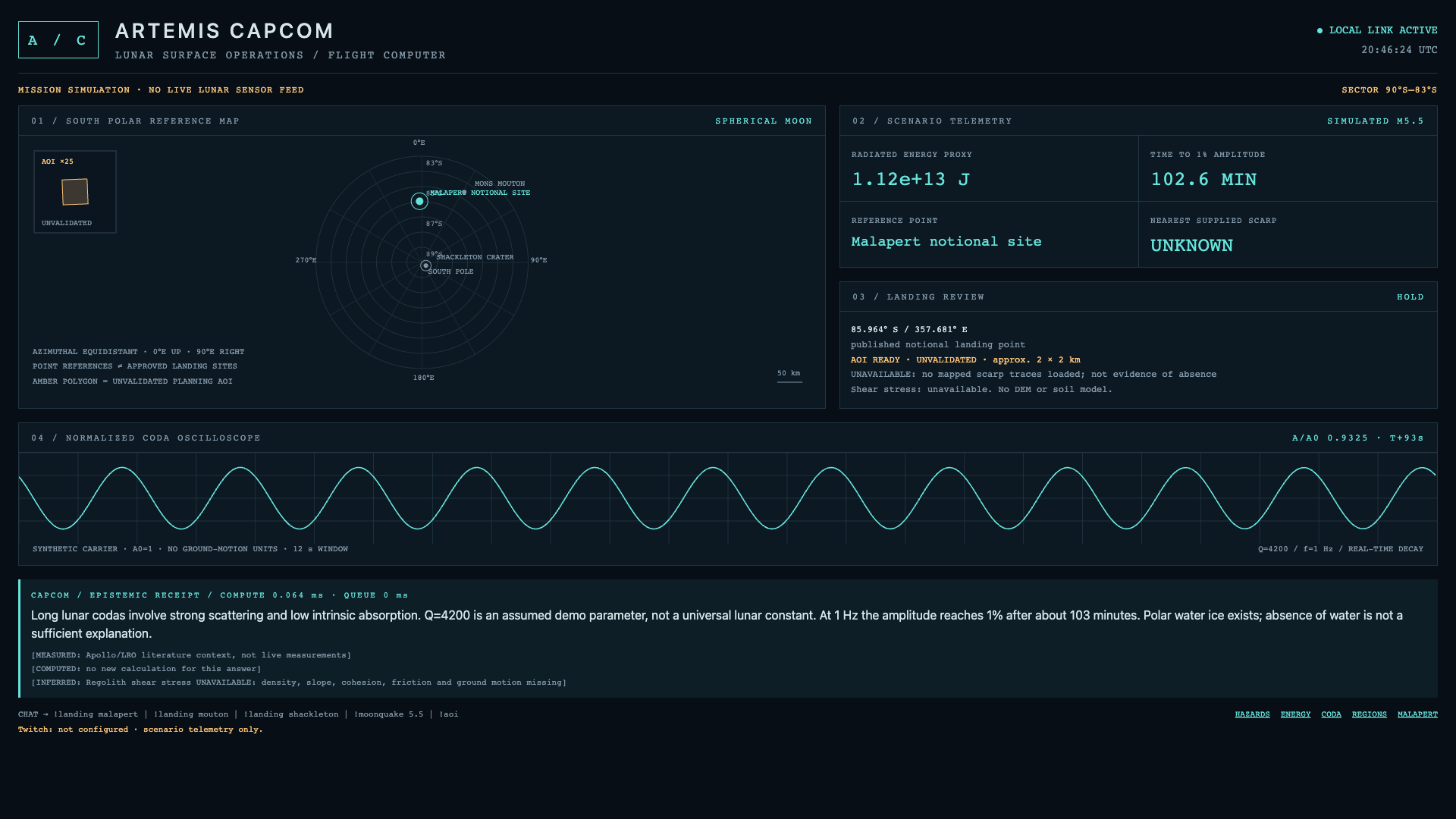
A one-page Director handles hosting and local rehearsal; a 1920x1080 browser overlay goes straight into OBS. Viewers can also ask CapCom science questions and explore illustrative lunar locations. All scores and physical quantities come from deterministic local functions. Optional Apple Silicon MLX produces short explanations in the background without stopping the game or chat heartbeat.
The distinguishing idea is epistemic honesty made playable: this is a simulation, fixtures are labelled, and the result can be reproduced from the disclosed formula. There are no earthquake forecasts, landing clearances or unmeasured power claims.
Evidence limit, stated plainly: live Twitch footage is a one-account self-test using xavaanes as host, bot, and voter, not an independent audience test. Optional MLX was tested separately; recorded gameplay uses deterministic mode. Validation: 82 tests pass in both Mac Python environments; all 44 published source files match the verified manifest. The linked demo video is an 80-second OBS recording that predates the latest validation and chat-formatting updates.
How we built it
This main Codex thread built the clean local implementation, wired and tested real MLX loading, implemented TLS IRC and private CLI authentication, and guided the first real Twitch-to-HUD smoke test. The November 1 audit separated the monolith, added audience rounds and stronger tests, designed the OBS overlay and Director, and prepared the release materials. The local mlx-metal MCP tool generated a scoring candidate and executed a Metal coda kernel; independent tests corrected one contract issue and rejected a second candidate rather than trusting tool admission. The repository includes receipts and the usage log. The Codex Session ID from the main build thread is entered in Additional info on this entry.
Challenges we ran into
The hardest limit was evidence: one real account had to stand in as host, bot, and voter, so the demo proves the integration end to end but does not prove how a crowd behaves. The first recording also came out at 720p with a synthetic voice that did not carry the demo. Keeping the deterministic fallback honestly labelled, never described as AI inference, took deliberate checks at every step, and the validation packaging had to be rebuilt so the published manifest matched the published files exactly.
What's next
If the entry is submitted, the submitted repo, video, and links freeze until winners are announced, and any further building continues in a copy. The idea worth keeping is the closing line of the demo: a community can learn by making a prediction together, and the math gives everyone an answer.


Log in or sign up for Devpost to join the conversation.