-
-
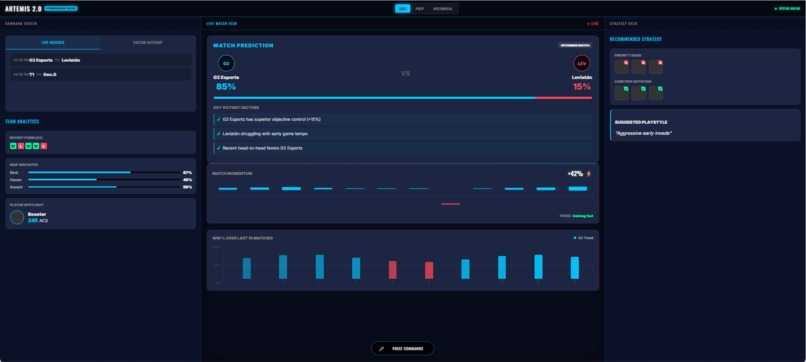
live
-
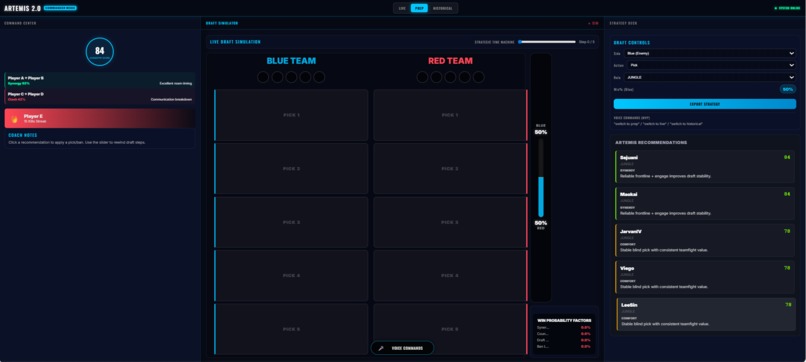
prep
-
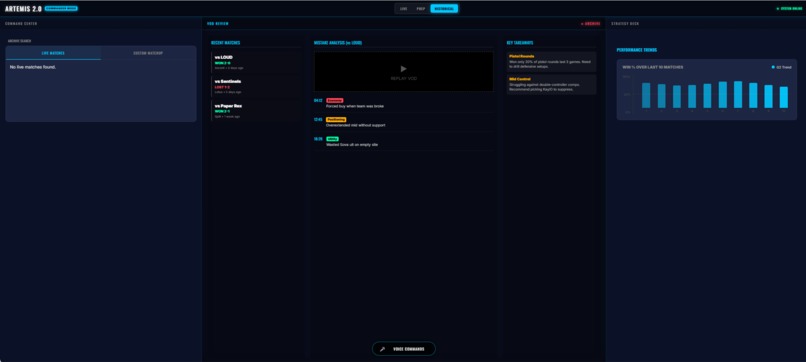
historical
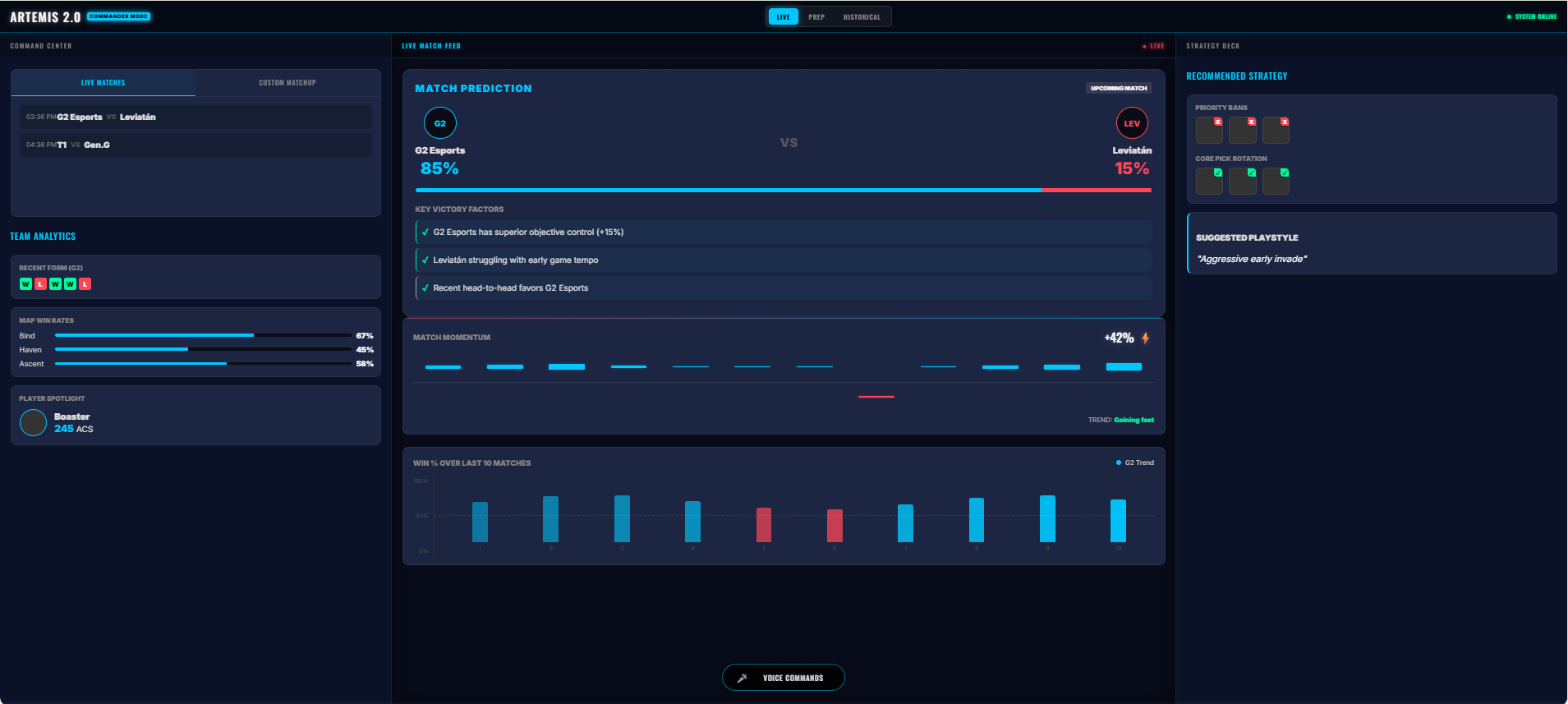
About the project
Project Story — ARTEMIS 2.0
About the Project
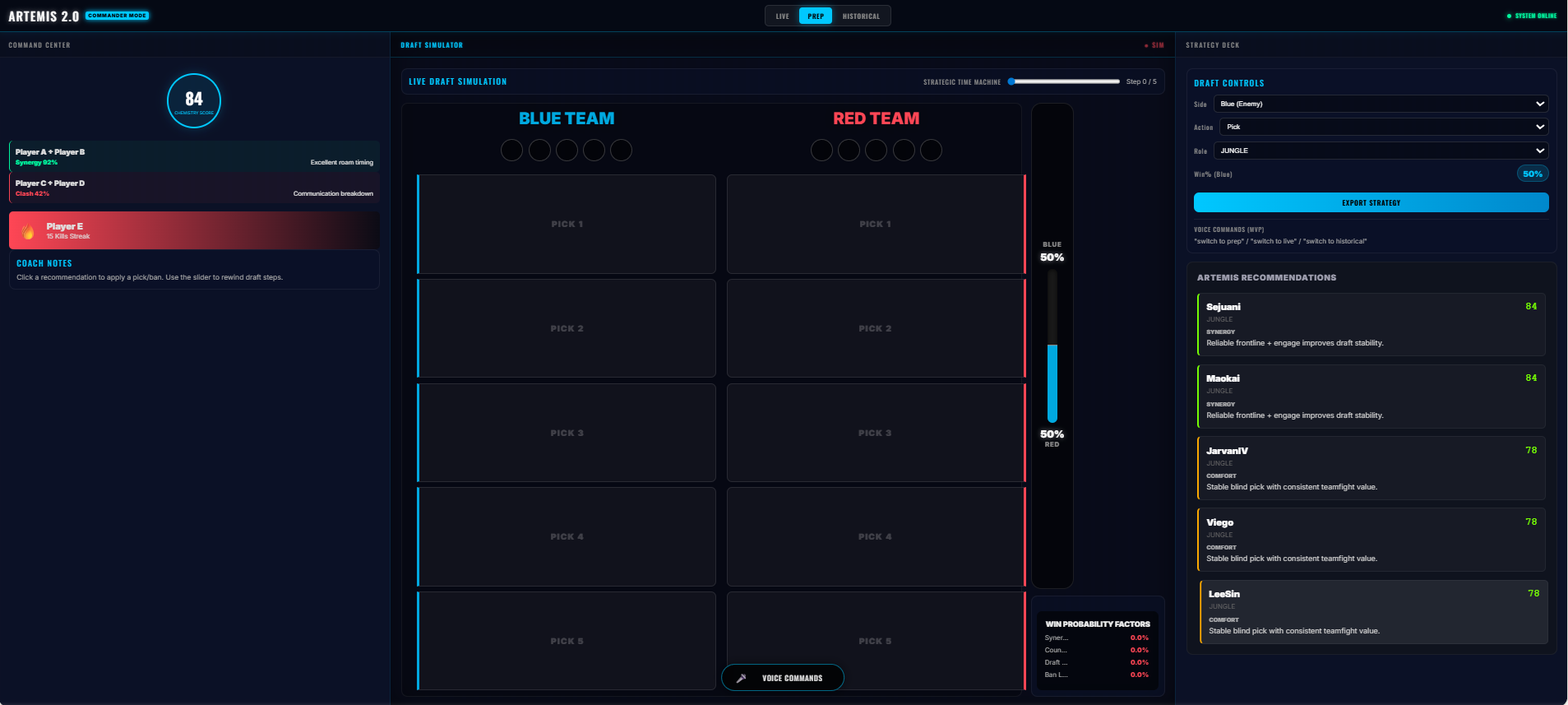
ARTEMIS 2.0 is a real-time League of Legends drafting assistant built to help coaches make faster, smarter, and more explainable decisions during the pick/ban phase. Drafts often decide games, yet they are still driven largely by intuition under intense time pressure. We wanted to change that.
The core idea was simple:
What if a coach could see how every pick or ban immediately changes the team’s chances of winning — and understand why?
What Inspired Us
We were inspired by two things:
Professional esports drafts
Watching competitive League of Legends, it’s clear that drafts are chaotic, high-stakes, and irreversible. Coaches must commit to decisions in seconds, often without tools that explain trade-offs clearly.Moneyball-style analytics
Just like Jonah Hill’s character in Moneyball, we were fascinated by the idea of turning “gut-feel” decisions into data-backed, explainable choices — without slowing people down.
This led us to ask:
Can we bring explainable, real-time decision support into esports drafts without overwhelming the user?
ARTEMIS 2.0 is our answer.
How We Built It
System Design
We built ARTEMIS as a demo-stable, real-time system with clear separation between frontend, backend, and modeling logic.
Frontend: React + Vite
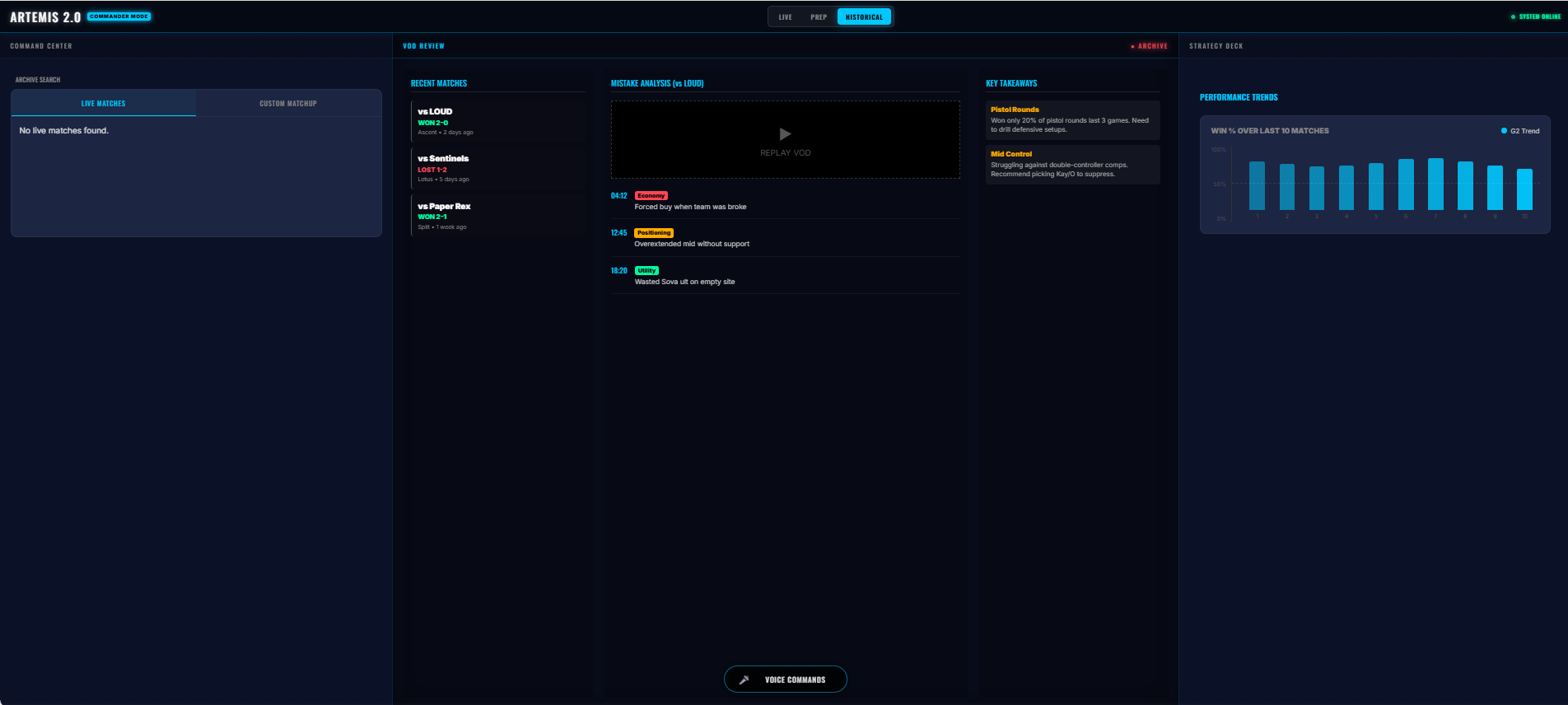
- A 3-column Commander Mode UI
- Live draft board (picks & bans)
- Win probability meter
- Explainable factor breakdown
- Strategic Time Machine (rewind & replay drafts)
Backend: Node.js + Express
- Draft prediction endpoint
- Draft recommendation endpoint
- GRID API integration with deterministic fallback
- Proxy-based networking for hackathon stability
Modeling Approach
Instead of training a heavy ML model during the hackathon, we designed a deterministic heuristic engine that outputs:
A win probability bounded as
[ 0.15 \le P(\text{win}) \le 0.85 ]SHAP-like factor contributions: [ \Delta P = w_s S + w_c C + w_t T + w_b B ] where:
- ( S ) = synergy
- ( C ) = counter-pick strength
- ( T ) = tempo
- ( B ) = ban leverage
This approach allowed us to:
- Keep responses instant
- Make reasoning transparent
- Ensure demo reliability
Importantly, the API is model-agnostic, meaning the heuristic can later be replaced by XGBoost or neural networks without changing the frontend.
What We Learned
Explainability matters more than raw prediction
Coaches don’t just want a number — they want to trust it.Demo stability is critical in hackathons
External APIs can fail. Designing reliable fallbacks is a competitive advantage.Interactivity beats static dashboards
The Strategic Time Machine became one of our strongest features because it makes “what-if” scenarios tangible.Good UX can make AI feel human
Clear visuals, minimal clicks, and real-time feedback made complex logic feel intuitive.
Challenges We Faced
1. Live Data Uncertainty
GRID APIs may be unavailable or unauthorized during judging.
Solution: deterministic fallback responses that preserve full functionality.
2. Balancing Speed and Intelligence
Heavy ML models risk latency and instability.
Solution: a fast heuristic engine with explainable outputs.
3. Making AI Understandable
Raw scores are meaningless without context.
Solution: SHAP-like explanations and clear factor labels.
4. Draft Complexity
Full professional drafts are long and constrained.
Solution: a simplified draft flow for demo speed, with a clear roadmap for expansion.
Final Thoughts
ARTEMIS 2.0 is not just a dashboard — it’s a decision-making companion for esports coaches.
By combining real-time probability, explainable reasoning, and interactive draft simulation, we turned one of the most stressful moments in competitive play into an opportunity for clarity and confidence.
This project taught us that the best AI doesn’t replace humans — it helps them decide better.


Log in or sign up for Devpost to join the conversation.