Inspiration
The inspiration behind Socrates and ArtAcademia stems from the need to enhance interview preparation and academic research processes as well as just more effective general learning. Preparing for technical interviews can be daunting, and many candidates struggle with identifying their knowledge gaps. Similarly, academic researchers often face challenges in efficiently processing and extracting relevant information from large volumes of documents. Our goal was to create an intelligent assistant that leverages advanced AI to provide personalized, insightful, and structured feedback to users, thus bridging these gaps while using the Socratic method to critically asses the confidence and grounding of the user's knowledge for effective learning.
What it does
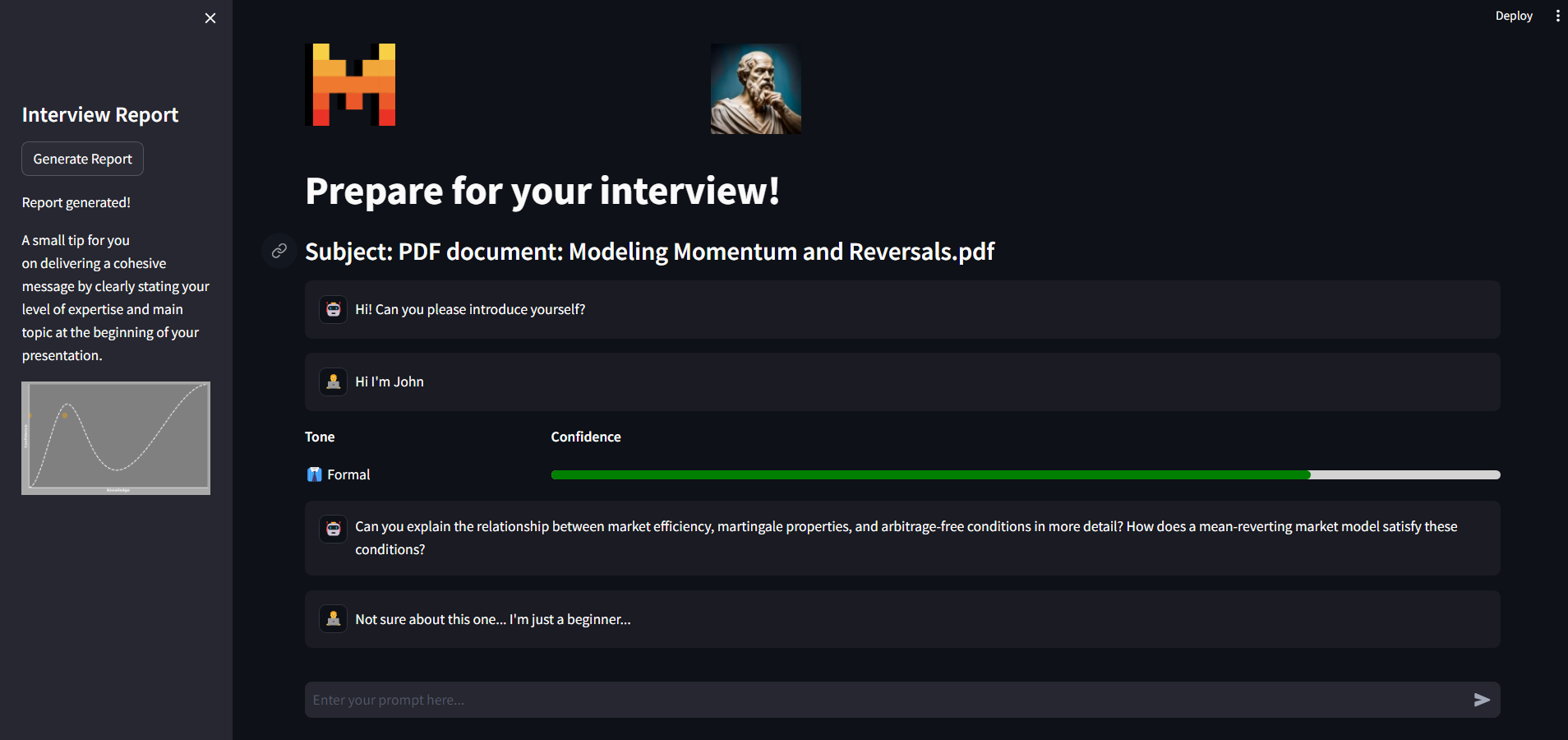
Socrates is an AI-powered interview preparation assistant designed to critically assess and improve a candidate's technical knowledge. It generates probing questions based on user input, providing tailored feedback, confidence ratings, and follow-up questions in real-time. Additionally, it processes and embeds PDF documents, retrieving relevant excerpts to answer user queries accurately with reference-backed responses. This dual functionality makes Socrates an invaluable tool for both interview preparation and academic research.
How we built it
Technology Stack:
- Streamlit: For building an interactive web interface.
- Groq AI: To power the conversational AI and document processing functionalities.
- LangChain: For creating advanced NLP models and managing conversational memory.
- Chroma: For vector storage and retrieval of document embeddings.
- MistralAIEmbeddings: For generating document embeddings using the Mistral model.
- PyPDFLoader: To load and parse PDF documents.
- Various Utility Modules: For tasks such as JSON parsing, document formatting, and report generation.
Steps:
- Interface Development: Built a user-friendly interface with Streamlit to interact with the assistant.
- Conversational AI Integration: Integrated Groq AI to handle user inputs and generate relevant questions and feedback.
- Document Processing: Used LangChain and Chroma for embedding documents and enabling efficient retrieval of information.
- Prompt Engineering: Created detailed prompt templates to guide the AI in generating accurate and reference-backed answers.
- Feedback Loop: Implemented a system to provide real-time feedback and insights based on user interactions.
Challenges we ran into
- Complexity of Conversational AI: Developing a system that can generate contextually relevant and probing questions required fine-tuning the AI models and prompt templates.
- Document Embedding and Retrieval: Efficiently processing and retrieving information from large volumes of PDF documents was technically challenging.
- Real-time Feedback: Ensuring the system could provide real-time insights and maintain a smooth user experience required optimizing the performance of our AI models.
- Structured JSON Responses: Designing a robust system to ensure all outputs adhered to the specified JSON format was critical for consistency and reliability.
- Measuring Confidence and Accuracy of Information: One of the significant challenges was accurately measuring and conveying the confidence level of the AI's responses. This involved developing a reliable method to score the AI's confidence based on various factors such as the complexity of the question, the clarity of the user's input, and the relevance of the retrieved documents. Additionally, ensuring the accuracy of the information provided by the AI required continuous validation against reliable sources and iterative improvements based on user feedback. Balancing these aspects to provide trustworthy and actionable feedback without overestimating or underestimating the AI's capabilities was a delicate and ongoing process.
Accomplishments that we're proud of
- Successfully integrating advanced AI and NLP techniques to create an intelligent assistant that significantly enhances interview preparation and academic research processes.
- Developing a user-friendly interface that provides real-time, actionable insights and feedback.
- Achieving efficient and accurate document processing and retrieval, enabling the generation of precise, reference-backed answers.
- Creating a scalable and robust system capable of handling diverse user queries and large document volumes.
What we learned
- The importance of prompt engineering in guiding AI models to produce accurate and relevant outputs.
- Effective ways to integrate various AI technologies to create a cohesive and functional application.
- Techniques for optimizing the performance of AI models to ensure real-time responsiveness.
- The value of user feedback in continuously improving the functionality and usability of our application.
What's next for ArtAcademia
- Enhanced User Interaction: Implementing voice recognition and response features to make the interaction more natural and intuitive.
- Semantics and EIL: Implementing a reliable method to analyse for tonality, and expertese level (can you explain it like I'm 5 ? 20. ? 60 ? )
- Expanded Document Support: Extending support to more document types and improving the accuracy of document parsing and embedding.
- Advanced Analytics: Adding features for deeper analytics and insights, helping users better understand their performance and progress.
- Collaboration Tools: Introducing collaboration features that allow users to work together and share insights in real-time.
- Mobile Application: Developing a mobile version of Socrates to make it accessible on the go.
- Continuous Learning: Integrating machine learning capabilities to allow the system to learn and improve from user interactions over time.


Log in or sign up for Devpost to join the conversation.