-
-
Practice Zone
Inspiration
Many aspiring artists hit a "wall" when transitioning from 2D sketches to 3D depth. Understanding perspective often involves dry theory or static diagrams that don't translate easily to the page. We wanted to build a bridge between digital 3D space and traditional drawing by giving artists a tool for spatial reasoning that eventually becomes second nature.
What it does
Art Fundamentals Tutor is an interactive training ground for mastering perspective.
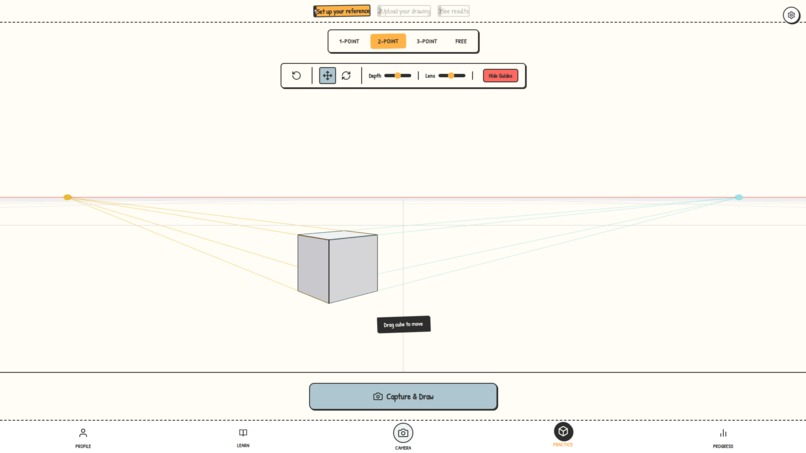
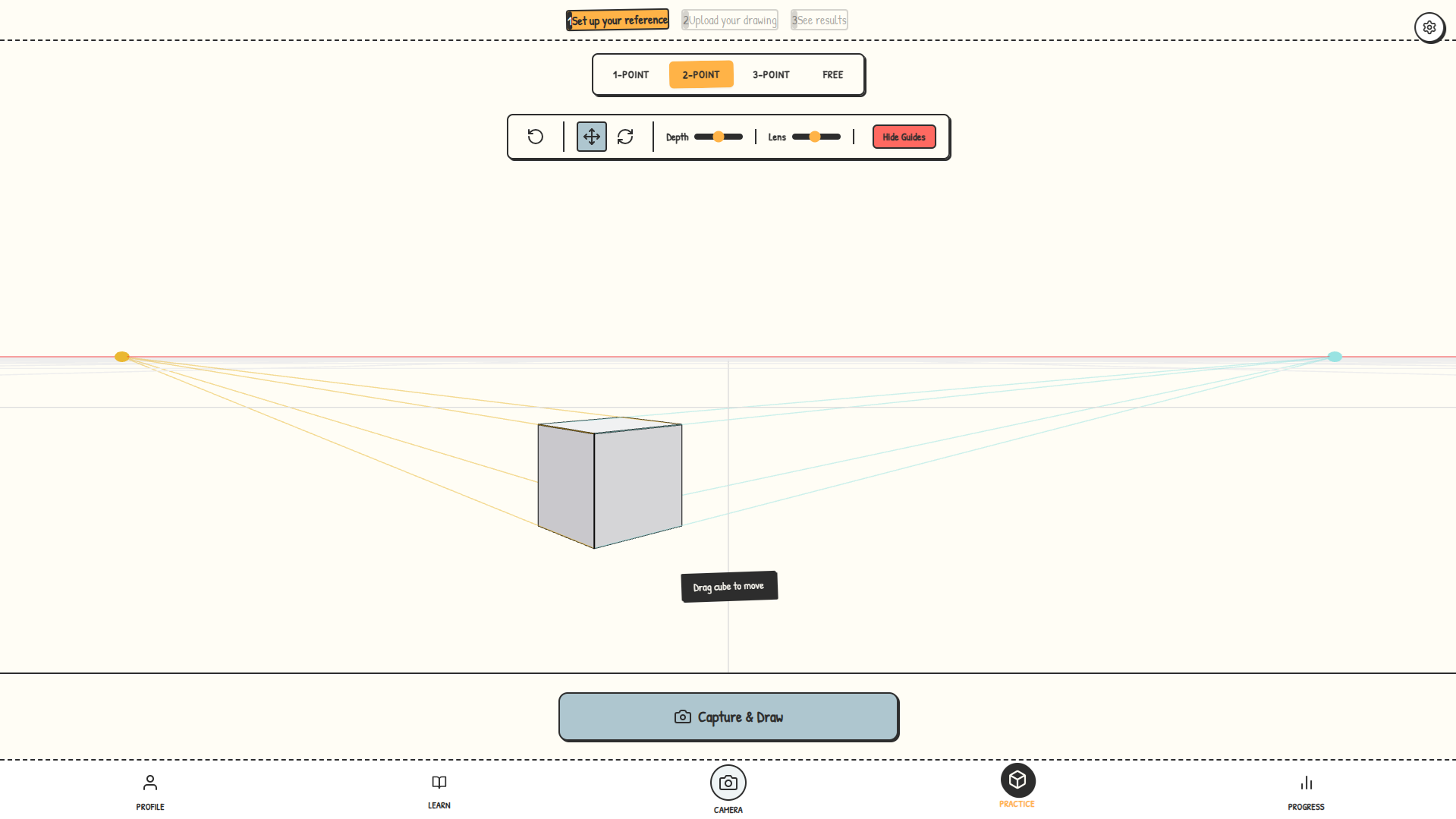
- The Sandbox: Users manipulate a real-time 3D workspace to visualize 1, 2, and 3-point perspective.
- The Challenge: Users draw their own version of the 3D scene on paper or digital canvas.
- The Critique: Using Gemini Vision, the app analyzes a photo of the user's drawing, compares it against the 3D wireframe, and provides an instant grade and constructive feedback.
- The Habit: A gamified leveling system with XP, streaks, and a personal gallery keeps artists motivated to practice daily.
How we built it
- Development Platform: Built entirely within Google Antigravity, leveraging its agentic development workflows to orchestrate complex tasks across the editor and browser.
- Frontend & 3D: Developed with React/Next.js and Three.js to create the interactive 3D workspace, allowing for real-time manipulation of geometry and vanishing points.
- AI Integration: Integrated Google Gemini for high-accuracy visual analysis. We utilized Antigravity's agent-first environment to streamline the integration of Gemini Vision, ensuring the AI could accurately interpret 3D metadata alongside user uploads.
Challenges we ran into
- Aligning the "Real" and "Virtual": Teaching the AI to accurately compare a hand-drawn 2D image to a perfect mathematical 3D model.
Accomplishments that we're proud of
- The Wireframe Overlay: Developing a system where the AI can visually point out exactly where a user’s lines went "off-grid" by overlaying the 3D wireframe onto their uploaded sketch.
- Agentic Efficiency: Successfully using the Antigravity IDE to reduce context switching, allowing us to build the full-stack application and AI critique zone.
What we learned
- AI as a Partner, Not a Replacer: We learned that AI is most effective in art education when it provides specific, technical feedback rather than just subjective praise.
- The Power of Agentic Workflows: Developing in an agent-first era with Google Antigravity taught us how to delegate repetitive verification tests to AI agents, letting us focus on the creative UX.
What's next for Art Tutor Fundamentals
- Complex Geometry: Adding primitives like cylinders and spheres for more advanced perspective training.
- Anatomy Module: Using the same 3D-to-AI feedback loop to teach human proportions.
Built With
- gemini-3-flash
- github
- google-antigravity
- next.js
- react
- three.js
- typescript

Log in or sign up for Devpost to join the conversation.