
Generative art refers to art that in whole or in part has been created with the use of an autonomous system. An autonomous system in this context is generally one that is non-human and can independently determine features of an artwork that would otherwise require decisions made directly by the artist. In some cases the human creator may claim that the generative system represents their own artistic idea, and in others that the system takes on the role of the creator.
"Generative art" often refers to algorithmic art (algorithmically determined computer generated artwork) and synthetic media (general term for any algorithmically-generated media), but artists can also make it using systems of chemistry, biology, mechanics and robotics, smart materials, manual randomization, mathematics, data mapping, symmetry, tiling, and more.
Types
Music Johann Philipp Kirnberger's "Musikalisches Würfelspiel" (Musical Dice Game) 1757 is considered an early example of a generative system based on randomness. Dice were used to select musical sequences from a numbered pool of previously composed phrases. This system provided a balance of order and disorder. The structure was based on an element of order on one hand, and disorder on the other.
The fugues of J.S. Bach could be considered generative, in that there is a strict underlying process that is followed by the composer. Similarly, serialism follows strict procedures which, in some cases, can be set up to generate entire compositions with limited human intervention.
Composers such as John Cage,: 13–15 Farmers Manual, and Brian Eno: 133 have used generative systems in their works.
Visual art The artist Ellsworth Kelly created paintings by using chance operations to assign colors in a grid. He also created works on paper that he then cut into strips or squares and reassembled using chance operations to determine placement.
Artists such as Hans Haacke have explored processes of physical and social systems in artistic context. François Morellet has used both highly ordered and highly disordered systems in his artwork. Some of his paintings feature regular systems of radial or parallel lines to create Moiré Patterns. In other works he has used chance operations to determine the coloration of grids. Sol LeWitt created generative art in the form of systems expressed in natural language and systems of geometric permutation. Harold Cohen's AARON system is a longstanding project combining software artificial intelligence with robotic painting devices to create physical artifacts. Steina and Woody Vasulka are video art pioneers who used analog video feedback to create generative art. Video feedback is now cited as an example of deterministic chaos, and the early explorations by the Vasulkas anticipated contemporary science by many years. Software systems exploiting evolutionary computing to create visual form include those created by Scott Draves and Karl Sims. The digital artist Joseph Nechvatal has exploited models of viral contagion. Autopoiesis by Ken Rinaldo includes fifteen musical and robotic sculptures that interact with the public and modify their behaviors based on both the presence of the participants and each other.: 144–145 Jean-Pierre Hebert and Roman Verostko are founding members of the Algorists, a group of artists who create their own algorithms to create art. A. Michael Noll, of Bell Telephone Laboratories, Incorporated, programmed computer art using mathematical equations and programmed randomness, starting in 1962. The French artist Jean-Max Albert, beside environmental sculptures like Iapetus, and O=C=O, developed a project dedicated to the vegetation itself, in terms of biological activity. The Calmoduline Monument project is based on the property of a protein, calmodulin, to bond selectively to calcium. Exterior physical constraints (wind, rain, etc.) modify the electric potential of the cellular membranes of a plant and consequently the flux of calcium. However, the calcium controls the expression of the calmoduline gene. The plant can thus, when there is a stimulus, modify its « typical » growth pattern. So the basic principle of this monumental sculpture is that to the extent that they could be picked up and transported, these signals could be enlarged, translated into colors and shapes, and show the plant's « decisions » suggesting a level of fundamental biological activity.
Maurizio Bolognini works with generative machines to address conceptual and social concerns. Mark Napier is a pioneer in data mapping, creating works based on the streams of zeros and ones in ethernet traffic, as part of the "Carnivore" project. Martin Wattenberg pushed this theme further, transforming "data sets" as diverse as musical scores and Wikipedia edits into dramatic visual compositions. The Canadian artist San Base developed a "Dynamic Painting" algorithm in 2002. Using computer algorithms as "brush strokes," Base creates sophisticated imagery that evolves over time to produce a fluid, never-repeating artwork.
Since 1996 there have been ambigram generators that auto generate ambigrams.
Italian composer Pietro Grossi, pioneer of computer music since 1986, he extended his experiments to images, (same procedure used in his musical work) precisely to computer graphics, writing programs with specific auto-decisions, and developing the concept of HomeArt, presented for the first time in the exhibition New Atlantis: the continent of electronic music organized by the Venice Biennale in 1986.
Software art For some artists, graphic user interfaces and computer code have become an independent art form in themselves. Adrian Ward created Auto-Illustrator as a commentary on software and generative methods applied to art and design.
Architecture In 1987 Celestino Soddu created the artificial DNA of Italian Medieval towns able to generate endless 3D models of cities identifiable as belonging to the idea.
In 2010, Michael Hansmeyer generated architectural columns in a project called "Subdivided Columns – A New Order (2010)". The piece explored how the simple process of repeated subdivision can create elaborate architectural patterns. Rather than designing any columns directly, Hansmeyer designed a process that produced columns automatically. The process could be run again and again with different parameters to create endless permutations. Endless permutations could be considered a hallmark of generative design.
Literature Further information: Oulipo, The Eureka, Electronic literature, Spam Lit, Informationist poetry, Language game, and Prehistoric Digital Poetry Writers such as Tristan Tzara, Brion Gysin, and William Burroughs used the cut-up technique to introduce randomization to literature as a generative system. Jackson Mac Low produced computer-assisted poetry and used algorithms to generate texts; Philip M. Parker has written software to automatically generate entire books. Jason Nelson used generative methods with speech-to-text software to create a series of digital poems from movies, television and other audio sources.
Live coding Generative systems may be modified while they operate, for example by using interactive programming environments such as SuperCollider, Fluxus and TidalCycles, including patching environments such as Max/MSP, Pure Data and vvvv. This is a standard approach to programming by artists, but may also be used to create live music and/or video by manipulating generative systems on stage, a performance practice that has become known as live coding. As with many examples of software art, because live coding emphasises human authorship rather than autonomy, it may be considered in opposition to generative art.
How to create a generative art
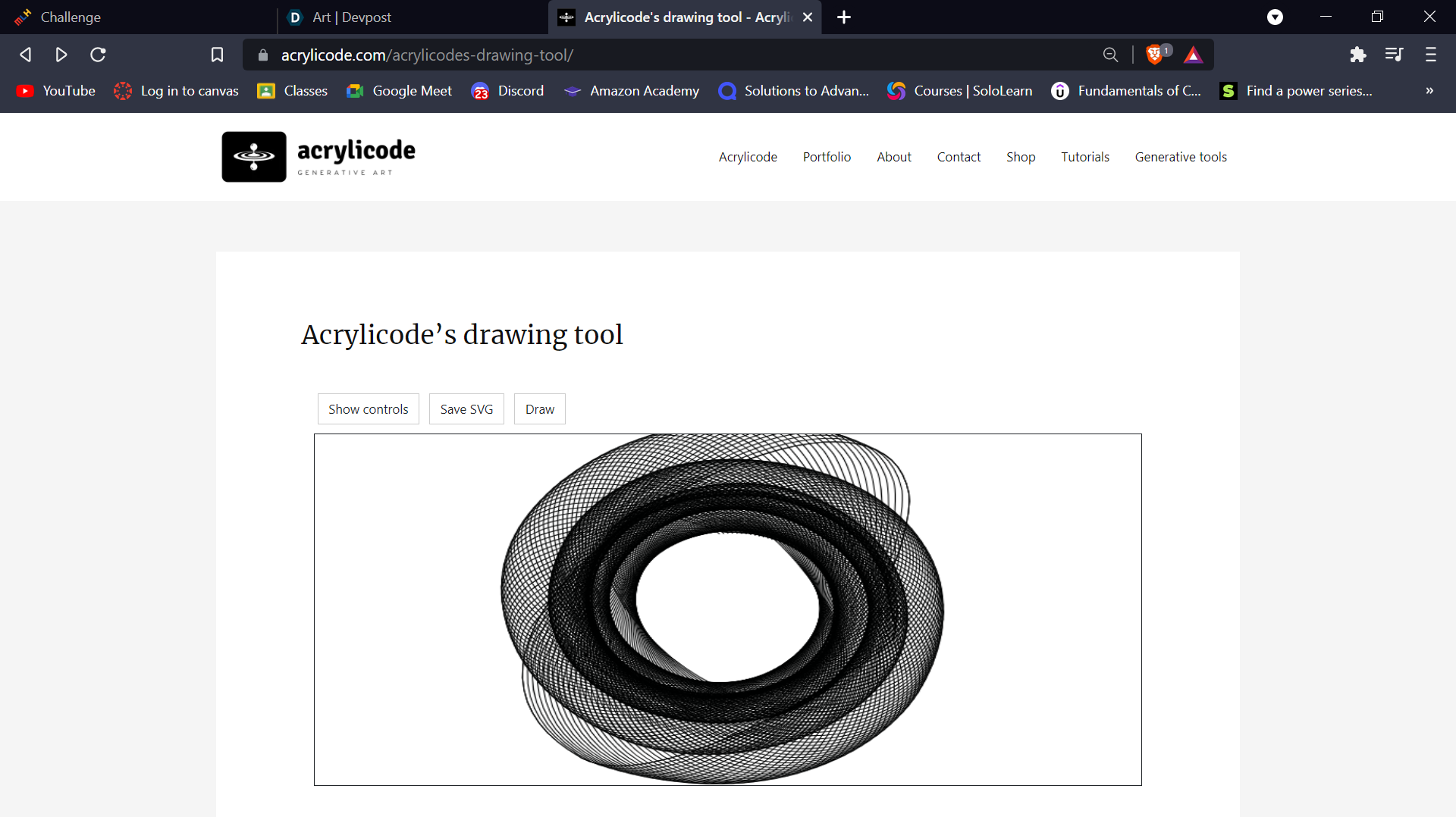
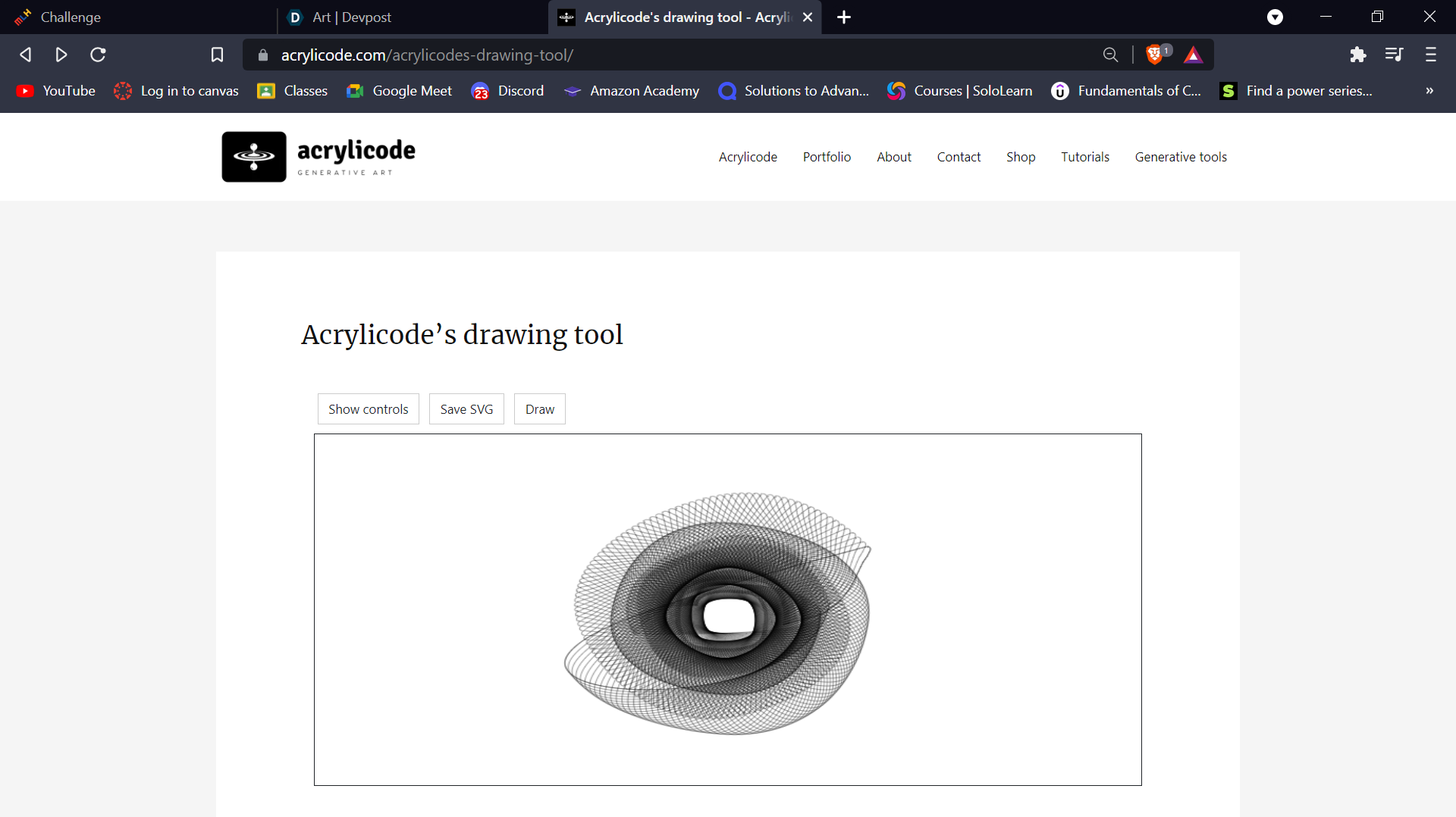
The tool can be found here: https://www.acrylicode.com/acrylicodes-drawing-tool/
Once you go there you should see this.
Now you should be able to draw with your mouse by moving it while pressing inside the drawing area. Start with a simple shape (with very complex shapes the experience may be a little slow). Something like this:
After you draw the shape you see that the “Harmonize” button is enabled and then you can click it to get into the harmonization part.
Once you click the “Harmonize” button you should see a couple of sliders on the Left. The most important slider is the “Number of Shapes”, you should increment this first. After incrementing it, you should see something like this :
After that, experiment with the other sliders to create different variations. If you want to delete everything and start over click on the “Draw” button. This will take you to the first step and then you can start again with your own custom shape. You can experiment with multiple small shapes to get different results. And once you are happy with the result, click on “Save SVG” to save the file. SVGs files are suitable for pen plotting. If you create something and want to publish it on Instagram, please tag us @acrylicode.berlin and share the link to the tool so others can also experiment themselves. I hope you enjoyed this short tutorial and hope you have a lot of fun with the tool.
We learned how to create art.

Log in or sign up for Devpost to join the conversation.