
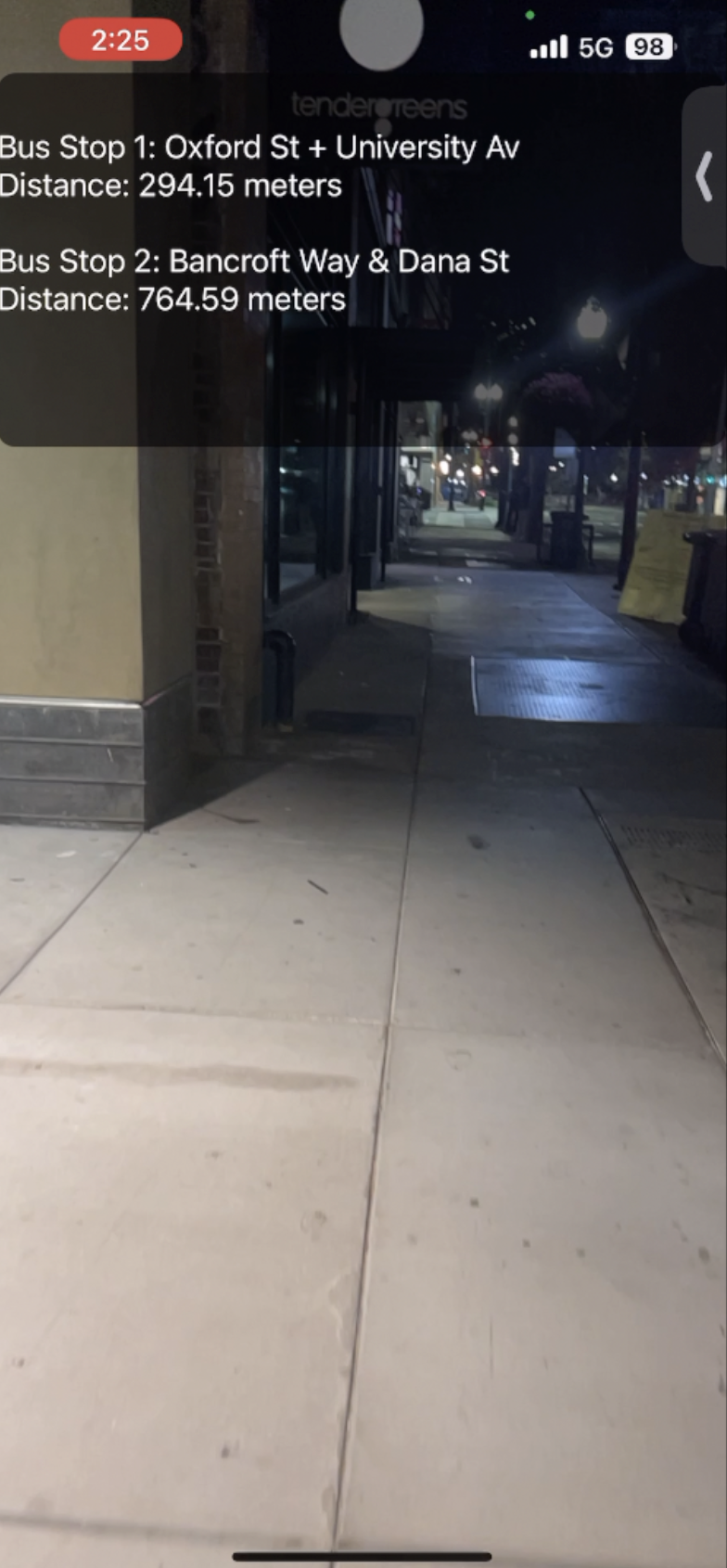
Note we combined real life signs and images of signs, as it was difficult to get footage of bus stop signs in real life due to location and time of day constraints. Only one of us live by the AC transit system.
Inspiration
Living in a world of ever-changing technology, it's clear that the future is about blending our digital experiences with our physical reality. We believe that augmented reality can be used not only for entertainment, but to simplify mundaine tasks. When we think of daily commuting using public transportation, accurate and timely information is key. While existing digital platforms provide this demand to some extent, the concept of smoothly integrating this information into our daily life was a spark for our innovation. We envisioned a solution where bus signs could tell us visually when the next bus is coming or how far away the closest bus stop is. Drawing inspiration from this concept, ARrive was born.
What it does
ARrive is an augmented reality (AR) application that recognizes AC Transit bus signs in real time. Once a sign is detected, the app overlays the STOP ID in pink text directly onto the sign and pertinent information about the bus schedules and their current status in an organized table. It displays in a table with the route number and the departure time. This enables users to simply point their device at a bus sign and instantly receive live updates. As an added feature, the app also guides users to the nearest bus stops by updating the distances constantly.
How we built it
We began with setting up our development environment in Xcode, using Swift for programming. After designing a basic UI, we integrated the AC Transit API to fetch real-time data about bus schedules and statuses. The heart of our application lies in its AR capabilities. We utilized ARKit for image recognition, using the AC Transit logos and bus signs as reference images. If the sign is recognized, the Stop ID is recognized through text recognition and our app fetches data from the API and overlays the information in AR, right on the recognized bus sign. Our application also retrieves your current location and the closest bus stops near you in order to constantly calculate your distance from the nearest bus stops. User interaction and feedback mechanisms were then added to enhance the user experience.
Challenges we ran into
One of our main challenges was guaranteeing ARKit's flawless integration with our API calls. It was a difficult task to achieve real-time recognition while also retrieving and showing precise data. Furthermore, dealing with numerous edge cases, such as network problems, identification flaws, or unexpected data, presented its own set of issues.
Accomplishments that we're proud of
Successfully creating an AR experience that recognizes and overlays bus information in real time is an accomplishment we are immensely proud of. The ability to provide users with instant, location-specific data by merely pointing their device at a sign is a leap forward in terms of user experience.
What we learned
This was the first augmented reality application our group has created. Beyond the technical skills of integrating ARKit and managing API responses, we learned the value of user experience. We realized that even the most cutting-edge technology needs to be grounded in a user-centric approach. The process taught us about the challenges of AR in real-world applications and the importance of robust error handling.
What's next for ARrive
Looking ahead, we envision expanding ARrive to support multiple transit systems. We're also keen on adding more interactive AR elements, such as real-time bus movement tracking or even integrating with ticketing systems for a truly seamless commute experience.
Built With
- arkit
- figma
- google-maps
- storyboard
- swift
- xcode


Log in or sign up for Devpost to join the conversation.