-
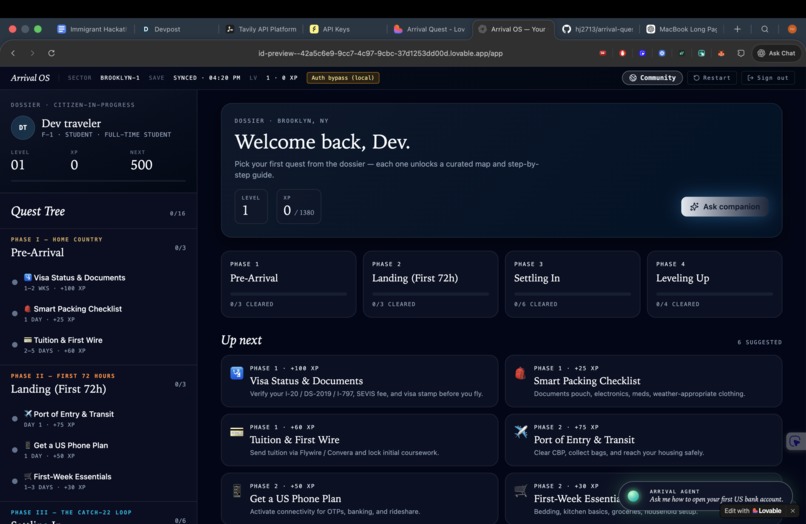
Quest Page
-
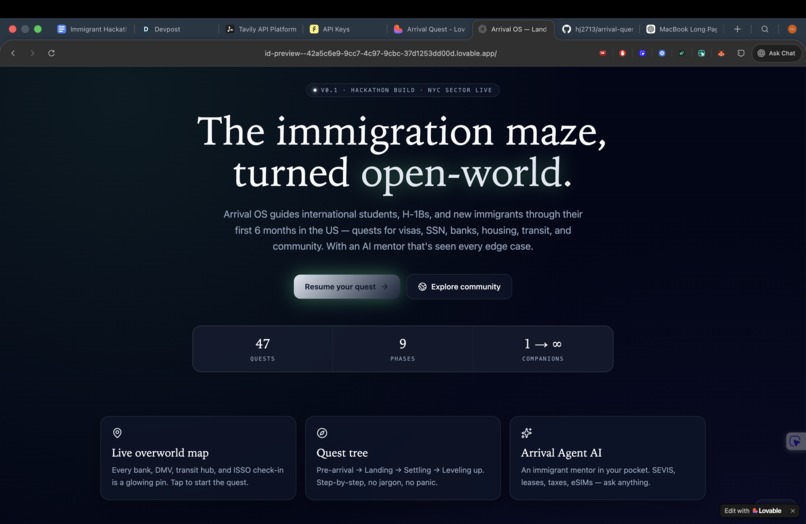
Home Page
-
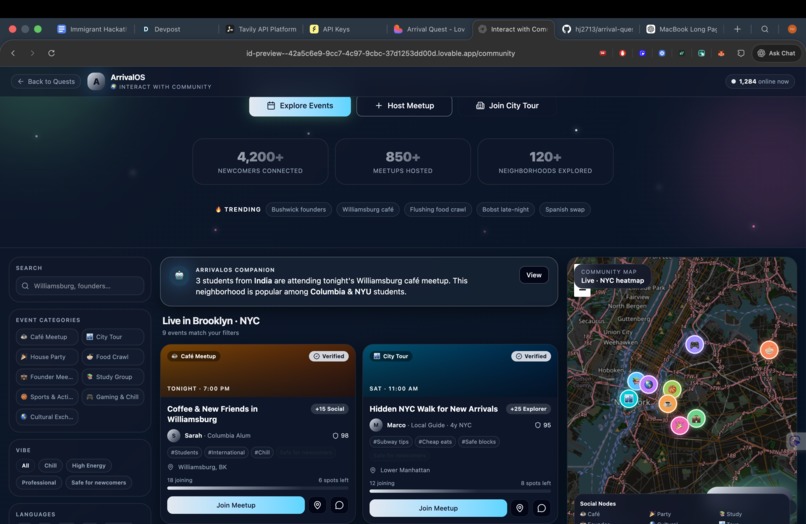
Community Engagement Page
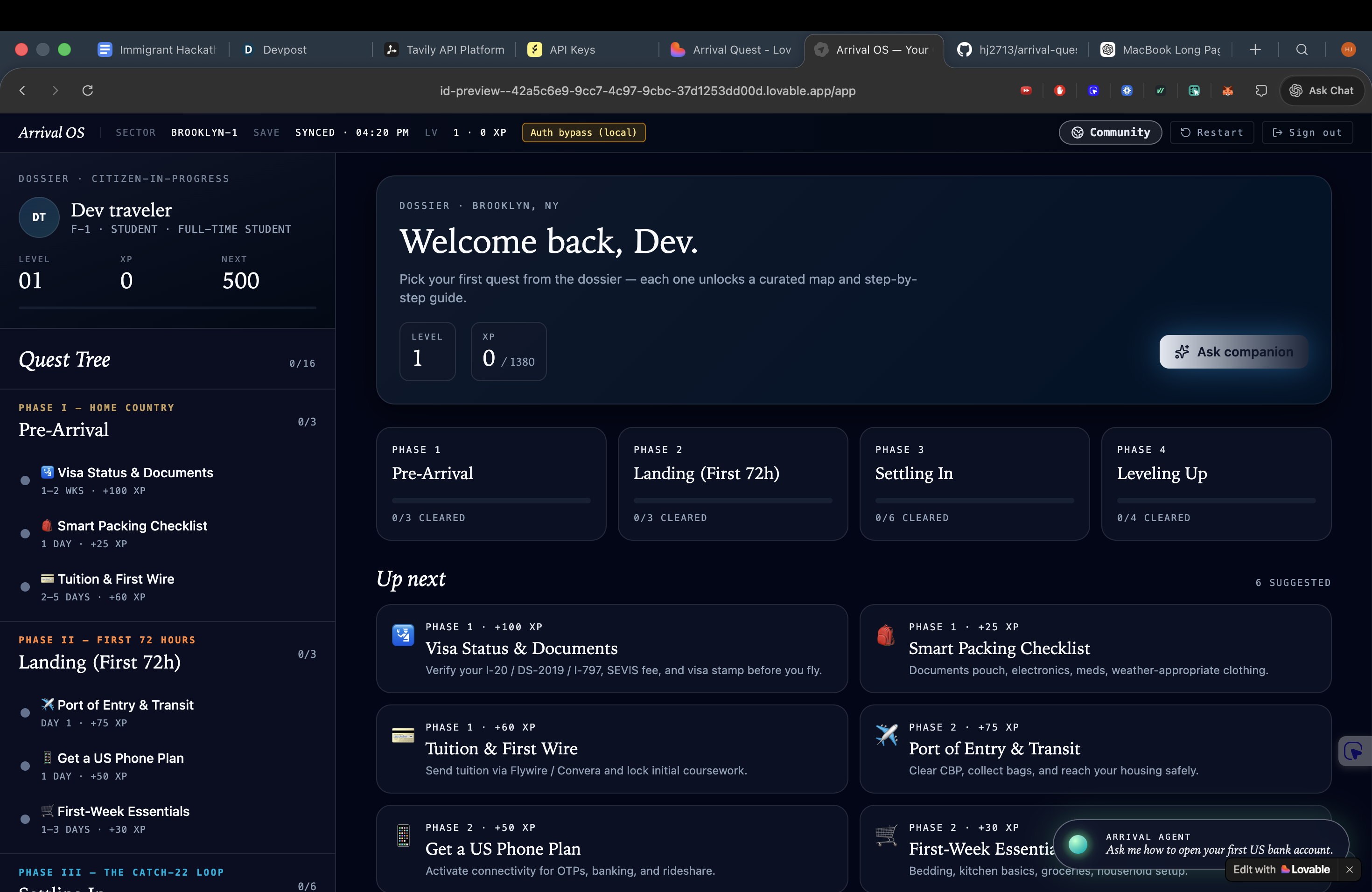
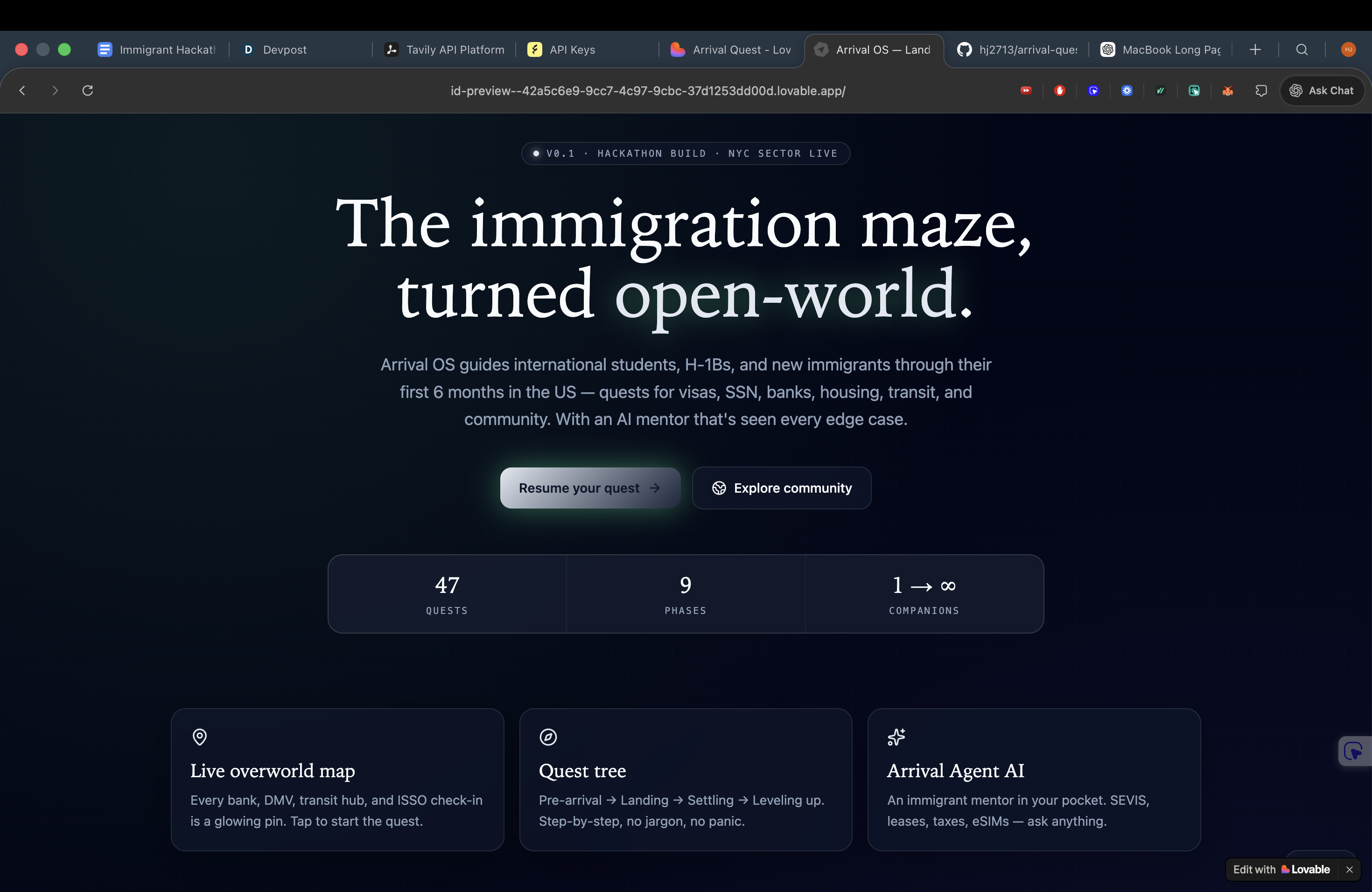
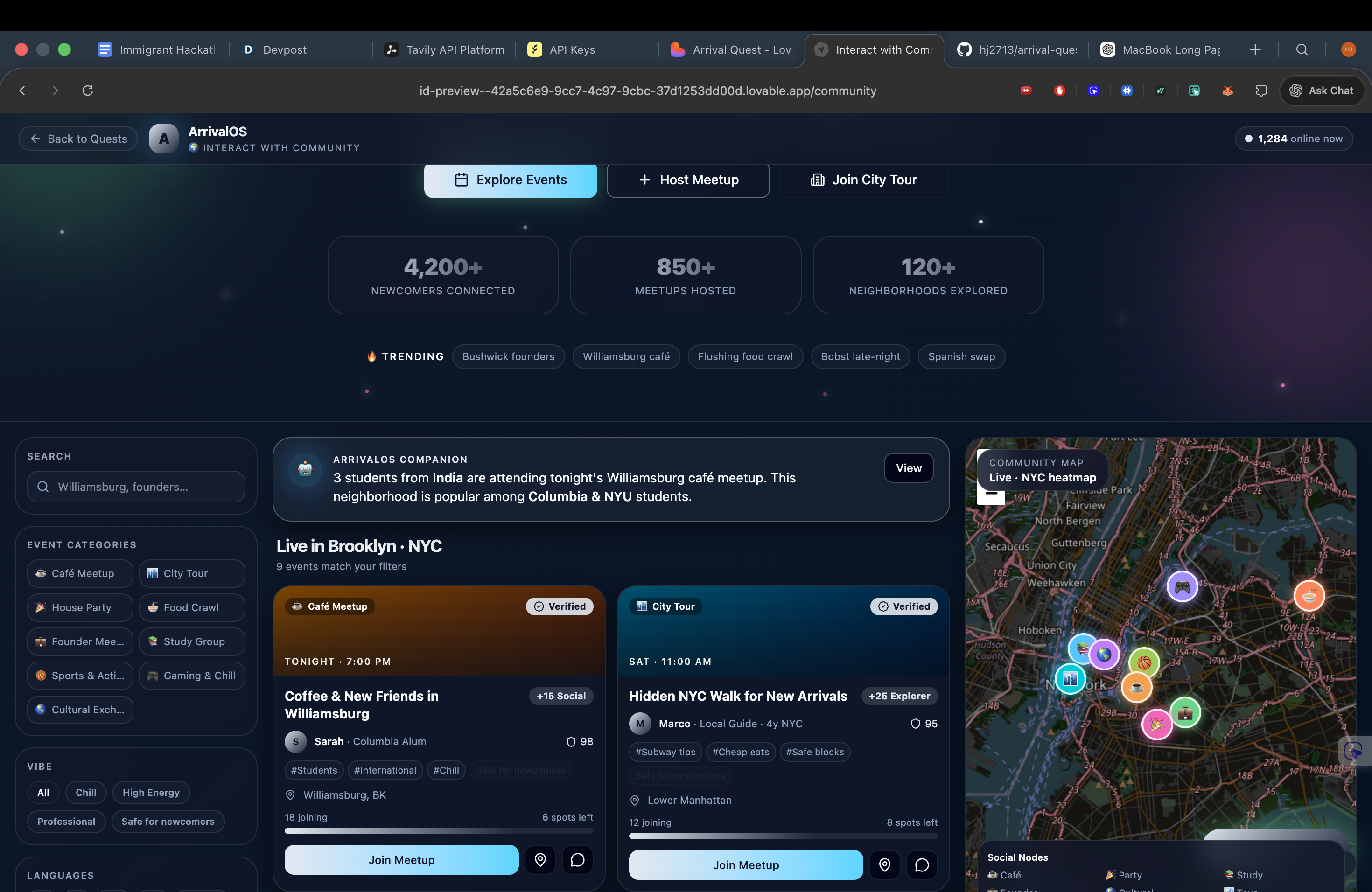
Arrival Quest
GitHub Repository
https://github.com/hj2713/arrival-quest
Inspiration
Moving to a new country feels like entering an open-world game without a tutorial.
Every immigrant or international student faces the same chaotic first weeks:
- immigration paperwork
- airport confusion
- finding housing
- opening bank accounts
- getting a SIM card
- understanding transportation
- building a social circle
- adapting to a completely new system
Most existing solutions are fragmented:
- random PDFs
- WhatsApp groups
- Reddit threads
- expensive consultants
- outdated university portals
We wanted to reimagine onboarding entirely.
Instead of building another boring checklist app, we built Arrival Quest — an AI-powered immigrant survival system that transforms relocation into a gamified, immersive, and emotionally supportive experience.
The core idea was simple:
“What if moving to a new country felt more like a guided open-world mission than surviving chaos alone?”
What it does
Arrival Quest is an AI-powered onboarding platform for immigrants and international students.
It combines:
- 🗺️ interactive city maps
- 🎮 gamified onboarding quests
- 🤖 AI onboarding companion
- 🌐 live web intelligence
- 👥 community discovery
- 📍 real-time local recommendations
Users progress through onboarding stages like:
- Pre-Arrival
- Landing (First 72 Hours)
- Settling In
- Leveling Up
Each stage contains actionable quests such as:
- immigration & visa setup
- airport navigation
- SIM card activation
- bank account setup
- housing discovery
- SSN onboarding
- credit building
- CPT/OPT guidance
- tax onboarding
The platform also includes:
- live community meetups
- founder events
- café meetups
- city tours
- study groups
- local newcomer communities
At the center is Arrival Agent, an AI companion that acts like:
an immigrant mentor + city guide + onboarding concierge.
The AI can:
- answer newcomer questions
- provide step-by-step guidance
- search the live web
- recommend nearby places
- suggest safer routes
- surface real-time events
- personalize onboarding journeys
How we built it
Frontend
We built the interface using:
- React
- TypeScript
- TailwindCSS
- Framer Motion
- Leaflet maps
The UI was intentionally designed to feel cinematic and immersive rather than corporate.
We wanted:
“Duolingo + GTA mission map + cyberpunk onboarding OS.”
AI System
We integrated:
- Featherless AI
- DeepSeek-V4-Pro
- Tavily Search API
The AI architecture combines:
- static onboarding intelligence
- real-time web retrieval
- contextual user state
- onboarding progress awareness
We implemented:
- streaming AI responses
- contextual prompt injection
- onboarding memory
- real-time search routing
- dynamic recommendation systems
Real-Time Web Intelligence
Static onboarding data becomes outdated quickly.
To solve this, we integrated Tavily as the live intelligence layer so the AI can fetch:
- current events
- transit updates
- nearby services
- local recommendations
- affordable stores
- newcomer events
- dynamic city information
This transformed the assistant from:
“a chatbot”
into:
“a real-time immigrant operating system.”
Challenges we ran into
1. Making onboarding emotional instead of transactional
Most onboarding systems focus only on information.
But immigrants don’t just need instructions.
They need:
- reassurance
- structure
- confidence
- community
- emotional support
Designing that emotional layer was one of the hardest parts.
2. Combining static + live intelligence
Some onboarding information is evergreen. Some changes constantly.
We had to design a hybrid architecture where the AI intelligently decides:
- when static onboarding knowledge is enough
- when live web search is required
3. Preventing AI hallucinations
Immigration-related guidance can be high-risk.
We built safeguards so the system:
- avoids legal guarantees
- emphasizes verification
- prioritizes trusted sources
- focuses on safe recommendations
4. Making maps useful instead of decorative
Most onboarding apps use static dashboards.
We wanted the city itself to feel alive.
So we designed:
- glowing map nodes
- onboarding quests
- community hotspots
- transit intelligence
- local discovery layers
Balancing immersion with usability was a major design challenge.
Accomplishments that we're proud of
- Built a fully immersive onboarding experience instead of a traditional app
- Created a real-time AI onboarding companion for immigrants
- Integrated live web intelligence using Tavily
- Designed a gamified progression system for relocation
- Built a community discovery layer for newcomers
- Created an emotionally supportive UX rather than a bureaucratic flow
- Combined maps, AI, quests, and social onboarding into one unified platform
Most importantly:
We built something that makes people feel less alone during one of the biggest transitions of their lives.
What we learned
We learned that immigrant onboarding is not just:
- a logistics problem
- a paperwork problem
- an information problem
It is also:
- an anxiety problem
- a loneliness problem
- a confidence problem
The most powerful technology wasn’t the AI itself.
It was making users feel:
“I can actually figure this out.”
We also learned that AI becomes dramatically more useful when combined with:
- context
- geography
- onboarding state
- emotional awareness
- live internet intelligence
What's next for Arrival Quest
We want Arrival Quest to evolve into a full AI-native relocation operating system.
Next steps include:
- autonomous onboarding workflows
- multilingual onboarding
- voice-based AI companion
- document parsing
- housing integrations
- live transit integrations
- AI-generated relocation plans
- local mentor systems
- verified immigrant communities
- global city expansion
Future versions could proactively help users:
- navigate bureaucracy
- discover opportunities
- build communities
- adapt culturally
- settle into entirely new lives
Our long-term vision is simple:
Wherever someone lands in the world, they should never have to figure life out alone.
Built With
- css
- featherless.ai
- googleadk
- javascript
- tavily
- typescript

Log in or sign up for Devpost to join the conversation.