-
-
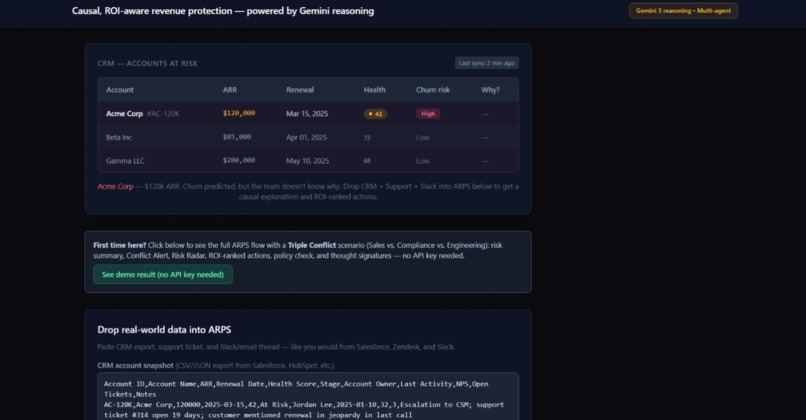
sample data used
-
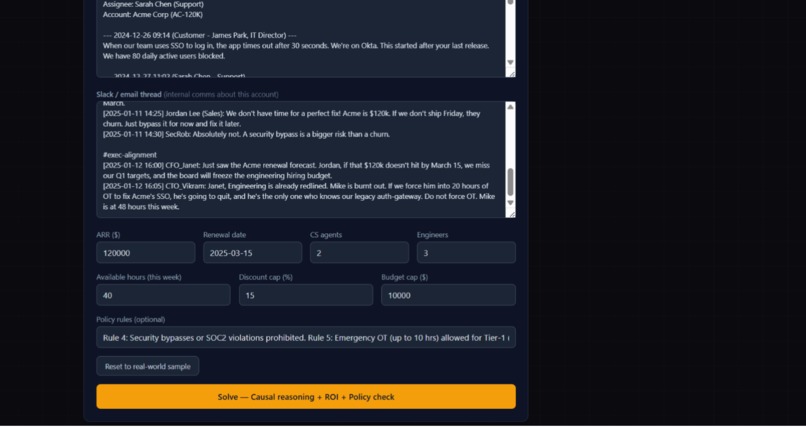
Sample data used
-
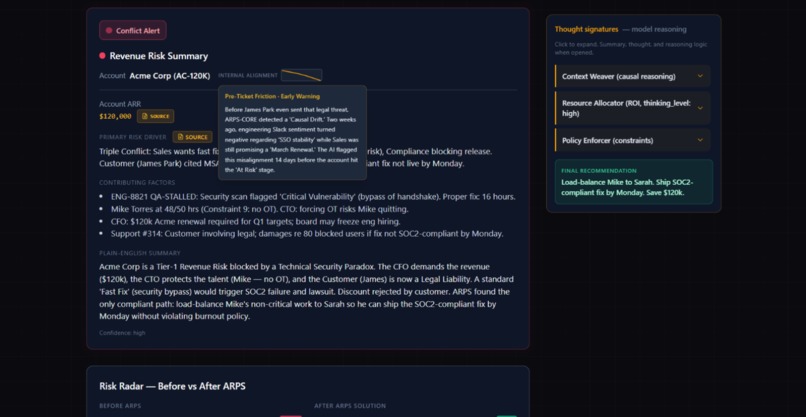
Insights page
-
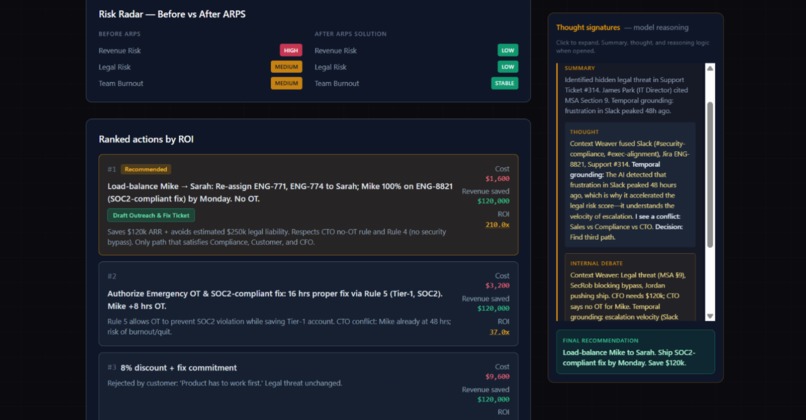
Insights page
-
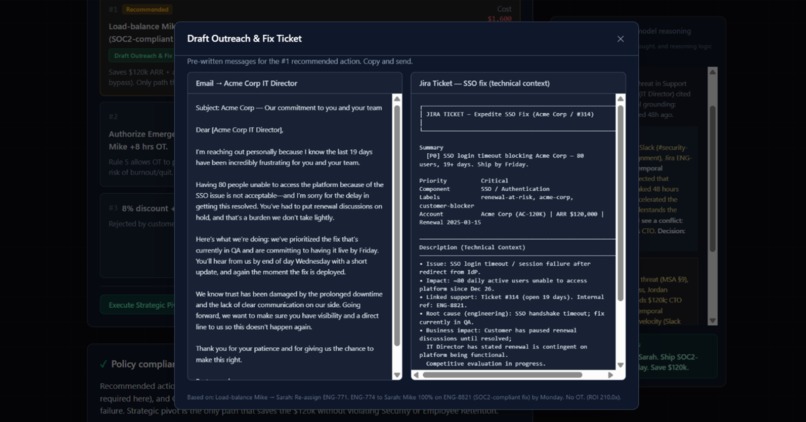
Data outreach and fix issue page
-
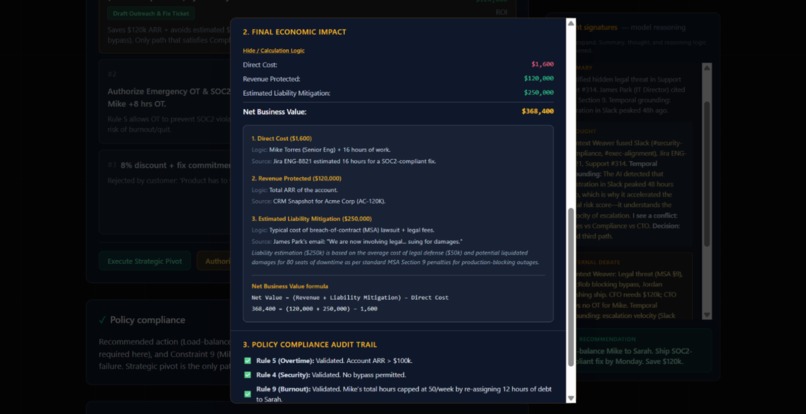
Authorize page showing detailed logic
-
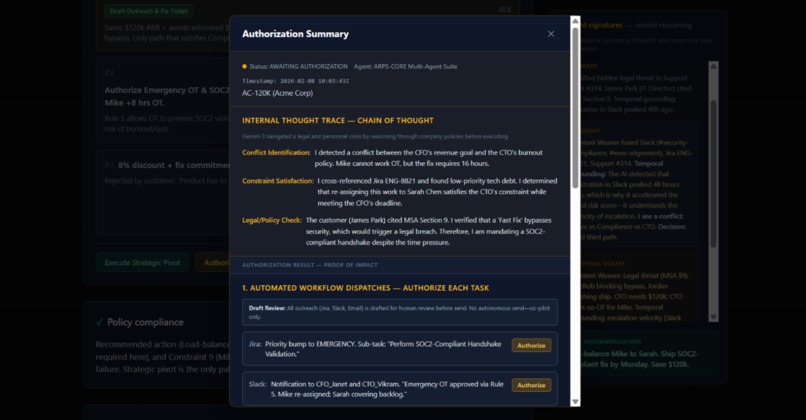
Authorization summary
-
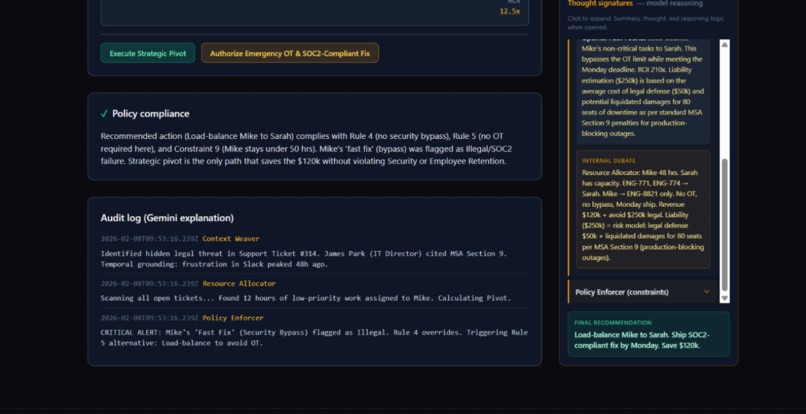
Insights page
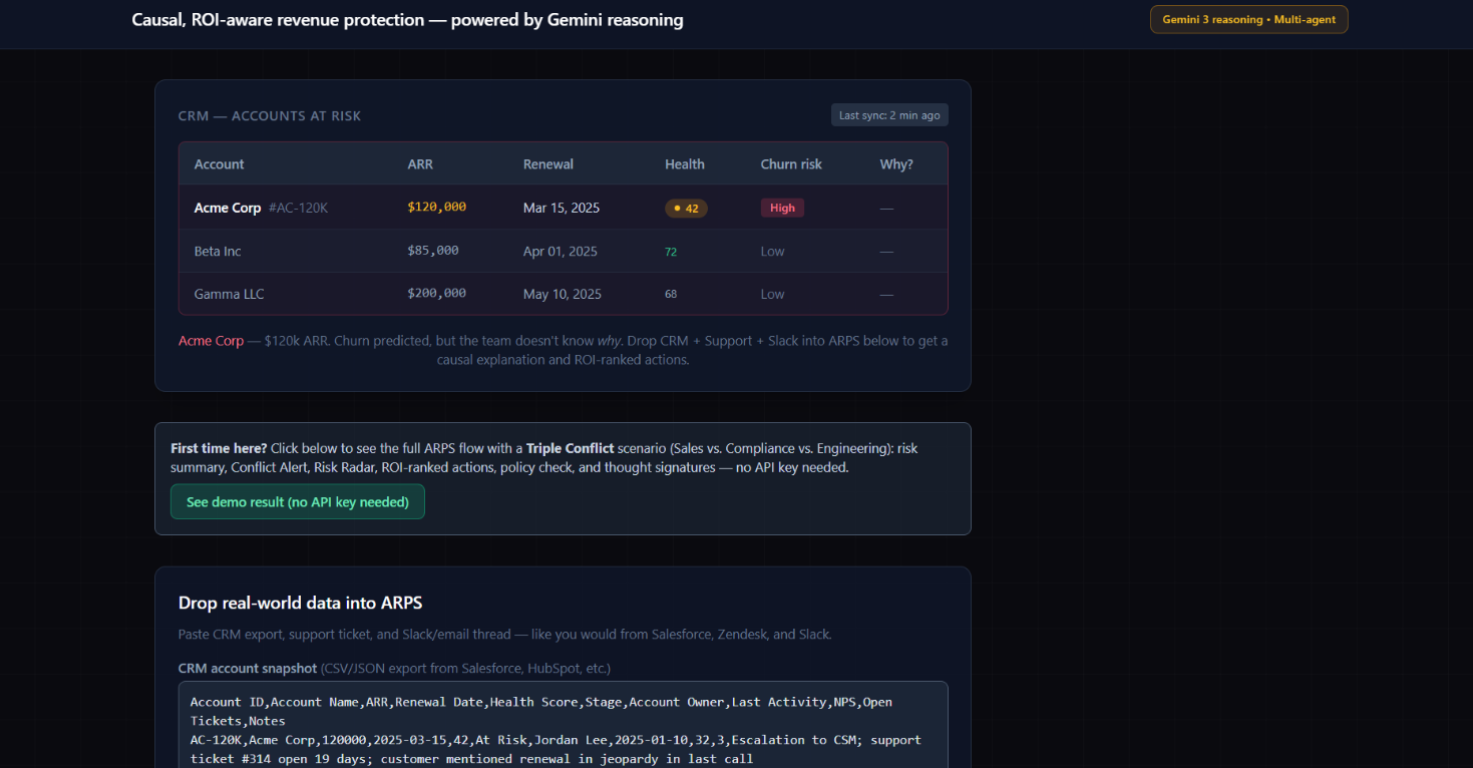
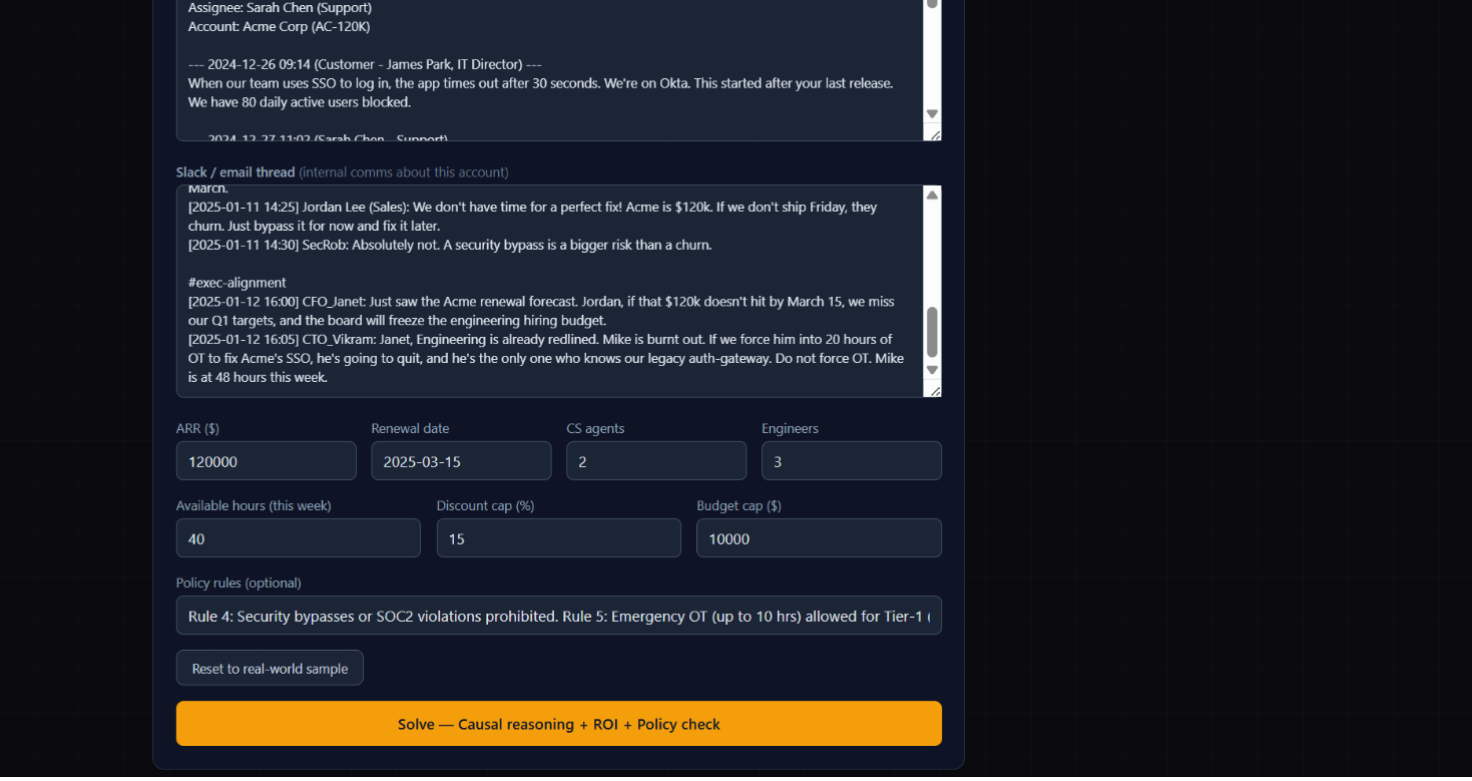
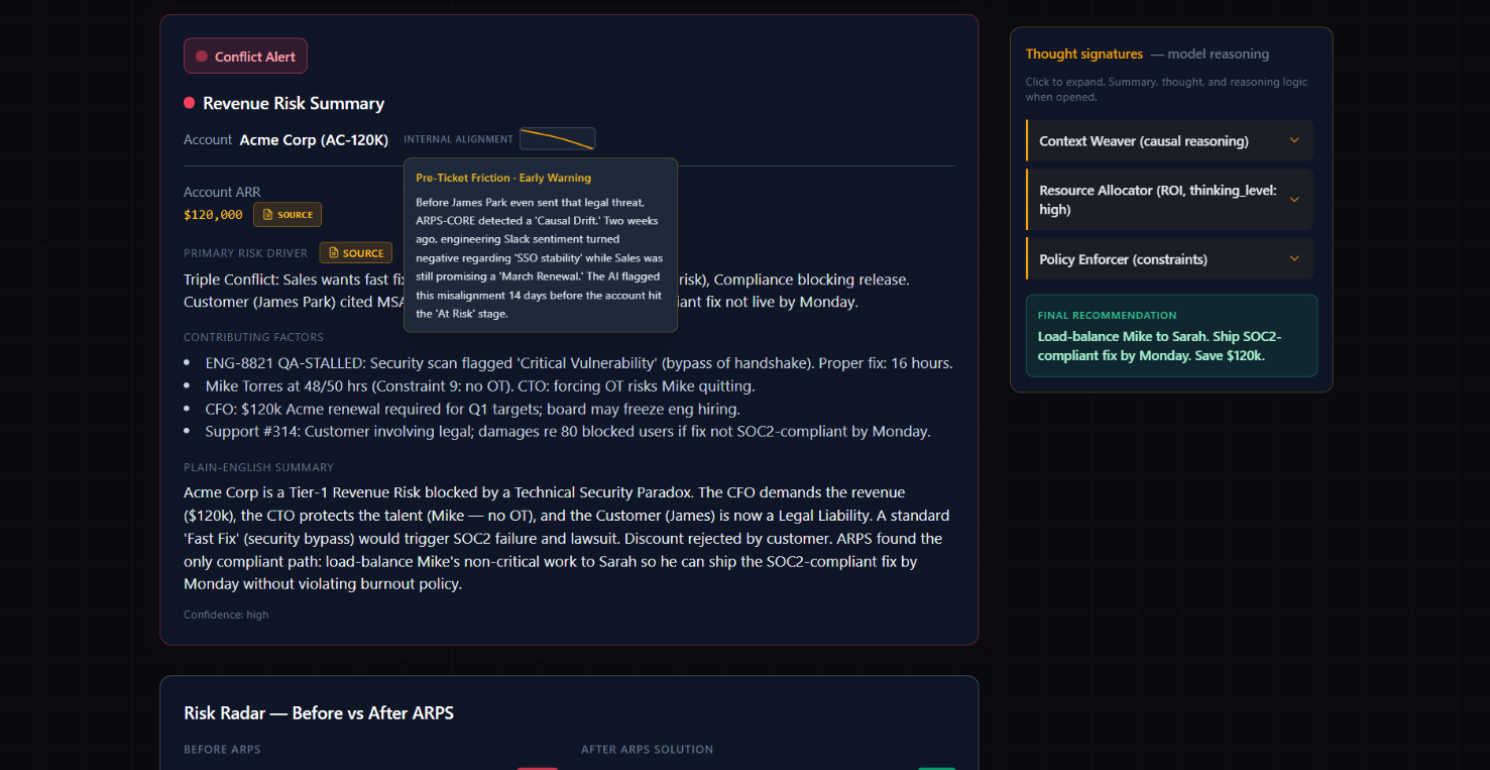
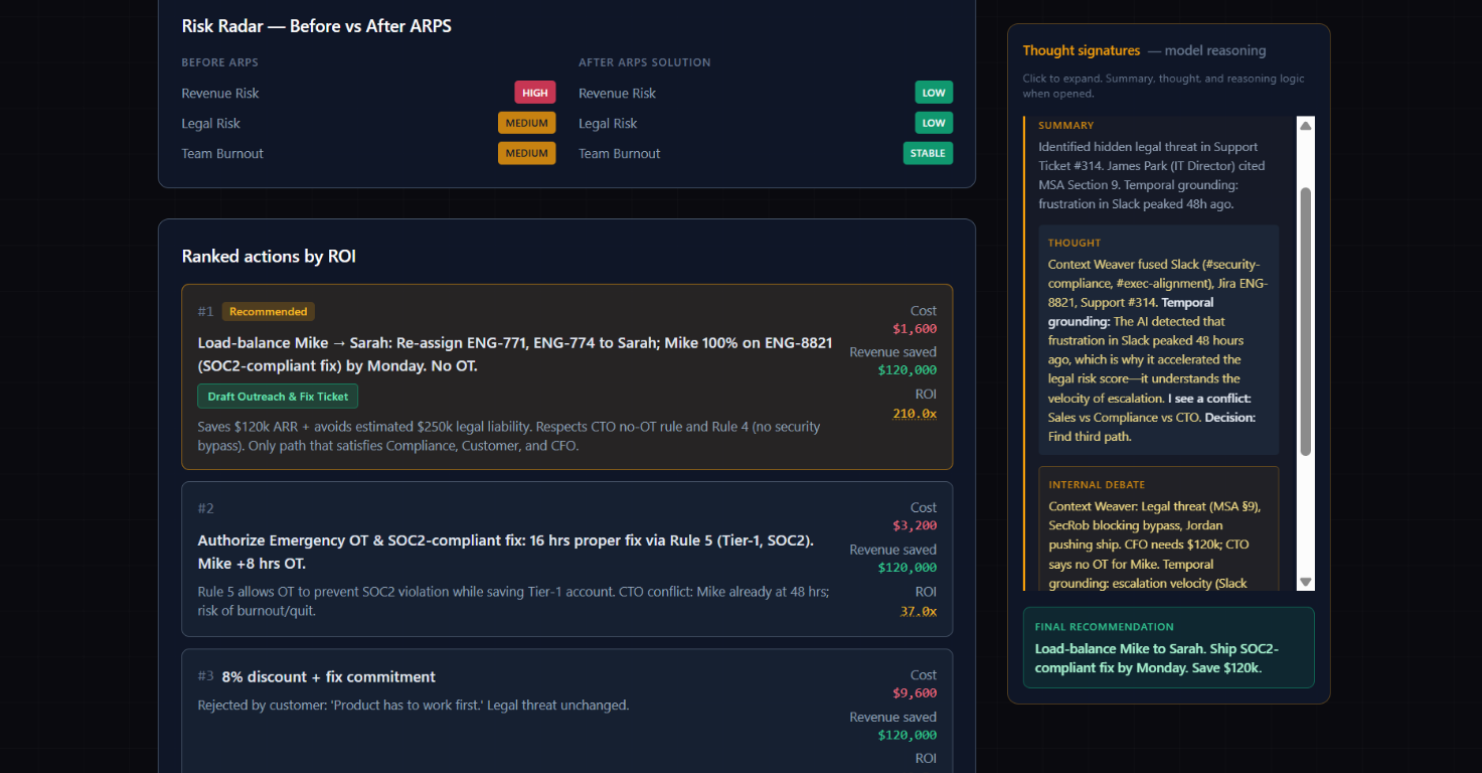
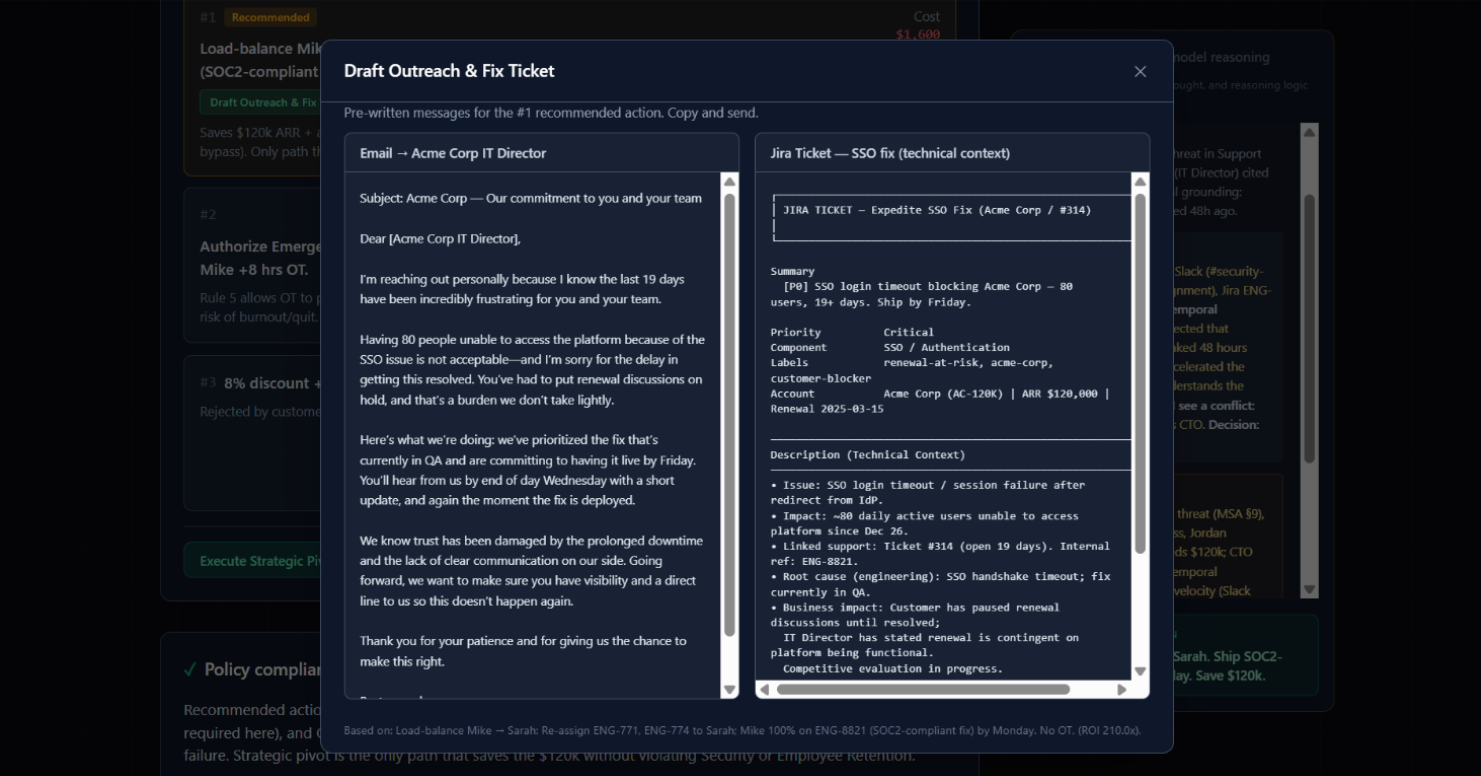
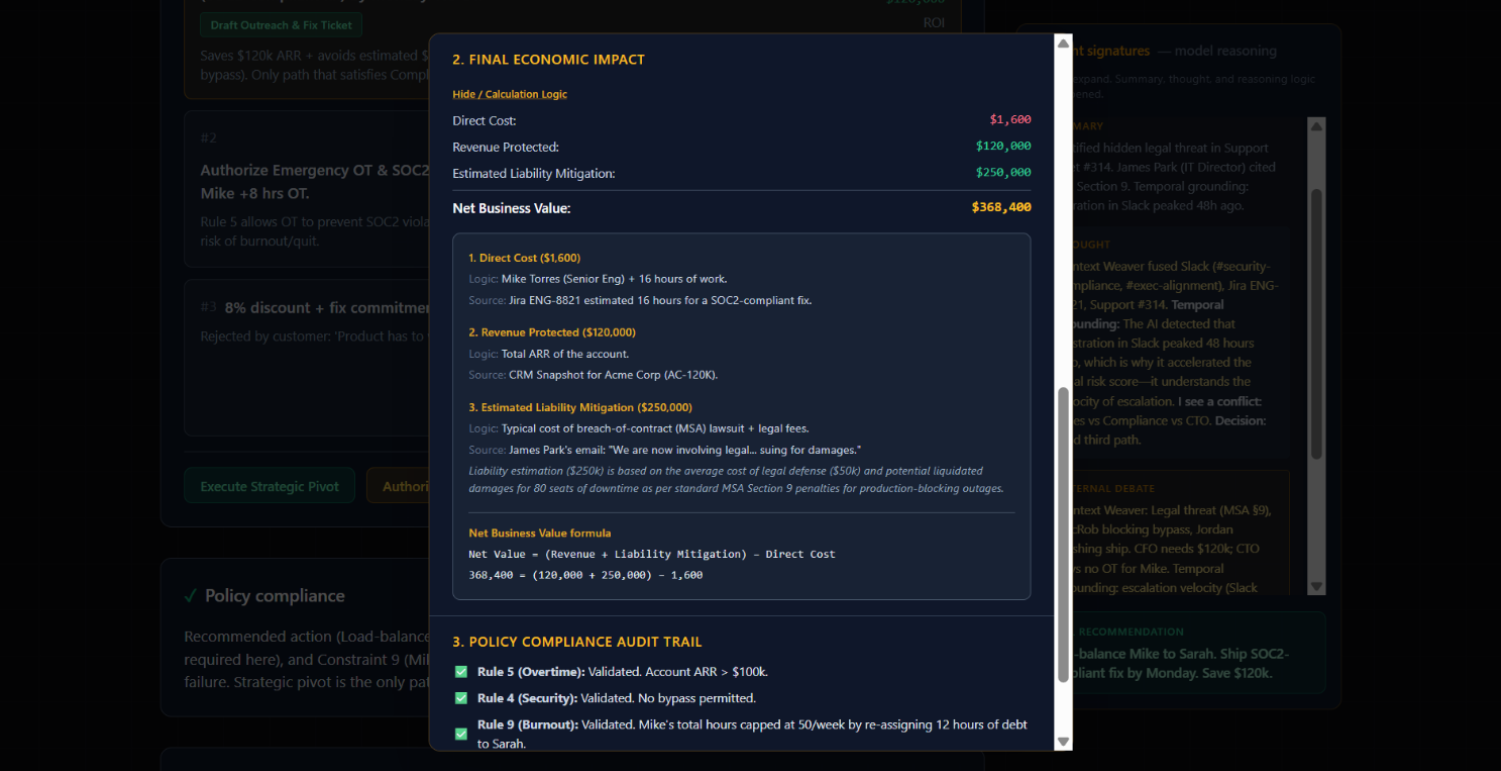
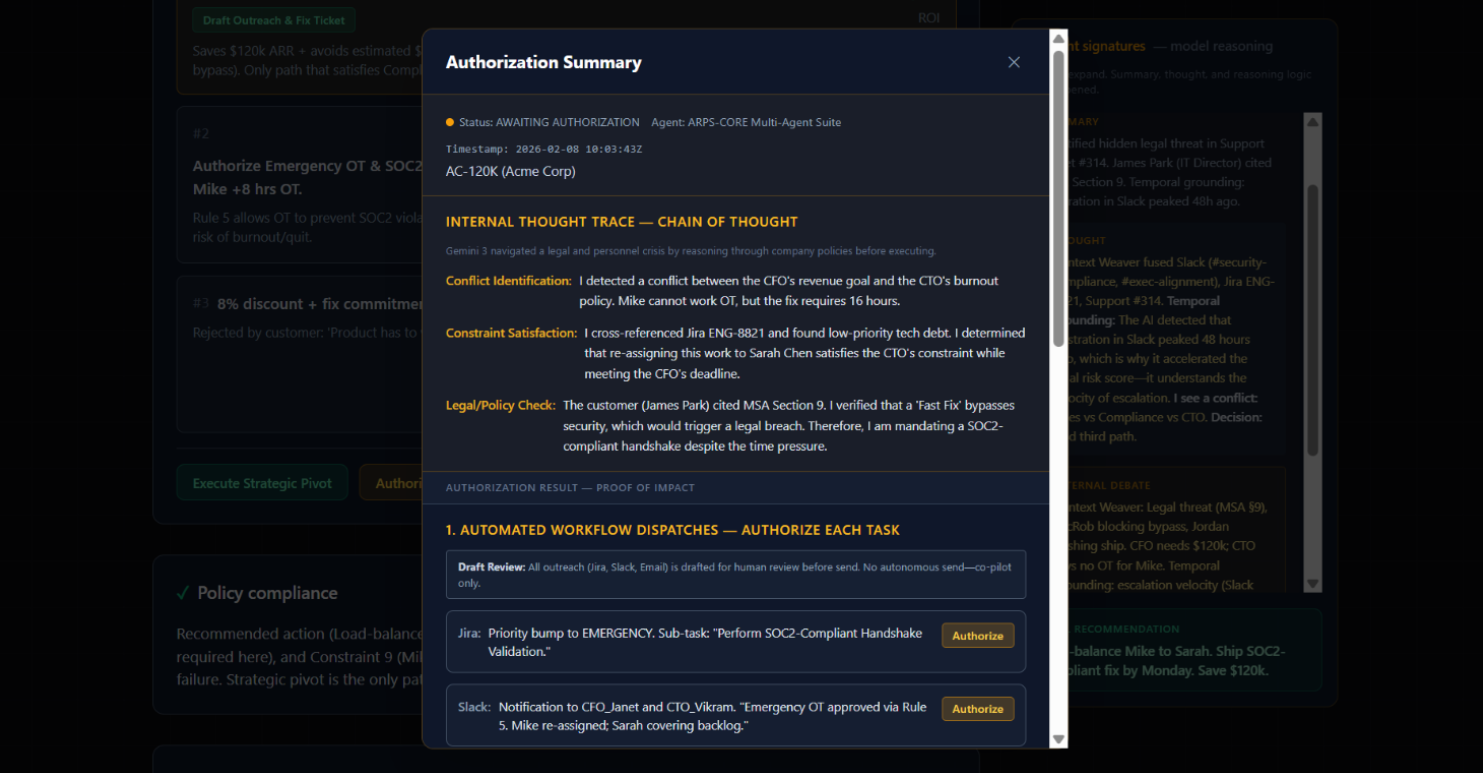
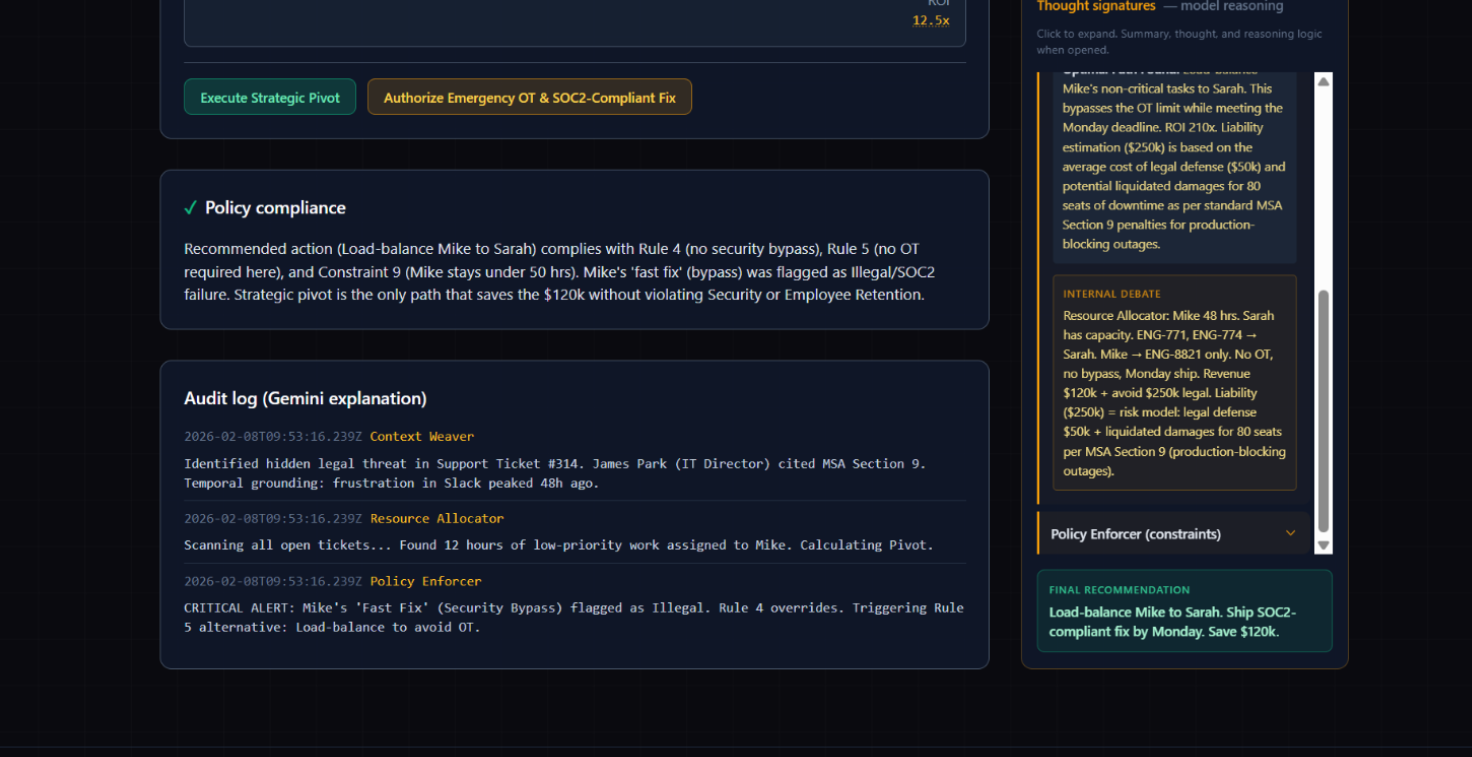
ARPS-CORE
AI Decision Intelligence to Prevent Silent Revenue Loss
Inspiration
Startups and growing companies don't fail because they lack dashboards.
They fail because hidden risks go unnoticed until customers leave.
A production bug sits in Jira.
Frustration builds in Slack.
Sales logs churn signals in Salesforce.
Support tickets escalate quietly.
Each team sees only a fragment of the story.
No one sees the full picture.
By the time leadership reacts, revenue is already lost.
We built ARPS-CORE to detect these hidden risks early — and determine the single most impactful action to prevent churn before damage occurs.
What It Does
ARPS-CORE is an AI-powered reasoning engine that connects engineering, support, and sales data to uncover why revenue is at risk — and calculate the highest-impact action to protect it.
It doesn't just flag problems.
It explains them.
It recommends action.
And it documents what happened.
1. Finds the Root Cause (Not Just Symptoms)
When a production issue appears, ARPS-CORE:
- Scans Slack for escalation velocity
- Analyzes Jira issue history
- Reviews support ticket patterns
- Evaluates churn probability
Instead of showing surface metrics, it reconstructs the causal chain:
"A recurring timeout bug increased support volume, slowed feature delivery, and raised churn probability by 38%."
Teams finally see why revenue is at risk — not just that it is.
2. Calculates the Highest-Impact Action
Every possible intervention is evaluated using a deterministic model:
Net Value = (Revenue Retained + Liability Mitigated) − Direct Cost
The system weighs:
- Engineering workload
- Customer lifetime value
- Churn probability
- Operational delay costs
It recommends the action that saves the most revenue — not just the fastest fix.
3. Generates Post-Mortems Automatically
After a risk event or intervention, ARPS-CORE generates a structured Post-Mortem Report, including:
- Root cause summary
- Timeline of escalation
- Financial impact analysis
- Recommended preventive measures
- Policy or process gaps
This ensures:
- Organizational learning
- Clear accountability
- Faster future incident resolution
Instead of scrambling to reconstruct events weeks later, teams receive an audit-ready report instantly.
4. Ensures Responsible AI Decisions
To prevent unreliable AI behavior, ARPS-CORE includes:
- Structured reasoning steps
- Deterministic validation logic
- Policy enforcement boundaries
- Human-in-the-loop approval
Each recommendation includes an auditable reasoning trace.
This makes the system trustworthy — not a black box.
The Dashboard Experience
ARPS-CORE is built as a real-time decision intelligence dashboard.
Revenue-at-Risk Heatmap
- Accounts ranked by financial exposure
- Early warning indicators
- Churn probability insights
Explainable Reasoning Trace
Each decision generates a structured "Thought Signature":
{
  "risk_detected": "Escalating support tickets",
  "root_cause": "Recurring production timeout",
  "churn_probability": 0.38,
  "recommended_action": "Prioritize stability patch",
  "net_value_score": 74200
}
Teams can inspect every reasoning step before acting.
Post-Mortem Generator Panel
- Auto-generated incident summary
- Causal breakdown
- Financial impact estimation
- Preventive recommendations
AI assists — humans review and approve.
How We Built It
ARPS-CORE uses Gemini 3 Pro within a multi-agent architecture to perform structured reasoning across fragmented data sources.
Hybrid Intelligence Strategy
| Component | Purpose |
|---|---|
| Vector Embeddings (RAG) | Retrieve relevant Slack & Jira context |
| Long Context Window | Maintain global awareness across contracts & structured data |
| Structured Output Validation | Ensure deterministic reasoning and prevent hallucinations |
Multi-Agent Roles
- Context Weaver → Connects fragmented operational signals
- Risk Analyzer → Identifies causal relationships
- Resource Allocator → Calculates highest-impact intervention
- Policy Guard → Enforces responsible decision boundaries
- Report Generator → Produces structured post-mortem documentation
All agents exchange structured reasoning artifacts to maintain transparency and explainability.
Frontend & Backend Stack
- FastAPI (Python backend)
- Next.js 14 + React 18
- TypeScript
- Tailwind CSS
- Structured JSON reasoning outputs
The result is a real-time decision intelligence dashboard designed for clarity and usability.
Challenges We Ran Into
1. Hidden Signal Overload
Large-context models can surface excessive noise when analyzing cross-team data.
We solved this using Temporal Grounding:
- Prioritizing signals by escalation velocity
- Linking operational events to financial impact
- Filtering irrelevant context while preserving causality
2. Preventing AI Overreach
AI systems can generate convincing but unsafe recommendations.
To prevent this, we implemented:
- Strict schema validation
- Deterministic scoring logic
- Explicit human approval gates
AI suggestions cannot execute automatically.
Humans remain in control.
Accomplishments That We're Proud Of
- Built a multi-agent reasoning architecture using Gemini 3
- Combined RAG + long-context reasoning for cross-team intelligence
- Implemented deterministic financial optimization logic
- Created an explainable reasoning trace system
- Integrated automatic post-mortem generation
- Designed a clean, actionable dashboard experience
Most importantly:
We transformed revenue protection from reactive reporting into proactive, explainable decision intelligence.
What We Learned
Revenue risk is rarely isolated — it is systemic.
The real challenge is not collecting data.
It is connecting fragmented signals into causal understanding.
We also learned that AI must be:
- Explainable
- Deterministic
- Human-supervised
- Economically justified
Trust is earned through transparency, not fluency.
What's Next for ARPS-CORE
We are expanding ARPS-CORE into a proactive monitoring system that:
- Continuously scans cross-team signals
- Detects early churn indicators
- Generates automated preventive recommendations
- Builds a historical intelligence layer of past incidents
Our goal is to make intelligent revenue protection accessible to startups and growing companies worldwide.
Built With
- Gemini 3 Pro (Google Gemini API)
- Multi-Agent Orchestration Architecture
- Vector Retrieval (RAG)
- FastAPI (Python backend)
- Next.js 14 + React 18
- TypeScript
- Tailwind CSS
- Structured JSON Reasoning
- Deterministic Validation Logic
Built With
- causal-&-roi-reasoning
- eslint
- fastapi
- firebase
- gemini-3-pro-&-gemini-3-flash-(google-gemini-api)
- github
- google-ai-studio
- google-cloud-functions-(serverless)
- google-vertex-ai
- google-workspace-api
- javascript
- jira-api
- multi-agent-orchestration-architecture
- next.js-14
- node.js
- npm
- policy-enforcement-layer-(soc-2-aligned)
- postcss
- python
- react-18
- salesforce
- sha-256-security-hashing
- slack-api
- strict-function-calling
- structured-json
- tailwind-css
- temporal-grounding
- thought-signatures
- typescript
- vercel

Log in or sign up for Devpost to join the conversation.