MOVA — Offline Economic Intelligence for African SMEs
The Problem
A huge amount of African commerce happens through conversations. A customer sends a WhatsApp message, a payment arrives by SMS, a merchant receives a voice note, or someone promises to pay next Friday.
Inside these conversations are orders, payments, debts, balances, and credit relationships — but the financial information is rarely structured.
I wanted to build around that reality. Instead of asking small businesses to change how they communicate or depend on expensive cloud infrastructure, I asked:
What if AI could understand the conversations businesses already use and turn them into financial intelligence — completely offline?
That's the concept behind MOVA.
What MOVA Does
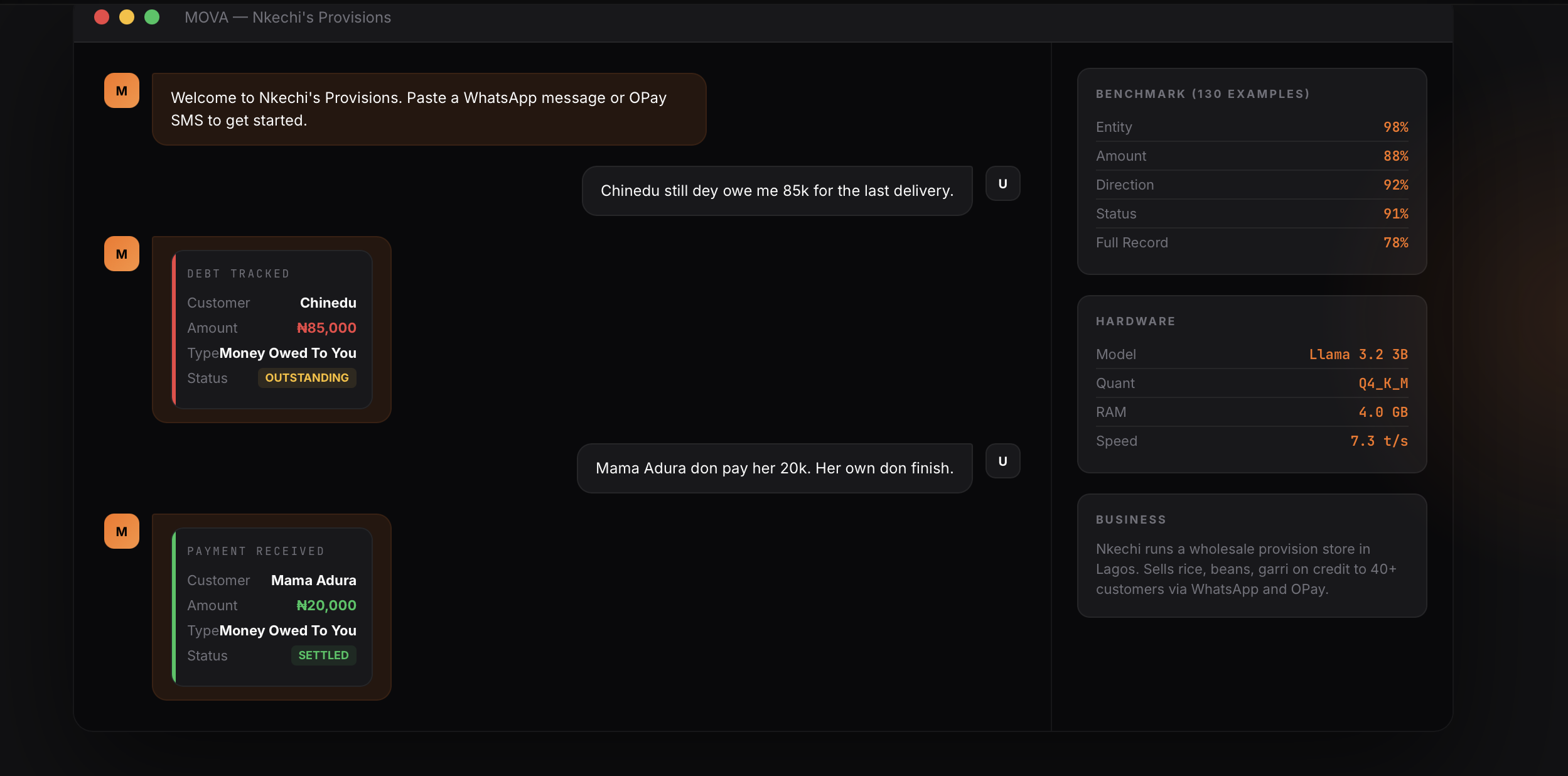
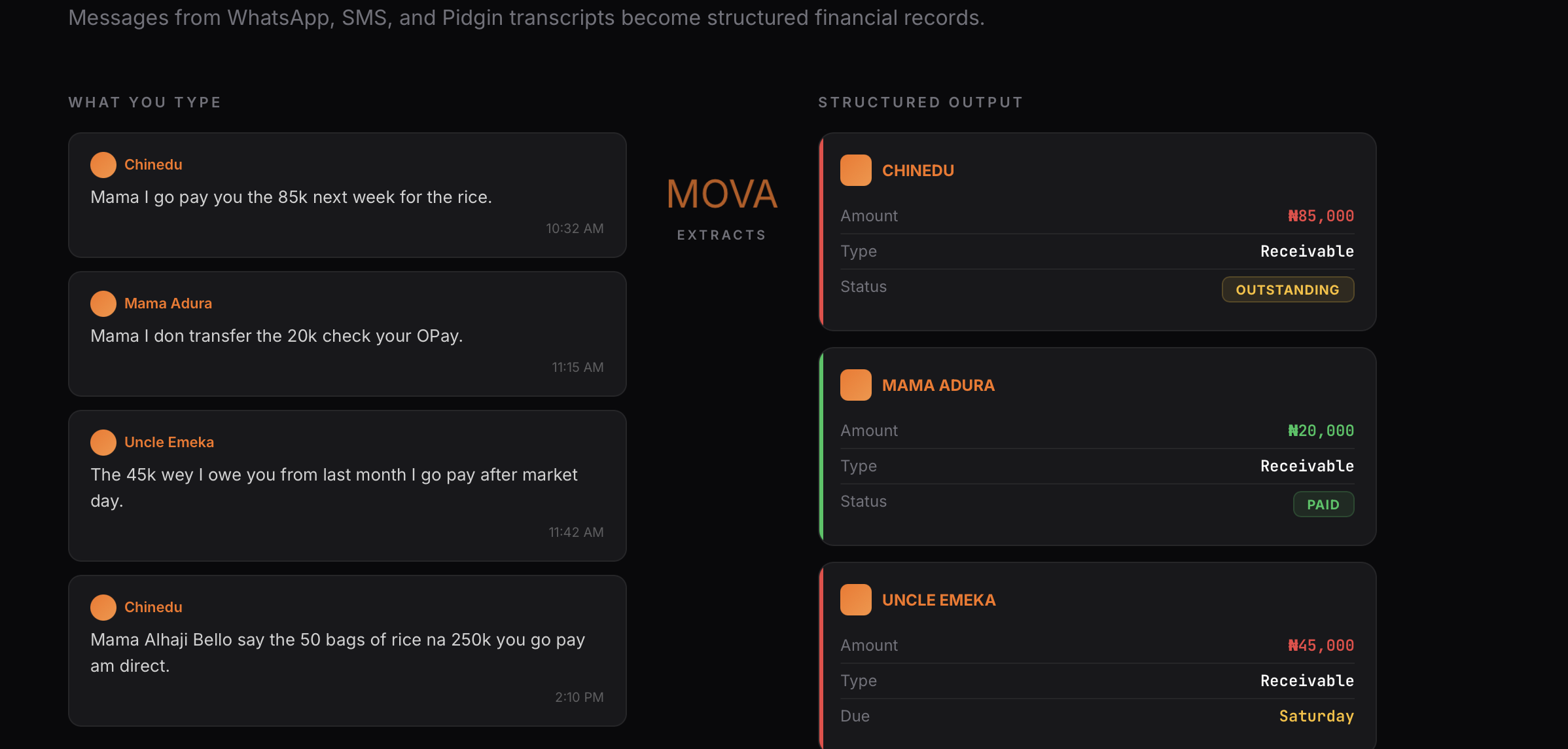
MOVA is an offline financial intelligence layer for African SMEs. It transforms messy WhatsApp-style messages, SMS, and Nigerian Pidgin into structured financial records.
For example:
"Chinedu still dey owe me 85k. He pay 20k yesterday. Make I remind am Friday."
To a human, this is a simple message. To MOVA, it contains a complete financial state:
- Customer: Chinedu
- Original debt: ₦85,000
- Paid: ₦20,000
- Outstanding: ₦65,000
- Direction: Receivable
- Status: Outstanding
- Follow-up: Friday
MOVA turns that unstructured conversation into information a merchant can actually act on.
Why Offline?
Cloud-based AI introduces costs and dependencies that can become barriers for businesses dealing with limited connectivity, expensive data, or unreliable infrastructure.
MOVA runs its language model locally. The core inference pipeline has no cloud API or external inference dependency.
I used a quantized Llama 3.2 3B Instruct model with llama.cpp to build an inference system capable of running within the commodity-hardware constraints of the Africa Deep Tech Challenge.
The objective was not to build the largest possible model. It was to make useful AI work on hardware that is actually accessible.
Building for African Commerce
I deliberately focused MOVA on the language and transaction patterns found in informal commerce. That includes:
- WhatsApp-style business conversations
- SMS transaction notifications
- Nigerian Pidgin
- Nigerian Naira transactions
- Informal credit and debt
- Partial payments
- Receivables and payables
- Fragmented conversational information
- Informal payment commitments
I also built a 130-example Nigerian commerce benchmark to evaluate the capabilities that matter specifically to MOVA's use case.
Nigerian Commerce Benchmark
| Capability | Accuracy |
|---|---|
| Entity extraction | 98% |
| Amount extraction | 88% |
| Debt direction | 92% |
| Status detection | 91% |
| Complete financial record | 78% |
These results showed me something important: a model can perform differently on a narrow, domain-specific task than it does on a general benchmark.
MOVA achieved 72% on ARC-Easy, while performing substantially better on the financial extraction tasks it was specifically designed for.
That changed how I evaluated the system. Instead of treating a general benchmark score as the entire definition of quality, I measured whether the model could actually understand the financial state inside African business conversations.
The Deep-Tech Constraint
The Africa Deep Tech Challenge is built around making useful AI run on commodity laptops, so I treated the hardware constraint as part of the product rather than an afterthought.
MOVA uses:
- Llama 3.2 3B Instruct
- Q4_K_M quantization
- llama.cpp
- Tauri
- React
- Rust
My measured local inference results were:
| Metric | Result |
|---|---|
| Parameters | 3.2B |
| Throughput | 7.32 tokens/sec |
| Peak RAM | ~4.0 GB |
| Thermal throttling | None observed |
The model was verified against the ADTC profiler, including parameter matching and accuracy evaluation.
Why I Used an LLM
Simple rules can identify something like ₦50,000 paid.
But real business conversations are rarely that clean.
A single conversation can contain multiple people, several transactions, partial payments, changing balances, informal language, relative dates, and implied relationships between debtors and creditors.
MOVA needs to reconstruct meaning from context. That is why I used a language model rather than building the entire system around keyword matching and regular expressions.
The Engineering Challenge
The hardest part wasn't getting a language model to generate text. It was finding the balance between:
Accuracy → Memory → Throughput → Thermal efficiency
A larger model could potentially improve general reasoning, but it also increases the computational cost of running locally.
I therefore had to treat model size, quantization, inference runtime, application architecture, and memory usage as one system.
I also learned that optimization is not just about making something faster. It is about deciding what performance actually matters for the user.
For MOVA, correctly identifying who owes whom and how much remains outstanding is more important than producing a sophisticated paragraph.
What I Learned
Building MOVA changed how I think about AI systems.
The strongest solution is not necessarily the model with the most parameters. It is the system that makes the right trade-offs for its environment.
I also learned the importance of evaluating AI against the actual problem being solved.
A general benchmark can tell me something about model capability, but my Nigerian commerce benchmark tells me whether MOVA can perform the job I built it to do.
What's Next
MOVA is designed as a foundation for a broader conversational commerce intelligence layer. The same underlying system could eventually support:
- Merchant order extraction
- Customer credit histories
- Payment reminders
- Inventory signals
- Transaction summaries
- Cash-flow intelligence
- Merchant credit assessment
- Offline-first financial workflows
The larger vision is simple:
“Who owes me money?”
For millions of small businesses, the answer isn't sitting in a spreadsheet. It's buried in WhatsApp chats, SMS alerts, voice notes, and half-remembered promises.
MOVA finds it.
It runs locally, understands Nigerian business language, and turns those scattered transactions into a live picture of what you're owed, what you owe, and what needs to happen next.
Because when your business runs on conversations, your financial records shouldn't disappear inside them.
Built With
- gguf
- llama.cpp
- llama3.2b
- react
- rust
- tauri
- typescript
- vite

Log in or sign up for Devpost to join the conversation.