-
-
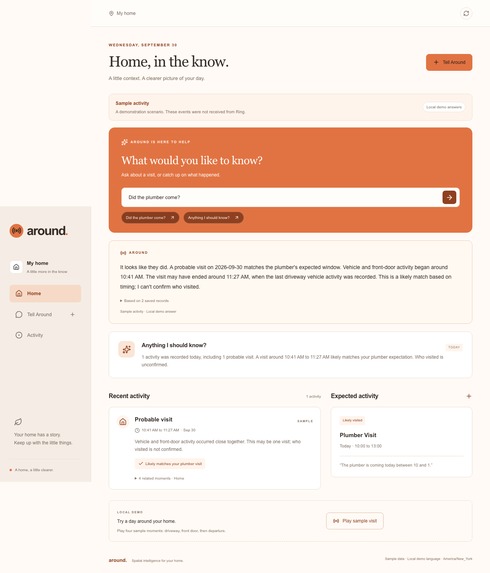
Desktop sample walkthrough: four moments become one probable visit. Local demo answers; these events were not received from Ring.
-
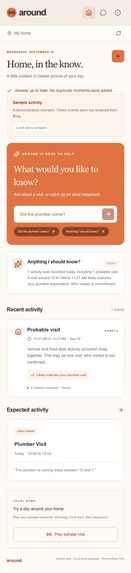
Mobile sample walkthrough: expected visit, grouped activity, and local demo answers. These events were not received from Ring.
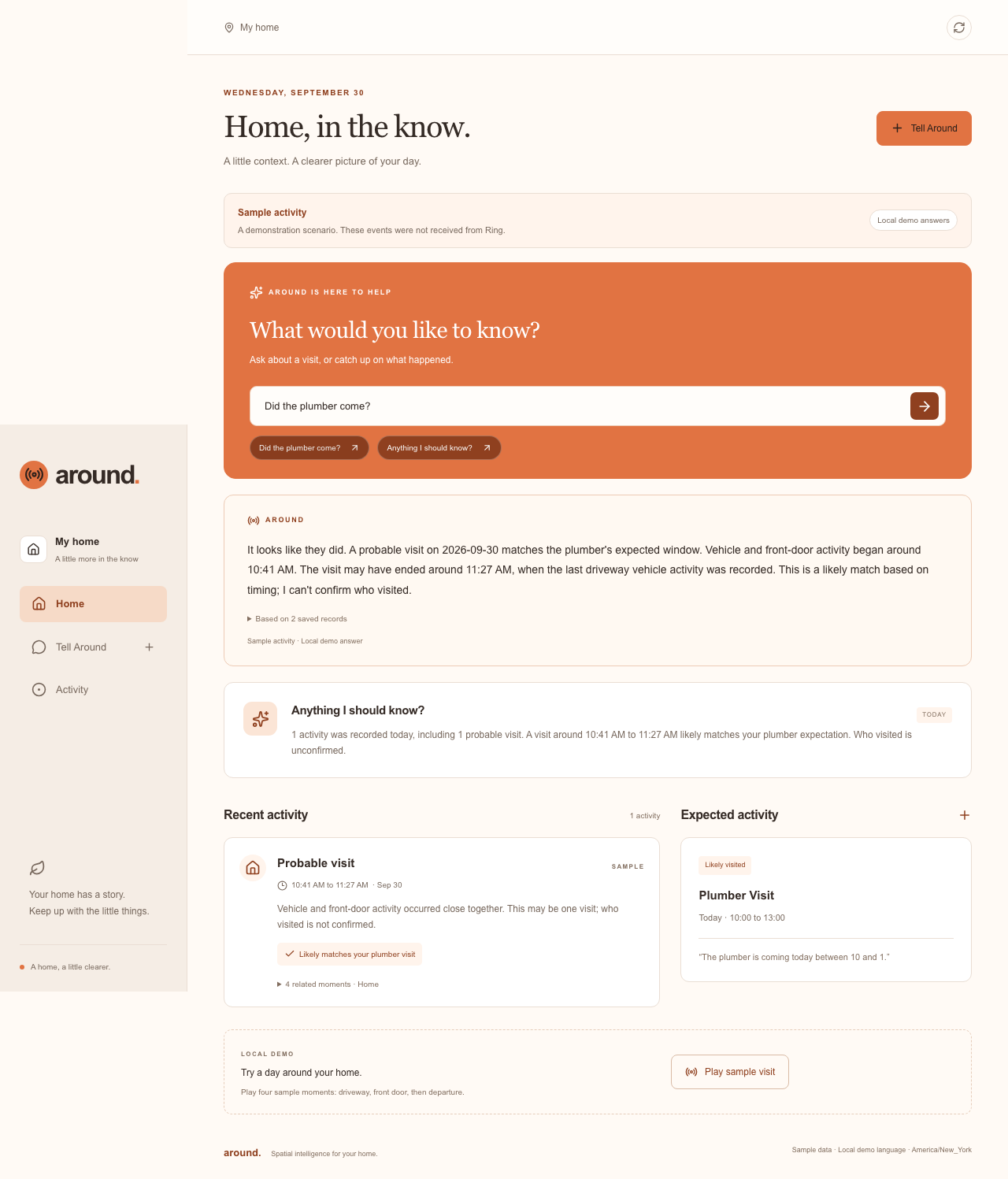
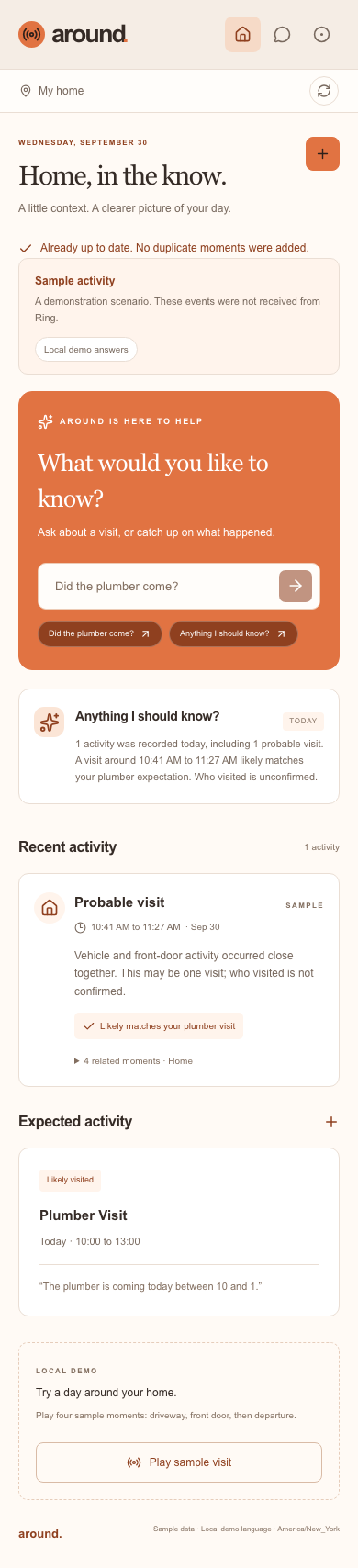
Spatial intelligence for your home.
Around helps homeowners connect expected activities with recorded activity. Tell it who you are expecting and when, then ask what happened.
The prototype focuses on a familiar question: “Did the plumber come?” Tell Around, “The plumber is coming today between 10 and 1.” It saves the expected visit and time window. Related driveway and front-door moments can become a probable visit that fits that expectation. Ask Around gives estimated timing and explains that a likely match does not confirm who visited. “Anything I should know?” gives a short briefing based on today's stored activity and expectations.
The public demo begins with this homeowner experience using labeled sample events and answers generated earlier by Amazon Bedrock. It then shows the official Ring Playground and real Ring records received by Around. Our actual Playground runs returned one device and three live-view requests. Around displays those as live views and excludes them from visits. The positive classified two-device visit is sample-verified, not a claim about live Ring detections.
Around is a local, single-home prototype. It offers a repeatable credential-free sample, with real Ring and Bedrock paths available for separately authorized configuration. Delivery confirmation, visitor recognition, voice input, alerts and home controls are planned for future releases.
Inspiration
A camera timestamp is rarely the homeowner's whole question. People want to know whether an expected service visit happened and what activity was recorded while they were away. Future releases will extend Around to more everyday questions, from confirming package arrivals to recognizing an expected dog walker.
We started with one expectation and one service-visit scenario. Saving what the homeowner expects makes later observations more useful, as long as the answer preserves what those observations can and cannot establish.
What it does
Tell Around saves a person or service, date and same-day time window. Activity grouping joins compatible observations at one home. Matching compares a probable visit's start with the expected window and keeps competing candidates ambiguous.
In the sample, four moments become one probable visit with estimated bounds of 10:41 AM to 11:27 AM. The timing supports a likely plumber match. Around does not currently identify the visitor or establish continuous presence. Ask Around can also explain that the stored evidence is insufficient and provide a daily briefing.
How we built it
Around uses Next.js, React, TypeScript, Tailwind CSS and Node SQLite. The Ring adapter normalizes official API responses into stored events. Deterministic code handles grouping, matching, dates and complete answer facts. The sample adapter uses the same domain logic in a separate source-labeled database.
Amazon Bedrock's Converse API, using Nova Micro through the AWS SDK for JavaScript v3, handles expectation parsing, freeform question interpretation and selection of validated fact IDs. Unknown selections fail visibly. The application renders the approved fact text, including its uncertainty, rather than displaying unrestricted model prose.
Ring integration
The sync route calls official device discovery and event history at runtime, validates IDs/timestamps and persists the result transactionally. Actual Around runs retrieved one Playground device and three live-view requests, including a new September 30 record. Those records influence the answer without becoming invented visits.
The configured two-device path and signed webhook handler are implemented and contract-tested. They support the richer expected-visit workflow, whose positive demonstration currently uses samples. Around's contribution is connecting expected activities with recorded evidence, not adding another motion notification. It does not claim live classified multi-device validation.
AWS Builder integration
Amazon Bedrock is the application's AWS runtime service. The verified model was Amazon Nova Micro in us-east-1. Tell Around uses one Converse request to parse an expectation. A normal freeform Ask uses interpretation followed by fact selection. The exact briefing shortcuts route deterministically and use one fact-selection request. The Home briefing itself is computed locally.
Actual app-side checks verified parsing, a dated insufficient-evidence answer from official Ring records, a corrected daily briefing and the positive sample flow. For visit answers, the selection step receives one mandatory whole fact; it does not infer who visited or freely compose new claims. These bounded roles are integrated with persistence and deterministic activity logic. No AgentCore, Strands, SageMaker, S3 or cloud-hosted application is implemented.
Challenges we ran into
The tested Ring Playground Motion/Vehicle controls returned live-view history, not classified events from multiple devices. We kept that distinction visible and used a separately labeled sample for the positive visit.
Bedrock onboarding encountered account verification and unexplained short-term-key access denial. An approved narrow IAM identity and one-day key enabled app-side inference. One model response misunderstood the explicit daily-briefing command. Deterministic command routing corrected that observed case, and the subsequent live recheck passed.
Recording introduced separate problems: native password prompts obscured sync results and one take captured the wrong browser surface. We preserved the failed takes and used clearly disclosed separate recordings and stills. The video does not claim uninterrupted request execution.
Accomplishments we are proud of
Around connects an expected visit, grouped activity and a qualified answer in one coherent interaction. The actual Ring path stores provider records and supports an insufficient-evidence answer instead of inventing an arrival. Bedrock has been exercised on both real Ring records and sample activity.
The current verification pass includes TypeScript, lint, 31 targeted tests, a production build and three browser scenarios. The source is public under MIT and the approved English demo is 118.3 seconds long. The sample can be run locally without credentials or paid inference.
What we learned
A live-view request, a motion detection and a probable visit are different kinds of evidence. Preserving those differences is central to a useful answer. Timing can suggest a match without identifying a person.
Keeping activity logic deterministic and language tasks bounded made the system easier to verify. We also learned to separate successful provider execution from usable video evidence: a recording of saved results needs to say that it shows saved results.
What's next for Around
First, validate classified events from two authorized Ring devices and test overlapping visits, missing observations and ambiguous expectations. Broader use would need authenticated household access, account linking, credential refresh and data-retention controls.
Future releases are planned to add delivery confirmation, visitor recognition, voice input, notifications and home controls. These capabilities will build on the current expected-visit experience, with each grounded in the evidence needed to give homeowners useful answers.
Potential impact
The initial audience is homeowners coordinating service visits while busy or away. Around could reduce the manual comparison of a schedule with separate camera moments. The sample demonstrates that interaction for an expected plumber visit, with a daily briefing as a second use case.
This is a product hypothesis, not measured customer impact. No adoption, time-saving or market-demand claim has been validated. The next product evaluation should test whether the qualified answers are useful and understandable in actual homes.
Video disclosure and credit
The video combines separate takes and labeled stills. The sample visit was not recorded by Ring and shows previously generated Bedrock answers. The real records are live-view requests, not proof of detected motion, a visitor or a matched visit. An unobscured sync click is not included. Sample typing and microphone graphics are edited visuals; voice input is planned for a future release and is not currently implemented.
The published description credits “Birds on Feeders” by Michael Black on Vimeo, provided through the official Ring Playground and identified there as CC BY 4.0. It names the original clipping, our crop, omitted audio and frame hold. Sparkle is an original local composition. Source notices retain Lucide/Feather attribution.
Built With
- amazon-bedrock
- amazon-nova-micro
- aws-sdk-javascript
- date-fns-tz
- lucide
- next.js
- node.js
- playwright
- react
- ring-api
- ring-playground
- sqlite
- tailwind-css
- typescript
- zod

Log in or sign up for Devpost to join the conversation.