Inspiration
It started with a question we kept coming back to: why does a smell hit you differently than anything else? One second you're fine, and then you catch a whiff of something and suddenly you're completely elsewhere. A memory, a feeling, a person, a place, all of it arriving before you've even had a chance to think. There's actually a name for this, the Proust Effect, and the reason it happens is that smell is the only sense that bypasses the thalamus and goes straight to the limbic system, the part of the brain that handles emotion, memory and survival instinct. That got me reading about interoception, which is basically your body's ability to feel itself from the inside. The chest tightening before a hard conversation. Knowing something is wrong before you can explain why. Your body picks up on so much that never makes it to your conscious mind. And yet when you look at wellness technology, nothing is really designed around that. We have trackers for steps, sleep, heart rate, but nothing for the signals happening underneath all of that. That's the gap Arom is trying to fill.
What it does
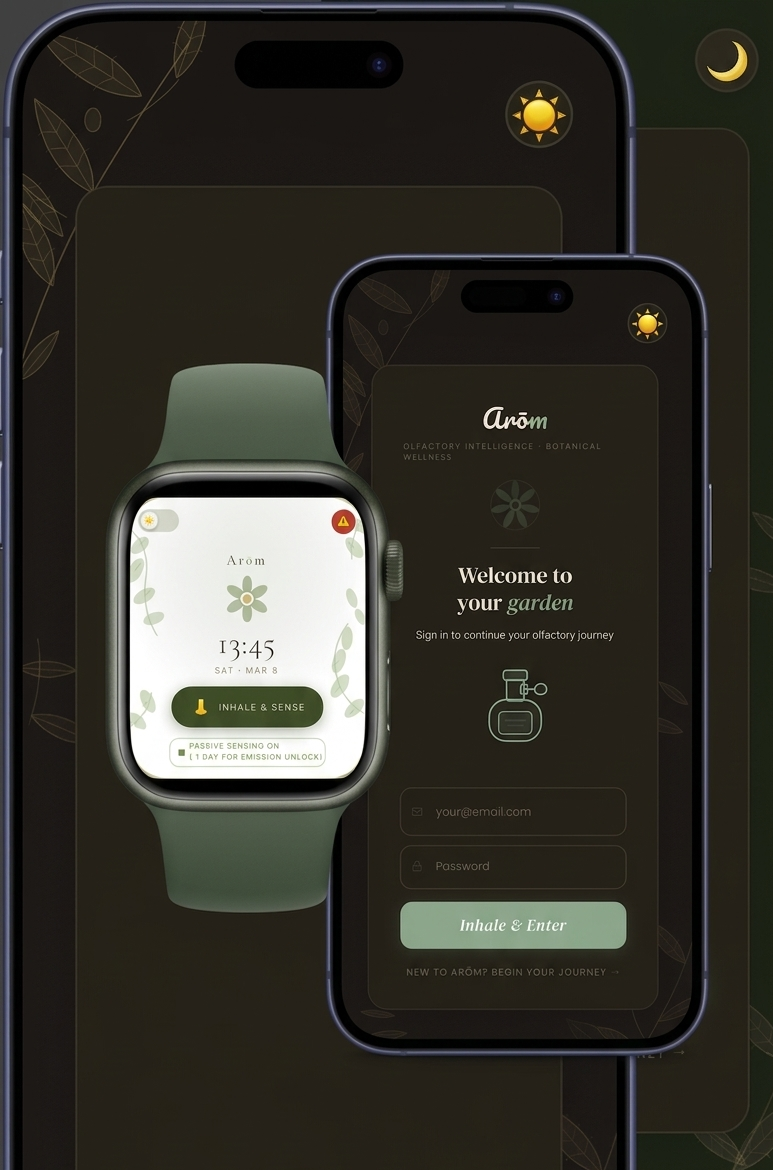
Arom is a speculative wearable and app system. The wearable reads the scent environment around you, the app helps you understand what those smells mean for your body, and together they emit personalised healing scents back based on your Ayurvedic body type, your allergies, and your scent history. The wearable sits on your wrist and continuously picks up scents within about 15 metres. It identifies compounds, reads your physiological response, warns you about allergens before you reach them, detects stress, and can release healing scents through a small cartridge system. The app is where all of that becomes meaningful. It gives you a morning check-in that logs your mood alongside real biometric data from the wearable. It shows you an Interoception Score, which is a measure of how connected you are to your body's signals on any given day. It tracks your live dosha state, which is your Ayurvedic energetic balance, and tells you what to eat, how to move, and which scents to seek out. There's a Scent Journal where every detection the wearable picks up becomes a draft entry waiting for your notes. A Garden that grows a plant every time you confirm a beneficial scent. A Picks tab with personalised scent recommendations. And an Allergen Shield that runs in the background and alerts you before exposure happens.
How we built it
The whole system was designed and prototyped in Figma, covering both the mobile app and the smartwatch interface end to end. The process started with a lot of research. Olfactory neuroscience, interoception studies, Ayurvedic assessment methods, sensory profiles for neurodivergent users, and how existing wellness tools handle data overload. From there we worked through the concept, the system architecture, and eventually the full interface design and prototype. The Interoception Score pulls together four signals: heart rate variability, cortisol response, the mood check-in, and scent responsiveness from recent journal logs. These are weighted and adjusted over time as the system learns your personal baseline, so the number you see reflects your body specifically, not a generic average. The active dosha state works similarly. Rather than locking you to a one-time quiz result, it calculates a daily shift from your base constitution based on your sleep, stress levels, and even the season. So the recommendations you get on a bad sleep week look different from the ones you get when you're well rested and balanced.
Challenges we ran into
The biggest one was information overload. The wearable is sensing constantly, which means there's a real risk of building something that just adds to the noise instead of reducing it. I spent a lot of time figuring out what the app should surface and when. The answer was basically: only show what's actionable right now. The journal waits for you. The garden updates quietly. The watch only vibrates when something actually matters. Explaining Ayurveda was harder than expected. It's a genuinely rich system with a lot of depth, but most people haven't encountered it and the terminology can feel unfamiliar or even a bit abstract. The design decision was to always pair the Ayurvedic framing with plain language. The app might tell you your Pitta is elevated, but it will also tell you what that means and exactly what to do about it. You can go deeper if you want, but you never have to. Designing for smell specifically was a strange and interesting constraint. It's invisible, it's immediate, and it bypasses conscious thought entirely. Trying to build a screen-based interface around something that is fundamentally pre-conscious took a lot of iteration, especially for the journal flow. The version that finally felt right was: detect, draft, wait, annotate, confirm. The app never logs anything for you automatically. You always have to choose to let something in.
Accomplishments that we're proud of
Honestly the thing we are most proud of is that the Interoception Score feels like a real metric. It's not something any existing wellness tool tries to measure and designing it in a way that felt credible rather than made up took real work. I'm also proud of how the garden turned out as a retention mechanic. It's not just a streak counter or a badge system. It's directly tied to the wellness behaviour itself, so the more you engage with your body, the more it grows. That felt like the right way to do it. Designing for neurodivergent users as a primary audience rather than an edge case was an important decision and I think it shows throughout the app, in the light and dark themes, in the way information is paced, and in the fact that sensory sensitivity is treated as something to work with rather than something to manage.
What we learned
A few things genuinely surprised me during this project. One is that humans have somewhere between 22 and 33 distinct senses depending on how you count them. Interoception is one of the most significant and one of the least designed for. Another is how scientifically grounded Ayurveda actually is. Going in I wasn't sure how seriously to take it, but the dosha framework maps closely onto current research on the gut-brain axis, nervous system regulation, and inflammatory response. It's not mysticism. It's patterns that modern physiology is starting to catch up with. The biggest design lesson was simpler though. The best interfaces aren't always the ones that give you more. Sometimes they're the ones that help you pay attention to what was already there.
What's next for Arom
The next step for Arōm would be refining the interaction between the wearable band and the mobile application. This includes improving how environmental scent data and body signals are translated into simple insights that users can easily understand. Another important direction would be testing the experience with users to see whether the system actually helps people become more aware of their internal states. Feedback from these tests would help refine features like the Bioception score, the scent journal, and the garden visualization. From a design perspective, the prototype could also be expanded to explore additional interaction states for the wearable band, such as clearer alerts, smoother scent logging, and better visual feedback for environmental detection. Overall, the goal would be to continue developing Arōm as a system that helps people notice patterns between their environment, scent, and how their body feels.
Built With
- figma
- figma-prototype
- figmake-ai


Log in or sign up for Devpost to join the conversation.