🚑 Arogyam AI – AI-Powered Emergency Response System
Inspiration
Every minute matters during a medical emergency, yet many people struggle to quickly determine the seriousness of an injury or reach the right medical help in time. We wanted to explore how AI could bridge that gap by providing instant injury assessment, first-aid guidance, and simulated emergency dispatch—all through a simple chat interface.
Our goal was to build an intelligent first responder that demonstrates how AI can support faster decision-making in emergency situations.
What it does
Arogyam AI allows a user to upload an image of an injury through a Telegram bot.
The system uses AI to:
- 🩺 Analyze the injury image
- 🚨 Classify the emergency severity (Low, Medium, High)
- 💊 Generate first-aid recommendations
- 🏥 Find the nearest suitable hospital
- 👨⚕️ Assign an available doctor
- 🚑 Dispatch the nearest available ambulance (simulated)
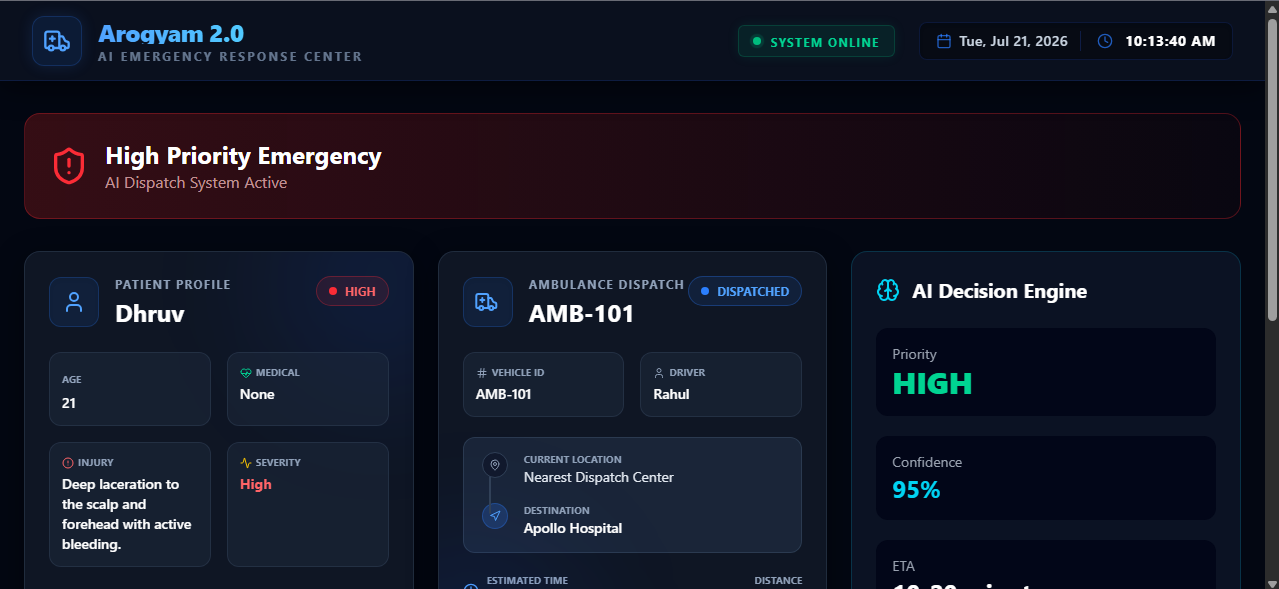
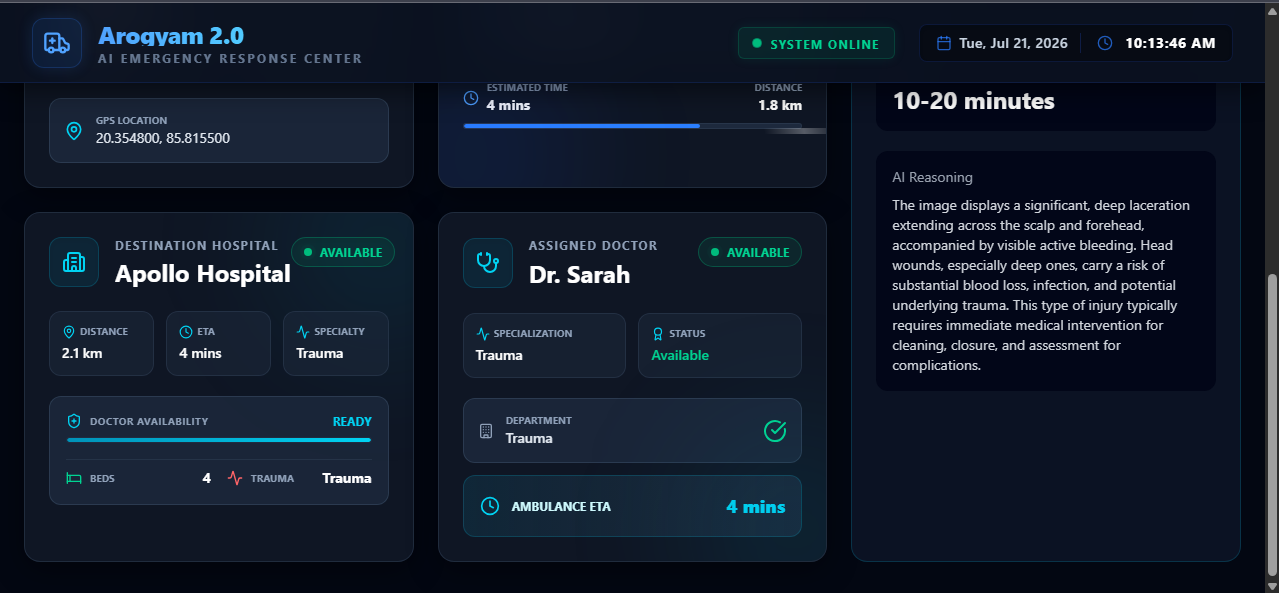
- 📊 Display everything live on an emergency dashboard
The dashboard provides emergency responders with real-time information about the patient, AI reasoning, hospital availability, ambulance status, confidence score, and estimated response time.
How we built it
The project consists of four major components:
- Telegram Bot for user interaction
- FastAPI backend to process requests
- Google Gemini Vision for AI-powered injury analysis
- React Dashboard for live emergency monitoring
The backend stores emergency information and updates a live dashboard every few seconds. Mock hospital, ambulance, and doctor datasets simulate a real emergency response network.
Challenges we ran into
During development we faced several technical challenges:
- Integrating AI vision with a reliable structured JSON response
- Building a complete end-to-end workflow between Telegram, FastAPI, and React
- Handling image uploads and different MIME types
- Managing API quotas while testing Gemini Vision
- Designing a dashboard that clearly communicates emergency information in real time
Each challenge helped us improve both the system architecture and the overall user experience.
What we learned
Throughout this project we gained hands-on experience with:
- AI Vision APIs
- Prompt engineering for structured medical outputs
- FastAPI backend development
- React dashboard development
- Telegram Bot development
- API integration
- Full-stack system architecture
- Real-time data flow between multiple services
Most importantly, we learned how multiple technologies can work together to create meaningful real-world solutions.
What's next for Arogyam AI
We plan to expand Arogyam AI with:
- 📍 Live GPS tracking
- 🚑 Real ambulance APIs
- 🏥 Real hospital integration
- 👨⚕️ Doctor availability APIs
- 📞 Automatic emergency calling
- 📱 Mobile application
- 🌍 Multi-language support
- ❤️ Electronic Health Record (EHR) integration
Our long-term vision is to build an AI-powered emergency assistance platform that can support patients and healthcare providers during the critical first few minutes of an emergency.


Log in or sign up for Devpost to join the conversation.