-
-
Thumbnail
-
01_arc_visual_lab
-
02_performance report
-
03_proof
-
04_showcase
Armillary
Inspiration
Optimizing local AI on Arm hardware is still surprisingly manual.
Developers often benchmark one implementation at a time, manually compare results, verify that optimizations did not change the output, and repeat the entire process for every new model or execution strategy.
We wanted to automate this engineering workflow.
Instead of asking "Which implementation should I use?", Armillary asks:
"Can we automatically discover the fastest correct implementation for this hardware?"
What it does
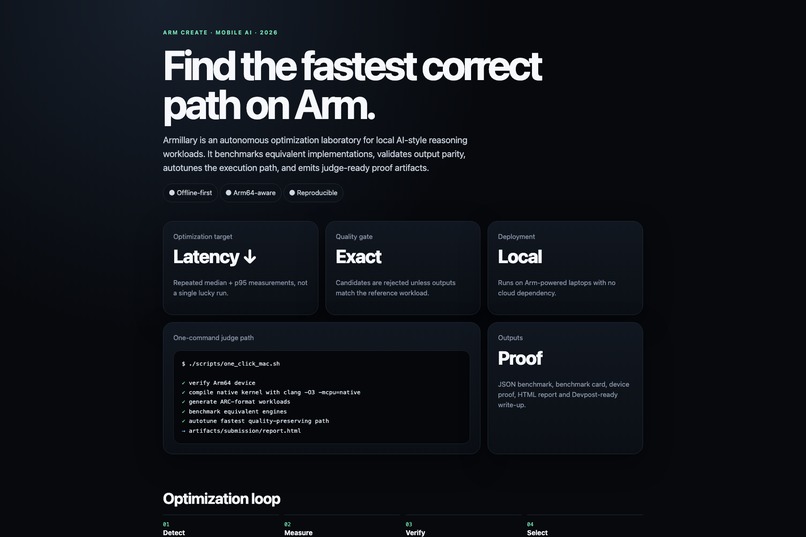
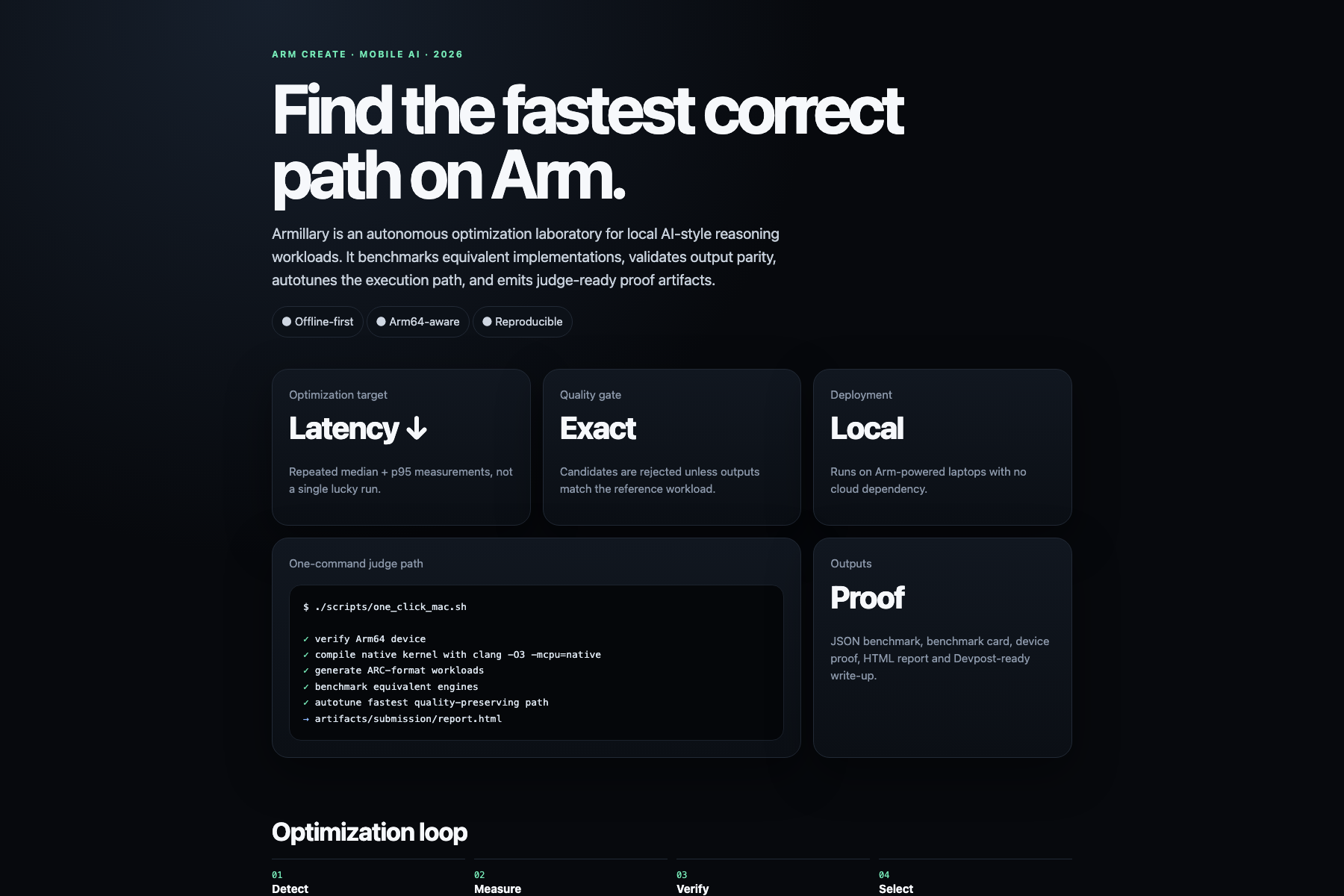
Armillary is an autonomous optimization laboratory for Arm-powered devices.
Given a reasoning workload, it automatically:
- profiles the hardware
- benchmarks multiple execution engines
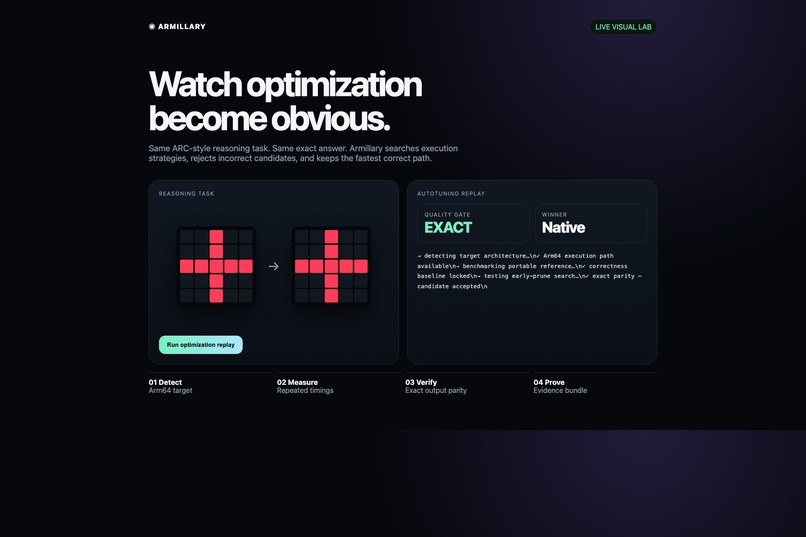
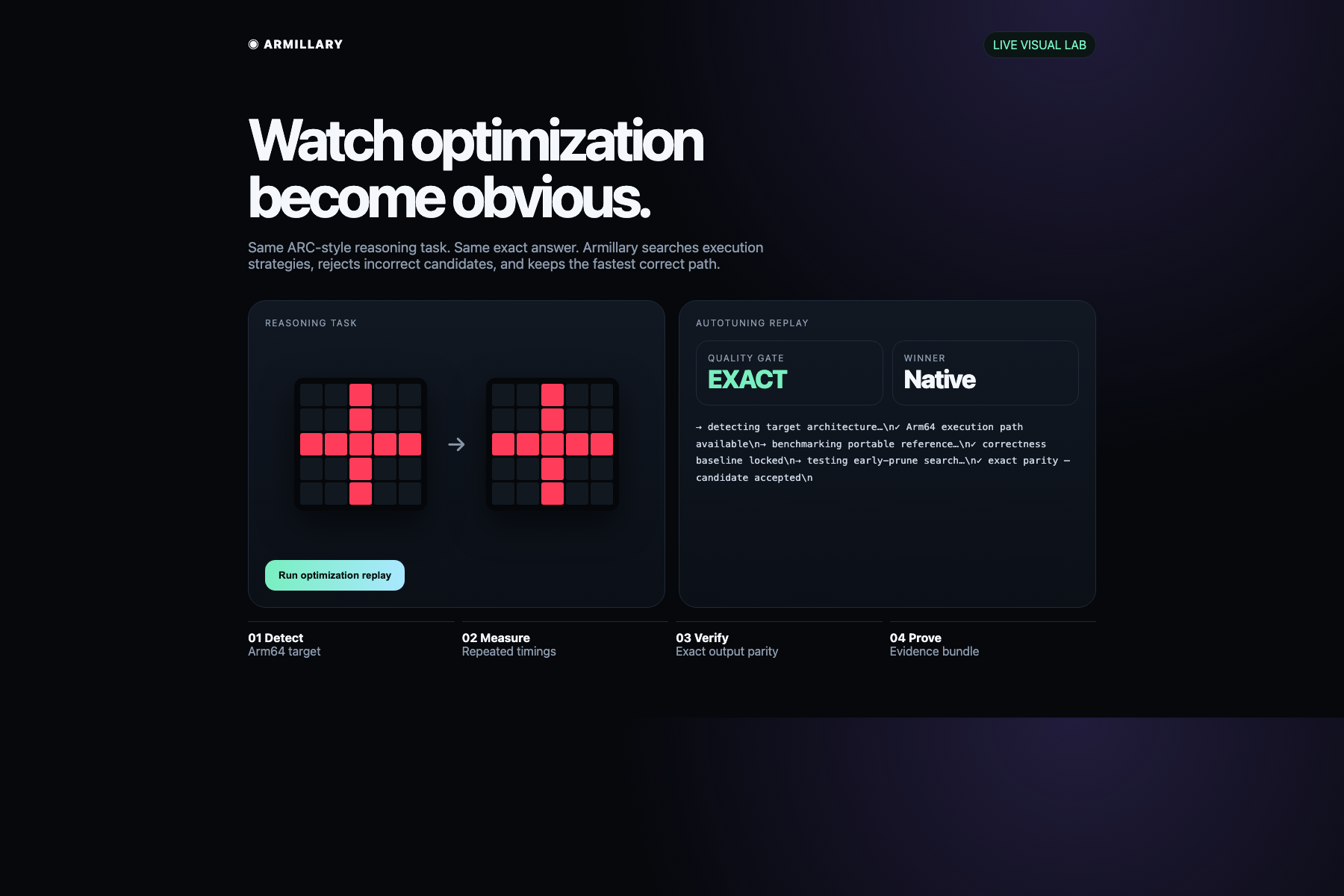
- verifies exact output parity
- rejects incorrect optimizations
- selects the fastest valid implementation
- generates reproducible benchmark reports
- creates submission-ready proof artifacts
The project includes an ARC-style reasoning benchmark to provide an objective workload with deterministic correctness.
How we built it
The project is intentionally lightweight and reproducible.
Core components include:
- Python reference implementation
- search-space pruning
- NumPy execution engine
- native C execution kernel
- architecture-aware compilation using
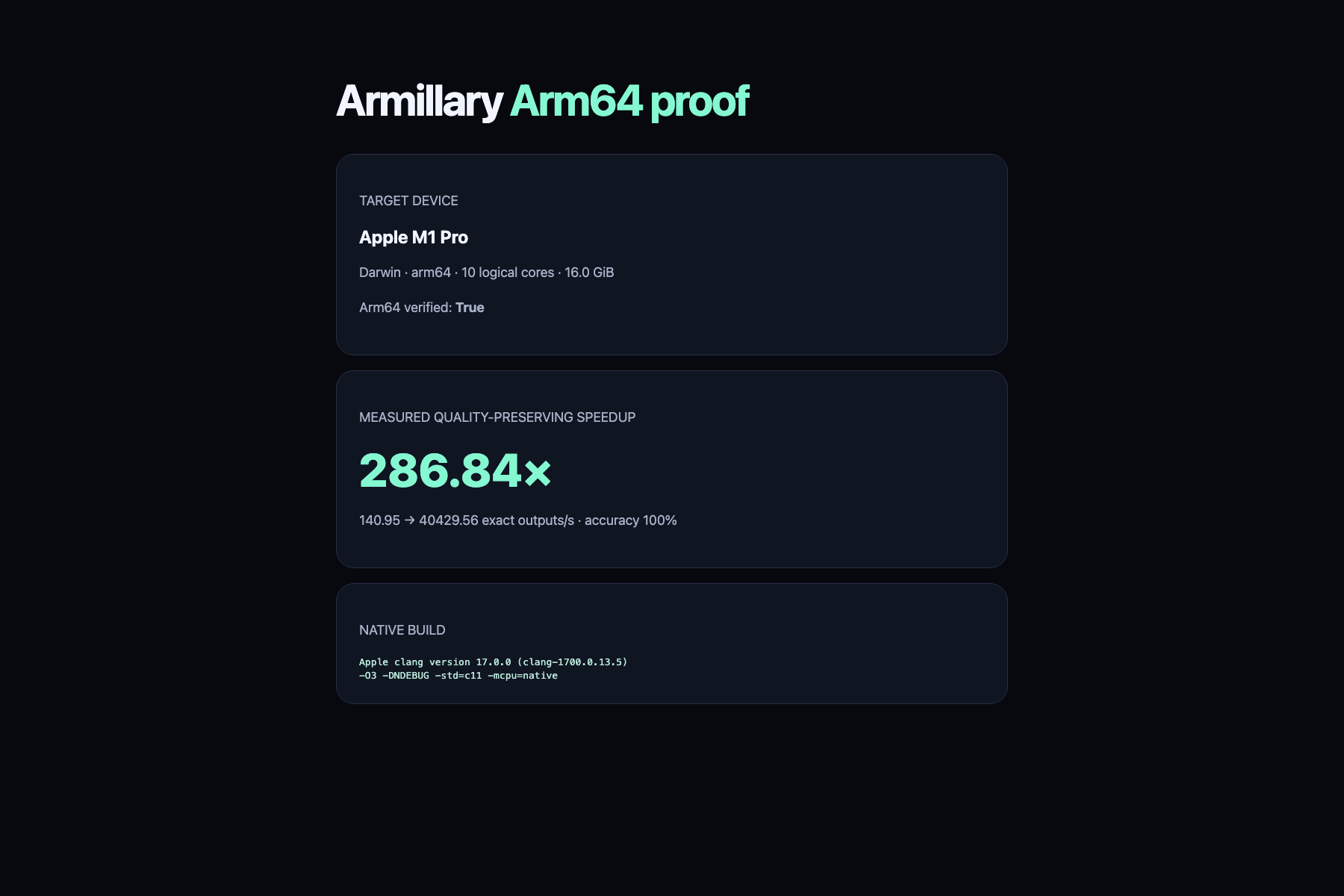
clang -O3 -mcpu=native
- automatic Arm64 hardware detection
- repeated benchmark measurements
- median and p95 latency reporting
- HTML performance dashboard
- proof artifact generation
- one-command execution on Apple Silicon
Every optimization must first pass an exact correctness check before it can be selected.
Speed without correctness is rejected.
Measured Results
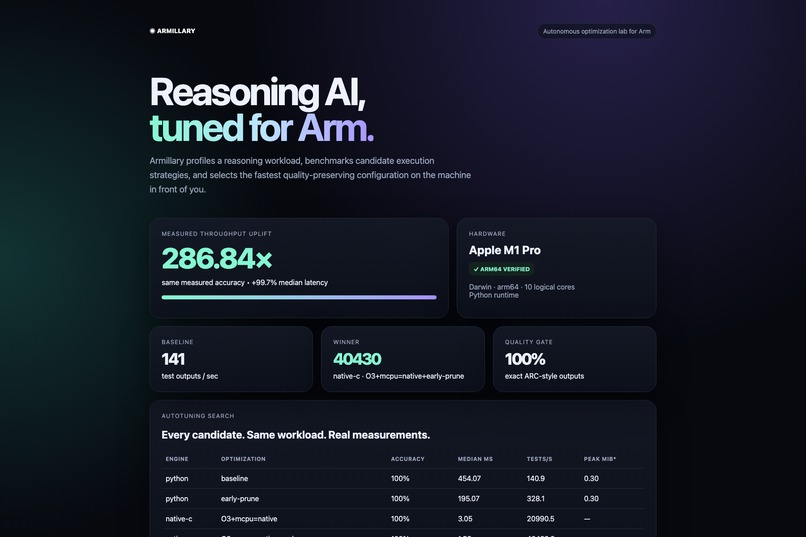
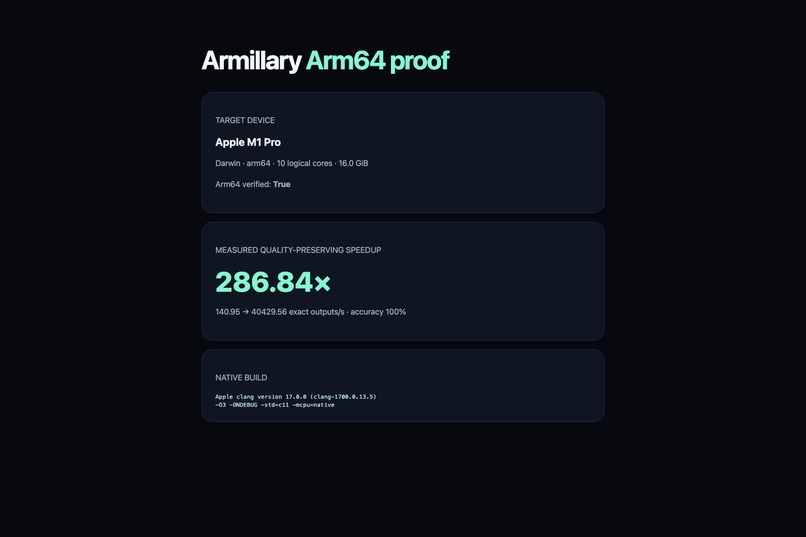
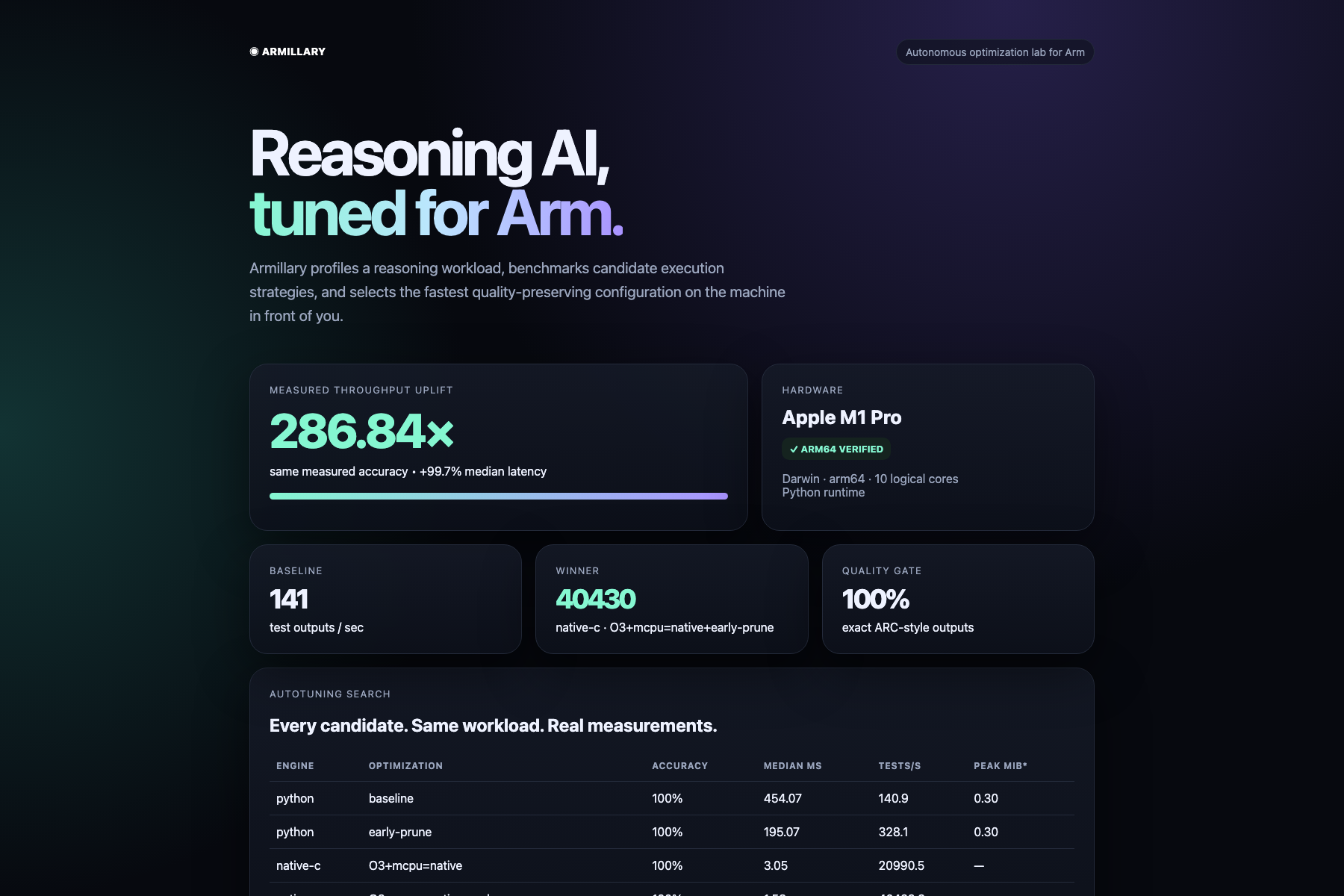
Measured on an Apple M1 Pro:
| Implementation | Median latency |
|---|---|
| Python reference | 454.07 ms |
| Python + Early Pruning | 195.07 ms |
| Native C | 3.05 ms |
| Native C + Early Pruning | 1.58 ms |
Results:
- 286.84× throughput improvement
- 100% exact output parity
- Arm64 verified
Rather than presenting a single performance number, Armillary measures the contribution of each optimization independently.
Challenges
One of the biggest challenges was making performance claims trustworthy.
Benchmarking is noisy, and faster code is meaningless if it changes the output.
We therefore built the project around three principles:
- repeated measurements
- exact output parity
- reproducible benchmark artifacts
Only candidates that produce identical outputs are considered valid.
What we learned
The biggest lesson was that optimization is not a single trick.
Real performance comes from combining:
- algorithmic improvements
- implementation improvements
- architecture-aware compilation
- automated benchmarking
- reproducible validation
Treating optimization as an experiment rather than a benchmark makes the workflow far more reliable.
What's next
The current project demonstrates the optimization workflow using an ARC-style reasoning workload.
Next steps include extending the same optimization framework to real local AI runtimes such as llama.cpp, ONNX Runtime and ExecuTorch while keeping the same reproducible benchmarking and verification pipeline.
We also plan to expand Armillary into a general optimization laboratory for local AI development on Arm platforms.

Log in or sign up for Devpost to join the conversation.