Inspiration
Small clinics, disability support offices, and community care teams receive urgent symptoms, access requests, paperwork, and routine scheduling messages in the same inbox. The first AI problem is not diagnosis. It is safe routing: find messages that need immediate human review while keeping sensitive intake text local.
Challenge track
This project fits the Mobile AI / on-device edge AI track. It is designed around local inference on Arm-powered devices rather than cloud-only AI.
What it does
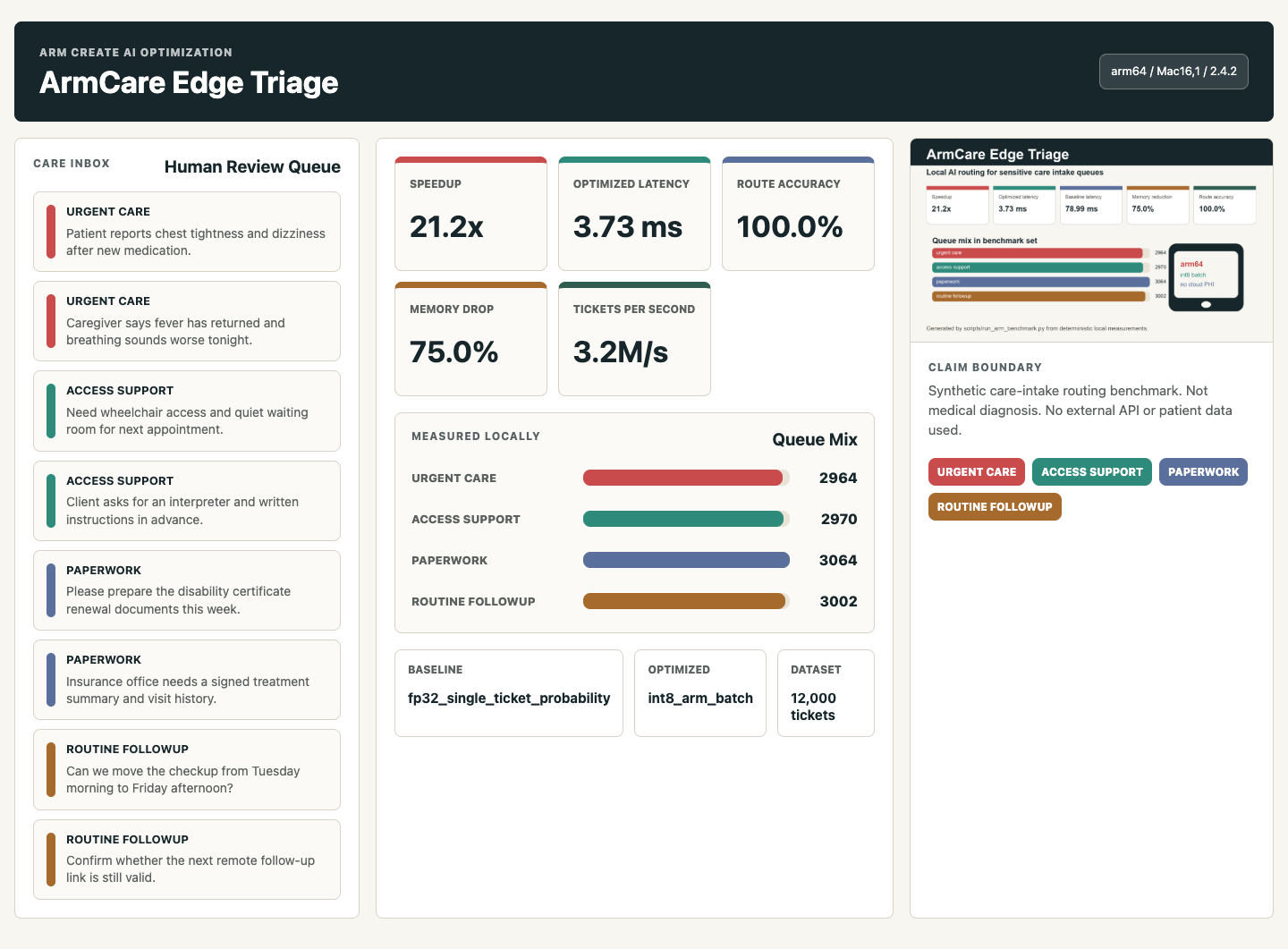
ArmCare Edge Triage runs a local AI priority classifier for care-intake messages. It routes messages into four human-review queues: urgent care, access support, paperwork, and routine follow-up. The dashboard shows the queue, benchmark metrics, and the explicit claim boundary.
Who it helps
This is for small care teams that do not have a large operations staff and cannot casually send private intake text to a cloud model. It gives them a fast local first pass so human staff can spend attention on the highest-risk queue first.
How AI is used
The AI component is an operational route classifier. It converts each intake message into a compact feature vector and predicts the review queue. It does not provide medical advice, diagnosis, or autonomous patient decisions.
Arm optimization
The project compares two local inference paths on Arm hardware:
- fp32_single_ticket_probability: a naive float32 path that handles one ticket at a time and computes probabilities.
- int8_arm_batch: a quantized int8 batch path designed for Arm edge inference.
The latest generated evidence on Apple M4 arm64 shows 21.16x speedup, 100.0% optimized accuracy on the deterministic synthetic benchmark, 100.0% agreement with the baseline, and 75.0% memory reduction. The benchmark is reproducible with npm run verify.
How it was built
I built a deterministic benchmark generator in Python and NumPy, a static dashboard in HTML/CSS/JavaScript, and a Playwright verifier that captures a screenshot and checks the claim boundary. The repo also includes a generated poster image, a narrated walkthrough, and JSON evidence.
Challenges
The main challenge was avoiding a vague AI demo. The submission needed measured optimization proof, not just a UI. I made the benchmark regenerate evidence files and kept the medical boundary explicit.
Links
- Public demo: https://daideguchi.github.io/armcare-edge-triage/
- GitHub: https://github.com/daideguchi/armcare-edge-triage
- YouTube demo: https://youtu.be/3M4srfq2kCs
Claim boundary
This project uses synthetic care-intake data. It is not medical diagnosis, not patient-risk scoring, and not a replacement for professional judgment.

Log in or sign up for Devpost to join the conversation.