ArmBench MiniLM in 30 seconds
Track: Cloud AI
- Problem: A smaller quantized model is not useful if its speedup is measured unfairly or its embeddings drift too far.
- Solution: ArmBench MiniLM turns FP32-to-INT8 optimization, benchmarking, fidelity checks, and reporting into one reproducible command.
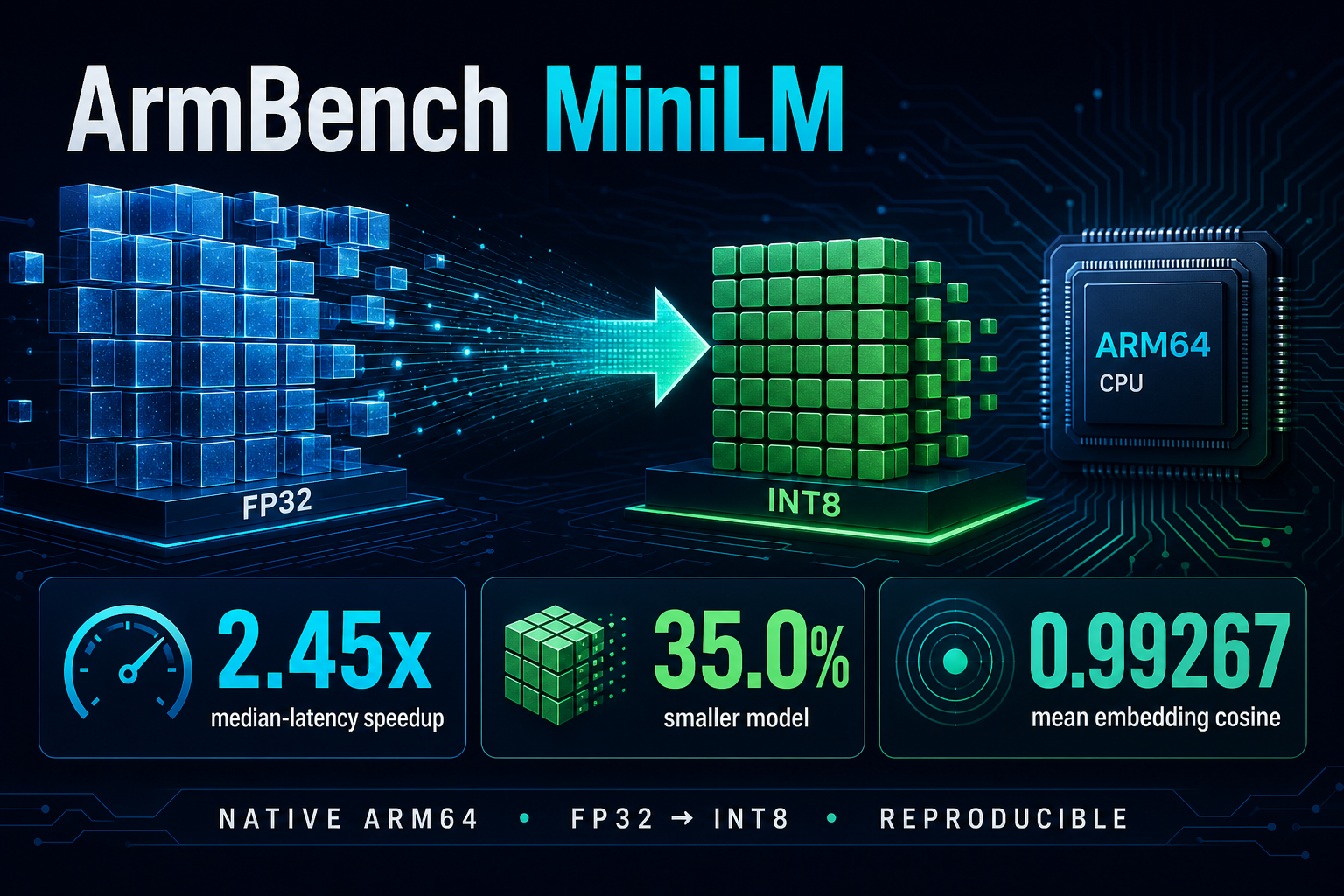
- Measured result: On a native Arm64 runner, INT8 delivered a 2.45x geometric-mean median-latency speedup, reduced model size by 35.0%, and retained 0.99267173 mean FP32/INT8 embedding cosine on the authored workload.
- New validation: A same-artifact FP32+BF16 option produced a repeatable 1.3348x speedup and passed a predeclared native Arm64 STS/retrieval quality gate with embedding cosines above 0.99998.
- Verify it: Source repository · submitted native Arm64 run · BF16 task-quality run · machine-readable result
Inspiration
Teams evaluating CPU inference are often told to quantize a model, but a smaller file alone is not enough evidence to trust a deployment. Latency tests can accidentally include tokenization or model loading, and a headline speedup can hide unacceptable representation drift.
ArmBench MiniLM was created to make the whole trade-off visible: speed, size, fidelity, provenance, and limitations in one inspectable evidence bundle.
What it does
ArmBench MiniLM:
- downloads an exact public revision of
sentence-transformers/all-MiniLM-L6-v2; - converts constant-weight
MatMulandGemmoperations from FP32 to dynamic per-channel signed INT8; - runs both models with identical ONNX Runtime CPU settings;
- measures model size, median and p95 latency, and sentence throughput;
- checks corresponding embedding cosine and every pairwise-similarity error; and
- emits JSON, Markdown, and standalone HTML reports.
The public GitHub Actions workflow runs on a native Arm64 Ubuntu runner, so the submitted numbers are reproducible without asking reviewers to provision hardware or trust a screenshot.
How we built it
- Python and uv for a locked, one-command environment
- ONNX Runtime for CPU inference and dynamic quantization
- Hugging Face Hub for a revision-pinned Apache-2.0 source model
- NumPy for pooling, normalization, and fidelity metrics
- GitHub Actions
ubuntu-24.04-armfor native Arm64 validation
Tokenization is deliberately outside the timed region. Each timed iteration includes ONNX inference, attention-mask mean pooling, and L2 normalization. Both models use four intra-op threads, one inter-op thread, the CPU execution provider, and the same authored sentence batches.
What we optimized
The original FP32 weights used by constant-weight MatMul and Gemm operators are converted to signed INT8 with per-channel scales. Activations remain dynamically quantized at runtime. This reduces stored weights and memory traffic while preserving the same model inputs and 384-dimensional sentence-embedding interface.
Measured results on native Arm64
The public 100-iteration run used four Arm64 CPU cores, ONNX Runtime 1.28.0, ten warm-ups, and 100 measured iterations per model and batch.
| Batch | FP32 median | INT8 median | Speedup | INT8 throughput |
|---|---|---|---|---|
| 1 | 2.928 ms | 1.629 ms | 1.80x | 613.7 sentences/s |
| 8 | 19.331 ms | 7.376 ms | 2.62x | 1,084.6 sentences/s |
| 32 | 74.264 ms | 23.815 ms | 3.12x | 1,343.7 sentences/s |
Across all three batches, INT8 produced a 2.45x geometric-mean median-latency speedup. The model file fell from 86.22 MiB to 56.04 MiB, a 35.0% reduction.
The optimized model retained 0.99267173 mean corresponding-embedding cosine (minimum 0.97647780) across 32 authored workload sentences. Mean pairwise-similarity absolute error was 0.01012334.
New downstream validation checkpoint
After freezing the original submission result, we tested four unchanged artifacts/sessions on a revision-pinned, hash-checked MTEB-derived gate: FP32, FP32+BF16, QInt8, and QInt8+BF16. The gate uses all 12 IndicCrosslingualSTS test configurations and the full 8,674-document, 1,406-query ArguAna test set at the project's 128-token deployment limit.
FP32+BF16 passed every predeclared condition. Relative to FP32, STS changed from -6.2773 to -6.2677, ArguAna nDCG@10 changed from 48.9917 to 49.0337, and corresponding-embedding cosine was 0.99998246 on STS and 0.99998768 on retrieval. Together with five independent native performance runs (1.3348x median geometric-mean speedup, 0.38% run CV), this makes FP32+BF16 a validated Arm64 FP32 serving option.
The submitted QInt8 artifact did not lose either task score, but its 0.98911148 STS corresponding-embedding cosine narrowly missed the deliberately strict 0.99 gate. We retain the immutable 2.45x speed result and disclose this boundary instead of claiming universal numerical equivalence. The English-only source model scores negatively on the English–Indic STS set, so that part is a preservation stress test—not a cross-lingual capability claim or an official MTEB leaderboard result. Read the retained quality evidence.
Fidelity guardrail
Both models embed the same 32 authored sentences. We compare corresponding normalized embeddings and every pairwise similarity. This is a numerical drift check, not a task-accuracy claim. It puts fidelity beside performance instead of leaving it as an assumption.
Reproduce it
No private dataset, Hugging Face token, or special hardware account is required.
git clone https://github.com/yhay81/armbench-minilm.git
cd armbench-minilm
uv sync --frozen
uv run armbench-minilm all --work-dir .armbench --output-dir results
The command downloads the revision-pinned FP32 ONNX model, creates the INT8 derivative locally, benchmarks both, evaluates drift, and writes benchmark.json, report.md, and report.html. To reproduce the submitted machine, fork the repository and run Native Arm64 benchmark from GitHub Actions.
Challenges we ran into
An optimization benchmark can accidentally measure tokenization, download time, model loading, or a different runtime configuration. We made the timing boundary explicit, pinned the model revision, stored checksums in the result, and generated all human-readable claims from the machine-readable JSON. We also report batch sizes separately because one aggregate number would conceal deployment-relevant trade-offs.
What makes it useful to developers
- One command reproduces download, quantization, measurement, fidelity checks, and reports.
- Reviewers can validate the result on a clean native Arm64 runner.
- No private data, token, pre-generated model binary, or special hardware account is required.
- The project reports limitations and quality drift alongside speedup.
What we learned
The valuable unit of optimization is not a smaller model file; it is a reproducible deployment trade-off. Pinning provenance and measuring output fidelity are as important as choosing a quantization operator.
What's next
Fuse transformer, pooling, and normalization graph operations; compare thread counts and Arm instance families; then evaluate a calibrated static S8S8 candidate against the same pinned task gate.
Limitations
- The 32 authored sentences are a fast numerical drift check; downstream evidence comes from a separate pinned engineering gate, not an official MTEB run.
- The English-only source model's cross-lingual STS score is negative, so the STS slice supports preservation testing only, not a cross-lingual capability claim.
- Five pinned ArguAna qrels point to documents absent from the source corpus and score zero under the declared contract.
- One GitHub-hosted virtual machine does not represent every Arm CPU or production workload.
- Dynamic quantization performance depends on model shape, batch size, thread count, runtime version, and hardware.
- The benchmark measures the embedding pipeline, not end-to-end search-service latency.
Licensing and AI assistance disclosure
The original project code is MIT licensed. The pinned MiniLM source model is Apache-2.0. OpenAI Codex materially assisted with implementation, tests, documentation, and submission drafting; every published measurement comes from the executable public workflow.
Built With
- github-actions
- machine-learning
- numpy
- onnx
- python

Log in or sign up for Devpost to join the conversation.