Inspiration
It's late, and you're leaning into the bathroom mirror, counting pores. Nobody else will ever see you from there. People talk at about a metre and sit across a table at one and a half (Hall, The Hidden Dimension, 1966).
We still judge ourselves at mirror range, and that view exaggerates:
- A camera at about 30 cm makes the nose about 30% wider, relative to the face, than a portrait from 1.5 m (a geometric model; Ward et al., JAMA Facial Plastic Surgery, 2018).
- We overestimate being noticed. In the classic "spotlight effect" study, students in an embarrassing T-shirt guessed that 46% of a room could say who was on it. 23% could (Gilovich, Medvec & Savitsky, JPSP, 2000).
YouCam's HD Skin Analysis answers the first question: what is there. We wanted to answer the next one, asked at that mirror: who can actually see this, and from where? That's a question about human eyes, which vision science has measured for decades.
What it does
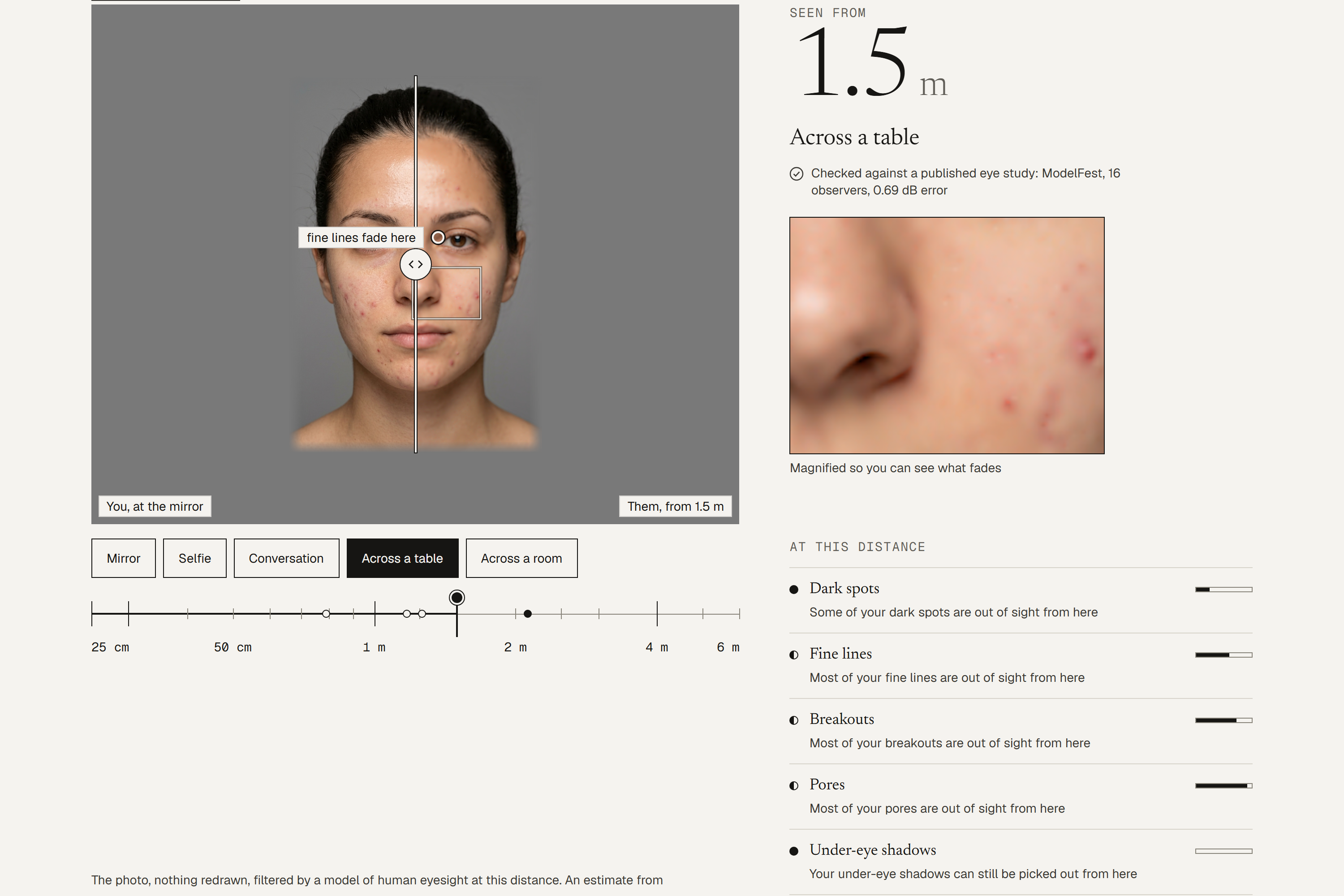
Arm's Length turns a YouCam Skin Analysis into what other people can actually see, and from how far, for a typical sharp-eyed person. Here is our demo face (synthetic, about 30, light olive skin, a few breakouts) end to end:
- YouCam finds every mark. The photo goes to YouCam HD Skin Analysis v2.1. It returns a mask for each concern: 450 pores, 64 dark spots, 40 breakouts and 93 fine lines on this face.
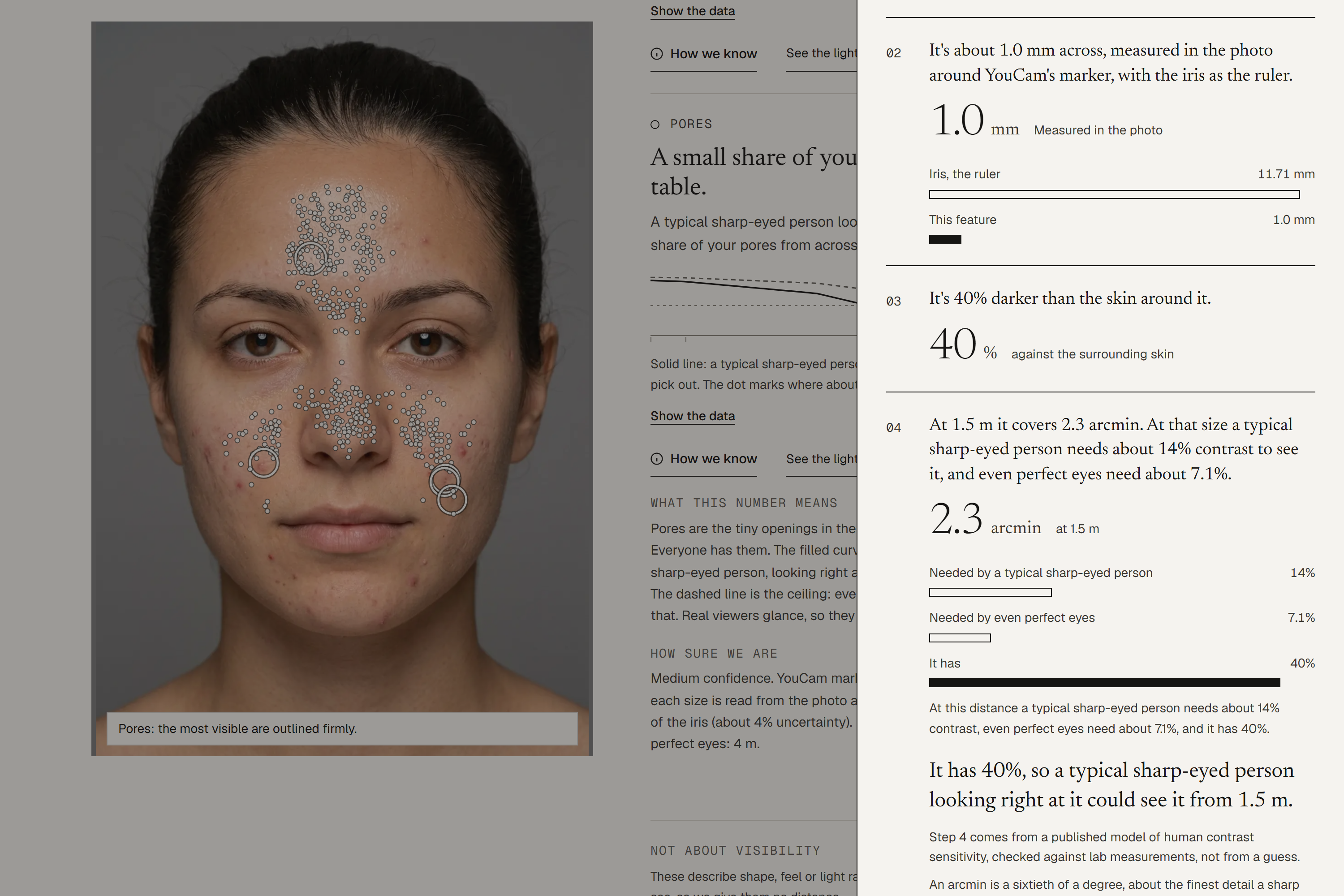
- We measure each one in millimetres and contrast. The iris is the ruler: adult irises are 11.71 ± 0.42 mm across (Rüfer et al., 2005), and MediaPipe finds them in the photo. One pore is about 1.0 mm wide and 40% darker than the skin around it, measured in linear light.
- A published model of human vision turns that into a distance. Watson & Ahumada's (2005) Standard A model works
from the angle a mark covers and its contrast:
- From across a table (1.5 m), that pore covers 2.3 arcminutes.
- A typical sharp-eyed person needs about 14% contrast to see a mark of that size. It has 40%, so it shows.
- But of all 450 pores, only about 37 do. Nine in ten are out of sight across a table.
- Three-quarters of the dark spots still show. The app tells you what doesn't fade, too.
- Step back. Drag a tape from Mirror (25 cm) to Across a room, and the photo is re-rendered as an eye would see it from there (Peli's band-limited contrast). Each concern shows how much of it is still visible.
- "How we know": a receipt for every mark. It shows YouCam's marker, the size against the iris ruler, the contrast, the angle, the threshold for a typical observer and for even perfect eyes, and the count at five distances.
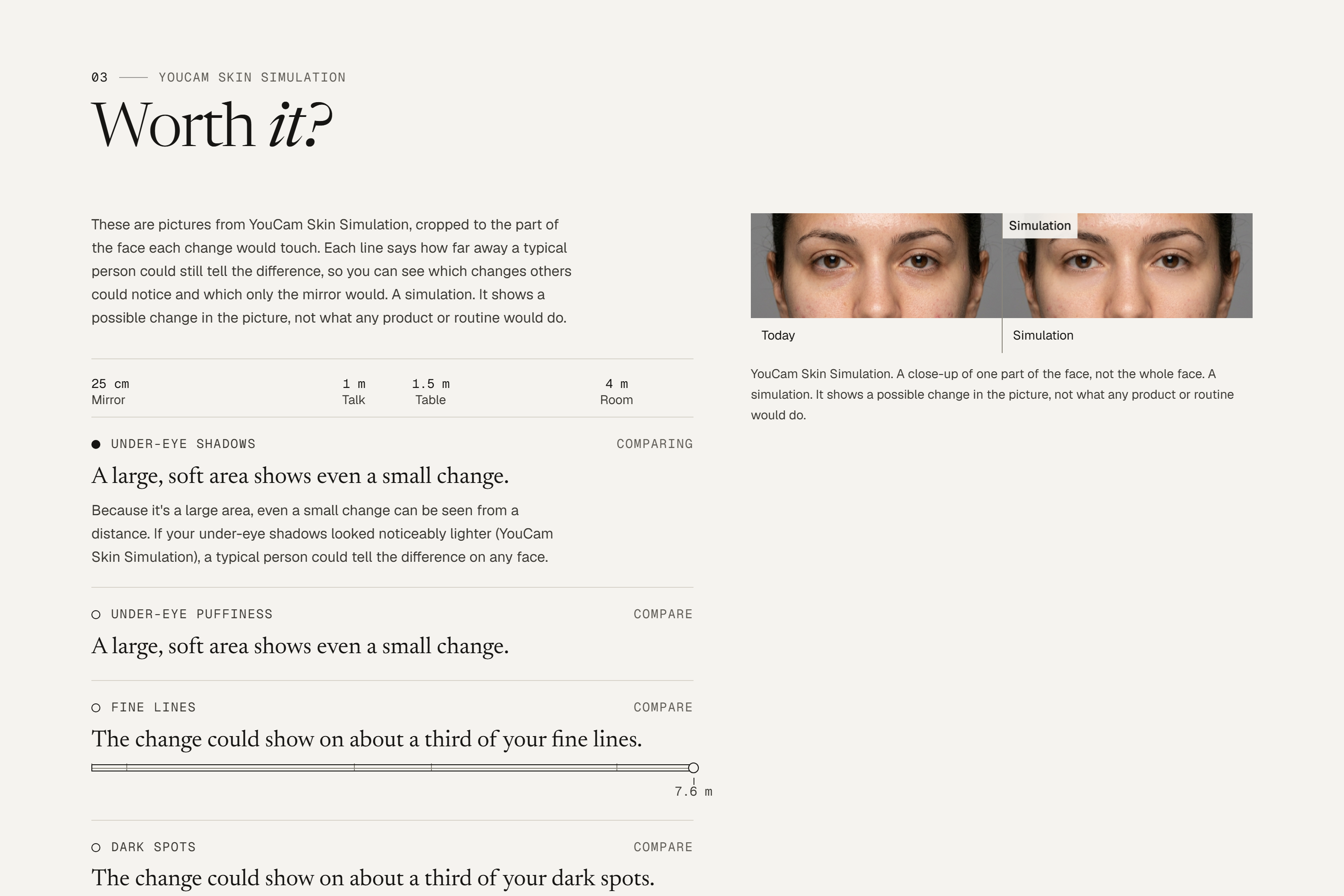
- Worth it? YouCam Skin Simulation shows a softer version of the same face, and we run only the difference
through the same model.
- On this face, at most one pore change in twelve (8.4%) would show across a table. Across our four demo faces it ranges from 4% to 14%.
- Lighter under-eye shadows would show from 10 m on every face.
- So you can see what anyone would notice before you buy anything.
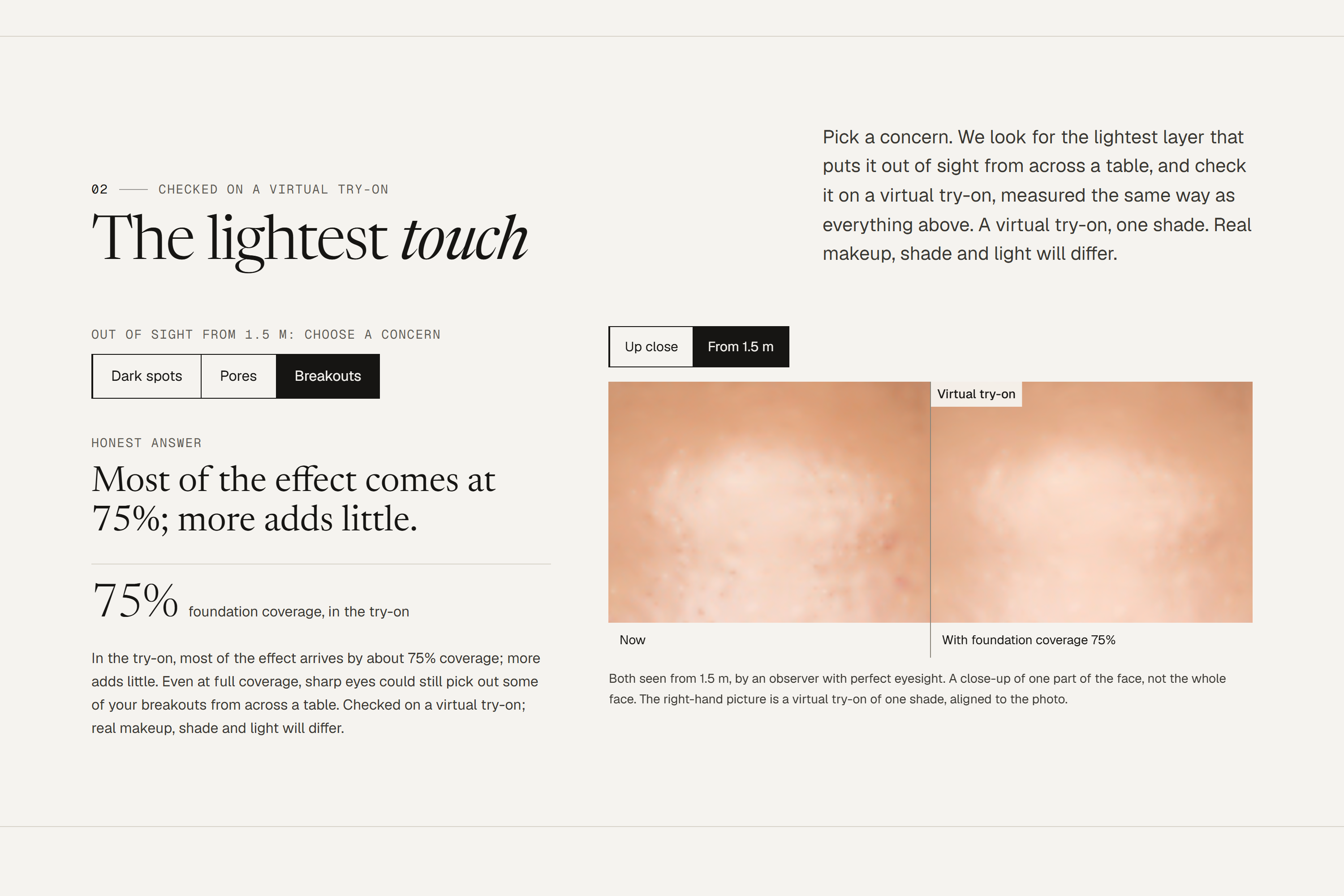
- The lightest touch, for tonight. YouCam Makeup Virtual Try-On renders foundation at four coverage levels, and we measure each render. On this face, 75% coverage takes the breakouts detectable across a table from 60% to 30%, and more adds little.
- Tomorrow, from their side. Describe your day ("9am video standup, lunch with a client by the window, dinner
date at 7"). An AI agent splits it into moments, runs our vision model for each through tools, and shows every
moment as the person there sees you:
- your face at its true size in their view, in that scene and that light;
- on the call, inside the video tile at the stream's resolution, so you see that pores can't come through;
- one sentence per moment ("Across the table in evening light, pores fade from view"), a held "your mirror" to compare, and at the end of the day what needs no cover at all.
Every number in the plan comes from a tool result, and a checker rejects any other. It uses no YouCam units: the analysis already did its job, and the agent builds on its numbers.
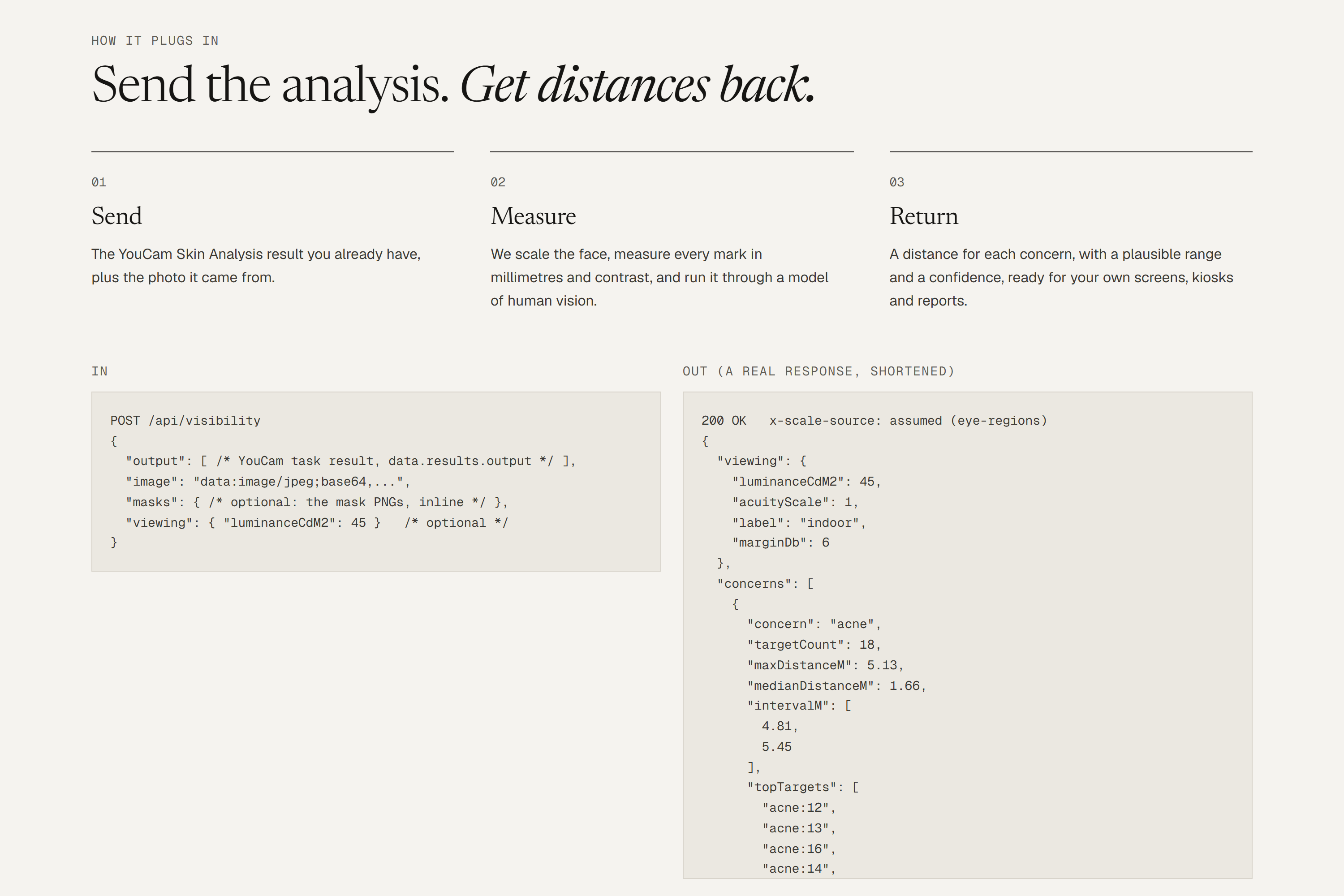
- For brands, a drop-in layer.
POST /api/visibilitytakes any YouCam Skin Analysis result and its photo, and returns a distance for every concern as JSON. It costs no extra YouCam units, and the route takes 0.8 s.
Who it's for:
- Anyone at the mirror, after a breakout or before buying something to change their skin.
- Beauty brands and retailers on YouCam: a claim a shopper can check on their own face, not a before-and-after promise.
Why it scales:
- A full session costs about 26 YouCam units: 16 for the analysis, 6 for the simulation, 1 per try-on render.
- All measurement runs in a browser Web Worker.
How we built it
Every distance comes from a published model of human vision. There is no language model in the product.
- YouCam, three APIs, all server-side. HD Skin Analysis v2.1 (8 HD concerns, 17 masks), Skin Simulation (half
strength, pixel-aligned to the same masks), and Makeup VTO (foundation
coverageIntensitywithskin_smoothat 0). Every paid call goes through a unit ledger, a balance floor, daily caps and a kill switch. Task deletion runs at the end of a session. - From masks to marks. Connected components, with skeletons for lines. YouCam draws pore and breakout markers at a fixed size, so we measure each mark in the photo, or fall back to a 0.5 mm prior and say so. Redness is read in a cone-opponent colour space (DKL, via Hunt-Pointer-Estevez LMS).
- The vision model. Standard A: an HPmH contrast-sensitivity function, a Gaussian aperture and Minkowski pooling (β = 2.41), with the published constants unchanged. A port of castleCSF (Ashraf, Mantiuk et al., 2024) covers colour contrast on larger areas. Each distance comes in two forms: one for an average observer, and a one-sided bound with a 6 dB margin ("even perfect eyes couldn't…").
- The scale. The uncertainty (3.6% population spread plus landmark error) is carried into every distance. The drop-in route can also estimate the scale from the masks alone, within 0.1% to 4.8% of the iris ruler on our four faces.
- Cross-checked, not just unit-tested.
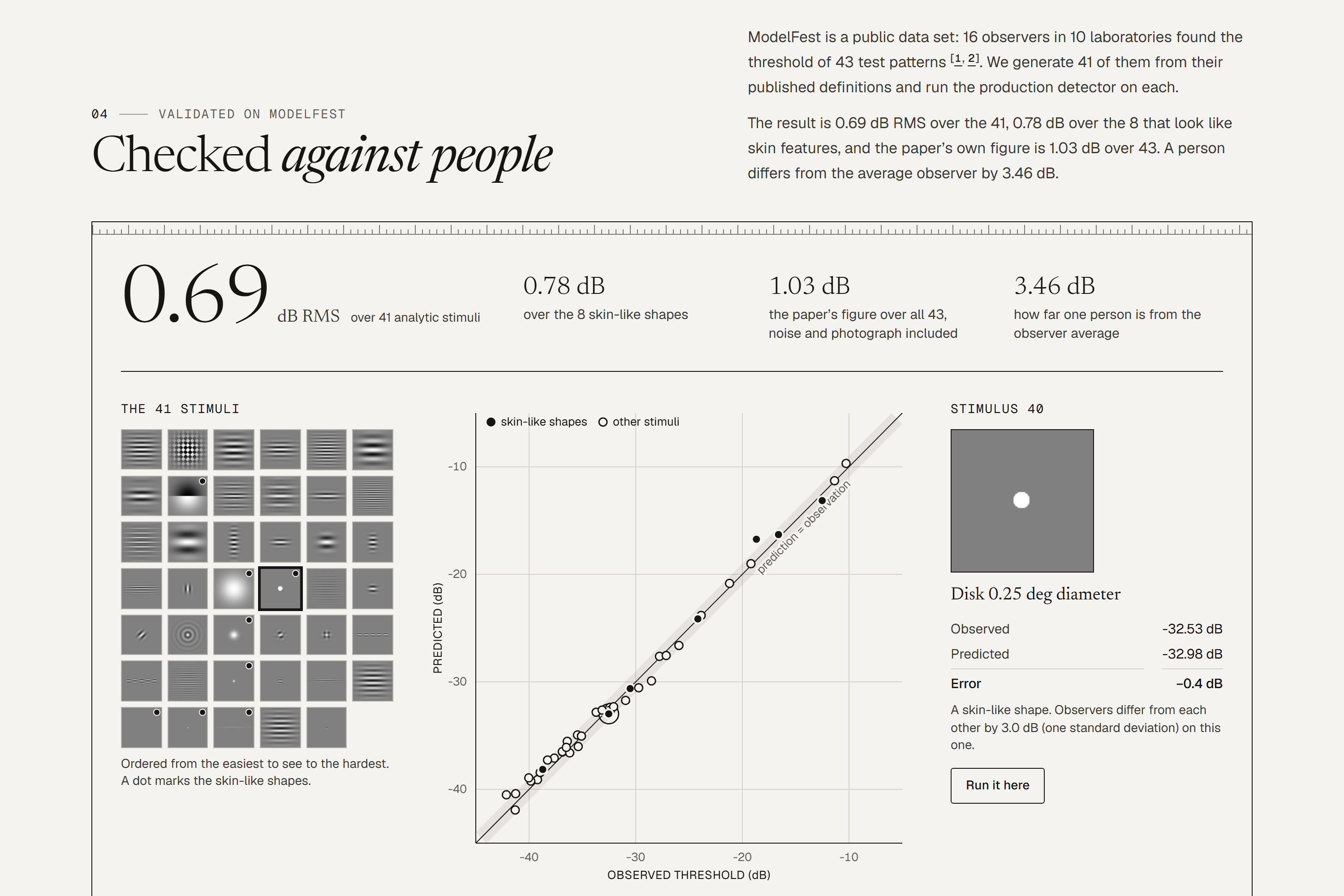
- Against people: we regenerated the ModelFest test patterns. Our implementation reproduces the thresholds of 16 observers in ten labs to 0.69 dB RMS over 41 patterns (0.78 dB over the 8 shaped like skin marks). That's a fifth of the 3.46 dB by which one person differs from the average. The paper's own figure is 1.03 dB over all 43.
- Against references: five ModelFest stimuli match an independent numpy implementation to 0.029 dB. The castleCSF port matches its reference to 4.2e-7 in log10.
- Reproducible:
- Every number in this text is generated into one ledger,
docs/NUMBERS.md, and a test fails if the ledger drifts from the code. - 412 unit and property tests (Vitest, fast-check).
- 63 end-to-end tests (Playwright), with axe scans asserting 0 violations on 14 routes.
/science, for technical readers. Interactive widgets run the same production functions that produce your results, with 15 inline-cited references.- The stack: Next.js 16, React 19, Tailwind 4, TypeScript strict, Zod,
sharp. - Built with Claude Code.
Why not just ask an AI?
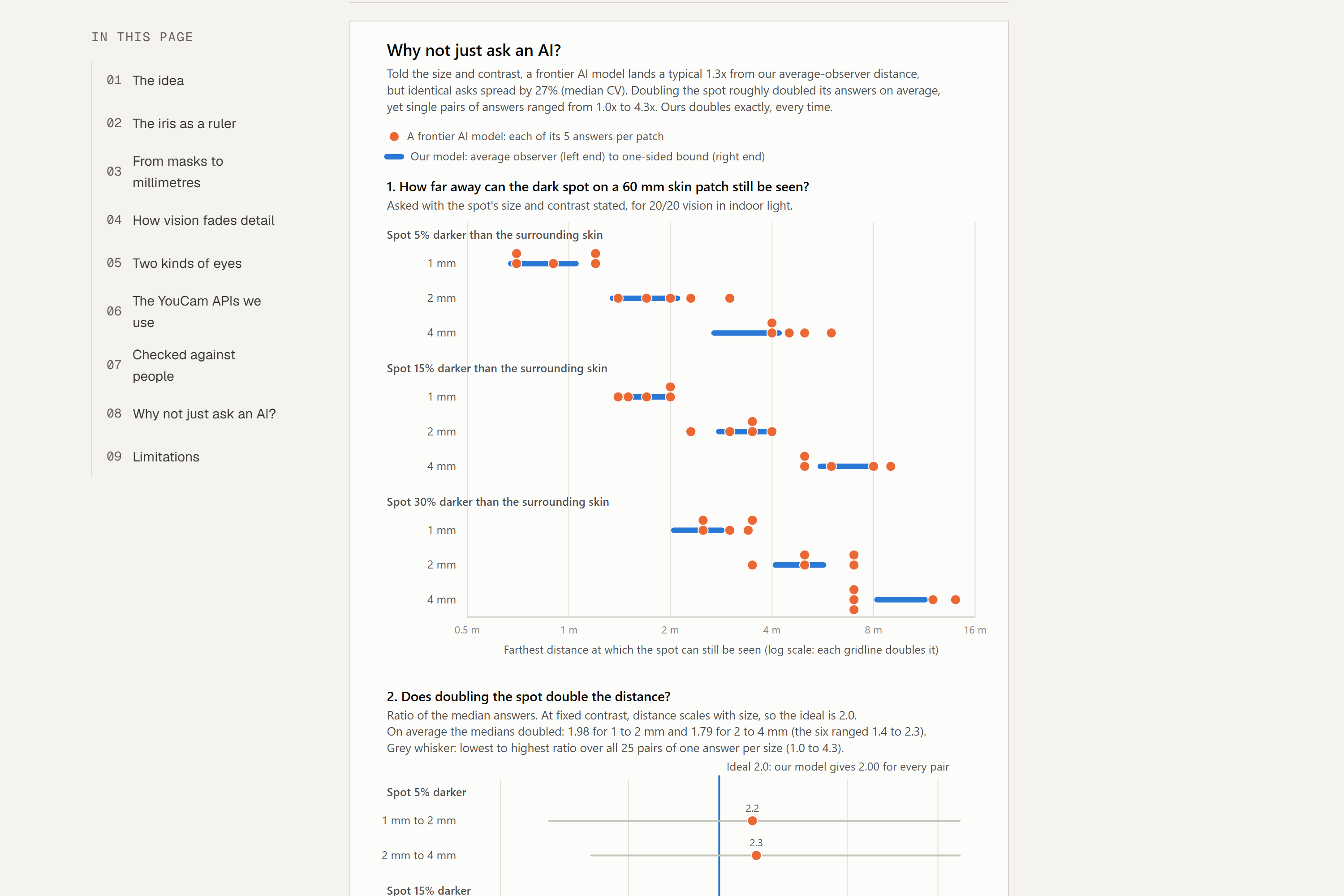
We asked. A frontier vision model (Claude Opus 5.5 on Amazon Bedrock) got the same questions, five times each: 65 calls, about $1.11.
- It knew the recipe. Told a spot's size and contrast, its median answer was 1.33x from ours (geometric mean). 23 of its 45 answers fell inside our range.
- But it doesn't give one answer. The same question, five times, gave answers up to 2.1x apart (median run-to-run spread 27%). Doubling a spot roughly doubled its answers on average, but single pairs ranged from 1.0x to 4.3x.
- On real faces it guessed. It said 0.8 m for pores on all four faces. It said "no breakouts" on three faces where YouCam had found 18, 5 and 3.
Arm's Length measures each face, gives the same number every run (a SHA-256 check), and scales exactly as geometry says. It knows the recipe; it can't measure your face. That's why the right place for an AI assistant is calling a measured tool like this one, rather than guessing. The prompts and every raw answer are in the repository.
Challenges we ran into
- The farthest mark lied. On the demo face one pore reaches 4.1 m for even perfect eyes, yet nine in ten are out of sight at 1.5 m for a typical observer. So we report shares at named distances.
- Comparing pixels honestly. A try-on render is shifted by an amount that differs per photo (one row on one face, three columns on another, none on a third), so we register every render before measuring it.
- Size isn't amount. Big, soft under-eye shadows are visible from far away on anyone, which says nothing about how much shadow you have. So the app says "a large, soft area, on everyone", not a distance.
- 1,000 units for everything. The build, the demo video and three weeks of judging share one free allowance. So the
demo faces replay recorded analyses, live mode is open but capped (a few analyses a day, and a floor of 300 units),
anyone who runs out can paste their own YouCam API key, and a submit is never retried, because one whose response was lost was still charged. The whole project has spent
[LEDGER: 184 + the video's live take]units. - A library that phones home. The face-landmark library posts usage telemetry to its vendor, with no off switch.
A
connect-src 'self'policy blocks it, and the face check still works.
Accomplishments that we're proud of
- An answer no score gives, "who can see this, and from where", with a receipt for every mark.
- A published vision model, rebuilt from scratch and checked against human data to 0.69 dB.
- Three YouCam APIs with distinct jobs, plus a drop-in layer any YouCam Skin Analysis customer could add free.
What we learned
- The question changes the answer. "How many pores do I have?" has a big number (450). "How many can anyone see across a table?" usually has a small one (about 37).
- Size dominates. Double a mark's size and it stays visible from twice as far.
- Measure first, then speak. Deterministic numbers made the product easier to test, to explain and to trust.
What's next
- A walk-back study with volunteers, comparing predicted and observed fade distances.
- An agent tool: a visibility skill an AI assistant can call.
- For brands: "out of sight across a table at 75% coverage" on a foundation's product page, computed on the shopper's own try-on.
Built With
- axe-core
- claude-code
- fast-check
- mediapipe
- next.js
- playwright
- psychophysics
- react
- sharp
- tailwindcss
- typescript
- vision-science
- vitest
- web-workers
- youcam-api
- zod
