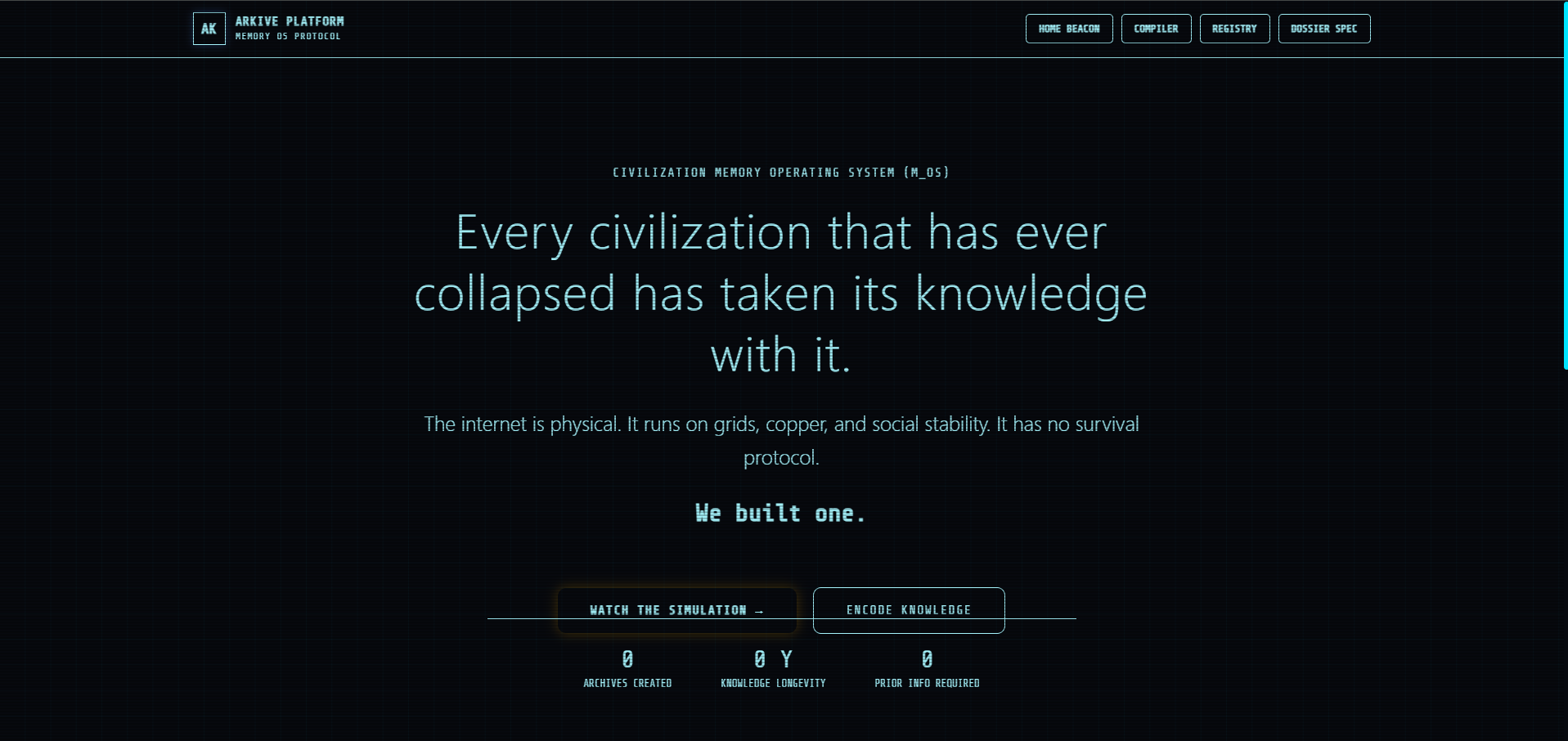
Inspiration Every civilization that has ever collapsed has taken its knowledge with it—Sumer, Alexandria, Rome, the Mayans. In each case, survivors could not reconstruct what was lost because knowledge was stored in formats that required the host civilization itself to decode.
Today, we store more information than at any point in human history, yet it is fundamentally fragile. The internet requires operational electrical grids, precise protocol standards (HTTP, DNS, TCP/IP), software interpreters, and persistent economic incentives. If any major pillar breaks at scale, our collective intelligence disappears. We haven't solved the vulnerability that destroyed the Library of Alexandria; we have simply scaled it.
ARKIVE was born from a contrarian question: How do you build a digital time capsule that contains its own instructions for being read by an intelligence with zero prior knowledge of our languages, technology, or software?
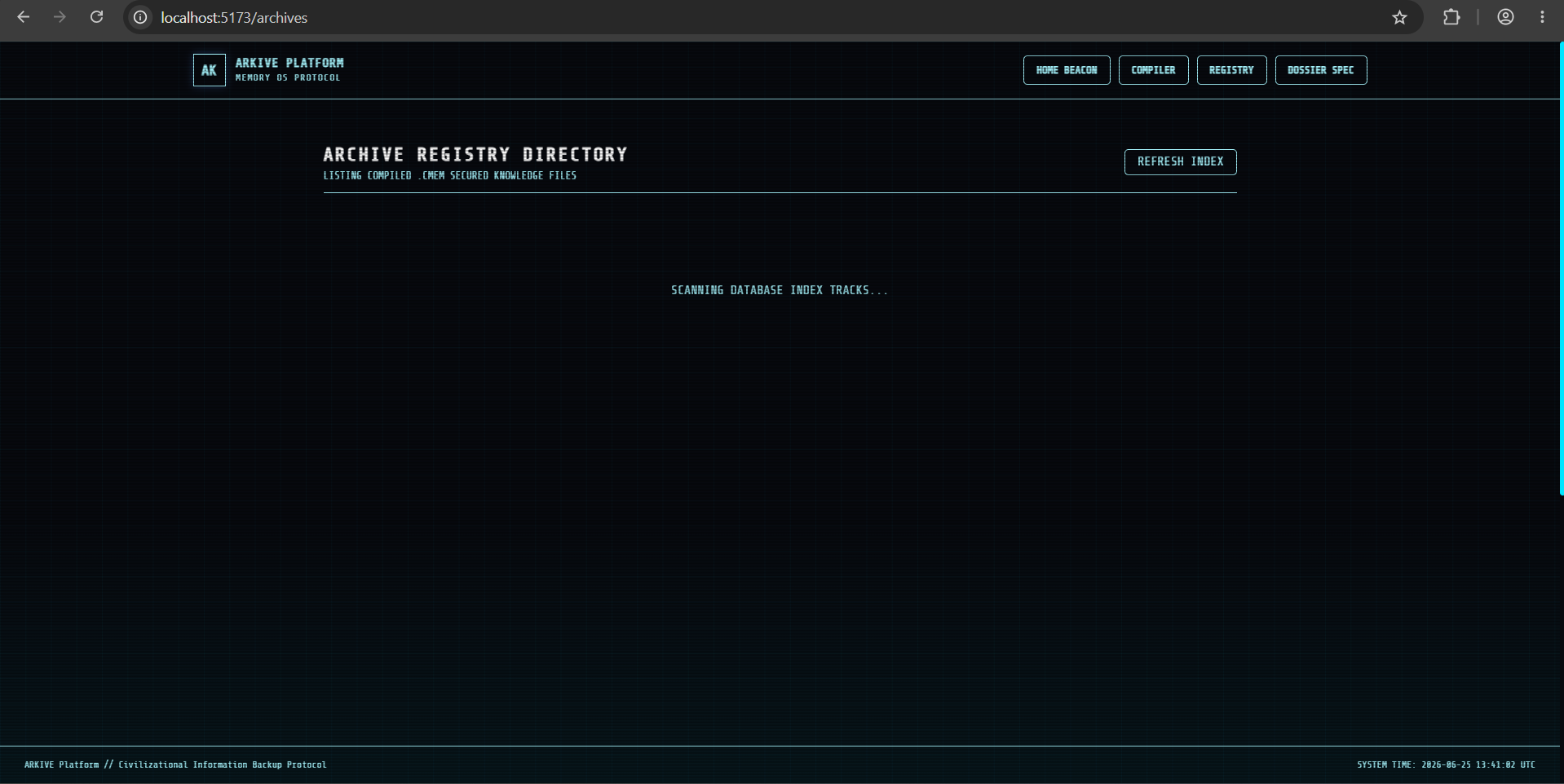
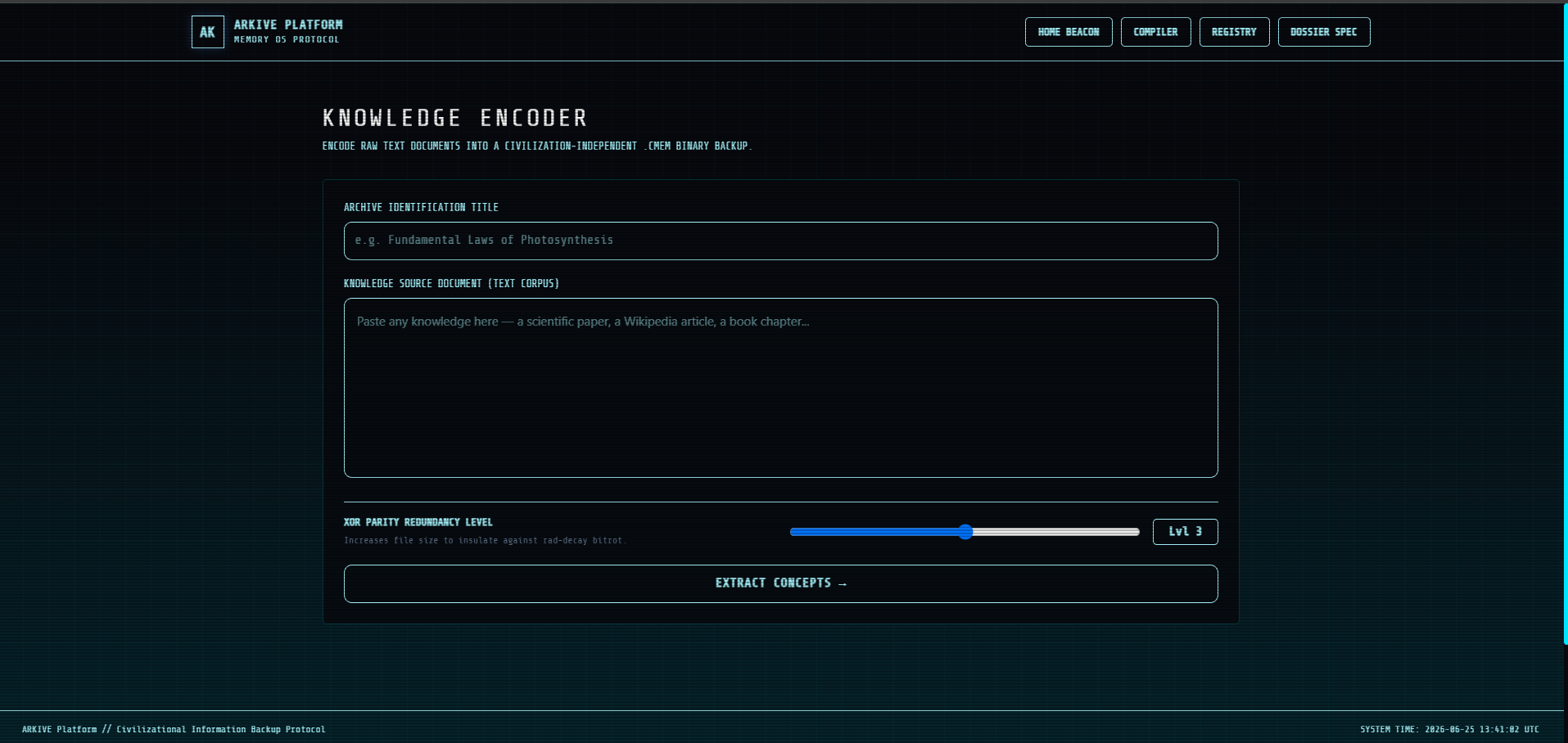
What it does ARKIVE is an operating system for civilizational memory. It ingests human knowledge (text, equations, diagrams), structurally optimizes it, and packages it into a custom .arkive format—a compressed, self-decoding knowledge archive designed to bootstrap a future intelligence back to human understanding from first principles.
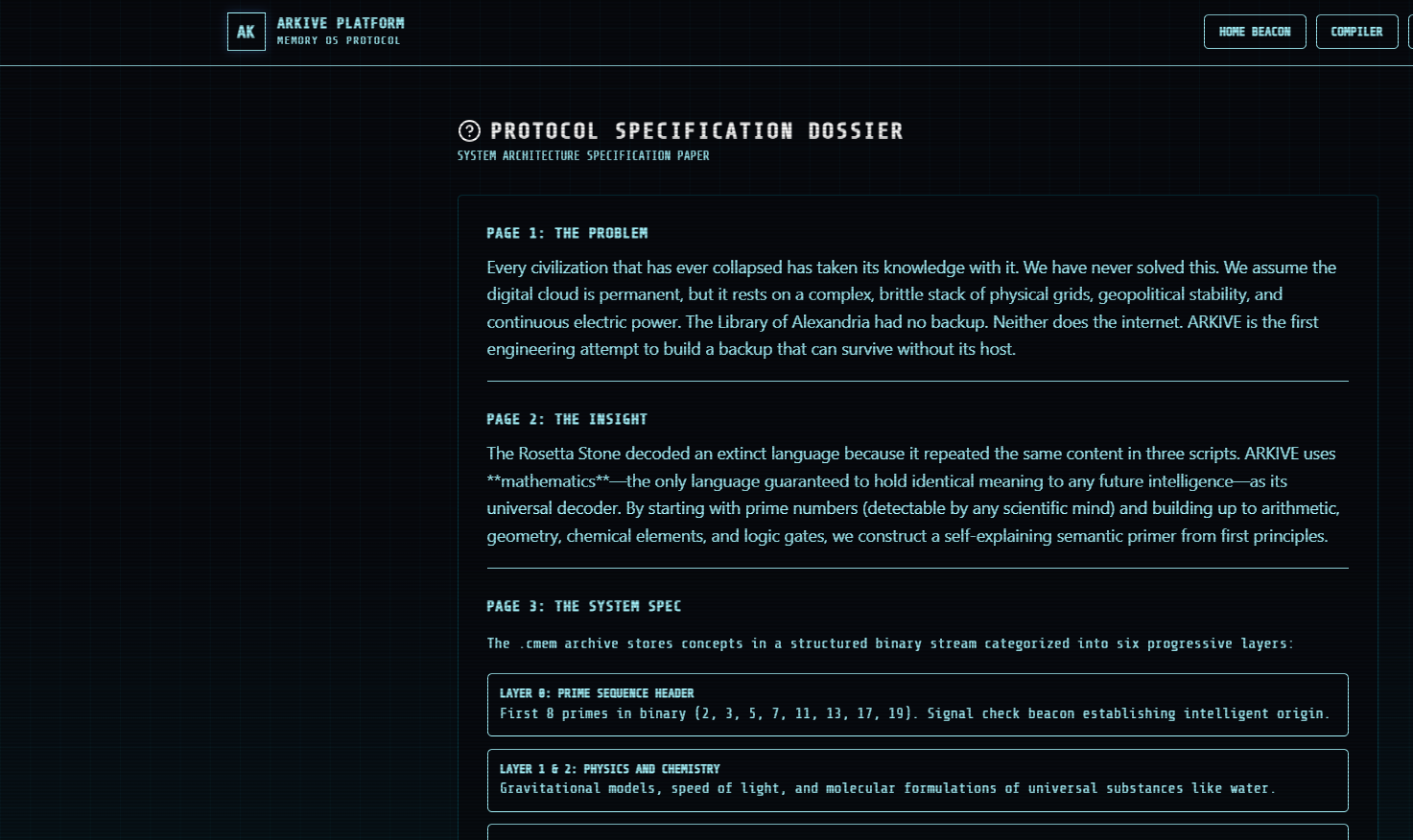
The Rosetta Bootstrap Header: Every file begins with a self-teaching mathematical primer. It uses mathematical universals (prime number sequences, Fibonacci counts, geometric ratios) to map quantities to symbols, symbols to words, and words to a minimal grammar structure.
Knowledge Graph Compression: Instead of storing flat text, it converts knowledge into semantic nodes and relationship edges, maps them to universal math anchors, and compresses them using a multi-layer pipeline.
Reconstruction Simulator: An immersive, cinematic dashboard that allows users to experience the archive from the perspective of a future scholar, watching the system decode itself layer by layer.
Survival Probability Calculator: An algorithmic scoring engine that tests the archive's resilience against six civilizational threat scenarios, including power grid failure, linguistic drift, and institutional collapse.
How we built it The platform is engineered using a robust, highly performant, and 100% open-source stack split into two distinct ecosystems:
The Core Processing Engine (Backend): Built using FastAPI and Python 3.11. Text and PDF data are processed using spaCy for custom semantic chunking. We bypassed high-level black-box abstractions to write our own data-compaction pipelines from scratch, including custom implementations of Huffman Encoding trees and LZ77 sliding-window dictionary compression. Semantic conceptual connections are structured using NetworkX graphs.
The Cinematic Interface (Frontend): Designed as a premium, minimalist, dark-themed system using React 18, Vite, and Tailwind CSS. The interactive, fluid conceptual maps are built directly with D3.js force-directed layouts, while the dramatic narrative steps in the Reconstruction Simulator use Framer Motion for precise micro-animations.
Data Persistence & Deployment: Metadata, archive schemas, and historical metrics are managed via a cloud-hosted MongoDB Atlas database. The entire ecosystem is deployed live, utilizing Render for the background processing API and Vercel for the client application.
Challenges we ran into Building an entire informational ecosystem from absolute scratch in a single week brought severe technical friction:
Deterministic Self-Decoding Logic: The conceptual paradox of creating a file format that explains its own structural decoding mechanism without relying on external libraries or operating system environments was incredibly difficult. We had to break text down to its absolute primitives, mapping logical propositions (AND, OR, NOT) into geometric and numerical patterns.
D3.js State Synchronization with React: Forcing D3’s direct DOM-manipulation paradigm to seamlessly bind with React’s declarative state updates without triggering rendering bottlenecks or erratic node tearing during layout simulation required writing custom, highly optimized react hooks.
Balancing Huffman and LZ77 Order of Operations: Achieving optimal compression ratios on semantic network data required deep tuning. Running LZ77 directly on the semantic nodes before building the Huffman bitstreams initially led to file bloating; we had to meticulously re-engineer the pipeline to pass delta-encoded relationship arrays through the compressors sequentially.
Accomplishments that we're proud of Building Custom Compressive Algorithms: Successfully implementing raw Huffman tree builders and dictionary-based sliding windows from absolute scratch instead of calling standard software packages.
The Universal Handshake: Designing a mathematical onboarding flow that successfully maps raw visual dot patterns and prime numbers into basic English linguistic structures without assuming any prior baseline.
A Unique Concept: Delivering a project that rejects the trend of building incremental wrappers, instead focusing on an ambitious, systems-level problem that looks decades into the future.
What we learned Information Theory Primitives: We gained a profound appreciation for Shannon entropy, structural redundancy, and the sheer complexity of moving data through deep time and space without degradation.
Constraint-Driven Engineering: Restricting the build to a 100% free stack forced us to optimize code efficiency, clear memory buffers aggressively, and maximize every kilobyte of computational space.
First-Principles Execution: The realization that the most impactful software architectures don't come from piling on more tools, but from ruthlessly stripping away assumptions until only undeniable truths remain.
What's next for ARKIVE Physical Medium Testing: Exporting the raw, compiled .arkive binary streams onto physical, high-durability mediums like long-term optical M-DISCs, laser-etched quartz glass, or magnetic tapes to evaluate true offline survivability.
Advanced Error Correction: Integrating native Reed-Solomon error correction matrices directly into the binary compiler to ensure the file can completely self-heal even if portions of the physical media suffer physical corruption or bit rot.
Multilingual Semantic Maps: Expanding the Rosetta Bootstrap sequence to bridge mathematical universals not just into English grammar, but into non-linear scripts and cross-cultural phonetic symbols, building a truly global civilizational anchor.

Log in or sign up for Devpost to join the conversation.