Inspiration
Arizona's arid climate means it’s dry and hot year-round. Walking to class, I can’t help but notice the sweat stain on my back—a constant reminder of the merciless sun. While we can’t stop the sun from shining, especially in Arizona, we can harness nature to fight against nature.
Trees, with 90-95% water in their stems, leaves, and roots, are natural warriors in this battle. Water's high heat capacity allows trees to absorb and dissipate heat, cooling their surroundings. Not only so, but trees are the main producers of oxygen on our Earth through photosynthesis.
Inspired by Arizona Tea, Arizona Tree was born from a desire to harness the power of trees to cool our environment. Our project is dedicated to fostering this natural battle between trees and heat, creating a greener, cooler future for Arizona.
What it does
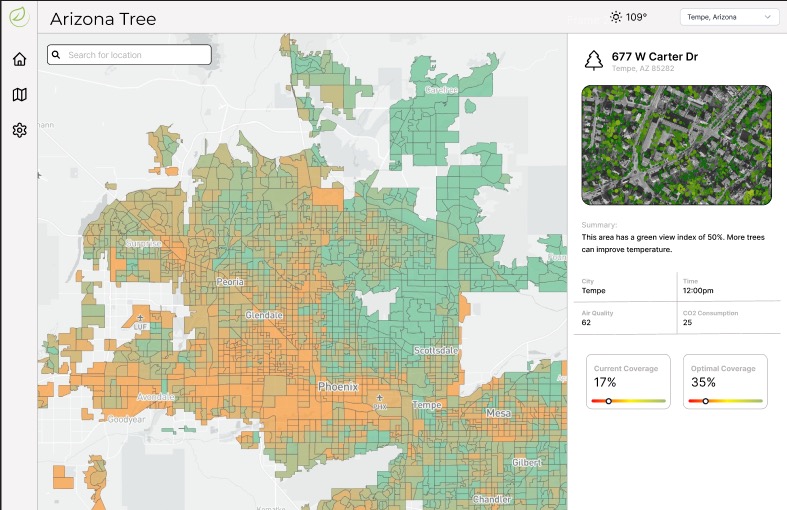
Our application features a specialized mapping tool that enables users to explore specific areas and assess tree density. The user will be able to look up those areas using geo-coding functions within the map. Then the application provides detailed insights into tree coverage, carbon levels, and heat intensity, and renders a comprehensive environmental snapshot using a machine-learning model that analyzes these data. Based on this data, the AI model recommends the optimal tree coverage percentage needed to create a cooler, more comfortable living environment.
How we built it
For frontend, we leverage Vite, TypeScript, and React.JS frameworks for a seamless, high-performance development experience, while Tailwind CSS ensures a modern, responsive yet simplistic design. On the backend, we use the power of Python and an advanced machine learning model to analyze environmental data and deliver precise recommendations.
Challenges we ran into
Implementing the map feature was by far the most challenging aspect of our project. Embedding a fully interactive map capable of analyzing tree density and coverage is a significant technical issue. Ensuring accuracy while delivering real-time data was no small feat at the same time. We had to train the model to be able to analyze the data and give accurate, meaningful results. By all means, this project was easy to visualize yet hard to implement.
Equally demanding was designing a UI/UX that balanced simplicity with functionality. We aimed for an interface that was intuitive yet powerful, making it easy for users to navigate. Achieving this balance between accessibility and comprehensive data presentation was critical to the success of our application.
Accomplishments that we're proud of
Despite the numerous challenges we faced, we persevered as a team, ultimately gaining a deep understanding of how each feature works in our application. We successfully implemented the mapping functionality, allowing users to explore tree coverage, while our machine-learning model accurately predicts environmental data. This breakthrough enabled the AI to generate detailed outputs, highlighting all trees and vegetation within specific regions.
Additionally, we intricately crafted the UI, ensuring a visually appealing and user-friendly experience. Every design choice was made to enhance engagement and provide an intuitive interface that aim to support the app’s advanced capabilities.
What we learned
After conducting in-depth research, we discovered a critical issue in Arizona—an alarmingly low level of canopy coverage that directly leads to soaring heat levels across the state. This issue is especially concerning in less wealthy neighborhoods, where the lack of trees amplifies the already extreme heat. The stark contrast between these areas and wealthier regions, such as Peoria, is evident. In Peoria and similar areas, the abundance of trees creates a lush, green environment that naturally cools the surroundings, leading to a more comfortable and livable neighborhood. This highlights the environmental inequality that exists, where less wealthy communities endure harsher living conditions simply due to the absence of green spaces.
Recognizing this imbalance, our mission is to ensure that everyone, regardless of their neighborhood, can experience the comfort and relief that comes from a well-covered, tree-rich environment.
Our goal is not just to address the temperature disparity but to foster healthier, more sustainable communities across Arizona. Through the power of technology and nature, we aim to promote a cooler, greener future where every community can enjoy the benefits of shade, improved air quality, and a more comfortable living environment. We believe that with the right tools and knowledge, everyone can take part in the effort to combat the heat and create a more equitable and sustainable Arizona for future generations.
What's next for Arizona Tree
Currently, Arizona Tree is focused on the regions within Arizona, where the effects of extreme heat and low tree coverage are most critical. However, our vision extends beyond the state. In the near future, we plan to expand our efforts to the entire Southwest region, which shares a similar arid climate and faces many of the same environmental challenges. This expansion will allow us to tackle the broader issue of heat and tree coverage in areas that, like Arizona, are in desperate need of greener, more livable environments.
Additionally, we are excited to introduce a new feature that will enable users to create and participate in tree-planting events. This feature will foster community involvement by connecting individuals who share the goal of making their neighborhoods more sustainable. By bringing people together to plant trees, we hope to empower local communities to take action in the fight against rising temperatures and environmental degradation.
Our ultimate goal is to make Arizona Tree not just a tool for assessing tree coverage, but a platform for collective action. Through this feature, we aim to amplify our impact by encouraging large-scale participation in greening efforts, making the Southwest a cooler, greener, and more sustainable region for everyone.
Built With
- axios
- python
- react
- tailwind
- typescript
- vite


Log in or sign up for Devpost to join the conversation.