Inspiration
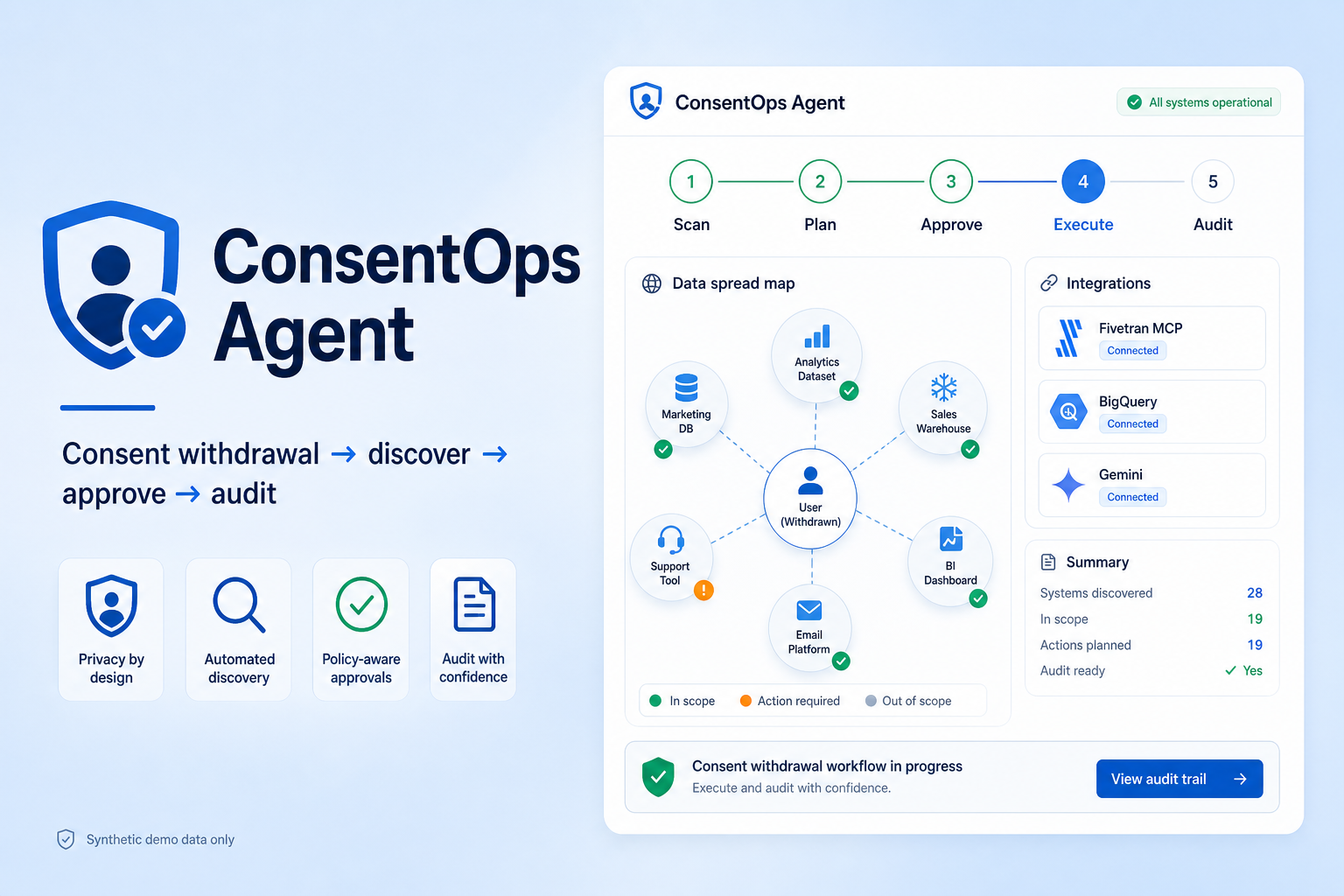
When someone withdraws consent, their data rarely sits in one table. It spreads across CRM, commerce, support, marketing, analytics, and payments—often landed in a warehouse by Fivetran. Most demos stop at policy slides. I built ConsentOps Agent to model the full operational loop: discover → plan → human approve → execute → live re-scan → audit.
What it does
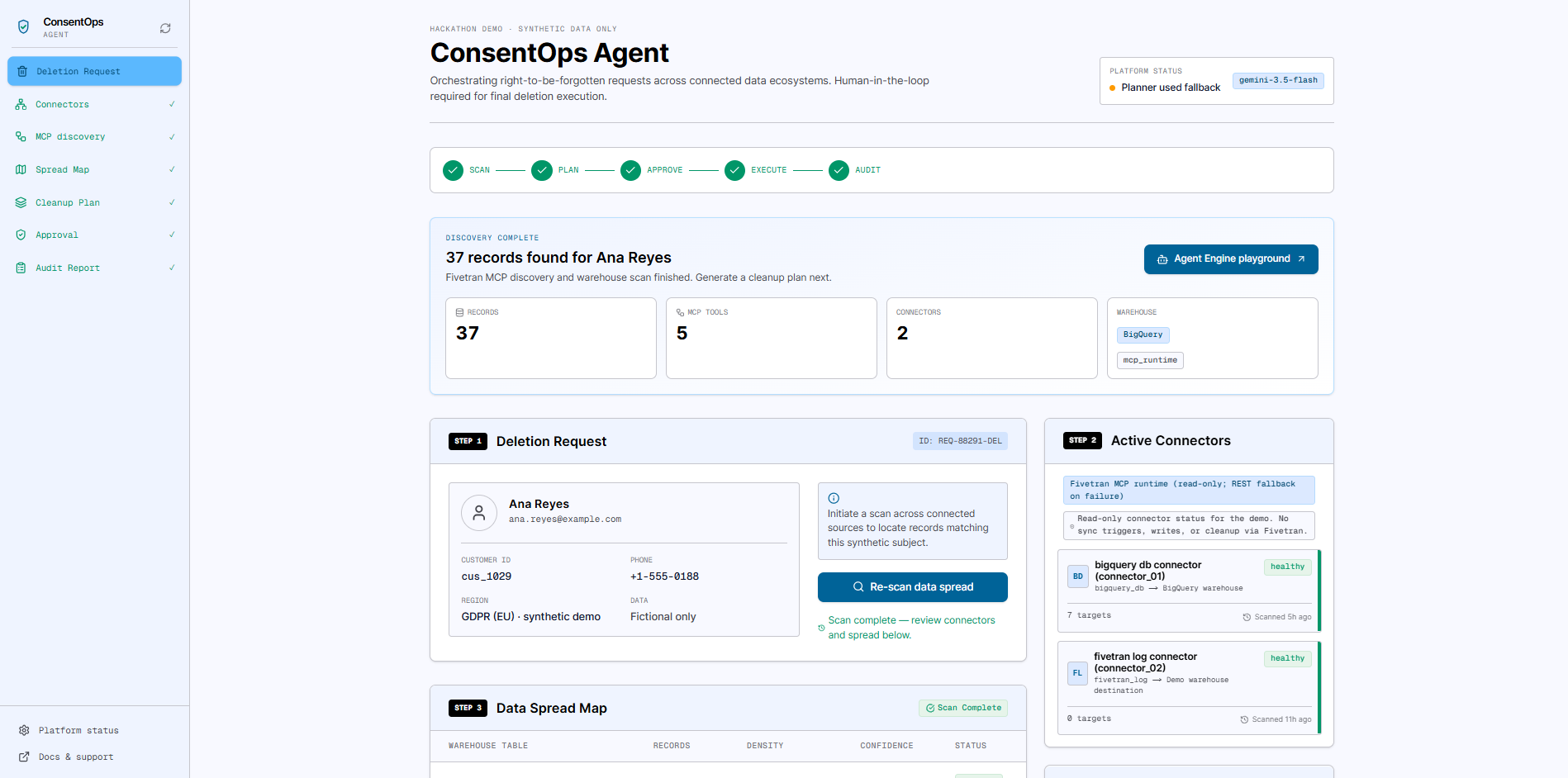
ConsentOps Agent helps operators respond to a consent withdrawal for a synthetic subject (Ana Reyes):
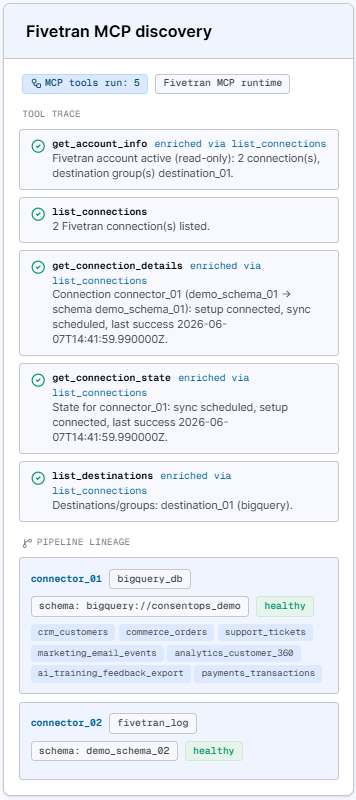
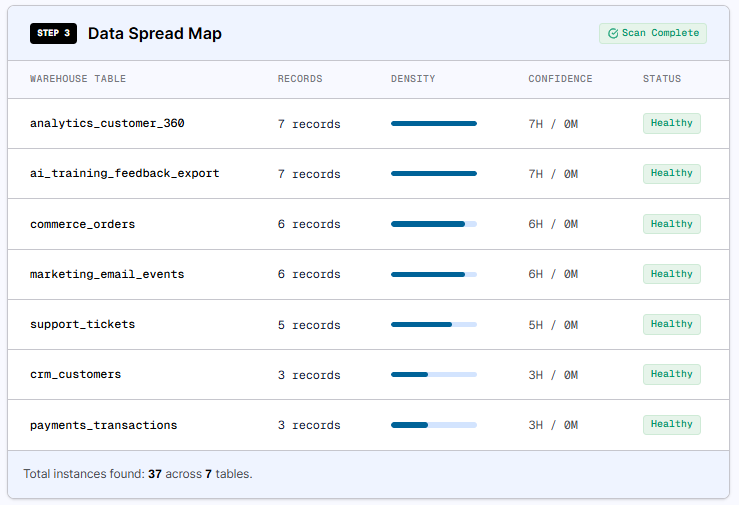
- Scan — Read-only Fivetran MCP discovery (connections, sync state, destinations) plus a BigQuery warehouse scan across seven demo tables (37 matches when fully seeded).
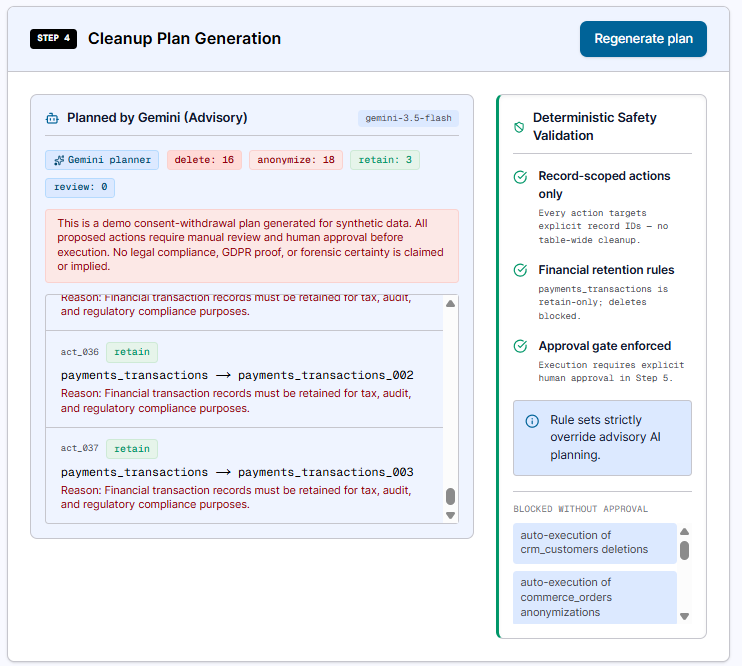
- Plan — Gemini (or deterministic fallback) classifies every record:
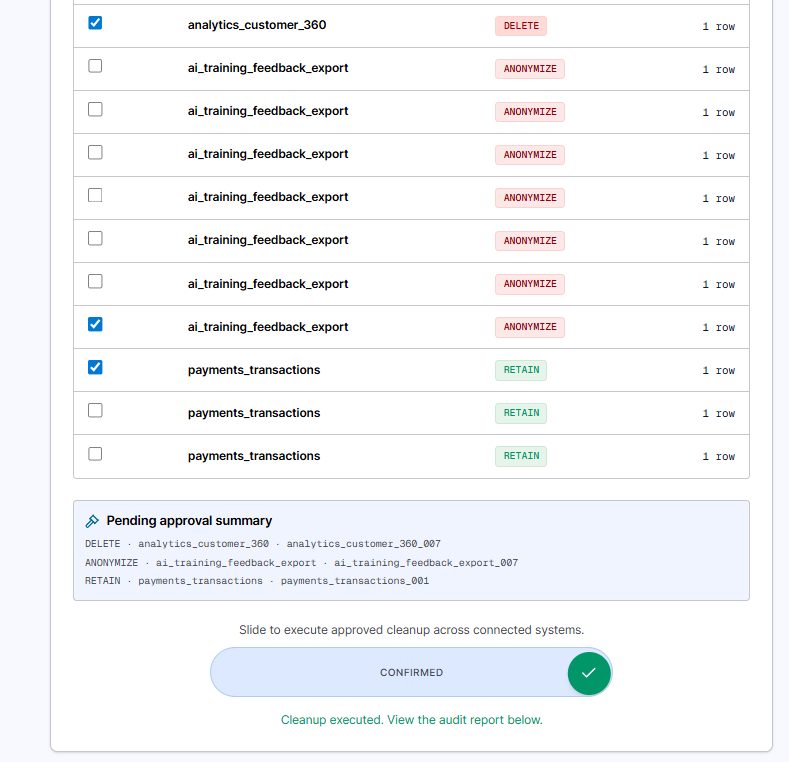
delete,anonymize,retain(with reason), orreview. - Approve — Reviewer selects specific action IDs (e.g. one delete, one anonymize, one retain)—not approve-all.
- Execute — Only approved actions run against BigQuery; payment deletes are blocked by policy.
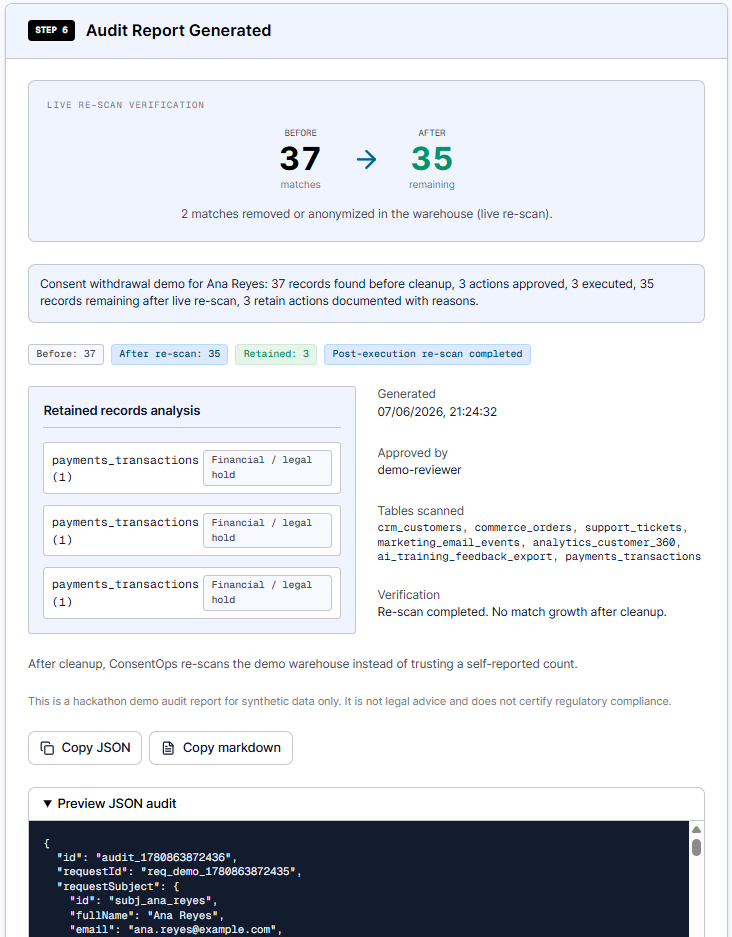
- Verify — Live re-scan (e.g. 37 → 35 after one delete + one anonymize; retain stays).
- Audit — JSON + markdown report of connectors inspected, actions run, and records remaining.
Synthetic demo data only. Not legal advice or compliance certification.
How I built it
- Next.js / TypeScript dashboard with a five-phase workflow (Scan → Plan → Approve → Execute → Audit).
- Fivetran MCP (read-only,
FIVETRAN_ALLOW_WRITES=false) via Cloud Run runtime + REST fallback for connector status. - BigQuery synthetic warehouse (
npm run bigquery:setup) with scan / execute / verify modes. - Gemini cleanup planner with deterministic safety validation and fallback.
- Agent APIs (
POST /api/agent/scan,/plan,/fivetran) for Google Cloud Agent Builder / ADK integration; optional Vertex AI Agent Engine deploy. - 159 Vitest tests covering approval gates, classification rules, and public API sanitization.
Challenges I ran into
- Wiring Fivetran MCP on Cloud Run while keeping the demo read-only and safe for public judges.
- Aligning live BigQuery match counts with fixture data (re-seed via
bigquery:setup). - Redacting raw Fivetran connection/schema IDs on public agent endpoints without breaking internal discovery.
- Keeping human-in-the-loop UX honest—the approval slider only completes after successful execution.
Accomplishments that I'm proud of
- End-to-end multi-step agent (not chat-only): MCP discovery → warehouse scan → Gemini plan → explicit approval → DML execute → live verify → audit.
- Safety layer: no table-wide deletes, payment protection, plan binding, demo-mode subject allowlist.
- Fivetran + BigQuery narrative: pipeline lineage on scan links ingestion to the warehouse ConsentOps cleans up.
- Production-minded Cloud Run deployment with OpenAPI spec and Agent Builder playbook.
What I learned
- Fivetran MCP is strongest for agent tool-calling at scan time; REST is a good read-only fallback for status panels.
- Judges care about live proof (match counts, before/after re-scan) more than architecture diagrams.
- Gemini plans must pass deterministic validation before any destructive work is offered to a human reviewer.
What's next for ConsentOps Agent
- Connector-scoped retention policies in the audit narrative.
- Optional Agent Engine playground deep-link from the dashboard.
- Broader warehouse adapters (still synthetic-only for demos).
Try the hosted demo: https://consentops-agent-538209538110.us-central1.run.app/
Built With
- bigquery
- docker
- fivetran-mcp-server
- fivetran-rest-api
- gemini-api
- google-adk
- google-cloud-run
- model-context-protocol-(mcp)
- next.js
- node.js
- react
- tailwind-css
- terraform
- typescript
- vertex-ai-agent-engine
- vitest
- zod

Log in or sign up for Devpost to join the conversation.