-
-
Opening
-
Guilt Screen snap
-
Guilt screen snap
-
generating interest
Inspiration
Most habit apps are designed to make you feel good about opening them. We built Arise because that's exactly the problem.
The people who need habit change the most aren't lacking motivation — they're lacking stakes. They've downloaded Habitica, Streaks, and every "build a better you" app on the App Store. They ghosted all of them by Week 2. Not because the apps were bad, but because the apps were too kind. They rewarded showing up. They never punished disappearing.
The inspiration came from two unlikely places: Solo Leveling (the anime where a weak hunter grinds hidden stats to become the world's strongest) and Duolingo's dark patterns (streak anxiety, guilt owls, the feeling that the app notices when you're gone). What if a habit tracker had the progression system of an RPG and the re-engagement ruthlessness of Duolingo — but played completely straight, no cartoon mascots?
Arise is that app.
What it does
Inspiration Most habit apps are designed to make you feel good about opening them. We built Arise because that's exactly the problem.
The people who need habit change the most aren't lacking motivation — they're lacking stakes. They've downloaded Habitica, Streaks, and every "build a better you" app on the App Store. They ghosted all of them by Week 2. Not because the apps were bad, but because the apps were too kind. They rewarded showing up. They never punished disappearing.
The inspiration came from two unlikely places: Solo Leveling (the anime where a weak hunter grinds hidden stats to become the world's strongest) and Duolingo's dark patterns (streak anxiety, guilt owls, the feeling that the app notices when you're gone). What if a habit tracker had the progression system of an RPG and the re-engagement ruthlessness of Duolingo — but played completely straight, no cartoon mascots?
Arise is that app.
What it does Arise runs a single, finite 66-day program — the psychological window research suggests for habit formation. No infinite streaks. No "start again Monday." One arc with a beginning, a middle, and an end.
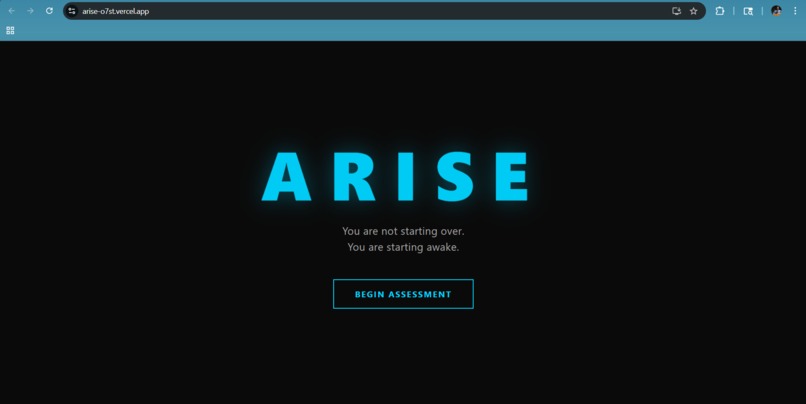
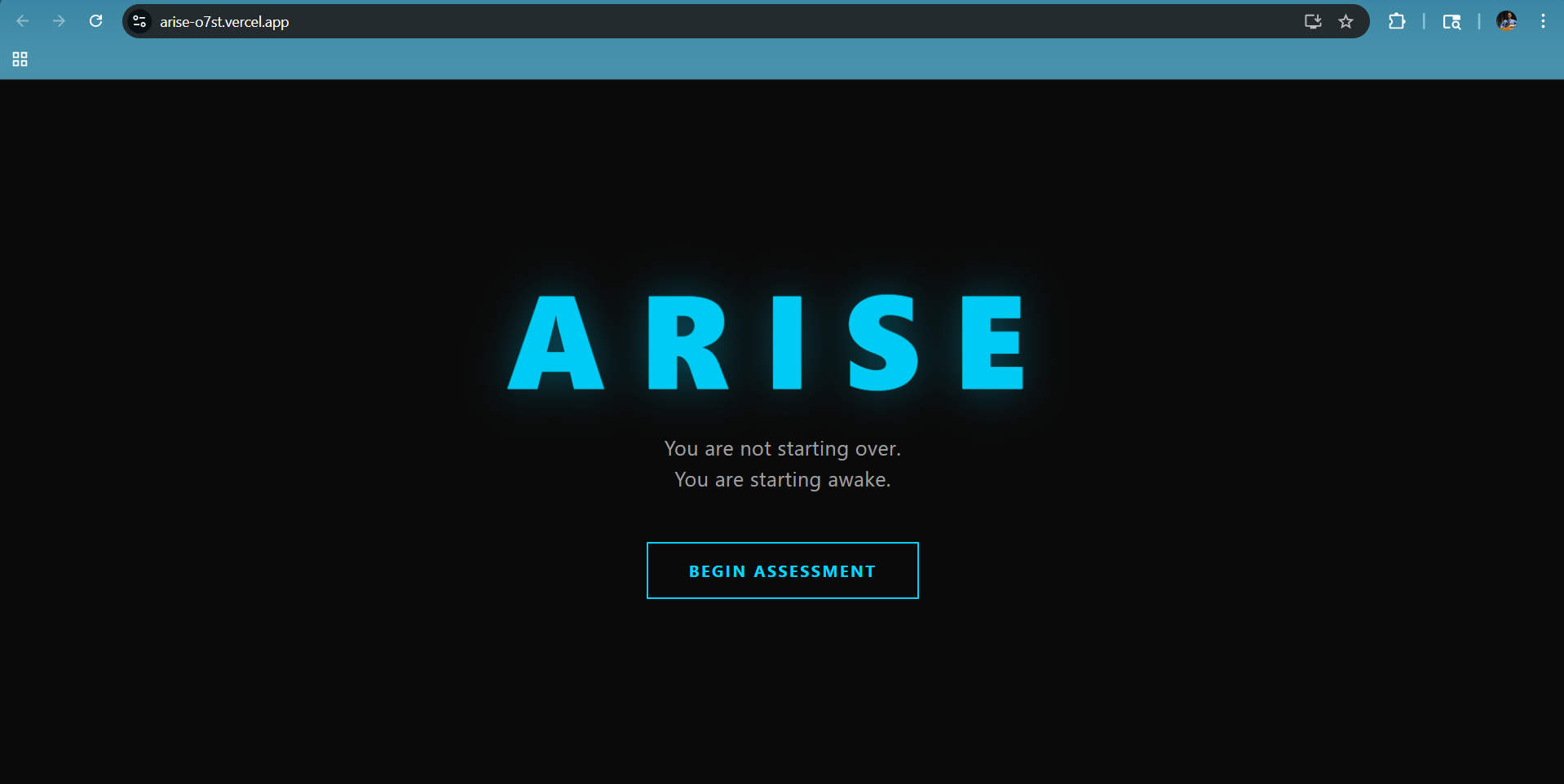
The onboarding starts with a ThresholdScreen: dark, minimal, one charged line of copy — "You are not starting over. You are starting awake." — and a single CTA. The diagnostic questions that follow are deliberately uncomfortable. The multiple-choice options aren't neutral ("I want to improve") — they're specific enough to sting ("I've been saying 'I'll start Monday' for months").
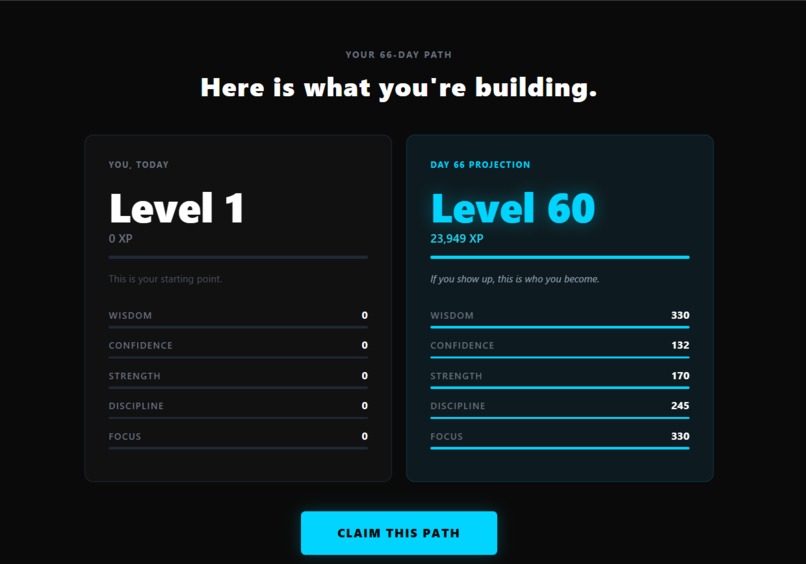
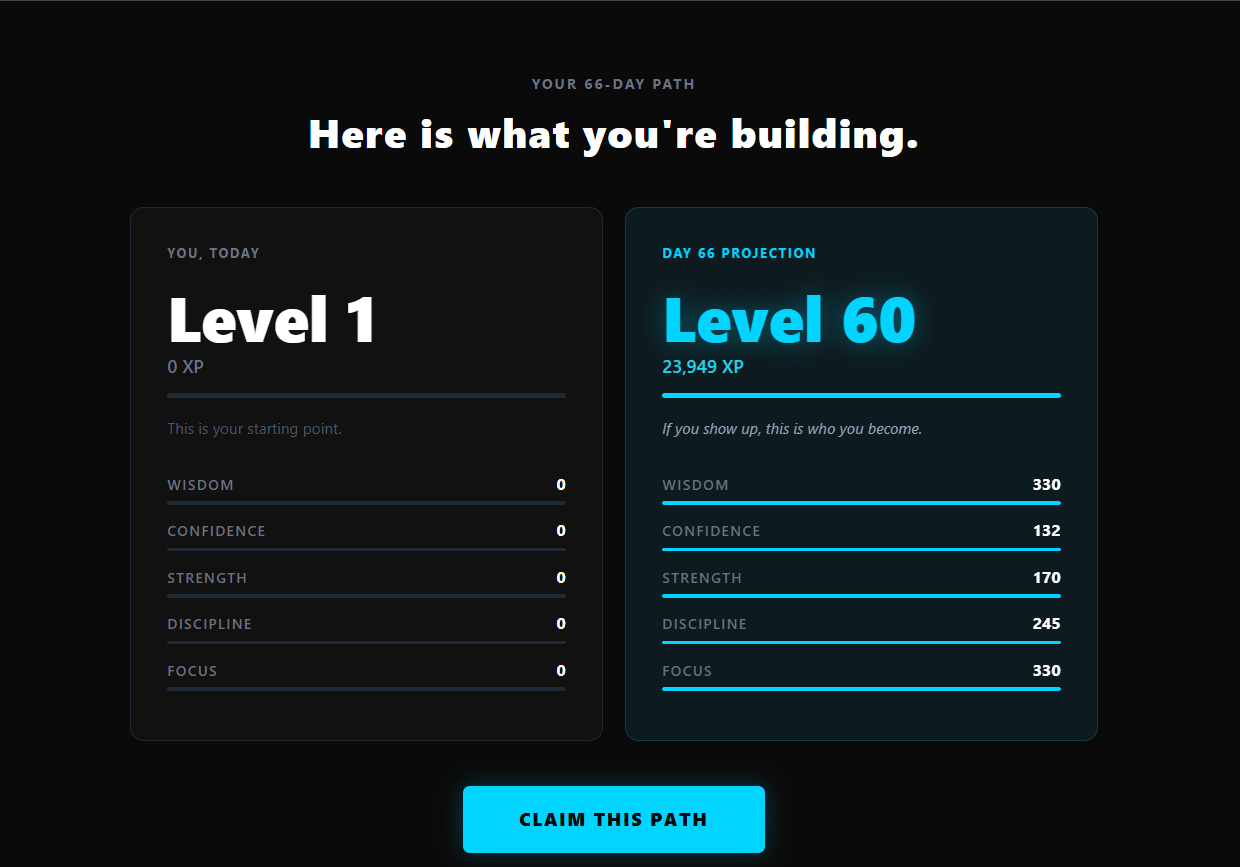
The plan confirmation shows the mathematical gap between who you are on Day 1 and who you'll be on Day 66 if you actually show up. Five RPG stats — Wisdom, Confidence, Strength, Discipline, Focus — animate from 0 to their projected values.
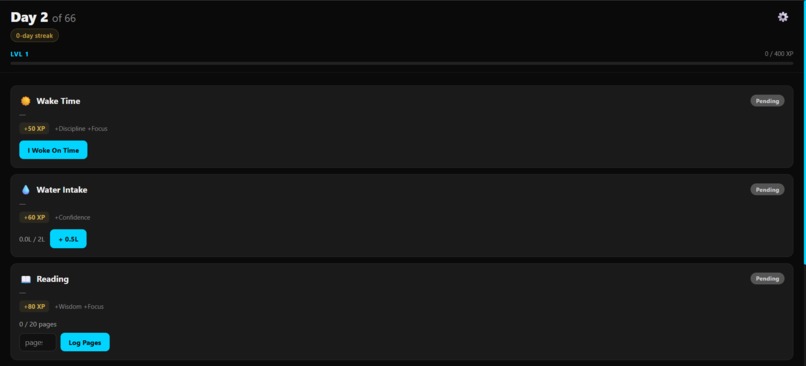
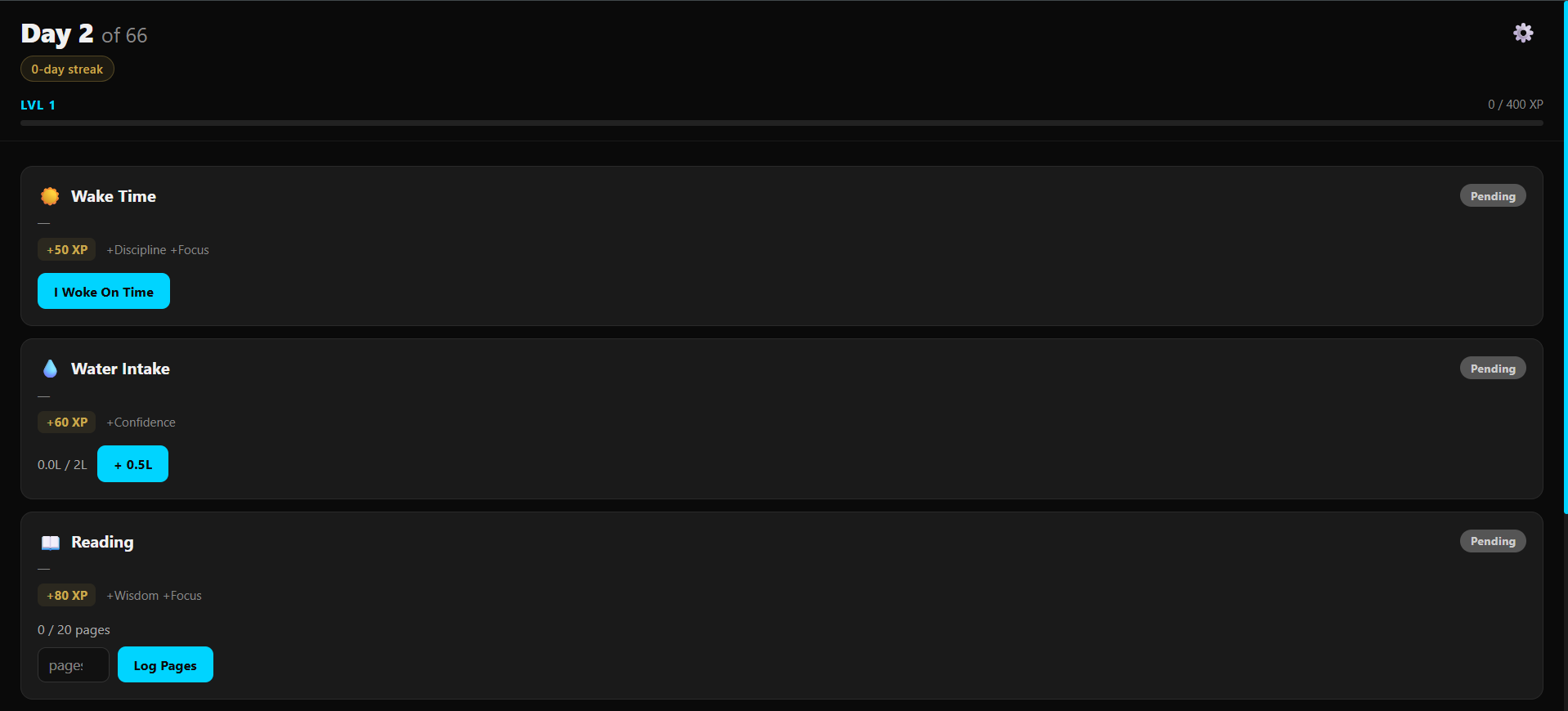
The daily dashboard shows 4–6 quest cards with live status chips: Done (green), Pending (neutral), At-Risk (amber), Easy Win (cyan). Status is computed, not stored — it updates every 60 seconds based on time of day and completion state. Each quest type has a distinct logging interaction: wake time is a single tap, water is an increment counter, cardio and training use a real countdown timer, reading accumulates pages, screen time is a manual entry.
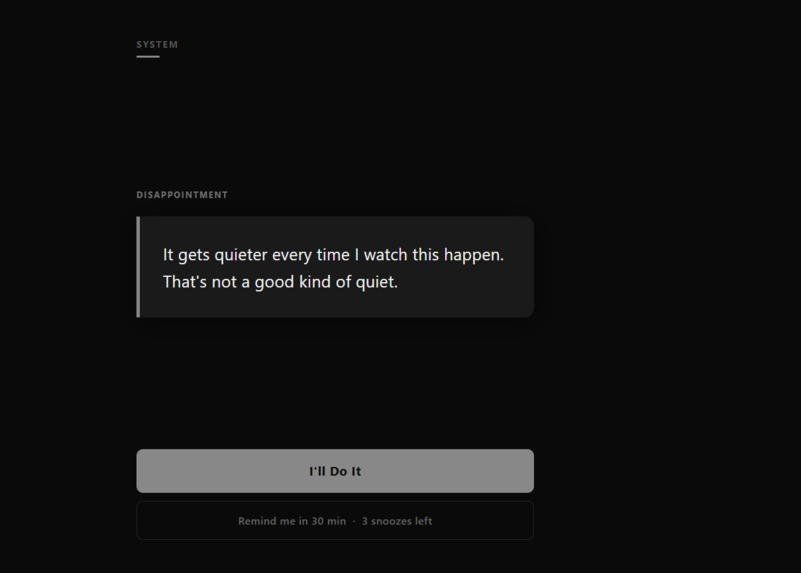
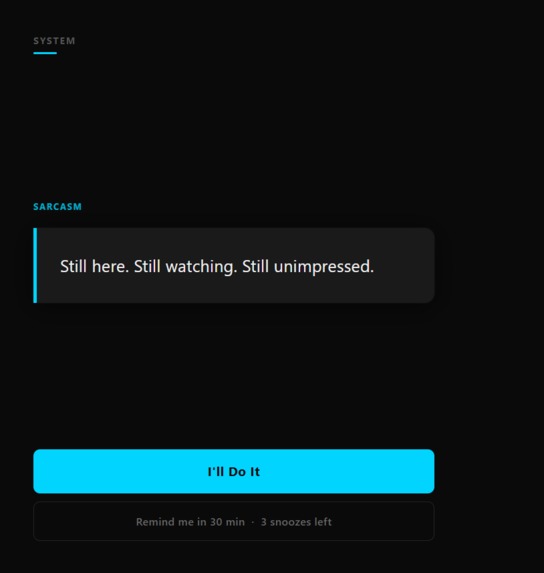
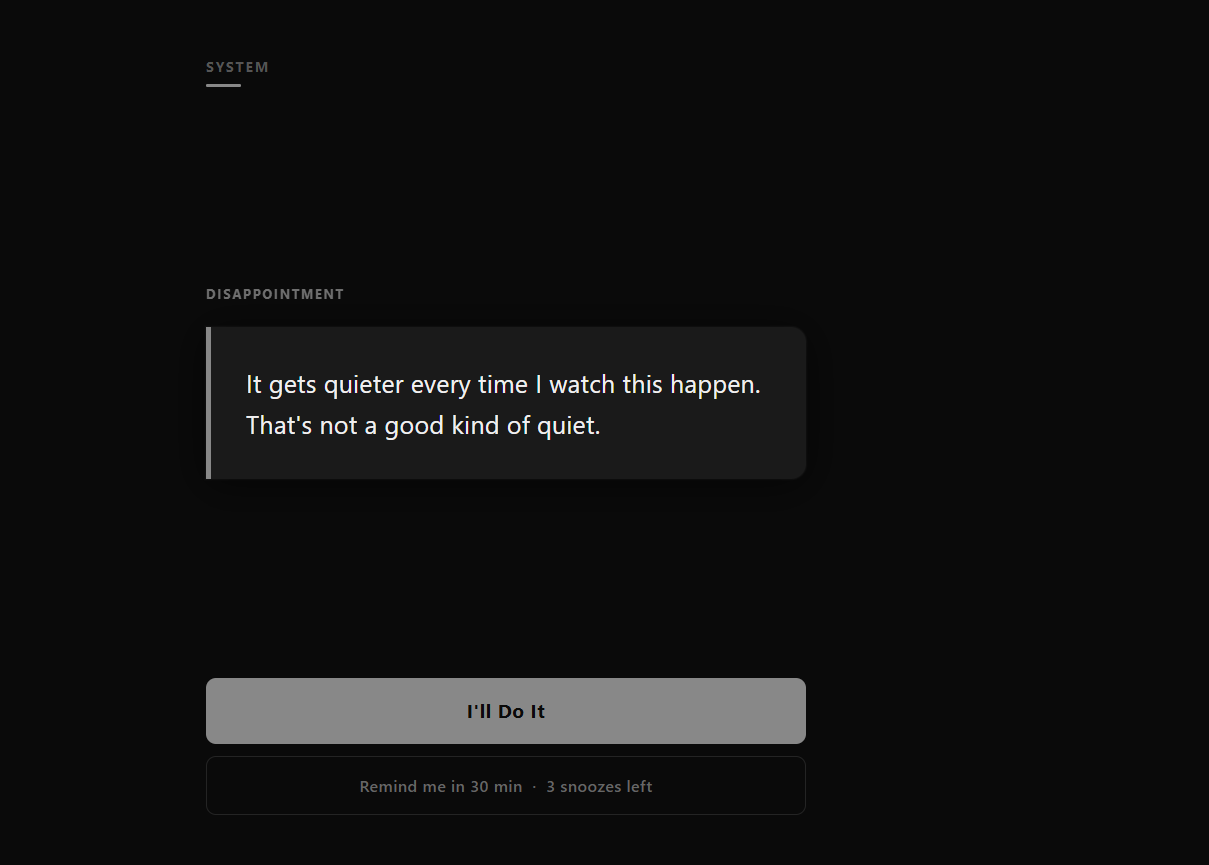
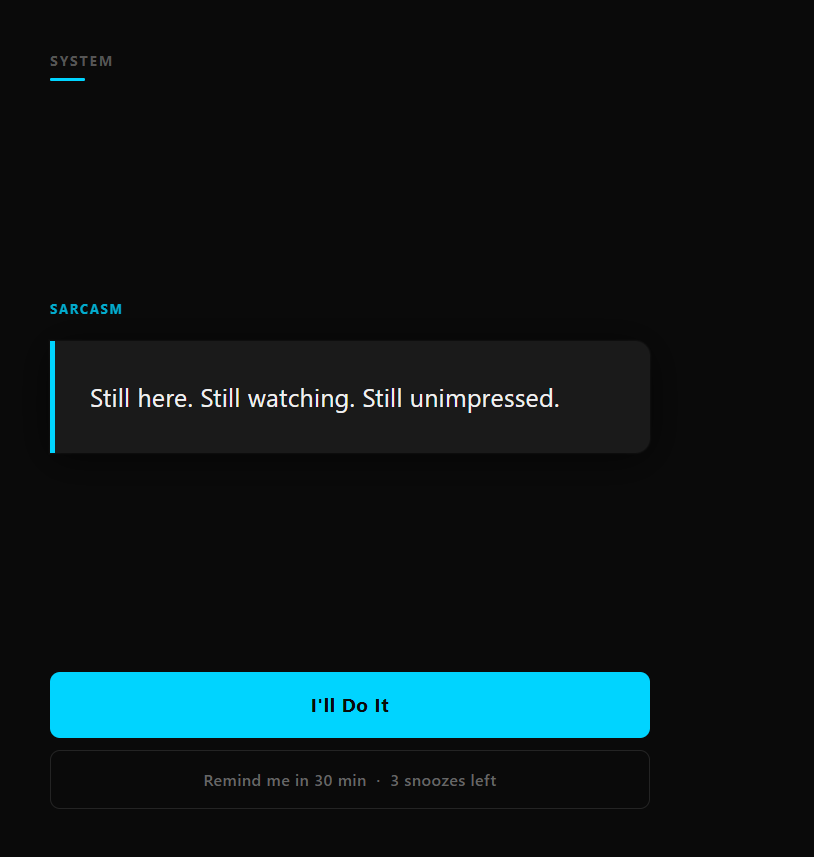
The guilt screen is the app's signature feature. When the clock passes your check-in time and you're below 50% completion, the dashboard is replaced by a light-novel chat interface. "System:" appears. A message is selected from 90 hand-written messages across three tones — sarcasm, disappointment, pressure — with no immediate repeats. You get 3 snoozes. On the 4th encounter, snooze disappears. You choose: "I'll Do It" or "Give Up on Today."
The rollback mechanic creates real stakes. Three consecutive days of failure triggers a rollback to the most recent 7-day checkpoint snapshot — XP, stats, and day counter all reset. Progress is not permanent until it's earned consistently.
How we built it
Arise is a pure frontend app — no backend, no auth, no cloud sync. All state lives in five localStorage keys.
Layer Tool Framework React 19 Build tool Vite 6 Styling Tailwind CSS v4 (CSS-first, @theme variables) Components shadcn/ui (manual install — full code ownership) Persistence Browser localStorage Deployment Vercel (GitHub auto-deploy) The architecture is a single-file screen state machine: App.jsx reads currentScreen from a useReducer-backed context and renders the matching component. No React Router — all navigation is dispatch({ type: 'NAVIGATE', screen: '...' }). This keeps navigation programmatic, which is essential for time-triggered screens (guilt at 8 PM, day transition at midnight).
The business logic lives entirely in pure functions in src/logic/ — no React imports, no side effects. getQuestCards(), getStatProjection(), checkRollback(), shouldTransition() are all plain JS. This made them easy to reason about and easy for AI tools to modify without breaking component logic.
The 90 guilt messages were written as part of the build — sarcasm, disappointment, and pressure tones, each with 30 messages designed to sound like a system that has been watching you specifically.
Challenges we ran into
The midnight check edge case. The useMidnightCheck hook ran on every screen — including during onboarding — and shouldTransition(null) returned true for any null lastOpenDate. This caused the app to immediately fire ADVANCE_DAY the moment a new user reached the dashboard for the first time, jumping them to Day 2 before Day 1 had started. Fixed by guarding the hook behind programStartDate and changing null to mean "not started" rather than "transition now."
XP double-awarding on reload. The WaterCTA component used a useEffect that auto-dispatched LOG_QUEST_COMPLETION whenever current >= target — including on mount, when current was initialized from already-completed completionData. Every reload added 60 XP. Fixed by removing the useEffect and dispatching only on button click, plus adding an idempotency guard in the reducer using a xpAwardedFor map per day.
Tailwind v4 on Vite 6. Tailwind v4's CSS-first config (@theme in CSS, no tailwind.config.js) required the @tailwindcss/vite plugin rather than PostCSS. Node 22.11.0 was also below the threshold for Vite 8's native Rolldown bindings, requiring a downgrade to Vite 6.
Accomplishments that we're proud of
The guilt screen. It works exactly as designed — a full-screen swap (not a modal), a light-novel aesthetic, messages that feel personal rather than generic, escalating pressure as snoozes run out, and a forced binary on the 4th encounter. It's the feature most likely to make someone put their phone down and go do the thing.
The rollback mechanic is genuinely punitive in a way that feels fair. Checkpoints at every 7-day milestone mean the rollback target is never more than a week behind — enough to sting, not enough to destroy.
The stat projection math means every onboarding decision has a visible consequence. A user who sets 5 cardio sessions per week sees a meaningfully higher Strength projection than one who sets 2. The app earns its "personalized" feel without any backend.
What we learned
Spec-driven development compounds. The time spent in /scope, /prd, /spec, and /checklist before writing a line of code meant that when building started, every decision had already been made. The build was execution, not exploration. Edge cases that would have been discovered mid-build (the rollback snapshot requirement, the task stacking mechanic, the one-time settings window) were surfaced and resolved at the planning stage.
Pure functions in logic/ were the right call. Every time a bug appeared, the fix was either in a component (UI state) or a pure function (business logic) — never tangled between them. The separation made debugging fast and made AI-assisted building dramatically more effective.
LocalStorage-only is underrated for single-user apps. Zero deployment complexity, zero cold-start latency, zero backend cost. For a 66-day personal program where data lives on your device anyway, it's the right default.
What's next for Arise — 66-Day Life Reset
Grace period at program start — if onboarding completes late in the day, prompt the user to start Day 1 tomorrow rather than immediately Weekly habit calendar — a 7-day strip on the dashboard showing which days were full completions, partial, and give-ups Cross-device sync — swap localStorage.js for a Supabase backend; the architecture already isolates all persistence in one file Day 66 completion ceremony — a cinematic payoff screen when the arc completes; the final system message Monetization — premium guilt message packs, custom stat themes, and a coached mode with a real accountability partner layer
Built With
- react
- shadcn/ui
- tailwindcss
- vercel
- vite
